

Use this solar lights buying guide to choose reliable path, garden, and security lighting with the right brightness, battery, weather rating, and fit.
A row of solar path lights can make a front walk feel polished by sunset, but the wrong set may barely glow after a cloudy afternoon. This solar lights buying guide cuts through the packaging claims so you can choose fixtures that suit your space, your local weather, and the job you actually need them to do.
Solar lighting is appealing for a reason: no trenching wires, no added electricity cost, and a relatively easy weekend upgrade. Still, not every solar light is built for the same purpose. A decorative lantern that creates a warm pool of light beside a planter is very different from a motion-activated floodlight meant to help you see the driveway at 10 p.m.
Start With the Job the Light Needs to Do
Before comparing finishes or browsing multipacks, decide whether you want accent lighting, navigation lighting, task lighting, or security lighting. This single choice determines how much brightness, battery capacity, and durability you should expect.
Accent lights are mostly about atmosphere. Think string lights over a patio, small lanterns in garden beds, or flame-effect stake lights along a fence. They can be dim and still look great because their value is visual rather than practical.
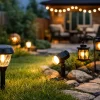
Path lights need enough output to define the edge of a walkway and help guests avoid steps, uneven pavers, or landscaping borders. They do not need to light the entire yard. A softer, downward-facing glow is usually more comfortable than a bright point of light at eye level.
Task and security lights need substantially more power. A solar wall light near the garage, side gate, shed, or trash bins should make faces, locks, and hazards easy to see. For these locations, models with motion sensors are often a better buy than lights that stay at full brightness all night.
Solar Lights Buying Guide: Check Brightness First
Brightness is measured in lumens, but product listings can make the number harder to interpret than it should be. More lumens generally mean more visible light, but the lens design, mounting height, beam angle, and color temperature also affect how bright a fixture feels.
For small decorative lights, 5 to 20 lumens can be enough. Path lights often fall in the 10 to 100 lumen range, depending on spacing and desired visibility. A porch, driveway, or side-yard security light may need 300 to 1,000 lumens or more, especially if it is mounted high or covers a broad area.
Be cautious with unusually high lumen claims on small, inexpensive fixtures. Some brands list a peak LED output rather than the real-world light produced through the lens over a full evening. Reviews that mention runtime and actual brightness are often more useful than a dramatic number on the box.
Choose a color temperature that fits the space
Warm white, usually around 2,700K to 3,000K, has a relaxed yellowish tone that works well for patios, decks, gardens, and traditional exteriors. Neutral or cool white, often 4,000K and above, appears crisper and can be useful near garages, gates, and work areas.
Cooler light can improve the sense of visibility, but it may look harsh against brick, wood, or a cozy seating area. If you are mixing solar fixtures with existing porch lights, match their color temperatures as closely as possible for a more intentional look.
Sun Exposure Matters More Than the Package
Every solar light depends on the same basic system: a panel collects sunlight during the day, a battery stores that energy, and an LED uses it after dark. If the panel does not get adequate direct sun, even a well-made fixture will disappoint.
Look at the location before buying. A south-facing, open area in much of the United States will usually give solar fixtures their best chance to charge. Dense tree cover, roof overhangs, tall fencing, and shaded north-facing areas can reduce performance dramatically. Winter sun angles and shorter days also mean that lights may run for fewer hours in colder months.
A useful rule is to plan for at least six hours of reasonably direct sunlight for standard dusk-to-dawn lights. Motion-sensor models can work in less favorable spots because they use less stored energy overall, but they still need enough sunlight to recharge consistently.
If your preferred fixture location is shaded, consider a model with a separate solar panel on a cord. The panel can be mounted several feet away in a sunnier position while the light stays where you need it. This is especially practical for covered porches, garage sides, and sheds beneath mature trees.
Pay Attention to Battery Type and Runtime
The battery is where a solar light either earns its place or becomes another item headed for the recycling bin. Most consumer models use rechargeable lithium-ion, lithium iron phosphate, nickel-metal hydride, or, in cheaper designs, older nickel-cadmium batteries.
Lithium-based batteries are common in higher-output lights because they can store more energy in a compact size. Lithium iron phosphate batteries are often valued for long life and better stability in outdoor use. Replaceable batteries are a plus for path lights and lanterns because battery capacity naturally declines after a few years of charging cycles.
Runtime claims should be read as a best-case estimate, not a guarantee. A light advertised for eight to 10 hours may reach that figure after a sunny summer day, then last only a few hours after several overcast days. For a location where dependable overnight illumination matters, choose a larger fixture, a known brand, and a motion-activated mode that conserves power.
Match Weather Resistance to Your Climate
Outdoor-rated does not mean indestructible. Check the IP rating, which describes protection against dust and water. An IP44 rating is generally suitable for light splashes and normal outdoor exposure, while IP65 offers better protection from rain and dust. Fixtures exposed to heavy storms, coastal air, sprinkler spray, or blowing snow benefit from stronger sealing and corrosion-resistant materials.
Plastic solar lights are affordable and lightweight, but thin plastic can fade, crack, or become brittle after repeated sun exposure. Powder-coated metal, stainless steel, aluminum, and quality UV-resistant plastics tend to hold up better. Stainless steel can still stain or corrode in salty coastal environments, so material quality matters as much as the label.
For ground stakes, inspect how the stake connects to the light. This is one of the most common failure points. A narrow, hollow plastic stake pushed into compacted soil can snap quickly. Models with reinforced stakes or replaceable ground mounts are a smarter choice for rocky or hard-packed yards.
Sensor Features Can Stretch Battery Life
Motion detection is one of the most useful features on solar security lights. Many models offer a dim setting at night, then brighten for 20 to 60 seconds when motion is detected. Others remain off until triggered. The first option improves orientation around an entry, while the second conserves more battery power.
Look for adjustable sensitivity, detection distance, and timer controls if the light faces a sidewalk, street, or neighbor’s property. A sensor that catches every passing car, swaying branch, or roaming cat will waste power and become annoying fast.
Dusk-to-dawn sensors are standard on path lights and decorative fixtures. Test the placement before final installation, since nearby porch lights or streetlights can fool the sensor into turning off early. Keep solar panels clean and free from leaves, mulch, and snow for the most reliable charging.
Installation Details That Make a Difference
Spacing is the difference between an elegant path and a runway. For most walkway lights, placing fixtures about 6 to 10 feet apart creates clear guidance without clutter. Use wider spacing when fixtures are brighter or the path is narrow. Instead of lining every inch of a patio, highlight corners, level changes, seating zones, and focal plants.
For wall-mounted security lights, install at a height that gives the sensor a clear view without aiming the beam into windows or directly at neighbors. Aiming light downward reduces glare and keeps the effect focused on the area that needs attention.
Do not install stake lights immediately after heavy rain if the soil is loose. They can lean as the ground settles. Make a pilot hole with a narrow tool in firm soil, then insert the stake carefully rather than forcing the fixture itself into the ground.
Know When Solar Is the Right Choice
Solar lights are a strong fit for garden paths, detached sheds, fences, mailboxes, decks, seasonal entertaining, and places where running electrical wire would be expensive or inconvenient. They are less dependable for areas that require consistent, powerful all-night lighting through long stretches of cloudy weather.
For a front entry used every evening, a wired fixture may still be the better primary source of light, with solar lights supplying accent and backup illumination. Think of solar lighting as a flexible outdoor tool, not a one-size-fits-all replacement for every hardwired fixture.
The best purchase is rarely the biggest multipack or the brightest listing. Choose lights with enough real-world output for the task, a sunny charging location, weather protection that matches your climate, and a design you will still enjoy seeing after the novelty wears off. A few well-placed fixtures can make an outdoor space safer, more inviting, and far easier to use after dark.














Leave a Comment
Your email address will not be published. Required fields are marked with *