
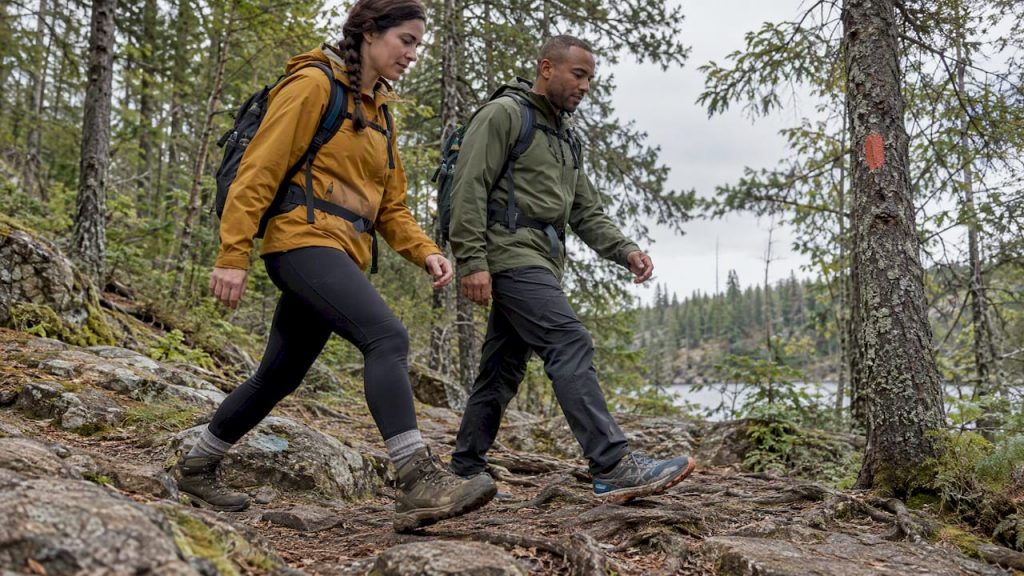
Hiking boots or trail runners? Compare weight, ankle support, grip, waterproofing and durability, with Canadian terrain and weather in mind, and pick the right pair.
Choose trail runners if you hike well-kept trails in dry, warm weather with a light pack and healthy ankles. Choose hiking boots if you face rocky ground, mud, snow patches, a heavy pack or a history of rolled ankles. Many Canadian hikers end up owning both, and that is not a luxury: a country with spring runoff, soggy coastal forest and granite ridges asks different things of your feet in May than in August.
This guide walks you through the real trade-offs, the Canadian conditions that tip the decision, and a simple way to choose before you spend a cent.
TL;DR
- Trail runners are lighter (roughly 300 to 500 grams per pair), dry faster and feel more nimble. Boots are stiffer, more protective and better with heavy packs.
- Ankle stability depends more on how much a shoe resists side-to-side twisting than on how high the collar sits.
- Boots tend to last far longer: leather uppers can handle thousands of trail miles, while many trail runners are done at 500 to 750 miles.
- In Canada, waterproof boots shine in spring runoff, wet coastal trails and boggy boreal sections. Trail runners shine on dry midsummer trails.
- The smartest answer is often a two-shoe strategy, plus a proper fit with the socks you will actually wear.
Table of Contents
- The core difference in plain terms
- Weight: why light feet feel like a gift
- Support and protection: boots, runners and the ankle myth
- Durability and cost over time
- Canadian weather and trail conditions
- When boots are the better choice
- When trail runners are the better choice
- The two-shoe strategy
- Can you hike in trail runners, or run in hiking boots?
- Getting the fit right
- Our perspective
- Want to reach hikers and outdoor readers?
- Quick decision checklist
- FAQ
- Sources
The core difference in plain terms
A hiking boot is built to protect and carry. It has a stiff sole, a sturdier upper, often a higher collar and extra toe protection. A trail runner is built to move. It is light, flexible and breathable, with a cushioned midsole and a grippy outsole borrowed from the world of trail running.
There is also a third option that blurs the line. Hiking shoes are a middle ground: more flexible than full boots, yet with more toe protection and stiffness than most lightweight trail runners, according to WIRED’s 2026 comparison. If neither extreme feels right, a low-cut hiking shoe is worth trying on.
Here is how the three stack up at a glance.
| Feature | Hiking boots | Hiking shoes | Trail runners |
|---|---|---|---|
| Weight | Heaviest | Middle | Lightest |
| Flexibility | Stiff | Moderate | Very flexible |
| Foot protection from rocks | Best | Good | Basic to good |
| Drying time when wet | Slow | Moderate | Fast |
| Heavy-pack comfort | Best | Good | Fair |
| Break-in period | Longest | Short | Minimal |
| Typical lifespan | Longest | Middle | Shortest |
None of these rows is a verdict on its own. Each one matters more or less depending on where you walk and what you carry, which is what the rest of this guide sorts out.
Weight: why light feet feel like a gift
The weight gap is the first thing you notice. Trail runners are typically 300 to 500 grams lighter per pair than boots, according to BorealBase’s Canadian footwear guide. That sounds modest until you remember every step lifts that weight. Over a 20-kilometre day, light shoes mean less fatigue in your hips and legs, and many hikers say they feel as though they could walk forever.
That is the appeal of trail runners, and it is real. Outside Online’s 2026 head-to-head also notes that trail-running shoes can excel for backpacking, which surprises people who assume heavy loads need heavy boots. Many ultralight hikers carry small loads, though, and that is the catch: the lighter your pack, the more a light shoe makes sense.
Support and protection: boots, runners and the ankle myth
Most people choose boots for ankle support. It is a sensible instinct, but the story is more nuanced than a tall collar.
The Appalachian Mountain Club explains that ankle stability is determined primarily by a shoe’s torsional rigidity, meaning its resistance to side-to-side twisting, rather than by the height of the collar (AMC, 2020). A stiff, stable low-cut shoe can resist a roll better than a soft, floppy high boot. When you try on footwear, grip the toe and heel and twist: the less it wrinkles, the more it protects you.
The same club has argued that boots can be overkill on gentle to moderate terrain if you have strong, injury-free ankles, which makes trail runners a viable alternative there (AMC, 2013). Outside Online adds a human note: boots give a psychological buffer, letting you worry less about exactly where each foot lands, yet that protection often feels excessive on common day hikes.
So ask yourself two honest questions:
- Have I rolled an ankle on a trail before?
- Will I be carrying more than a day pack over uneven ground?
If the answer to either is yes, lean toward stiffer footwear, and consider a mid-cut boot.
Rock, roots and the Canadian Shield
Terrain is where Canada pushes back. BorealBase notes that boots with stiffer soles and mid-cut ankles provide essential stability and protection on rugged, uneven ground such as the exposed granite and deep roots of the Canadian Shield, as well as on rocky alpine scree and talus in the Rockies. A stiff sole also spreads pressure across sharp rocks, so you feel fewer jabs through the midsole after hours of walking.
On a groomed gravel path or a packed forest trail, that same stiffness is wasted. You carry the extra weight without using the extra protection.
Durability and cost over time
Footwear is a trade-off between feel now and life later. The AMC reports that boots built with tough leather uppers can last thousands of trail miles, while many trail runners typically wear out after 500 to 750 miles as their lightweight fabrics and cushioned midsoles break down (AMC, 2020).
Here is what that means in practice. If you hike 15 weekends a year at about 15 kilometres each, you cover around 225 kilometres, or roughly 140 miles. At that pace, a pair of trail runners could last you several seasons, and the durability gap hardly matters. If you log long mileage every summer, trail runners become a consumable you replace often, and boots start to look like better value.
The midsole matters as much as the upper. Cushioning can feel flat long before the fabric tears, so retire shoes when the bounce is gone and your feet ache sooner than they used to, not only when you see holes.
Canadian weather and trail conditions
Footwear advice written for the American Southwest or the Alps does not always fit here. Canadian hiking comes with a calendar.
Rain, mud and spring runoff
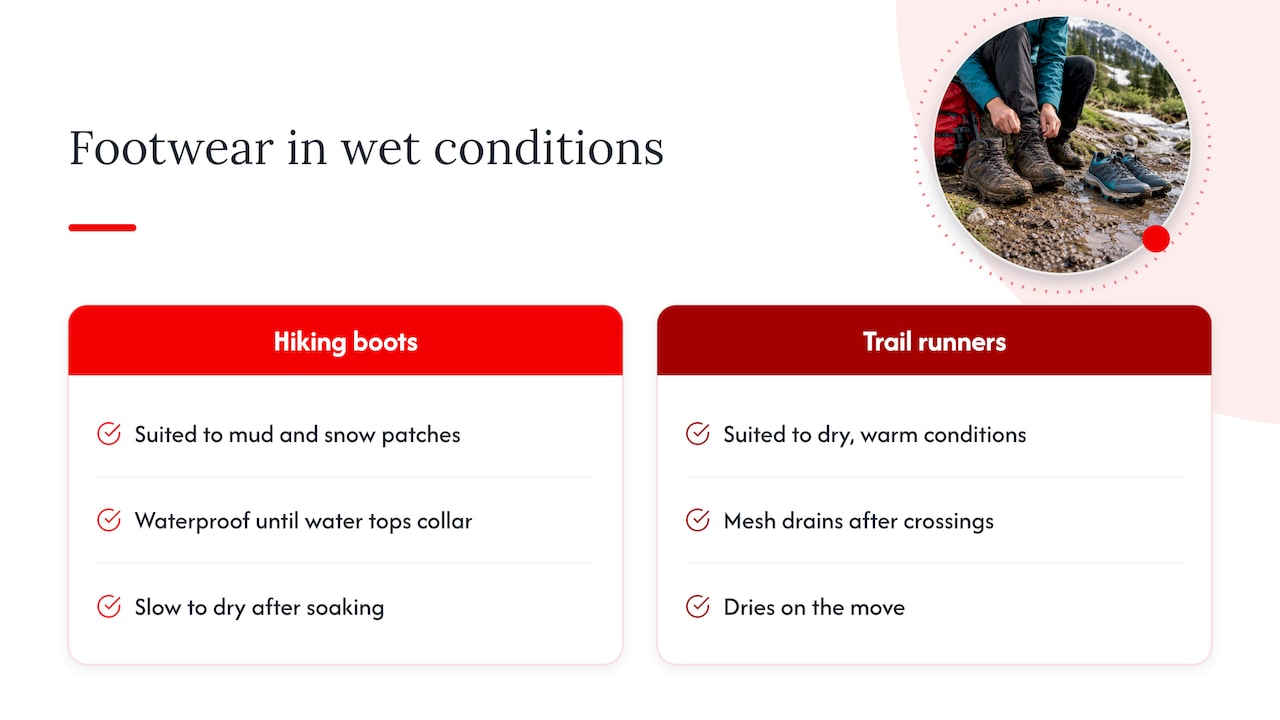
BorealBase says waterproof boots are favoured in Canada because of persistent moisture from spring runoff in the mountain parks, perpetually damp coastal B.C. trails and boggy boreal sections in Ontario and Quebec. Boots suit mud and snow patches. Trail runners suit dry, warm conditions, and when they do get wet they dry faster.
That last point deserves emphasis. A waterproof membrane keeps water out until it pours in over the collar. After a stream crossing or a deep puddle, a waterproof boot holds water like a bucket and takes a long time to dry, while a mesh trail runner drains and dries on the move. Some hikers pick breathable shoes and accept wet feet, trusting good socks. Others prefer to stay dry and take a heavier, slower-drying boot. Both approaches work, as long as you choose deliberately.
Rain on your body matters too. If you are weighing how to keep the rest of you dry, this comparison of poncho versus rain jacket covers how each handles wind and wet on the trail, which pairs naturally with your footwear choice.
Parks Canada’s guidance is straightforward: wear suitable footwear, such as hiking boots or running shoes, to avoid injury, and boots should sit well above the ankle and be waterproof (Parks Canada, Rouge National Urban Park). Note that the agency accepts both boots and running shoes. What it asks is that your footwear matches the trail.
Snow, ice and shoulder seasons
Canadian trails stay in play long after the leaves fall. Parks Canada points out that winter trails are not routinely cleared, so ice cleats or boots with snow-ready features are essential for safety. This is a case where trail runners are not the answer: they offer little insulation, minimal weather sealing and a low cut that lets snow in. If you are planning cold-season outings, our guide to packing for Canadian winters by region and activity covers layers and gear to pair with your boots.
The backcountry spare
Here is a tip that works for both camps. In its backcountry guidance for Yoho National Park, Parks Canada recommends bringing lightweight sandals or runners for fording streams or relaxing at camp, even if you hike in sturdy boots. Dry camp shoes let your feet recover at the end of the day. If you like the idea of a sandal for that job, we looked at one rugged option in our Teva Universal Trail Sandal review.
When boots are the better choice
Reach for boots when several of these apply:
- Rocky, rooty or technical terrain. Long stretches of rock, scree or talus punish soft soles.
- Mud and snow patches. Higher uppers and sturdier materials keep more of the trail out of your shoe.
- Heavy packs. Multi-day trips with food, shelter and water add load, and stiffer footwear helps your feet carry it.
- Past ankle injuries. A mid-cut, rigid boot gives extra confidence and protection.
- Cold, wet shoulder seasons. Think early spring runoff and late autumn.
BorealBase’s guide lists the same factors: sustained rocky terrain, significant mud, snow patches, heavy packs or ankle injury history all favour boots.
When trail runners are the better choice
Trail runners earn their place when:
- The trail is maintained. Groomed paths, boardwalks and packed dirt do not need armour.
- The weather is dry and warm. Breathable mesh keeps feet cooler and drains quickly.
- Your pack is light. A day pack with water, a layer and snacks is no challenge.
- You value speed and comfort. Little to no break-in is a big perk. You can often wear them straight from the box.
- You hike long distances in summer. Reduced weight adds up over many kilometres.
One caution: protection from rocks varies a lot between models. Some trail runners have a rock plate and a reinforced toe cap, and others are closer to road shoes. Check the sole and toe on the shoe in your hand.
The two-shoe strategy
BorealBase describes a pragmatic Canadian approach: waterproof boots for wet spring and early summer conditions, then trail runners for midsummer hiking on well-maintained trails. We like this way of thinking because it ends the either-or argument. You are not picking a team. You are picking the tool for the day.
A simple version looks like this:
| Season or situation | A sensible pick |
|---|---|
| Spring melt, muddy trails, snow patches | Waterproof mid-cut boots |
| Midsummer on groomed trails | Trail runners |
| Alpine scree and talus, heavy pack | Stiff boots |
| Long summer day hike, light pack | Trail runners or low hiking shoes |
| Late autumn, first snow | Boots, with traction devices as needed |
| Camp or stream crossings | Lightweight sandals or runners as a spare |
If your budget allows only one pair, choose for the conditions you will face most often, and add traction aids or gaiters for the rest. Gaiters are a handy bridge: they keep mud, debris and snow out of low shoes, so trail runners can stretch into the shoulder seasons on easier trails.
Can you hike in trail runners, or run in hiking boots?
Yes to the first, with limits. Many hikers walk entire trails in trail runners, and that is common on well-maintained paths. The limits are the ones above: less protection from sharp rock, less support under a heavy load, a shorter lifespan and little help in snow or deep mud. A road-running shoe is a weaker stand-in still, because its tread is made for pavement and its upper is thin, so it slips on wet roots and loose gravel.
Running in hiking boots is possible for a short jog to catch a bus or cross a clearing, but boots are heavy, stiff and designed to resist the foot’s natural roll. You would tire quickly and risk blisters. If you want cushioned shoes for walking days in town or on paved paths, see our look at the Hoka Clifton 10 built for long daily miles and our roundup of walking shoes for travel.
Getting the fit right
The right category in the wrong size is still the wrong shoe. Canadian retailers advise trying on footwear in the afternoon, when your feet are naturally swollen, and wearing the exact socks you plan to hike in, which helps you avoid problems such as black toenails (BorealBase).
A few more habits help:
- Check toe room. Your toes should wiggle freely, and you should have space in front when you kick your toe against the floor.
- Walk downhill. Use a store ramp or incline. If your toes slam forward, go up half a size or lace differently.
- Hold your heel. A little heel lift is normal. A lot means blisters later.
- Break in boots first. Wear them around the house, then on short walks, before a big trip.
- Build fitness along with the footwear. Sore feet and fatigued legs often come from jumping into big mileage too fast. A plan such as building mileage on a busy schedule shows how to ramp up gradually, which protects your feet as much as good shoes do.
If you travel for your hikes, remember that a medical emergency far from home can be costly. Our guide to Canadian travel insurance and medical coverage explains what to look at before you set out.
Our perspective
We have watched the boots-versus-runners debate swing back and forth, and our view is simple: stop treating it as a loyalty test. Footwear is a tool, and the best tool depends on the day.
We think most casual hikers in Canada are over-bootd on dry summer days and under-prepared on wet spring ones. A trail runner on a groomed path in July is a joy, and a waterproof, stiff-soled boot on a rooty, muddy trail in May is a relief. Our advice is to pick the shoe for the worst realistic ten minutes of your hike, not the average mile. If that worst stretch is rocky, wet or cold, wear the boot. If it is a gravel path and a hot afternoon, wear the runner.
We also encourage you to treat fit as non-negotiable and to carry a spare pair of camp shoes. Comfortable feet are what turn a good hike into a great one, and we would rather you spend an extra afternoon in a shop than a week nursing blisters.
— Alexander
Want to reach hikers and outdoor readers?
If you run an outdoor, footwear or travel business and want to reach readers who are researching gear and trips, we offer banner placements and guest posts. Explore the options on our advertising page and tell us what you would like to share.
Quick decision checklist
Before you buy, run through this list:
- Where will I hike most: groomed trails, rocky ridges, boggy forest or snowy paths?
- What does my pack weigh on a typical outing?
- Have I injured my ankles before?
- Do I hike mostly in dry summer, or through spring melt and autumn too?
- How many kilometres a year will I log, and will I mind replacing shoes sooner?
- Can I try both categories on, in the afternoon, with my own socks?
If most answers point to easy, dry, light and short, start with trail runners. If they point to rough, wet, heavy or cold, start with boots. If they split down the middle, try a hiking shoe or buy one pair of each.
FAQ
Are trail runners good enough for hiking in Canada?
On well-maintained trails in dry, warm weather, yes. They are lighter, more comfortable out of the box and dry quickly. For rocky alpine terrain, deep mud, snow or heavy packs, boots are the safer choice.
Do hiking boots really protect your ankles better?
Not only because of their height. The AMC says stability depends mainly on torsional rigidity, meaning resistance to twisting, so a stiff shoe can protect better than a soft tall boot. Test this by twisting the shoe in your hands before you buy.
How long do trail runners last compared with boots?
Many trail runners wear out after roughly 500 to 750 miles, while leather boots can handle thousands of trail miles, according to the AMC. Retire any shoe when the cushioning feels flat or your feet start to hurt earlier than usual.
Should I buy waterproof footwear?
If you hike in spring runoff, on damp coastal trails or through boggy boreal sections, waterproof boots are a popular choice in Canada. For hot, dry summer trails, breathable trail runners that dry fast may feel better.
Sources
- Hiking Boots vs. Hiking Shoes vs. Trail Runners: Choosing What’s Right for You (Appalachian Mountain Club)
- Hiking Boots vs Trail Runners: Best Footwear for the Backcountry (Appalachian Mountain Club)
- Should You Hike in Boots or Trail Runners? (WIRED)
- Trail Running Shoes vs. Hiking Boots Head-to-Head (Outside Online)
- Hiking Footwear & Clothing: How to Dress for Trails (BorealBase)
- Hiking tips, Rouge National Urban Park (Parks Canada)
- Backcountry, Yoho National Park (Parks Canada)
- Poncho vs Rain Jacket: Hikers Block Wind, Travelers Pack Light
- Half Marathon Training on a Busy Schedule: A 3-Day Plan












Leave a Comment
Your email address will not be published. Required fields are marked with *