
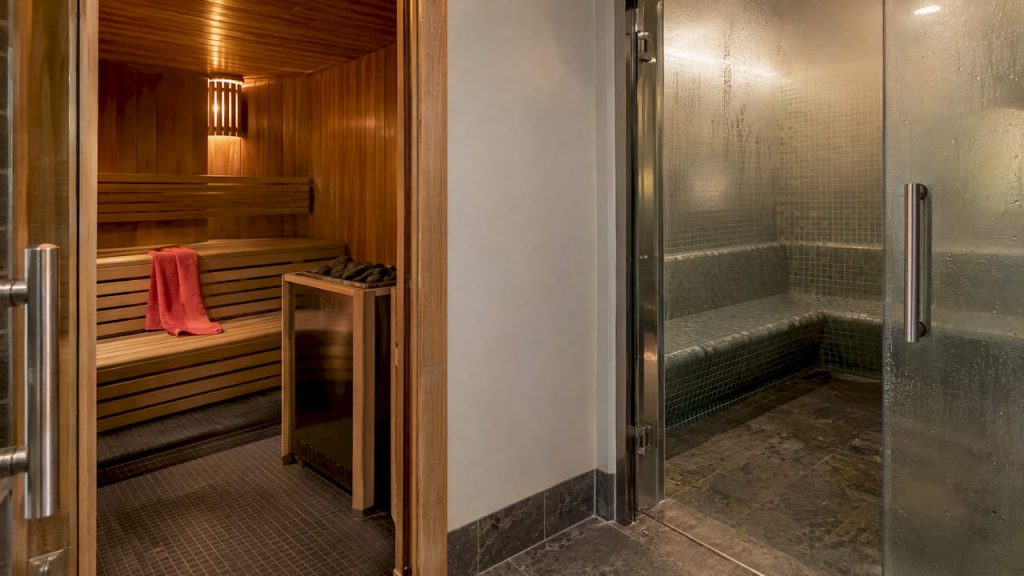
Sauna or steam room? Compare temperature, humidity, benefits, strain on your body and safety, so you can pick the heat that fits your goals and your health.
A sauna gives you hot, dry air. A steam room gives you cooler, saturated air. That one difference in moisture shapes everything else: how hard your heart works, how you sweat, how your airways feel and how long you will want to stay. Pick a sauna if you like intense, dry heat and a long-studied routine. Pick a steam room if you prefer gentler warmth and humid air, especially in cold Canadian months when your nose and throat feel dried out.
Below, we compare the two on temperature, humidity, benefits and risks, with figures from Canadian health researchers and peer-reviewed studies, then help you decide which to book at your gym, spa or hotel.
TL;DR
- A dry sauna runs roughly 80 to 100°C at 10 to 20% humidity. A steam room runs far cooler, around 43 to 49°C, but at close to 100% humidity.
- Saunas have the larger body of research, mostly on heart health, blood pressure and wellbeing. Direct comparisons between saunas and steam rooms are still scarce.
- Steam rooms feel kinder to the airways in winter, but humid heat can strain your body more than its lower temperature suggests.
- Keep sessions to roughly 15 to 20 minutes, drink water, skip alcohol and take it slowly if you have a heart condition, high blood pressure or are pregnant.
- Either one works for relaxation. The better choice is the one you will use safely and regularly.
Table of Contents
- The core difference: dry heat or wet heat
- Why a cooler room can feel just as demanding
- Benefits: what the evidence says about saunas
- Benefits: what about steam rooms?
- Which one should you choose?
- Safety: who should be careful
- What to wear and what to do before and after
- Sauna vs steam room at a glance: a quick decision guide
- Work with us
- FAQ
- Sources
The core difference: dry heat or wet heat
Both rooms are built to raise your body temperature while you sit still. They get there in opposite ways.
A traditional sauna heats an insulated, usually wood-lined room with a stove, an electric heater or sometimes gas. Canada’s National Collaborating Centre for Environmental Health (NCCEH), a public health body, describes dry saunas as running at 80 to 100°C with 10 to 20% relative humidity, while steam saunas operate at up to 50°C with 80 to 100% humidity. Infrared saunas, which warm you with radiant light rather than hot air, sit lower, at 48 to 60°C.
A steam room is a sealed, waterproof space, usually tile, glass, stone or acrylic, filled by a steam generator. The North American Sauna Society puts a steam room at 110 to 120°F (about 43 to 49°C) and 100% humidity, against 150 to 195°F (roughly 66 to 90°C) for a traditional sauna.
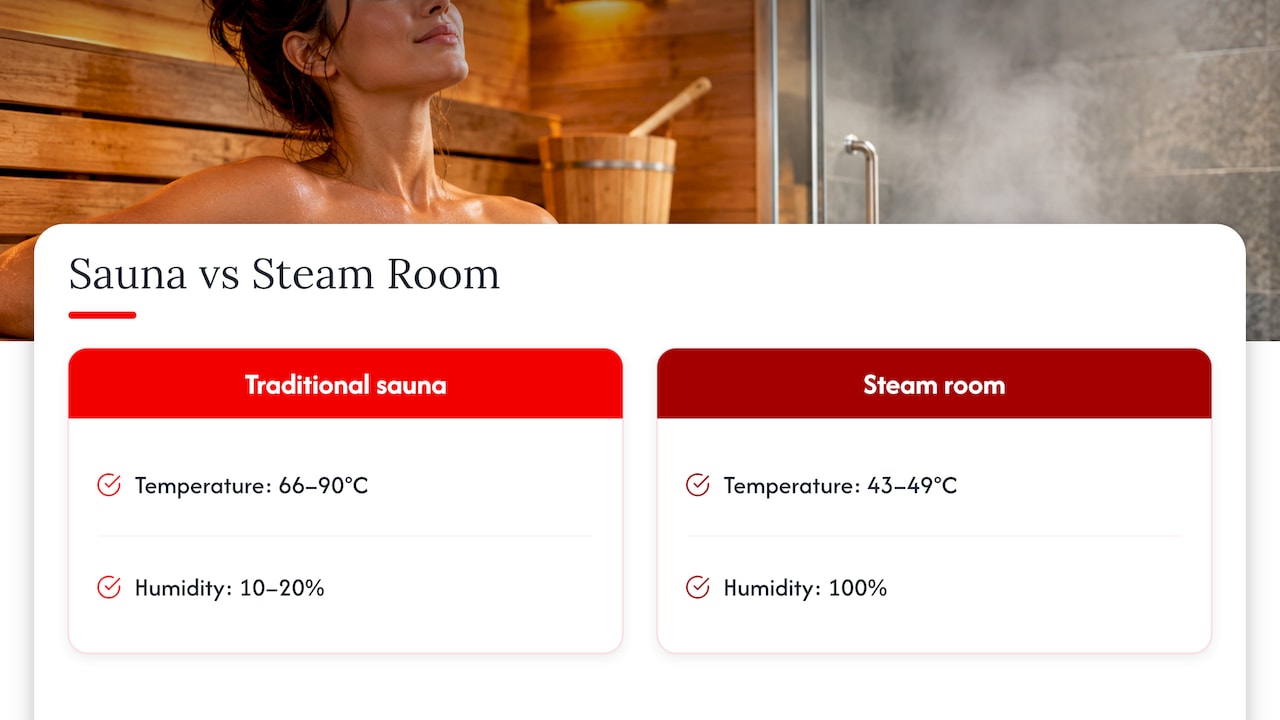
Humidity in a sauna is not fixed. Throw water on the hot rocks and you get a short burst of steam, so a Finnish-style sauna can feel dry or damp depending on how you use the ladle. The same society notes humidity in a traditional sauna can range from 10% up to 60% or more depending on the water added.
Side by side
| Dry sauna | Steam room | |
|---|---|---|
| Typical temperature | 80 to 100°C (NCCEH); about 66 to 90°C (North American Sauna Society) | About 43 to 49°C |
| Humidity | 10 to 20%, higher if you add water to the rocks | 95 to 100% |
| Heat source | Wood stove, electric heater or gas, with hot rocks | Steam generator boiling water |
| Room materials | Wood, insulated | Tile, glass, stone or acrylic |
| How it feels | Intense, dry, easy to breathe in short bursts | Warm, heavy, enveloping, can feel close |
| Typical session | 10 to 20 minutes, sometimes in rounds | A shorter, more moderate stay is common |
If you are comparing the two to decide what to try first, this table already answers most of it: high heat and dryness on one side, lower heat and wetness on the other.
Why a cooler room can feel just as demanding
It seems logical that 45°C must be easier on you than 90°C. Not always. Your body cools itself by evaporating sweat. In saturated air, sweat barely evaporates, so heat has nowhere to go and your skin stays hot and slick.
Research reviewed by the NCCEH found that, compared with dry saunas, steam saunas led to lower water and body-mass loss, bigger rises in core temperature and heart rate, and greater heat strain. A University of Jyväskylä study in which 50 healthy adults completed four sauna experiments likewise found that higher humidity increased physiological strain during sauna bathing, with both temperature and humidity contributing to greater heart-rate increases.
The practical lesson: do not judge a steam room by its thermometer. A short, comfortable stay is the right measure, and you should leave when you feel lightheaded, not when you have reached some target time.
Benefits: what the evidence says about saunas
Most of what we know about heat bathing comes from saunas, particularly Finnish-style dry saunas.
A 2024 review by Laukkanen and Kunutsor found that Finnish saunas have the most consistent evidence for lowering the risk of hypertension, cardiovascular disease, thromboembolism, dementia and respiratory conditions, and may improve musculoskeletal symptoms, mental wellbeing, sleep and longevity. In one cohort cited there, men who used a sauna four to seven times a week had a 47% relative decrease in hypertension risk over 24.7 years.
An earlier systematic review of 40 clinical studies with 3,855 participants concluded that regular dry sauna bathing has potential health benefits, with the strongest case for cardiovascular disease. If you want the longer story on how heat exposure might relate to healthy ageing, this overview of what the research shows on sauna and longevity walks through population studies in plain language.
What the studies cannot tell you
Long-term studies show associations, not proof. Regular sauna users may also exercise more, earn more or be healthier to begin with. A 2025 meta-analysis of 20 randomised trials of passive heating lasting at least a week found no significant effect for most measures, though whole-body heating produced a modest systolic blood pressure drop of about 4 mmHg. Claims about detox and fat loss go further than the evidence does.
So think of a sauna as a pleasant habit with encouraging research behind it, not a treatment. Pair it with the basics: movement, sleep and a decent diet. Our guide to walking versus running and Canada’s 150-minute activity target is a good place to start building that foundation, and our fitness section has more routines to pair with your heat sessions.
Benefits: what about steam rooms?
Steam rooms have a much thinner research record. A Dr Catherine Conlon piece in the Irish Examiner notes that there is more research on saunas than on steam rooms, and not yet enough comparing the two to say much about differences in health effects.
What we can say comes from how the body responds to heat in general. Verywell Health explains that both saunas and steam rooms raise your core temperature, which loosens stiff joints and muscles and improves circulation. That is why either can feel good after a workout or a long flight.
Muscle and joint relief
Heat widens your blood vessels so blood moves more efficiently. In a CBC White Coat report, an expert explains that heat forces blood vessels to dilate widely to release heat, and that the largest research impacts of heat therapy are cardiovascular. For tight muscles, both rooms offer the same basic mechanism: warmth. Choose by comfort. Some people find dry heat deeper; others prefer the soft, all-over feel of steam.
Breathing and winter air
This is where steam rooms earn their reputation. In the same CBC report, another expert explains that warm, humid air is less of a shock to the lungs than cold, dry air. It will not cure a lung condition, but it can ease asthma or emphysema symptoms that worsen in winter weather. That makes a steam room a comfortable stop after a cold commute or a day shovelling snow.
Research on steam inhalation for congestion is mixed. Healthline’s overview describes a 2015 study in which steam with peppermint oil may have helped clear sinus and lung congestion, while a review of six trials on the common cold was inconclusive. Treat the steam room as a comfort, and see your doctor for persistent breathing problems.
Relaxation and sleep
Both rooms give you a quiet, phone-free half hour where there is nothing to do but sit. That alone helps many people unwind. Saunas have the research linking regular use to better sleep and mood. Steam rooms offer the same calm setting, and many people simply find humid warmth more soothing.
Which one should you choose?
No single winner exists. Match the room to what you want from the session.
Choose a sauna if you want
- The most-studied option. The strongest evidence for heart health and blood pressure comes from dry Finnish saunas.
- Intense, dry heat. You sweat freely because sweat evaporates, and many people find the heat easier to tolerate in short rounds.
- A routine with a structure. Rounds of heat followed by cooling down in fresh air is a long-established pattern.
- Something you could have at home. Compact outdoor cabins are a popular garden project. If that appeals, this cube-style home sauna shows how modern designs fit a small backyard.
Choose a steam room if you want
- Lower temperatures. If 90°C feels like too much, 43 to 49°C is a gentler way into heat bathing, with the caution above about humidity.
- Humid air for winter dryness. Warm moist air can feel soothing when cold weather has left your nose and throat irritated.
- Soft, easy relaxation. The tiled, enclosed setting suits a slow, quiet unwind after exercise.
If you are still undecided
Try a short sauna round first at your gym or spa, then a short steam session on another day. Notice how each affects your heart rate, breathing and mood afterward. Your own response is the best guide.
One common option is to combine them in a single visit: sauna first, a rinse and rest, then steam. If you do, listen to your body and keep the total time modest.
Safety: who should be careful
Heat bathing is safe for most healthy adults who use it sensibly, but it is a real physiological stress. The NCCEH’s January 2026 review lists adverse outcomes reported with sauna use, including heart-related events in people with unstable coronary artery disease, heatstroke, a lung condition called sauna lung, muscle breakdown, eye irritation and death. Heatstroke incidents were reported in people aged 26 to 79 after exposures of 25 minutes to three hours.
See your doctor first if you have
- A heart condition or high blood pressure. Heart and Stroke Foundation guidance says people with heart conditions or high blood pressure should consult a healthcare provider first.
- A recent heart attack, severe aortic stenosis, uncontrolled hypertension or severe valve disease. The 2024 review says people with stable cardiovascular conditions can safely engage in sauna bathing, but these groups should exercise caution or avoid it.
- Pregnancy. The CBC report notes that pregnant people should consult a provider before using a hot bath or sauna.
If you carry extra weight and are thinking about starting heat therapy, this guide on heart health and when to see a clinician explains what to ask before you begin.
Sensible habits for any heat room
- Skip alcohol. The 2024 review links sauna-related sudden deaths largely to alcohol consumption, and the NCCEH reports that deaths have involved alcohol and bathing alone.
- Bring a friend or tell staff. Unaccompanied bathing appears in those same reports.
- Drink water before and after. Overlong sessions risk dehydration, according to the CBC report.
- Watch the clock. The NCCEH advises visible thermometers and timers. Evidence cited by CBC suggests heat therapy is most effective at 15 to 20 minutes, four to seven times a week. You do not need to start there. Begin with a few minutes and build.
- Mind the floor. An analysis of 209 sauna-injury patients at an Austrian trauma centre found slips and falls were the most common cause, followed by dizziness and fainting, with wet floors often cited. Walk, never run, and stand up slowly.
- Cool down gradually. The same review warns that sudden cold-water exposure after a sauna can trigger a cold shock response, and that people with hypertension should avoid sudden cooling. If you like contrast therapy, read how cold plunge benefits appear over time before you try it, and ease in.
- Leave if you feel off. Dizziness, nausea, a pounding heart or a headache means step out, sit somewhere cool and sip water.
Rules differ across Canada
The NCCEH notes that regulatory oversight of saunas in Canada is inconsistent, and many provinces and territories lack comprehensive sauna-specific requirements or routine inspections. Some do set limits: Alberta caps dry saunas at 85°C and steam saunas at 60°C. A well-run facility should post temperatures, provide a clock and warn patrons who have medical conditions. If your gym has none of these, ask staff.
What to wear and what to do before and after
A few everyday questions come up again and again.
- What to wear: Rules vary by facility. Public gyms and hotels generally expect a towel and swimwear or a wrap. Check posted signs. Sit on your towel, and avoid synthetic fabrics or metal jewellery that can get uncomfortably hot.
- Shower first: A quick rinse before you enter is standard courtesy and helps keep the room clean.
- Shower after: A lukewarm or cool shower helps you cool down gently. Keep it comfortable, not icy.
- Eat lightly: Going in right after a heavy meal or on an empty stomach can make you lightheaded.
- Take off glasses and contacts if the room is very hot or steamy. The NCCEH lists eye irritation among reported sauna effects.
Sauna vs steam room at a glance: a quick decision guide
| Your priority | Better fit |
|---|---|
| Backed by the most research | Sauna |
| Lower temperature | Steam room |
| Soothing humid air in winter | Steam room |
| Heart-health routine (after medical clearance) | Sauna |
| Muscle relaxation after a workout | Either |
| Building a home setup | Sauna |
| Short, gentle first session | Steam room, kept brief |
Work with us
We publish practical guides across wellness, travel, tech and home life. If your brand sells products or services that help Canadians relax, recover or build better routines, you can reach our readers through banner ads or a guest post.
Our perspective
We see the sauna-versus-steam question as a good example of how readers want clear answers in a field where the research is still catching up. The honest picture is encouraging: dry saunas have a substantial body of research behind them, and steam rooms offer a gentler, soothing option that many people love.
Our advice at Lizard’s Lunch is to treat heat as one part of a wider routine. Move regularly, sleep well, and add a sauna or steam session when it makes you feel good. Start short, drink water, and speak with your doctor if you have a heart or blood pressure condition.
We keep writing guides like this one, covering exercise, cold exposure, air quality and home comfort, so you can see the full set of options for feeling well and then choose what fits your life. Our team at Lizard’s Lunch will keep updating these guides as new Canadian research and guidance arrive.
Alexander
FAQ
Is a sauna or a steam room better for you?
Neither is better for everyone. Saunas have more research behind them, especially for heart health and blood pressure, while steam rooms provide gentler, humid heat that many people find soothing for the airways. Choose the one you will use safely and comfortably, and ask your doctor first if you have a heart condition.
Can I use a sauna and a steam room in the same visit?
Yes, many people do. Keep each stay short, drink water between them and cool down gradually. Skip the second room if you feel dizzy, since both place demands on your heart and circulation.
How long should I stay in?
Evidence cited by CBC suggests that 15 to 20 minutes is the most effective session length for heat therapy, but beginners should start with a few minutes. Humid rooms can strain your body more than their lower temperature suggests, so leave as soon as you feel unwell.
Is a steam room good for a cold?
Warm, humid air can bring short-term comfort for a stuffy nose or irritated airways, though research on steam for colds is inconclusive. Do not use a sauna or steam room if you have an active fever, and see a doctor if symptoms persist.
Do I need to shower after a sauna?
A lukewarm shower helps you cool down and rinse off sweat. Avoid sudden icy water, because the NCCEH warns that abrupt cold exposure after a sauna can trigger a cold shock response, particularly for people with high blood pressure.
Sources
- NCCEH rapid review on saunas, January 2026
- NCCEH sauna rapid review, full PDF
- North American Sauna Society: sauna types
- Verywell Health: sauna vs steam room
- Laukkanen and Kunutsor, passive heat therapies review, 2024
- Clinical effects of regular dry sauna bathing: systematic review
- University of Jyväskylä: steam increases physiological strain
- CBC White Coat: heat therapy and vascular health
- Healthline: steam room benefits and risks
- Irish Examiner: the benefits of sauna and steam
- Heart and Stroke Foundation: hot and cold therapies
- Sauna vs steam room health evidence comparison


















Leave a Comment
Your email address will not be published. Required fields are marked with *