

Compare walking and running through Canadian activity guidelines, health research, calorie use, and injury risk, then choose a weekly plan you can sustain.
Running wins on time efficiency: it burns more calories per minute and builds cardiorespiratory fitness faster. Walking wins on accessibility: it is lower impact, easier to sustain, and delivers comparable long-term health gains once weekly energy expenditure matches running’s. The real benchmark to hit is 150 minutes of moderate or 75 minutes of vigorous activity per week, so the smartest answer for most people is whichever mode they can keep doing, often a walk-run mix.
TL;DR:
- A 20 minute run often matches a 30 minute brisk walk for calorie use, while wearable estimates remain imprecise, so track activity minutes instead.
- Matched energy expenditure was associated with similar reductions in hypertension, high cholesterol, diabetes, and coronary heart disease, while vigorous exercise improved VO2max more.
- A Canadian walk and jog program reports 9% to 11% injury rates among novice runners; keep early runs to two or three weekly sessions.
- Add two weekly strength sessions for the hips, glutes, and core, and increase either running duration or intensity, never both in one week.
Table of Contents
- Calories and energy expenditure: how to compare walking and running practically
- Long-term health outcomes: what cohort and review evidence shows about disease risk and mortality
- Injury risk and musculoskeletal load: practical safety and progression advice
- Accessibility, adherence, and lifestyle fit: how each mode affects habit formation
- How to choose: a short decision framework and weekly templates
- Evidence summary: Canadian guidelines and key studies in plain language
- Mental health benefits comparison of walking vs running, including effects on stress, anxiety, and mood enhancement
- Impact on bone density and muscular strength differences between walking and running
- Effects on sleep quality and cognitive function relevant to walking versus running
- Our team perspective: a balanced recommendation from Lizard’s Lunch
- FAQ
- Sources
Calories and energy expenditure: how to compare walking and running practically
Running almost always burns more calories per minute than walking at a comparable effort level, simply because it moves your body faster and recruits more muscle force with each stride. That makes running the better choice when your constraint is time: 20 minutes of running can match or exceed the calorie cost of a 30 minute brisk walk.
But the comparison shifts once you look at speed rather than time. Research on energy expenditure in walking versus running found that walking’s metabolic cost rises non-linearly as you approach your maximal walking speed, and at speeds close to about 92% of that maximum, walking can actually cost more energy than running at the same pace. In practice, this means fast, intentional walking intervals can rival a jog for calorie burn while keeping impact low, a useful option if your joints need a break from pounding.
A few practical anchors help translate this into a weekly plan:
- A 30 minute brisk walk and a 20 minute run often land in a similar calorie range for a given body weight.
- Interval walking (alternating fast and moderate paces) improved VO2peak and metabolic markers more than steady, moderate walking in some intervention studies.
- Weekly targets are easier to track in MET-hours or guideline minutes than in raw calories, since the two modes convert differently depending on speed and body weight.
Wearable calorie counters are convenient but not precise instruments. A partner analysis of wearable accuracy points out the kind of error range these devices typically carry, which is one more reason to anchor your plan to guideline minutes rather than a number on your wrist.
Long-term health outcomes: what cohort and review evidence shows about disease risk and mortality
When researchers match walkers and runners by total energy output rather than by activity type, the health payoff converges. A large prospective cohort analysis comparing runners and walkers found that equivalent energy expenditure, measured in MET-hours per day, was linked to similar reductions in hypertension, high cholesterol, diabetes, and coronary heart disease risk regardless of which activity produced that expenditure.
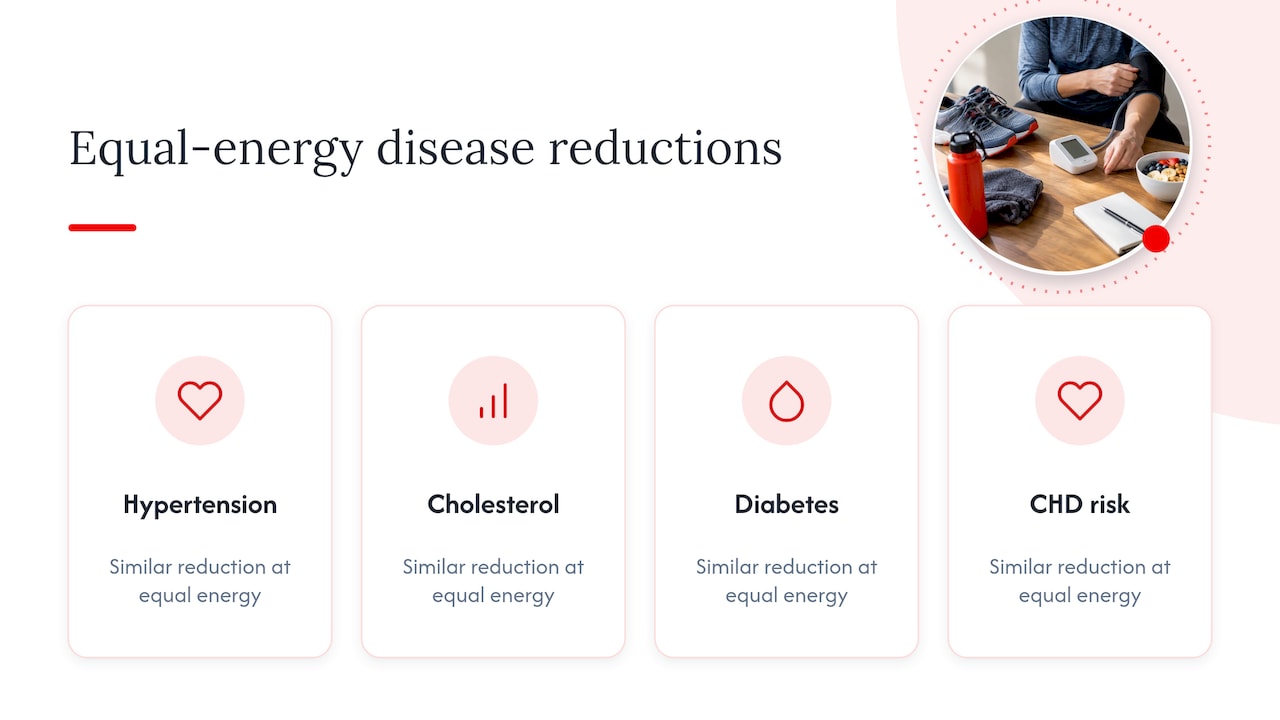
Equivalent weekly energy expenditure from walking or running produces comparable reductions in several major chronic disease risks, according to that cohort evidence, which tracked large groups of exercisers over time.
Runners in these cohorts often show larger average health benefits, but that gap tends to reflect dose, not mode: running packs a bigger energy expenditure into a shorter session, so runners frequently accumulate more total weekly activity almost by default. Vigorous activity does carry some per-unit-time advantages, particularly for VO2max and certain metabolic markers, where intensity itself seems to matter beyond total volume. For everything else, from blood pressure to long-term mortality risk, the evidence points to total dose as the deciding factor. The practical takeaway: pick the mode that lets you reliably hit and exceed the weekly minimum, rather than assuming running is inherently superior.
Injury risk and musculoskeletal load: practical safety and progression advice
Running loads your joints harder than walking does. Ground reaction forces during running around 2.5 times body weight, compared with roughly 1.2 times body weight for walking, according to injury-prevention guidance built around novice runner data. That difference explains why new runners face a higher injury rate than new walkers, especially in the first few months before bones, tendons, and connective tissue adapt.
The good news is that structured progression meaningfully lowers that risk. A Canadian Start-to-Run framework built around walk-run intervals reports injury rates in the 9 to 11% range among novices who followed a progressive schedule, well below what unstructured starts typically produce.
If you are moving from walking to running, a few rules make the transition safer:
- Alternate walk and run intervals for the first several weeks instead of running continuously.
- Cap running sessions at two to three per week while your body adapts.
- Warm up for 10 to 15 minutes before any running session.
- Increase intensity or duration gradually, never both in the same week.
A Get Active Questionnaire style screening before starting, and a visit to a physiotherapist if pain persists past a few days, catch most problems early.
Pro Tip: Add two strength sessions a week targeting your hips and trunk. Stronger glutes and core muscles absorb impact forces that would otherwise land on your knees and ankles.
Accessibility, adherence, and lifestyle fit: how each mode affects habit formation
The best exercise is the one you still do in six months, and walking has a structural advantage here. It requires no skill, no recovery day, and almost no equipment, so it folds into daily life: a walk to the store, a loop after dinner, a call taken on foot. That low barrier is a major reason walking shows consistently high adherence across age groups.
Running delivers more fitness per minute, but it asks more of you in return: more recovery time, more motivation on tired days, and more planning around soreness. That trade-off is worth naming honestly rather than glossing over, because it affects which mode actually survives a busy month.
A few tactics improve adherence for either mode:
- Stack a walk onto an existing habit, like a morning coffee or a work call.
- Schedule runs like appointments, at the same time and day each week.
- Join a walking or running group for built-in accountability.
- Use a dedicated walking app, such as Pointy, to log routes and stay motivated without needing an account or ads.
Brisk walking alone, done consistently, is a legitimate primary strategy, not a consolation prize, particularly for aging-related health outcomes.
How to choose: a short decision framework and weekly templates
Start with three questions: What is your main goal? How much time do you realistically have? Do you have a history of joint or tendon injuries? Someone chasing fat loss with 20 minutes a day leans toward running or fast-walk intervals. Someone prioritizing joint health or recovering from injury leans toward walking. Someone with no injury history and moderate time can blend both.
A few templates to start from:
- Beginner walking plan: a 30 minute brisk walk, five days a week, holding a pace where conversation is possible but singing is not.
- Six-week walk-run progression: alternate one minute of jogging with two minutes of walking, repeated for 20 to 30 minutes, three times a week, shifting the ratio toward running every one to two weeks as it feels manageable.
- Intermediate weekly split: two running days, two low-impact cross-training days such as cycling or swimming, and two strength sessions focused on hips, glutes, and core.
- Monitoring rule: if soreness lingers more than 48 hours or sleep quality drops, cut volume by a quarter the following week rather than pushing through.
When in doubt about where to start, a quick health screening before ramping up intensity is a smart first step, especially if it has been a while since you trained consistently.
Evidence summary: Canadian guidelines and key studies in plain language
The core benchmark comes from Canadian physical activity guidance: 150 minutes of moderate aerobic activity or 75 minutes of vigorous activity weekly, plus strength work twice a week.
- Cohort data comparing runners and walkers found similar disease-risk reductions at matched energy expenditure.
- A systematic review of walking linked roughly 30 minutes of brisk walking, five days a week, to lower cardiovascular risk and mortality.
- Running loads tissues faster but takes months to adapt to safely, per Start-to-Run guidance.
- Most of this evidence is observational, not from randomized trials, so it shows strong association rather than absolute proof.
Mental health benefits comparison of walking vs running, including effects on stress, anxiety, and mood enhancement
Both modes support mood and stress regulation, though the mechanism and experience differ. Walking tends to deliver a steadier, more meditative effect: a 20 to 30 minute walk, especially outdoors, gives your mind room to decompress without the physiological demand of sustained hard effort. That makes it a reliable option on high-stress days when a harder workout feels like one more thing to manage.
Running produces a more pronounced post-exercise mood lift for many people, tied to the higher intensity and the sense of accomplishment that comes with pushing through a harder session. It can also serve as a structured outlet for anxiety, giving restless energy somewhere concrete to go.
Neither mode is clearly superior across the board, and the better choice often depends on your state going in: walking when you need calm, running when you need release. What matters more than the choice between them is consistency, since irregular exercise of either kind does less for mood than a routine you can actually sustain. For many people, alternating between the two based on how the day feels captures the benefits of both without forcing a single approach.
Impact on bone density and muscular strength differences between walking and running
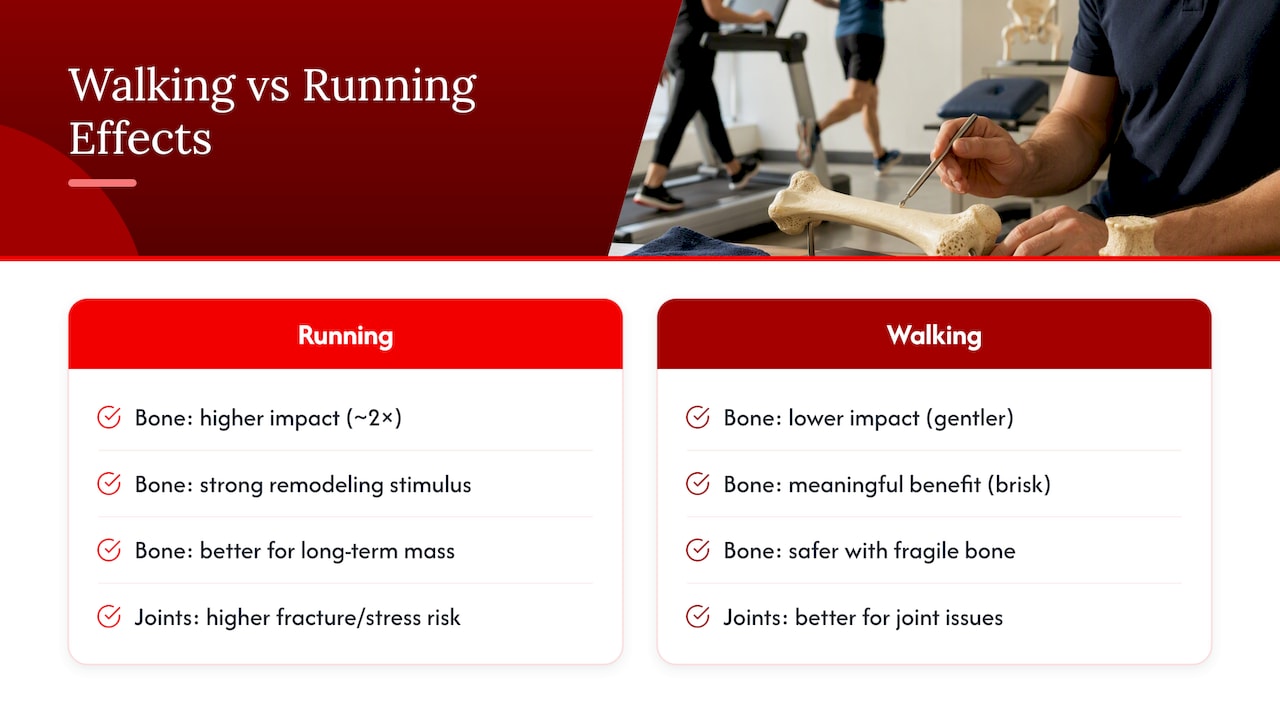
Running’s higher impact forces give it an edge for bone density, since bone responds to mechanical loading, and the repeated ground reaction forces of running, roughly double what walking produces, provide a stronger stimulus for bone remodeling over time. That is particularly relevant for maintaining bone mass as you age, when bone density naturally declines.
Walking still contributes meaningfully to bone health, especially brisk walking, but its lower impact means the stimulus is gentler. For someone with existing joint issues or early-stage osteoporosis, that gentler load is often an advantage rather than a shortcoming, since it builds some bone-supportive benefit without the fracture or stress-injury risk that higher-impact running can carry in fragile bones.
On the muscular side, running builds more lower-body power and muscular endurance in the calves, hamstrings, and glutes, thanks to the explosive push-off each stride demands. Walking builds less raw strength but still engages the same muscle groups, and brisk or incline walking narrows that gap considerably. Neither mode builds significant upper-body or overall muscular strength, which is exactly why the twice-weekly strength training recommended in Canadian activity guidelines matters regardless of which cardio mode you choose. For a practical starting point, our guide to strength training for beginners breaks down how to add that layer without overcomplicating your week.
Effects on sleep quality and cognitive function relevant to walking versus running
Regular aerobic activity, walking or running, supports deeper and more consistent sleep, largely by helping regulate circadian rhythm and reducing the physiological arousal that keeps people awake. The timing matters more than the mode: a walk or run finished at least a few hours before bed tends to support sleep, while a high-intensity run too close to bedtime can leave some people wired rather than tired.
Cognitively, both modes support sharper attention and memory over time, with aerobic fitness linked to better executive function in general. Walking’s lower demand makes it easier to sustain daily, which matters for cognitive benefits that accumulate with consistency rather than intensity. Running’s higher intensity may offer a sharper short-term boost to focus and mood immediately after a session, useful before a demanding task or a stressful meeting.
For older adults in particular, brisk walking carries strong evidence for supporting cognitive health alongside cardiovascular benefits, reinforcing that it is not a lesser option but a well-supported primary strategy. If you are weighing how exercise fits into a broader wellness routine that includes sleep and nutrition, our guide to building a healthy lifestyle covers how these pieces work together.
Our team perspective: a balanced recommendation from Lizard’s Lunch
We think the walking versus running debate asks the wrong question. The goal is meeting and exceeding the weekly guideline minimum with a mode you will repeat for years, not picking a winner. We lean toward combining both: brisk walking as your base, running added gradually through a walk-run progression if you want it, and two weekly strength sessions protecting the joints doing the work. For readers building that foundation, our strength training guide and our piece on what a healthy lifestyle actually looks like are good next stops.
— Alexander
This article is general information, not a substitute for advice from a qualified doctor. Consult a qualified healthcare professional about your own circumstances before acting on anything here.
FAQ
Is walking for 30 minutes the same as running?
Not quite in calorie terms, since running typically burns more energy in the same 30 minutes. But at matched total weekly energy expenditure, cohort evidence shows walking and running produce similar reductions in chronic disease risk.
Is running 10,000 steps the same as walking it?
Running a given distance generally burns somewhat more calories than walking the same distance, since running involves more vertical motion and faster muscle contraction. Total steps matter less than total time and intensity when it comes to the health outcomes covered by Canadian activity guidelines.
What is the 3-3-3 rule for walking?
This is not a term tied to the Canadian guidelines or the peer-reviewed research referenced here, so definitions found online vary and are not independently verified. The guideline that is well established is 150 minutes of moderate or 75 minutes of vigorous activity per week.
Is it better to run for 20 minutes or walk for an hour?
Both can meet your weekly activity target, and the guideline minutes treat them as roughly interchangeable paths to the same benchmark. The better option is whichever one fits your schedule and joints, since consistency matters more than which path you take to the weekly total.
How do I start running safely if I am currently a walker?
Begin with a walk-run progression, alternating short running intervals with longer walking recovery periods, rather than running continuously from day one. Start-to-Run guidance recommends limiting running sessions to two or three per week at first to let bones and tendons adapt.


















Leave a Comment
Your email address will not be published. Required fields are marked with *