
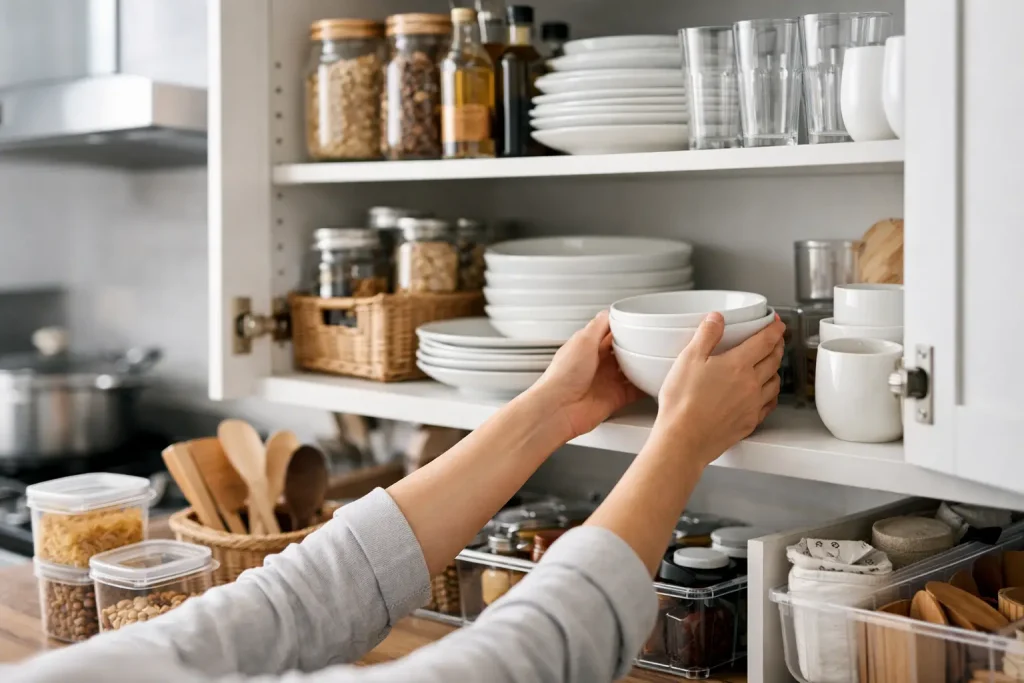
Learn how to organize kitchen cabinets with simple zones, smart storage, and easy habits that keep dishes, pantry items, and tools in order.
You notice cabinet chaos at the worst possible time – when dinner is half-cooked, the measuring cups are missing, and a tower of plastic containers falls out the second you open the door. If you have been searching for how to organize kitchen cabinets, the good news is that you do not need a full remodel or a weekend-long reset. You need a layout that matches how you actually cook, snack, unload groceries, and clean up.
The fastest way to get there is to stop thinking of cabinets as empty boxes and start thinking of them as work zones. That shift changes everything. Instead of asking where random items fit, you decide what belongs near the stove, what belongs near the sink, and what should stay out of the way until you need it.
How to organize kitchen cabinets by zone
Most cabinet problems are really workflow problems. If your coffee mugs are across the kitchen from the coffee maker, or your food storage containers are buried under serving platters, the cabinet setup is fighting your routine.
Start with the main zones. Keep plates, bowls, and everyday glasses near the dishwasher or drying rack so putting them away takes less effort. Store pots, pans, cooking utensils, oils, and spices close to the stove. Put cutting boards, mixing bowls, and prep tools near the area where you usually chop and assemble meals. Cleaning supplies, dishwasher pods, trash bags, and dish towels should stay near the sink.
This approach is simple, but it prevents one of the biggest organizing mistakes: storing like items together when they are used in different parts of the kitchen. It sounds logical to keep all baking items in one place, for example, but if your stand mixer lives in a lower cabinet and your measuring cups are on the other side of the room, that category-based system may be less helpful than a use-based one.
Empty first, then edit hard
If you want cabinets to stay organized, you have to reduce what goes back in them. Pull everything out one cabinet at a time so the job does not turn into total kitchen shutdown. As you empty each space, wipe the shelf and look at what you actually own.
Be honest about duplicates, chipped dishes, expired pantry items, and gadgets you never use. That novelty avocado slicer had a moment. If it has not been touched in a year, it is taking premium real estate from something you use every day.
This step matters because no organizer can fix overcrowding. Shelf risers, bins, and turntables help, but only after you cut down the volume. A cabinet stuffed to the edge will always look messy again within days.
What deserves the best cabinet space
The easiest rule is frequency first. Items you use daily should sit between waist and eye level when possible. That includes everyday dishes, glasses, lunch containers, coffee supplies, and your go-to cookware.
Less-used items can move higher or lower. Holiday platters, specialty appliances, and large serving bowls do not need easy access. If you only pull out the roasting pan twice a year, it should not be blocking the skillet you use four nights a week.
There is one trade-off here. If you have a small kitchen, perfect placement is not always possible. In that case, prioritize your busiest routines first: breakfast, weekday cooking, lunch packing, and cleanup. Those are the tasks that benefit most from smart cabinet placement.
Set up each cabinet with a clear job
A cabinet works better when it has a single purpose. Mixed-use cabinets are where clutter starts because they invite random storage.
Your dish cabinet should hold dishes, not dishes plus batteries, plus lunch bags, plus candles. A pantry cabinet should hold food, not food and water bottles and appliance manuals. When each cabinet has a job, putting things away becomes automatic.
This is also where simple products can help. Stackable shelves make better use of vertical space for plates, mugs, or canned goods. Clear bins keep snacks, packets, or baking supplies from drifting around. Lazy Susans work well for oils, vinegars, sauces, and small jars that disappear in deep corners. Pull-out shelves are especially helpful in lower cabinets where items tend to get shoved to the back and forgotten.
You do not need to buy all of these. The best tool depends on the problem. If your shelves are tall and half-empty, risers help. If your cabinets are deep, bins or pull-outs are more useful. If small bottles get lost, a turntable makes sense.
How to organize kitchen cabinets for everyday dishes
Everyday dishes should be the easiest items to grab and the easiest to put away. Stack plates by size, nest bowls together, and keep mugs in one dedicated section. If you have enough room, place cups and glasses on a separate shelf so heavier plates do not crowd them.
Try not to overstack. Tall piles of plates look tidy for about a day, then become awkward and annoying. Shorter stacks are easier to manage and less likely to chip.
If kids are regularly grabbing their own items, consider putting durable cups, plates, and snack bowls in a lower cabinet they can reach safely. That small adjustment can cut down on both mess and constant requests for help.
Tame food storage containers before they take over
Almost every kitchen has one cabinet that feels personally offended by lids. This is where matching and containment matter.
Keep containers and lids together in the same general area, but separate by type. Nest containers by shape and size, then store lids upright in a bin or file-style rack so you can flip through them instead of lifting a messy stack. If you have mismatched pieces with no partners, now is the time to let them go.
A smaller collection that nests neatly beats a giant pile of maybe-matching plastic every time. If you pack lunches often, store these containers near lunch bags, wraps, or reusable utensils to create a useful grab-and-go zone.
Make lower cabinets easier to use
Lower cabinets are where good systems go to disappear. Because you cannot see the back easily, things get lost fast.
Heavy pots, pans, small appliances, and mixing bowls usually belong here. Use pan organizers or vertical dividers so skillets, lids, and baking sheets can stand upright instead of forming a loud metal pile. For appliances, avoid stacking too many items if it means lifting three things just to reach the blender.
If bending and digging makes a cabinet frustrating, that cabinet will become messy again. Pull-out baskets or deep bins solve that by bringing the contents to you. They are especially useful under the sink, where cleaning supplies can turn into a clutter trap.
Don’t waste cabinet doors and awkward corners
The inside of a cabinet door can store more than people realize. Lightweight measuring spoons, pot holders, small wraps, or cleaning gloves can fit there with simple door-mounted organizers or hooks.
Corners are trickier. If you have a hard-to-reach corner cabinet, reserve it for bulky but less-used items. It is rarely the best spot for anything you need every day. That is one of those it-depends areas where the right answer is based on access, not just category.
Build habits that keep cabinets organized
The best cabinet system is one you can maintain without thinking too hard. That means resetting a few small habits.
Put groceries away by zone, not by whatever shelf has space. Return items to the same spot after unloading the dishwasher. Do a five-minute cabinet reset once a week, especially in high-traffic areas like snack storage, food containers, and the dish cabinet.
Labels can help if multiple people use the kitchen, but they are not mandatory. For many households, visual simplicity does the job. If bins are obvious and zones make sense, people are more likely to follow the system.
One more tip that pays off over time: leave a little empty space. Cabinets packed to 100 percent capacity are harder to maintain, harder to clean, and more likely to become jumbled. A bit of breathing room makes the entire kitchen feel more functional.
When your kitchen is tiny, simplify even more
Small kitchens need stricter boundaries. If cabinet space is limited, keep only the items that earn their spot. Multipurpose cookware, nesting bowls, uniform containers, and stackable dishes are easier to store than bulky one-use tools.
You may also need to split items by frequency instead of strict category. For example, keep your everyday skillet in the most accessible cabinet and store specialty bakeware somewhere less convenient. This is not about creating a picture-perfect pantry. It is about making your kitchen easier to use on a busy Tuesday.
A well-organized cabinet setup should save time, reduce frustration, and make your kitchen feel bigger than it is. Start with one cabinet, give it a clear purpose, and build from there. The goal is not perfection. It is opening a door and finding exactly what you expected to find.















Leave a Comment
Your email address will not be published. Required fields are marked with *