
Discover why choose solar panels for your home in 2026! Cut bills, boost property value, and embrace energy independence with our guide.
Solar panels are one of the most financially rewarding and environmentally responsible upgrades a homeowner can make, cutting electricity bills, reducing carbon emissions, and adding measurable value to your property. The decision to go solar is no longer just for the eco-conscious few. With payback periods of 6 to 13 years and 25-year net savings reaching $75,000 for some U.S. homeowners, photovoltaic (PV) systems have become a mainstream financial strategy. Whether you are drawn by the advantages of solar energy, the promise of energy independence, or simply the desire to shrink your monthly utility bill, this guide gives you the real numbers and practical insight to make a confident decision.
Why choose solar panels for your home finances?
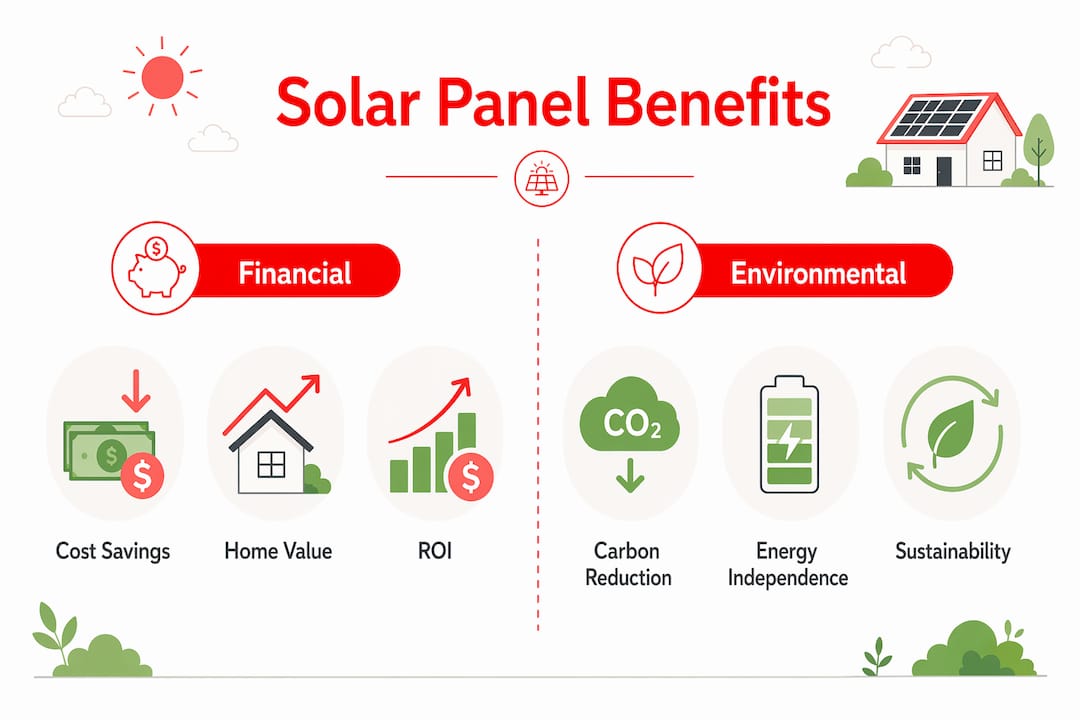
Solar panels deliver financial returns through three distinct channels: reduced electricity bills, potential income from exporting surplus power to the grid, and a higher home resale value. Understanding all three helps you see the full picture rather than focusing only on monthly savings.
The payback period and long-term returns
The 10 to 20% annual ROI that solar systems generate places them ahead of many traditional investments. That figure reflects the combination of avoided electricity costs and, where net metering policies apply, compensation for excess energy sent back to the grid. Net metering rules vary significantly by state, so checking your local utility’s policy before installation is a step you cannot skip.
A typical residential system costs around $2.58 per watt nationally, putting a 12 kW system at roughly $30,505 installed before incentives. The federal Investment Tax Credit (ITC) currently allows you to deduct 30% of installation costs from your federal taxes, which meaningfully shortens the payback window. State-level rebates and utility incentives can reduce costs further, so your actual out-of-pocket figure may be considerably lower.
How solar panels affect home resale value
Installing solar panels increases home resale value by 3% to 6.9%, adding roughly $15,000 on a $375,000 home based on 2024 to 2025 housing market data. That figure is not speculative. It reflects what buyers are willing to pay for a home with lower ongoing energy costs. If you plan to sell within the next decade, a solar system can return a significant portion of its cost through the sale price alone.
| Financial Benefit | What to Expect |
|---|---|
| Payback period | 6 to 13 years depending on location, rates, and system size |
| 25-year net savings | $12,000 to $75,000 for U.S. homeowners |
| Home value increase | 3% to 6.9% added to resale price |
| Annual ROI | 10 to 20% based on avoided electricity costs |
| Federal tax credit | 30% of installation cost deducted from federal taxes |
- Buy outright: Highest long-term savings, full ownership, and tax credit eligibility from day one.
- Solar loan: Spreads cost over time while you still own the system and claim incentives.
- Lease or PPA (Power Purchase Agreement): Lower upfront cost, but you do not own the panels and may not qualify for tax credits. Savings are smaller but still real.
Pro Tip: Get at least three quotes from certified installers and compare cost per watt rather than total price. A slightly higher quote for a more efficient system often delivers better returns over 25 years.
How do solar panels help the environment?
The environmental case for solar is compelling and concrete. A typical 4 kWp residential system avoids 0.7 to 1.5 tonnes of CO2 annually, which adds up to 17 to 37 tonnes over a 25-year lifespan. That is roughly equivalent to taking a car off the road for several years. For homeowners who care about their carbon footprint, few single actions deliver this scale of impact.
Here is how solar panels contribute to a cleaner planet across multiple dimensions:
- Carbon emission reduction. Every kilowatt-hour your panels generate is a kilowatt-hour that does not come from a coal or gas plant. Over a system’s lifetime, the cumulative reduction is substantial.
- Rapid carbon payback. Modern silicon PV modules reach carbon neutrality within 1 to 3 years of operation, despite the energy used in manufacturing. After that point, every unit of electricity generated is genuinely clean.
- Zero water consumption. Unlike coal, natural gas, and nuclear power plants, which require enormous volumes of water for cooling, solar panels consume virtually no water during electricity generation. This makes solar particularly valuable in drought-prone states like California, Arizona, and Texas.
- Reduced local air pollution. Generating your own electricity means fewer pollutants like nitrogen oxides and particulate matter in your local air. Communities with high solar adoption see measurable improvements in air quality.
“Solar energy is not just a financial investment. It is a direct contribution to cleaner air, lower water stress, and a more stable climate for the next generation.”
The carbon payback figure deserves special attention. Critics sometimes argue that manufacturing solar panels creates emissions that cancel out the benefits. The data says otherwise. Within three years at most, your system has already offset its manufacturing footprint. Every year after that is a net environmental gain.
What factors affect whether solar panels are worth it for you?
The benefits of solar panels are real, but they are not identical for every homeowner. Several practical factors determine how quickly you recoup your investment and how much you save over time.
Roof suitability and shading
Roof orientation, shading, and condition are the three most critical physical factors. South-facing roofs in the Northern Hemisphere capture the most sunlight, but east and west-facing roofs still perform well. Heavy shading from trees or neighboring buildings can reduce solar output by 40 to 60%, which dramatically extends your payback period. Before committing, have a qualified installer conduct a shading analysis using tools like Aurora Solar or PVWatts.
Your electricity rate and consumption habits
The higher your electricity rate, the faster solar pays back. Homeowners in states like California, Massachusetts, and Hawaii, where rates exceed $0.25 per kilowatt-hour, see the fastest returns. Those in low-rate states like Louisiana or Arkansas will still benefit, but the payback period stretches longer.
Using appliances during daylight hours is one of the simplest ways to maximize savings. Running your dishwasher, washing machine, and electric vehicle charger while the sun is shining means you consume your own free solar power rather than drawing from the grid. This behavioral shift alone can meaningfully improve your system’s financial performance.
- High electricity rates: Faster payback, stronger ROI.
- Daytime energy use: Maximizes self-consumption and reduces grid reliance.
- Larger household consumption: Justifies a bigger system and improves economics.
- Long-term homeownership: You need to stay long enough to pass the payback threshold.
- Homeownership status: Renters cannot install panels; landlords can, but tenant billing arrangements add complexity.
Should you add a battery?
Adding a solar battery boosts self-consumption and provides backup power during outages, but it increases upfront costs significantly. Popular options like the Tesla Powerwall or Enphase IQ Battery add $10,000 to $15,000 or more to your total system cost. The financial case for a battery depends heavily on your local net metering rate. If your utility pays close to retail rate for exported power, a battery adds less financial value. If export rates are low, storing surplus energy for evening use makes more economic sense.
Pro Tip: Model your battery investment separately from your panel investment. Many homeowners find panels alone deliver excellent returns, while the battery decision depends on your specific utility rates and how much you value backup power.
Comparing solar panel types and installation options
Not all solar panels are created equal, and the type you choose affects both performance and long-term value.
Monocrystalline vs. polycrystalline panels
Monocrystalline panels offer greater efficiency and higher wattage output than polycrystalline panels, making them the preferred choice for homes with limited roof space. Typical panel wattage now ranges from 350W to 450W for premium monocrystalline models from manufacturers like SunPower, LG, and Panasonic. Polycrystalline panels cost less upfront but require more roof area to generate the same output. For most homeowners, the higher efficiency of monocrystalline panels justifies the modest price premium, particularly when roof space is constrained.
Higher panel wattage and quality often result in better payback over time despite higher initial cost. The cheapest quote is rarely the best value. A system that degrades faster or underperforms its rated output will cost you more in lost savings over 25 years than you saved at purchase.
| Panel Type | Efficiency | Best For | Relative Cost |
|---|---|---|---|
| Monocrystalline | 19% to 23% | Limited roof space, maximum output | Higher |
| Polycrystalline | 15% to 17% | Larger roofs, budget-conscious buyers | Lower |
| Thin-film | 10% to 13% | Specific commercial or curved applications | Varies |
What to look for in warranties and installers
Performance warranties typically cover 10 to 15% degradation over 25 to 30 years, meaning your panels are guaranteed to produce at least 80 to 90% of their original output at the end of their rated life. This degradation is factored into reputable installer proposals, so ask to see the production estimates year by year.
- Verify installer credentials through the North American Board of Certified Energy Practitioners (NABCEP).
- Request itemized quotes that separate equipment costs from labor and permitting fees.
- Check whether the installer handles utility interconnection paperwork or leaves that to you.
- Confirm the warranty covers both the panels and the inverter, since inverters typically carry a 10 to 12 year warranty and may need replacement mid-system life.
Key takeaways
Solar panels deliver measurable financial returns, significant environmental benefits, and long-term energy independence for homeowners who choose the right system for their specific situation.
| Point | Details |
|---|---|
| Strong financial returns | Payback in 6 to 13 years with net savings up to $75,000 over 25 years. |
| Home value boost | Solar adds 3% to 6.9% to resale value, roughly $15,000 on a median-priced home. |
| Real environmental impact | A 4 kWp system avoids up to 37 tonnes of CO2 over its lifetime. |
| Roof and behavior matter | South-facing roofs and daytime energy use maximize savings and shorten payback. |
| Panel quality pays off | Monocrystalline panels and reputable installers deliver better long-term value than the cheapest option. |
Why I think solar is one of the smartest home investments right now
I have spent years watching homeowners agonize over whether solar is “really worth it,” and the honest answer is: it depends on your situation, but the odds are increasingly in your favor. What strikes me most about the 2026 solar market is that the conversation has shifted. People used to ask about payback periods. Now they ask about energy price resilience. That is a meaningful change.
Electricity prices have been volatile and trending upward for years. Every kilowatt-hour your panels generate is one you are not buying at whatever the grid charges next year or the year after. That insulation from price volatility is worth something that does not show up cleanly in a payback calculation, but it is real.
Where I see homeowners go wrong is in chasing the lowest quote or over-investing in batteries before they understand their usage patterns. The smartest approach is to size your system to your actual consumption, optimize your daytime energy habits, and treat the battery decision as a separate financial question. Pairing solar with home automation upgrades like smart thermostats and automated appliance scheduling can squeeze even more value from your panels by shifting loads to peak generation hours automatically.
Solar is not magic. It requires a good roof, a reasonable electricity rate, and a commitment to staying in your home long enough to reap the returns. But for homeowners who check those boxes, it is one of the few home improvements that pays you back financially while doing something genuinely good for the planet. That combination is hard to beat.
— Alexander
Power up your home and your savings
If solar panels have you thinking bigger about your home’s energy future, you are already on the right track. Smart energy upgrades rarely stop at the roof. Combining solar with other energy-efficient home improvements like upgraded insulation, smart HVAC systems, and LED lighting creates a compounding effect on your monthly bills. At Lizardslunch, we cover the full spectrum of home improvement strategies that actually move the needle on your finances. For practical ideas that go beyond solar, explore our money-saving home tips and discover how small, strategic changes across your home can add up to thousands in annual savings.
FAQ
Why choose solar panels over other energy upgrades?
Solar panels deliver both immediate bill reductions and long-term asset value, making them one of the highest-ROI home upgrades available. Unlike insulation or HVAC upgrades, they also increase your home’s resale value by 3% to 6.9%.
How does solar energy work for a typical home?
Photovoltaic panels convert sunlight into direct current (DC) electricity, which an inverter converts to alternating current (AC) for household use. Surplus power is either exported to the grid or stored in a battery for later use.
Is solar energy worth it if I live in a cloudy region?
Solar panels still generate electricity on cloudy days, though at reduced output. States like New York and Oregon have strong solar markets because high electricity rates compensate for lower sun hours, keeping the financial case solid.
How long do solar panels last?
Most residential solar panels carry a 25-year performance warranty and continue generating electricity beyond that. Expect roughly 10 to 15% output degradation over 25 to 30 years, which is already factored into reputable installer proposals.
What is the fastest way to shorten my solar payback period?
Shifting high-consumption appliances like dishwashers, washing machines, and EV chargers to daylight hours maximizes self-consumption and reduces grid reliance, directly accelerating your return on investment.


















Leave a Comment
Your email address will not be published. Required fields are marked with *