

Learn how to organize garage tools with zones, wall storage, cabinets, and simple maintenance habits that keep every project moving smoothly all year.
The screwdriver you need is usually hiding beneath three paint cans, a tangled extension cord, and the box from a tool you bought two years ago. Learning how to organize garage tools is less about making the room look like a showroom and more about making Saturday projects start on time. A good setup lets you find what you own, protects expensive gear, and keeps sharp or heavy items out of the way.
The best system is one you can maintain without a major cleanup every month. Start by matching storage to the tools you actually use, the space you have, and the kinds of projects that happen in your garage.
Start by Sorting Before You Buy Storage
Resist the urge to buy bins, cabinets, or a wall full of hooks before you know what needs a home. Pull tools out of drawers, boxes, buckets, and corners, then group them by purpose. Hand tools, power tools, lawn equipment, automotive supplies, painting gear, and hardware should each have their own pile.
As you sort, set aside duplicates, broken items, and tools that do not fit your current life. Three rusty adjustable wrenches may not deserve premium drawer space. A working spare can stay, but damaged tools should be repaired, recycled where appropriate, or discarded safely.
This is also the moment to notice gaps. If drill bits, sanding discs, and driver heads are scattered everywhere, the issue may not be the drill itself. It may be that its accessories have never had a dedicated container.
How to Organize Garage Tools in Zones
Think of the garage as a small workshop with activity zones rather than one big storage room. Keeping related supplies together cuts down on the back-and-forth that makes simple jobs feel frustrating.
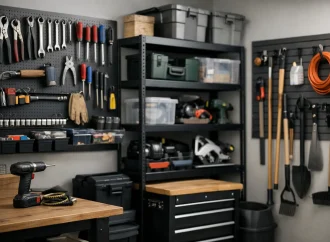
Place everyday hand tools near a workbench or a clear tabletop. Keep power tools nearby, ideally in a cabinet, rolling chest, or shelving unit where their cases can be grabbed quickly. Put automotive items close to where the car is parked, while lawn and garden equipment belongs near the garage door or the route to the yard.
A paint zone can hold brushes, rollers, trays, drop cloths, and labeled cans. Hardware such as screws, anchors, nails, and picture hangers works best in small clear drawers or stackable organizers near the work area. The key is to avoid creating a “miscellaneous” zone. That is usually just a future pile with a nicer name.
If your garage also stores bikes, sports gear, holiday decorations, or bulk household supplies, give those categories their own boundaries. Tools should not compete with beach chairs or storage totes for the same shelf.
Put the Most-Used Tools Within Easy Reach
Frequency should determine location. Tools you reach for every week deserve the most convenient spots: eye-level wall storage, the top drawer of a rolling tool chest, or the front section of a workbench cabinet.
A wall-mounted pegboard works well for lightweight hand tools because each item stays visible. Outline tool locations with a marker or add simple labels if multiple people use the space. Slatwall panels are another flexible option, especially for garages that need adjustable hooks, baskets, and shelves.
For heavier items, use wall hooks rated for the load and attach them to studs or a properly installed rail system. Store shovels, rakes, ladders, leaf blowers, and extension cords vertically whenever possible. Floor space is valuable, and long-handled tools are much less likely to become a tripping hazard when they are off the ground.
There is a trade-off with open storage: it is convenient, but it collects dust and can look cluttered. Reserve wall displays for the tools you use often. Keep specialty tools, measuring devices, and expensive cordless equipment in enclosed storage.
Choose Storage That Fits the Tool
One storage solution rarely handles every category well. A practical garage usually combines several types of storage, each doing a specific job.
A sturdy workbench with drawers is useful for pliers, tape measures, utility knives, drill bits, and other smaller essentials. Drawer liners prevent tools from sliding, while inexpensive drawer dividers stop the contents from becoming a metal jumble.
Lockable cabinets are a smart choice for chemicals, sharp blades, power tools, and anything you want to keep away from children. They also protect equipment from dust, though garages with high humidity may still require moisture control. Never store gasoline, propane cylinders, or other hazardous materials in a way that conflicts with local safety guidance or product instructions.
Clear, lidded bins make sense for accessories and seasonal project supplies. Label every bin on the front, not just the top, so you can identify it when bins are stacked. Labels such as “Painting Prep,” “Plumbing Parts,” and “Drill Accessories” are more useful than broad labels like “Garage Stuff.”
A rolling tool cart is worth considering if you regularly work in the driveway, on vehicles, or around the house. It keeps a core collection mobile without forcing you to carry a heavy toolbox back and forth.
Give Power Tools and Cords a Better System
Power tools create clutter quickly because every tool comes with batteries, chargers, bits, manuals, guards, and cords. Keep each tool with the accessories that belong to it whenever practical. A labeled case, a dedicated shelf bin, or a drawer compartment prevents the common problem of owning a saw but spending 15 minutes looking for its blade wrench.
Create one charging station instead of plugging chargers into outlets across the garage. A shelf near an outlet can hold chargers and spare batteries, while a power strip with surge protection can keep cords organized. Do not leave batteries charging unattended for long periods, and follow the manufacturer’s charging and temperature recommendations.
Extension cords deserve their own hook, reel, or large tote. Coil each cord loosely rather than wrapping it tightly around your elbow, which can twist and weaken the wire over time. Label cords by length if you own several. Knowing which one is 25 feet and which is 100 feet saves needless untangling.
Make the Workbench Earn Its Space
A workbench becomes a dumping ground when it has no rules. Keep only active project materials on its surface, and give everything else a nearby home. Even a small bench can work well when the top stays mostly clear.
Use the wall above the bench for frequently used hand tools, a task light, and perhaps a small magnetic strip for drill bits or sockets. Keep a small container for fasteners removed during a repair so they do not roll away. If you do messy projects, place a durable mat or scrap piece of plywood on the surface rather than damaging the bench itself.
For homeowners without room for a permanent bench, a folding worktable or rolling cart can be the better choice. It will not offer as much storage, but it keeps a compact garage flexible.
Build a 10-Minute Reset Habit
An organized garage does not stay organized because of fancy cabinets. It stays organized because tools return to their assigned spots after a job. Before you go inside, take 10 minutes to put away tools, empty project debris, and return borrowed items.
Keep a small trash can and recycling container near the work area for packaging, worn sandpaper, and empty hardware bags. Once or twice a year, do a quick reset: wipe down tools, check for rust, test batteries, and review whether your layout still matches the projects you do most.
The goal is not perfection. It is opening the garage, spotting the right tool immediately, and having enough clear floor space to get to work.
















Leave a Comment
Your email address will not be published. Required fields are marked with *