

Compare Blue Cross, Manulife, TD, Tugo, Travel Guard and Medipac; prioritize medical evacuation limits and the pre existing condition stability window…
Yes, Canadians traveling anywhere outside their home province should carry private travel insurance, and the shortlist worth comparing includes Blue Cross travel plans, Manulife (CoverMe), TD Insurance travel plans, Tugo, Travel Guard Canada, and Medipac. The two checks that matter most are the medical evacuation limit and the pre-existing condition stability window. Before buying, line up quotes side by side and confirm both numbers rather than the sticker price.
TL;DR:
- Medical evacuation limits should match the potential cost of care at your destination, especially if traveling to high-cost areas like the United States.
- Confirm whether evacuation and repatriation are included in the policy, as some plans only cover emergency treatment without transport costs.
- Check the specific pre-existing condition stability window and ensure your health status aligns with the insurer’s requirements before purchasing.
- Be wary of vague pre-existing condition clauses, unclear evacuation coverage, and inconsistent claim process descriptions in policy wording.
- For snowbirds, prioritize high medical ceilings and evacuation coverage; for short trips, focus on trip cancellation, medical limits, and destination-specific costs.
Table of Contents
- Shortlist: top Canadian travel insurers and who each suits best
- Side-by-side comparison table: compare the shortlist on key buying axes
- How to choose: checklist, questions to ask sellers, and red flags to avoid
- What travel insurance covers in Canada: medical, cancellation, baggage, evacuation and how provincial coverage interacts
- Our team at Lizard’s Lunch: practical tips and links to deeper guides
- Our team’s pick for two typical Canadian travel profiles
- A different way to plan the rest of your trip
- Sources
- FAQ
Shortlist: top Canadian travel insurers and who each suits best
Comparing plans starts with matching a provider’s strength to your trip, not just its brand name. Each insurer below built its reputation around a specific traveler type, and knowing which one mirrors your own habits saves time.
Blue Cross travel plans carry the weight of a large national footprint, with single trip and multi-trip options sold through provincial affiliates across the country. They suit travelers who want a familiar, established name and a broad menu of coverage tiers.
Manulife (CoverMe) built its lineup around flexibility, offering several plan tiers under the CoverMe brand with strong cancellation add-ons. This makes it a natural fit for travelers who want to customize a policy rather than accept a single fixed package.
TD Insurance travel plans work best for existing TD banking customers, since the insurer bundles travel coverage with other financial products and sometimes discounts the premium for account holders.
Tugo stands out for its digital-first approach and its willingness to write PEC riders for unstable pre-existing conditions, a feature many competitors limit or exclude entirely.
Travel Guard Canada leans on its global assistance network, pairing trip cancellation packages with round-the-clock support lines, useful for travelers who want a single call to resolve an emergency abroad.
Medipac focuses almost entirely on snowbirds and senior travelers, offering some of the higher medical ceilings in the market for long winter stays in warmer climates.
A quick summary of what to weigh:
- Blue Cross: broad provincial presence, mid-range pricing, wide plan selection.
- Manulife (CoverMe): flexible tiers, strong cancellation features, mid to premium pricing.
- TD Insurance: bundling discounts for bank customers, mid-range pricing.
- Tugo: digital-first purchase experience, PEC riders on select plans, mid-range pricing.
- Travel Guard Canada: 24/7 assistance, comprehensive cancellation packages, mid to premium pricing.
- Medipac: high medical ceilings built for long stays, premium pricing for senior-focused coverage.
Whichever name you land on, read the actual policy wording before you pay. Pre-existing condition clauses hinge on a stability or look-back period, and that window varies by insurer, so a quote that looks cheap can turn expensive the moment a claim gets denied over a missed disclosure.
Side-by-side comparison table: compare the shortlist on key buying axes
Once you have narrowed your options, line them up against the factors that actually decide whether a claim gets paid.
Medical ceilings up to $5 million CAD are common across the Canadian market, but a ceiling only matters against what it needs to cover. A short hospital stay in the United States can run far higher than the same treatment at home, so the right question is not “how big is the limit” but “does the limit cover a realistic worst case at my destination.”

Pro Tip: Match the medical limit to your destination’s cost of care, not to the biggest number on the brochure: choose the policy that covers your expected maximum hospital bill where you are actually going.
How to choose: checklist, questions to ask sellers, and red flags to avoid
Picking a policy comes down to asking the right questions before you sign, not after you file a claim.
- Confirm the medical coverage limit and whether it fits the cost of care at your destination.
- Check that evacuation and repatriation are included, not just emergency treatment.
- Ask for the exact pre-existing condition stability window and what counts as a “change” in your condition.
- Note any pending tests or referrals, since an unresolved test can void a claim even for an unrelated illness.
- Review activity exclusions if your trip includes skiing, diving, or other higher-risk pursuits.
- Ask how the policy handles a government travel advisory or a pandemic-related disruption.
- Confirm the claims line operates 24/7 and ask what documentation they require to pre-authorize evacuation.
Questions worth putting directly to a seller or broker:
- “Define stability for pre-existing conditions and tell me the exact look-back period.”
- “What documentation do you need before you will pre-authorize a medical evacuation?”
- “Are trip cancellation and trip interruption both included, or sold separately?”
- “What happens if my tour operator already refunds part of the trip?”
Red flags to walk away from: vague or undefined pre-existing condition wording, no mention of evacuation coverage at all, no clear description of the claims process, and refund terms that read differently in the fine print than in the sales pitch.
Where you buy matters too. A direct insurer often gives the widest plan selection. A broker can compare several insurers for you, useful if your health history is complicated. A bank like TD Insurance offers convenience for existing customers. A credit card can include travel coverage, but its limits tend to run lower and its exclusions stricter than a dedicated policy, which is worth remembering before you assume the card in your wallet already has you covered.
What travel insurance covers in Canada: medical, cancellation, baggage, evacuation and how provincial coverage interacts
A travel policy is really several coverages bundled together, and each one solves a different problem.
- Emergency medical: pays hospital and physician costs abroad, the coverage most Canadians think of first.
- Medical evacuation and repatriation: moves you to adequate care or home, a cost provincial plans do not touch.
- Trip cancellation: reimburses prepaid costs if you cancel before departure for a covered reason.
- Trip interruption: covers unused portions of a trip if you must return early after it has started.
- Baggage and delay: compensates for lost, stolen, or delayed luggage and related delay expenses.
Provincial and territorial health plans leave real gaps here. Canada’s public health system may reimburse a portion of an out-of-country emergency, but only at domestic rates, and it will not prepay a foreign hospital directly, leaving you to cover the balance and arrange coverage before you go. Evacuation costs fall outside provincial coverage entirely.
Our team at Lizard’s Lunch: practical tips and links to deeper guides
Research shows that analyzing policy wording in detail reveals common patterns behind claim denials that are worth flagging directly.
- Answer every medical question on the application accurately, since a mismatch with your records is a common reason claims fail.
- Keep test results and doctor’s notes handy in case your insurer requests them during a claim.
- Confirm your provider’s look-back window before you travel, not after you file.
- Buy an evacuation limit that matches your destination, especially for travel to the United States.
For more background, our guide to travel insurance basics walks through common exclusions in plain language, and our piece on whether travel insurance is necessary helps if you are still deciding. Readers watching their budget might also like our roundup of ways to save on travel.
Our team’s pick for two typical Canadian travel profiles
A snowbird heading south for the winter should prioritize a high medical limit, evacuation coverage, and an annual multi-trip plan, adding a PEC rider if any condition has changed recently. A weekend city trip calls for different priorities: solid trip cancellation and a single-trip policy with a medical limit sized for wherever you land, especially if that’s the United States. Match the plan to the trip, not the other way around.
— Alexander
A different way to plan the rest of your trip
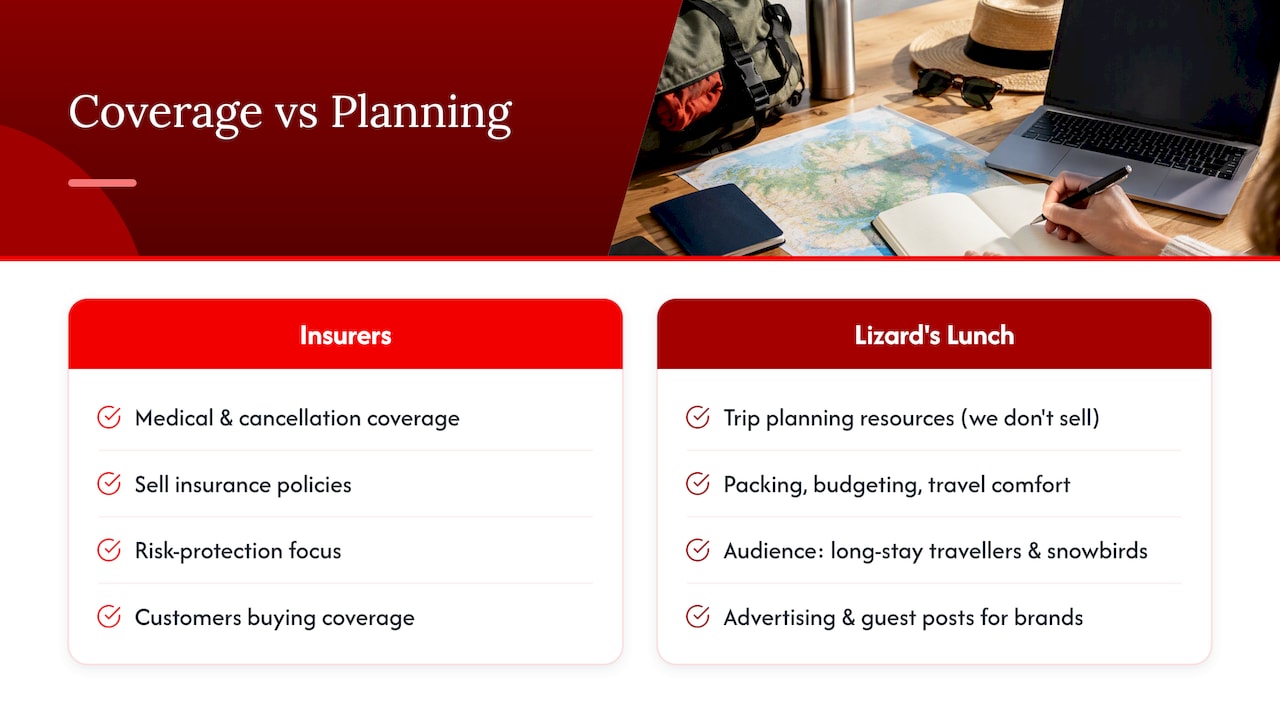
Comparing insurers takes care of your medical and cancellation risk, but the rest of your trip planning, from packing smart to budgeting wisely, is where Lizard’s Lunch fits in. We are not an insurance provider and we do not sell policies, so think of us as the resource you turn to once your coverage is sorted and you are figuring out everything else. Our guides cover practical ground the insurers above do not touch, including how to travel comfortably on long-haul trips and how to stretch a travel budget further.
If you run a business in the travel or insurance space and want to reach Canadian readers researching exactly this kind of decision, our advertising and guest post options put your brand in front of that audience directly. Meanwhile, long-stay travelers and snowbirds packing for extended trips may also find value in travel-friendly bedding solutions designed for frequent flyers. Check out our advertising page to see how a guest post or banner placement could work for your brand.
This article is general information, not a substitute for advice from a qualified financial advisor. Consult a qualified financial professional about your own circumstances before acting on anything here.
FAQ
Who offers the best travel insurance in Canada?
There is no single best insurer for every traveler; Blue Cross travel plans, Manulife (CoverMe), Tugo, Travel Guard Canada, and Medipac each suit different needs, from broad network coverage to high medical ceilings for snowbirds. The right choice depends on your destination, trip length, and any pre-existing conditions you need covered.
Which company is the best for travel insurance?
The strongest fit depends on your profile: Tugo suits travelers needing a PEC rider for a changed health condition, Medipac suits snowbirds needing high medical ceilings, and TD Insurance suits bank customers who want bundled coverage. Compare medical limits and pre-existing condition wording directly on quotes rather than relying on brand reputation alone.
What is the average cost of travel insurance in Canada?
Travel insurance pricing varies by age, trip length, and destination, so no single figure applies to every traveler. Compare quotes across providers using the same trip details to see how your own premium is likely to shape up.
What is the most reputable travel insurance?
Reputation in this market comes down to claims handling and clear policy wording rather than a single ranking. The Government of Canada advises buying private coverage precisely because public health plans leave gaps, so look for an insurer with a transparent pre-existing condition definition and a documented evacuation process before you buy.














Leave a Comment
Your email address will not be published. Required fields are marked with *