

2026 Canada update on first time buyer grants: new GST/HST rebate rules, FHSA and HBP interaction, a checklist to cut out of pocket costs.
The federal programs that matter most for first-time buyers in 2026 are the FHSA, the Home Buyers’ Plan, the First-Time Home Buyers’ GST/HST rebate, and the Home Buyers’ Tax Credit. Together, they can shave tens of thousands off a purchase, with the GST/HST rebate alone worth up to forty thousand dollars on qualifying new builds. Read the federal breakdown below first, then check your province, since rebate amounts and land transfer tax relief vary widely by region.
TL;DR:
- The federal programs offer significant savings, with the GST/HST rebate worth up to forty thousand dollars for qualifying new builds, but regional variations can greatly affect total benefits.
- The First Home Savings Account allows contributions up to eight thousand dollars annually with tax-free withdrawals for a home purchase, while the Home Buyers’ Plan lets you borrow up to sixty thousand dollars from RRSPs but requires 15-year repayment.
- Provincial and municipal rebates can add to federal benefits, with Ontario exemplifying program alignment that enables stacking federal and provincial relief on new homes, but other regions vary widely and need careful verification.
- Eligibility depends heavily on a four-year ownership and residency rule, and applications must be carefully timed, documented, and filed within specific windows, with restrictions on using FHSA and HBP funds simultaneously.
- Buyers should check regional rules, confirm first-time status, and coordinate rebate applications early, especially when recent life changes like separation or self-employment might impact qualification.
Table of Contents
- Federal Programs Explained: FHSA, HBP, GST/HST Rebate, and HBTC
- Provincial and Municipal Rebates: What to Check in Your Region
- Eligibility Rules Every First-Time Buyer Must Check
- How to Apply: Timelines, Documents, and Practical Steps
- Using FHSA and HBP Together: What Works and What Doesn’t
- Our Team’s Prioritized Checklist for This Month
- Where to Verify the Rules Yourself
- Sources
- FAQ
Federal Programs Explained: FHSA, HBP, GST/HST Rebate, and HBTC
Four federal tools do the heavy lifting for first-time home buyer grants in Canada, and each works differently.
- First Home Savings Account (FHSA): you get $8,000 in contribution room in your first year, with a lifetime contribution limit of forty thousand dollars. Contributions are tax-deductible and qualifying withdrawals for a first home are completely tax-free, which makes it the closest thing to a built-in savings booster the government offers.
- Home Buyers’ Plan (HBP): you can pull up to sixty thousand dollars from your RRSP per person, meaning a couple could access twice that amount combined. The catch is repayment: you owe that money back to your RRSP over 15 years, and missed payments get added to your taxable income.
- First-Time Home Buyers’ GST/HST rebate: this is the newest and arguably the most valuable piece. Qualifying new or substantially renovated homes can receive a full rebate on the federal portion of GST/HST, worth up to fifty thousand dollars, with a phase-out between one million and one million five hundred thousand dollars in purchase price.
- Home Buyers’ Tax Credit (HBTC): a non-refundable tax credit claimed directly on your annual tax return for the year you buy your first home. It is smaller than the other three, but it costs nothing extra to claim if you already qualify.
Not every program applies to every purchase. The GST/HST rebate only covers new construction, while the FHSA and HBP work on new or resale homes alike.
Provincial and Municipal Rebates: What to Check in Your Region
Ottawa sets the floor, but provinces and cities decide how much further your savings go. Common program types include:
- Provincial rebates on the provincial portion of HST, layered on top of the federal GST/HST relief for new builds.
- Land transfer tax rebates or full exemptions for qualifying first-time buyers.
- Municipal down-payment assistance pilots, usually limited to specific cities and often first-come, first-served.
Ontario is the clearest example of provincial-federal alignment. The province coordinated its own HST relief on new homes to work alongside the federal rebate structure, following legislation introduced to support that implementation. That means an Ontario buyer purchasing a qualifying new home can potentially stack provincial and federal relief, though the exact provincial dollar amount depends on your purchase price and municipality.
British Columbia, Quebec, and the Atlantic provinces each run their own land transfer tax exemptions and rebate thresholds, and none of them mirror each other exactly. Before you assume a rebate applies, confirm the current numbers on your province’s own housing or finance ministry page. Deadlines and application windows shift more often at the provincial level than at the federal level, so treat provincial rules as something to verify close to your closing date, not something to assume from a blog post.
Eligibility Rules Every First-Time Buyer Must Check
Most disqualifications happen because buyers misunderstand the “first-time” definition, not because they lied on an application.
- The four-year rule: you qualify as a first-time buyer if you (or your spouse or common-law partner) have not owned and lived in a home during the current calendar year or the four preceding years. That includes homes owned jointly with a former partner.
- Residency and age basics: you generally need to be a Canadian resident for tax purposes, and most programs require you to be at least 18.
- Qualifying property types: new builds, substantially renovated homes, owner-built homes, and qualifying co-op shares typically count. Cottages and rental-only properties usually do not.
- Common disqualifiers: claiming the FTHB GST/HST rebate a second time, missing construction or occupancy deadlines, or having a spouse who owned a home in the past four years even if you personally did not.
How to Apply: Timelines, Documents, and Practical Steps
Filing for a rebate is straightforward on paper, but the details around timing trip up more buyers than the paperwork itself.
- Confirm your first-time status against the four-year rule before you sign anything, including your spouse’s ownership history.
- Decide how the GST/HST rebate gets applied. Builders can credit the rebate directly at closing, which simplifies your cash flow, or you can file for it yourself afterward using CRA forms GST190 or GST191 depending on your situation.
- File within the CRA’s application window, which typically runs around two years from the date of occupancy or completion.
- Save every document: purchase agreements, builder invoices, occupancy certificates, and any written correspondence about rebate crediting. Keep originals for six years, since the CRA can request them during a review.
Pro Tip: If your builder offers to credit the rebate at closing instead of having you file for it later, get that credit written into your purchase agreement. A verbal promise from a sales rep means nothing if the paperwork does not match it.
Timing also matters at the legislative level. The current rebate rules apply to agreements entered on or after March 20, 2025, with construction needing to be substantially complete before 2036 for owner-built homes in some cases. If your agreement predates that window, you may not qualify at all.
Using FHSA and HBP Together: What Works and What Doesn’t
You cannot make an FHSA qualifying withdrawal and an HBP withdrawal for the same home purchase. You have to pick a lane, or split which account funds which portion of your purchase if your plan allows it.
- FHSA gives you tax-free growth and a tax deduction on contributions, but the $40,000 lifetime cap limits how much you can shelter.
- HBP gives you access to whatever RRSP balance you already built up, sometimes far more than $40,000, but every dollar comes with a 15-year repayment clock.
A buyer who started saving years ago in an FHSA gets a cleaner, debt-free withdrawal. A buyer who needs to tap an existing RRSP for a down payment now gets more cash upfront through the HBP, at the cost of a repayment obligation that competes with future mortgage payments. Our finance planning coverage digs deeper into weighing tradeoffs like this one.
Our Team’s Prioritized Checklist for This Month
A good starting point is to: confirm your four-year first-time status in writing, open an FHSA even with a small deposit, ask your builder directly whether they will credit the GST/HST rebate at closing, map out an RRSP withdrawal plan if you’re leaning on the HBP, and bookmark both the CRA and your province’s housing pages.
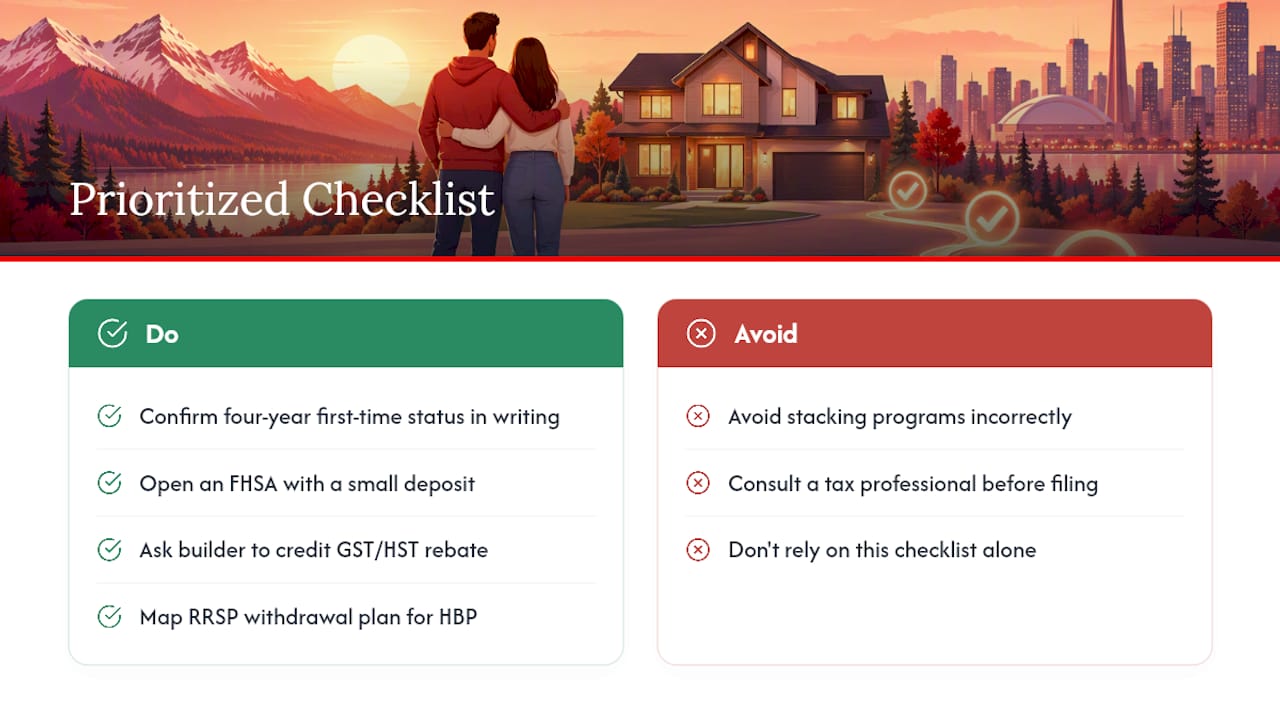
Provincial rules shift more often than federal ones, and stacking programs incorrectly can cost you a rebate entirely. When your situation involves a recent separation, self-employment income, or a non-resident spouse, talk to a tax professional before you file anything. Government pages change; treat this checklist as your starting point, not your final word.
Where to Verify the Rules Yourself
- Canada: eligibility and contribution limits.
- Home Buyers’ Plan participation guide: withdrawal and repayment rules.
- Excise and GST/HST News No. 122: rebate amounts, forms, and timing.
- CMHC homebuyer incentives: calculators and program summaries.
This article is general information, not a substitute for advice from a qualified financial advisor. Consult a qualified financial professional about your own circumstances before acting on anything here.
Sources
FAQ
What salary do I need to afford a $500,000 house in Canada?
Lenders typically want your housing costs under roughly 32% of gross income, so many buyers need a household income in the $95,000 to $110,000 range depending on debt, down payment size, and current mortgage rates. Your actual number shifts with interest rates and whether you qualify for FHSA or HBP funds to lower your mortgage size.
Is there a $50,000 first-time home buyer rebate in Canada?
Yes, but it applies specifically to the First-Time Home Buyers’ GST/HST rebate on qualifying new or substantially renovated homes, not a cash grant available to every buyer. The rebate phases out between $1 million and $1.5 million in purchase price.
How much mortgage can I get with a $70,000 salary in Canada?
Most lenders qualify buyers for a mortgage based on multiples of gross income, so your salary might support a mortgage amount depending on debt load and the stress test rate. Using your FHSA or HBP for a larger down payment reduces how much you need to borrow.
What are the new incentives for first-time buyers in Ontario in 2026?
Ontario coordinates its provincial HST relief on new homes with the federal GST/HST rebate structure, meaning eligible new-build buyers can potentially stack both. Exact provincial amounts depend on your purchase price, so confirm current figures on Ontario’s own housing pages before you budget around them.
Can I use both the FHSA and the HBP for the same home?
No. You cannot make an FHSA qualifying withdrawal and an HBP withdrawal for the same qualifying purchase. You need to choose which account funds your purchase, or split which portion of the transaction each covers if your plan structure allows it.
















Leave a Comment
Your email address will not be published. Required fields are marked with *