
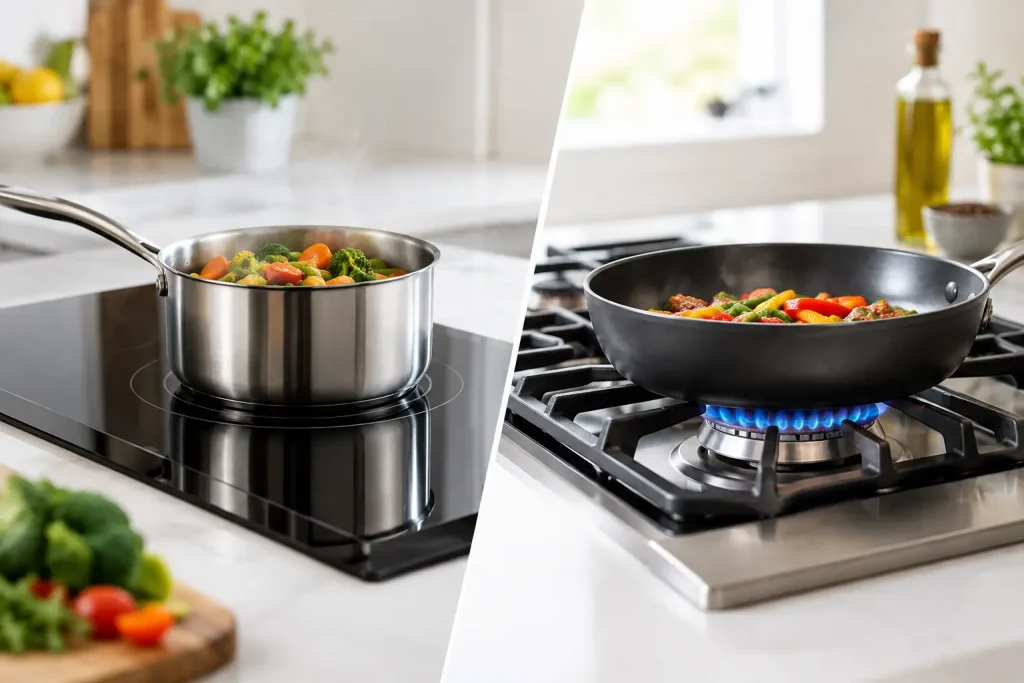
Compare induction versus gas cooking for speed, control, cost, safety, cookware, and kitchen upgrades so you can choose the right range with confidence.
The choice gets real the moment a pan of onions is sputtering on the stove and dinner needs to move. Induction versus gas cooking is not simply a debate about what looks best in a kitchen. It affects how quickly you cook, how warm the room feels, what cookware stays in your cabinet, and potentially how much work is involved before a new range can be installed.
For most households, neither option wins every category. Induction delivers remarkable speed and a cleaner cooking surface, while gas offers visible flame control and familiar versatility. The better fit depends on your cooking habits, home setup, budget, and tolerance for change.
Induction Versus Gas Cooking: The Core Difference
Gas burners create heat by burning natural gas or propane. The flame heats the bottom and sides of the cookware, and some of that energy escapes into the surrounding air. It is a proven, familiar setup that works with nearly any pot or pan and gives cooks an immediate visual cue when heat is on.
Induction cooktops use electricity to create a magnetic field beneath the glass surface. That field heats compatible cookware directly. The cooking surface itself does not generate the heat in the same way a traditional electric coil or radiant-top range does. It warms mainly from contact with the hot pan.
That difference explains much of the real-world experience. Induction can bring water to a boil quickly, respond fast when you lower the setting, and leave less stray heat in the kitchen. Gas provides a flame you can see, works with rounded-bottom cookware and some specialty pans, and remains usable during a power outage if the range can be lit safely according to its manufacturer instructions.
Speed and Heat Control in Everyday Cooking
If fast weeknight meals are the priority, induction has a compelling edge. Because energy goes directly into the pan, a compatible induction burner commonly heats water faster than gas. It also adjusts heat very quickly, which helps when a sauce is threatening to boil over or eggs need gentler treatment.
Gas is still excellent for responsive cooking. Turn the knob down, and the flame shrinks immediately. Many experienced cooks value that visual feedback, especially for stir-frying, simmering, and techniques that involve moving a pan on and off the heat. A gas burner also lets heat travel up the sides of a wok or large skillet in ways a flat induction surface cannot replicate.
The practical caveat is that performance varies widely by appliance. A powerful gas range will outperform a bargain gas model, and a quality induction cooktop with a high-output burner can feel dramatically stronger than a basic electric range. Compare individual burner power, not just fuel type, when shopping.
Cooking with a wok, grill pan, or large cookware
Gas has the advantage for open-flame techniques, including charring tortillas or peppers directly over a burner. It also accommodates most cookware shapes. Flat-bottom carbon-steel woks can work well on induction, but traditional round-bottom woks need a specialized induction unit or a different approach.
Induction is especially good with flat-bottom pots, Dutch ovens, sauté pans, and stockpots. For households that mostly make pasta, soups, sauces, skillet meals, and breakfast, it is often a natural fit.
Safety, Indoor Air, and Kitchen Comfort
Induction offers a clear household safety benefit: there is no open flame. The glass can remain hot after cooking, but it generally cools faster than a conventional radiant electric surface and is less likely to ignite a nearby towel or paper item. Many units also detect when a pan is removed and reduce or stop heating.
Gas requires more attentiveness. Flames can be accidentally left on, and handles, sleeves, and loose materials should stay clear of the burner. Gas cooking also produces combustion byproducts, including nitrogen dioxide, inside the home. A properly sized, externally vented range hood helps remove heat, moisture, odors, and pollutants, but it needs to be used consistently.
Induction does not eliminate the need for ventilation. Frying fish, searing steak, and cooking with oil still create smoke and particles. But without a combustion flame, the kitchen usually stays cooler and the ventilation system has less combustion-related material to manage.
For families with young children, aging adults, or anyone concerned about an open flame, induction can be a particularly appealing upgrade. For serious cooks who already have a strong vent hood and are comfortable managing a gas flame, gas can remain a sensible choice.
Cookware Compatibility Can Change the Math
Gas works with almost every cookware material, including aluminum, copper, glass, ceramic, stainless steel, cast iron, and carbon steel. The main limitation is stability: very small or uneven pieces can be awkward over grates.
Induction requires cookware with a magnetic base. Cast iron and many stainless-steel pans qualify. Aluminum, copper, glass, and ceramic cookware generally will not work unless they have an induction-ready magnetic layer built into the bottom.
A simple magnet test can save frustration. If a magnet sticks firmly to the pan’s base, the cookware should work on induction. That does not guarantee ideal performance, since warped pans and extremely thin bases can heat unevenly, but it is a useful first check.
Before budgeting for a new cooktop, inspect the pans you use most. Replacing a few favorite pieces may be manageable. Replacing an entire premium collection can make a gas range more economical in the short term.
Installation and Operating Costs
A gas range generally needs a gas line, a shutoff valve, and a grounded electrical outlet for ignition and oven controls. If the home already has service in place, installation may be straightforward. If it does not, adding a gas line can become a substantial project.
Induction ranges need a 240-volt electrical circuit, usually similar to the circuit required for an electric range. Some homes have adequate electrical capacity already; others may need a panel upgrade or new wiring. Portable plug-in induction burners are an inexpensive way to test the cooking experience, but they do not predict the full power or capacity of a built-in range.
Purchase prices vary at every level. Entry-level gas ranges can cost less than premium induction models, yet induction choices are becoming more available across price points. Also consider the hidden costs: ventilation improvements for gas, electrical work for induction, possible cookware replacements, and any changes to cabinetry or countertops.
Operating costs depend on local utility rates and how often you cook. Induction is highly energy-efficient because less heat escapes around the pan. That can reduce wasted energy, although the savings may be modest compared with the cost of a major kitchen renovation. It is better to treat efficiency as a long-term advantage rather than the only reason to replace a working appliance.
Cleaning and Maintenance
A smooth induction surface is hard to beat after a messy dinner. Since the area around the pan does not get as hot, spills are less likely to bake onto the cooktop. Once the surface is cool, it usually takes a wipe with a soft cloth and cooktop cleaner.
Gas grates, burner caps, and burner wells need more hands-on cleaning. Splatter can collect in corners, and blocked ports can affect flame quality. The upside is durability: heavy grates can handle substantial cookware, and the cooking surface does not have glass that may crack from a hard impact.
Induction glass is durable but not indestructible. Avoid dropping cast-iron cookware, sliding rough pan bottoms aggressively, or using abrasive cleaners. A little care keeps it looking polished for years.
Which Cooking Setup Fits Your Household?
Choose induction if you want fast boiling, a cooler kitchen, easier cleanup, and an open-flame-free cooking surface. It makes particular sense for smaller kitchens, busy families, and cooks who use flat-bottom magnetic pans most of the time.
Choose gas if you love cooking over a visible flame, depend on specialty cookware, frequently char or flame-roast foods, or want a range that may be usable when the power is out. It can also be the lower-hassle option when a home already has a reliable gas setup and strong ventilation.
There is a smart middle path for anyone undecided. Try a quality portable induction burner with one compatible pan for a few weeks. You will quickly learn whether the speed, quiet precision, and glass surface feel like an upgrade or whether you miss the flame. The right stove is the one that makes the meals you actually cook feel easier, safer, and more enjoyable.
















Leave a Comment
Your email address will not be published. Required fields are marked with *