

Compare pull-down, pull-out, bridge, pot filler, touchless, single-handle and two-handle kitchen faucets, and learn how to match one to your sink in Canada.
The kitchen faucet you choose depends on three things: how many holes your sink has, how much room you have above and behind it, and how you actually use the sink every day. The main types are pull-down, pull-out, bridge, pot filler, wall-mounted, touchless, single-handle and two-handle. Each one solves a different problem, and the best one for your neighbour may be the wrong one for you.
We wrote this guide to help you narrow the field before you ever step into a showroom or open a shopping tab. You will find what each type does well, where it falls short, how to measure your sink, and what to check for Canadian rules.
TL;DR
- Pull-down faucets have a tall arc and a sprayer that drops into the sink, which suits deep sinks and big pots. Pull-out faucets sit lower and the sprayer comes toward you, which suits low windowsills and shallower sinks.
- Count your sink’s mounting holes first. A single-hole sink needs a single-handle design, and a three-hole sink can take a two-handle or bridge faucet, or a single-handle faucet with a deck plate.
- Single-handle faucets are easier when your hands are full or wet. Two-handle faucets offer a traditional look and simpler washer repairs.
- Kitchen faucets sold in Canada are regulated for flow, with a standard maximum of 7.0 L/min as of July 2026, so a stronger spray comes from design, not from more water.
- Measure clearance behind the faucet and under the sink before you buy, not after.
Table of Contents
- Start with your sink, not the faucet
- The main kitchen faucet types at a glance
- Pull-down vs. pull-out: the choice most people are really making
- Single-handle vs. two-handle faucets
- Bridge faucets
- Pot filler faucets
- Wall-mounted faucets
- Touchless kitchen faucets: pros and cons
- Bar and prep faucets
- Design for every user in the household
- Canadian rules and what to check on the box
- How to choose: a step-by-step checklist
- Matching a faucet to a kitchen
- Where to buy, and what to expect from the shopping process
- Our perspective: fit first, features second
- For brands and writers in the home space
- Frequently asked questions
- Sources
Start with your sink, not the faucet
It is tempting to pick a faucet by finish and photo. We would flip that order. Our team’s view is that sink compatibility matters more than aesthetics. A graceful, high-arc pull-down in a shallow sink can splash everywhere, while a low-profile pull-out may not leave enough room under the spout to fill a large stockpot.
Before you browse, collect four facts:
- Hole count. Sinks come with between one and five mounting holes, and a deck plate can hide up to three of them. Look at the top of the sink or the counter, and count the openings, including any filled by a soap dispenser or a side sprayer.
- Deck thickness. Faucet mounting hardware is made for a range of thicknesses. A thick stone counter or a sink with a raised rim can limit what fits.
- Clearance to the backsplash and window. Handles and spouts need room to move.
- Space under the sink. A pull-down hose and its weight need somewhere to hang, and a garbage disposal, water filter or storage bin can get in the way.
The most common and most expensive mistake is buying a single-hole faucet for a three-hole sink without planning for a deck plate, also called an escutcheon. It can work well, but it changes the look you pictured, and returns and delays are a headache. Decide on the plate before you order.
The main kitchen faucet types at a glance
| Type | How it works | Best for | Watch out for |
|---|---|---|---|
| Pull-down | High arc, sprayer pulls down into the sink | Deep sinks, large pots, single-bowl sinks | Needs height clearance above the sink |
| Pull-out | Lower spout, sprayer pulls toward you | Low windowsills, shallower sinks, small kitchens | Less room to fill tall pots |
| Single-handle | One lever controls temperature and flow | Busy cooks, shared households | Cartridge repair can be more specialized |
| Two-handle | Separate hot and cold handles | Traditional and period kitchens | Needs both hands, more holes |
| Bridge | Two handles joined by a horizontal bar | Farmhouse and classic looks | Needs a compatible sink and often a specific hole layout |
| Pot filler | Wall-mounted arm above the stove | Serious cooks who boil a lot of water | Needs a dedicated water line and professional installation |
| Touchless | Sensor or tap-on control | Messy hands, hygiene-minded households | Needs power and sensor care |
| Bar or prep | Smaller faucet on a second sink or island | Islands, wet bars | Not meant to replace your main faucet |
The rest of this guide walks through each one, with the trade-offs that tend to matter in a real home.
Pull-down vs. pull-out: the choice most people are really making
This comparison drives most of the searching, and it is simpler than it looks. A pull-down faucet has a tall arc, and the spray head pulls straight down into the sink, while a pull-out faucet sits lower and the head pulls toward you. Both let you rinse the sink, fill pots on the counter, and wash produce without lifting things.

When a pull-down is the better call
Pull-down faucets are the default in many newer kitchens, and for good reason. The tall spout gives you room to wash large pans and fill a stockpot in the sink. The spray head points down into the basin, so water goes where gravity wants it. They pair naturally with deep, single-bowl sinks.
The catch is height. You need clearance above the faucet for the arc and for pulling the hose all the way out. If you have a cabinet or shelf above the sink, measure it.
When a pull-out is the better call
A pull-out faucet has a lower profile, which makes it a good match for kitchens with a window directly behind the sink, or for shallower sinks where a tall arc would splash. The sprayer head pulls forward toward you, which can feel natural when you are rinsing a cutting board or a baking sheet at the front of the sink.
The trade-off is room under the spout. If you regularly fill a tall stockpot or a large kettle, check the gap between the spout and the sink base before you commit.
The part nobody mentions: how the hose goes back
The retraction mechanism matters over years of use. Many pull-down and pull-out faucets use a weight on the hose, and some use a magnetic dock that snaps the head back into the spout. In our experience, weights can lose alignment or snag on supply lines under the sink, while a magnetic dock keeps the head seated and prevents that sagging look. If a faucet lists a magnetic docking system, it is worth a premium for most households.
Hose parts are also specific to the faucet type. Replacement hoses for pull-out and pull-down models are not interchangeable, so write down which type you own before you order a spare.
Single-handle vs. two-handle faucets
Handle count affects how the faucet feels every day, and how many holes you need.
Single-handle
A single lever controls both temperature and flow. You can operate it with one hand, or a wrist, or an elbow when your hands are covered in dough. Single-handle faucets also tend to be easier to install because they need fewer holes, and they usually have a more modern profile.
The downside is that fine temperature control can be a little less precise, since a small movement of the lever changes both. And when the cartridge wears out, it usually calls for a replacement part rather than a quick washer swap.
Two-handle
Separate hot and cold handles give a classic look and let you dial in temperature gradually. They suit traditional and farmhouse kitchens, and they pair with bridge designs. You need both hands to mix water, though, which is less convenient when you are juggling a pot.
Maintenance is often simpler. According to one manufacturer’s comparison, single-handle cartridges typically need replacement every 5 to 7 years, while the washers in two-handle valves are often a simple DIY job every 3 to 5 years. Treat those intervals as rough ranges, since water quality and use change them. Hard water tends to shorten the life of any internal part.
Which should you pick?
If your sink has one hole and you cook often, go single-handle. If you have three holes and love a traditional look, two handles can look best. If you have three holes and want a modern single-lever faucet, plan on a deck plate to cover the unused openings.
Bridge faucets
A bridge faucet connects two handles to a single spout with a horizontal bar, which gives a classic, almost laboratory-meets-farmhouse look. It is a good choice for a vintage-inspired kitchen or a deep apron-front sink. Most bridge models are paired with a side sprayer or a pull-down spout.
Because of their hole layout, bridge faucets are the least flexible type. Check that the spacing of your sink holes matches the faucet before you fall in love with one. They also tend to be more of a statement piece than a workhorse, so think about whether a single-handle pull-down might serve your daily routine better.
Pot filler faucets
A pot filler is a wall-mounted arm with a folding or fixed spout, placed above the cooktop. You fill a heavy pot where you will use it, so you are not carrying gallons of water across the kitchen. It is a luxury for most households, and a real convenience for people who make a lot of pasta, stock or canning batches.
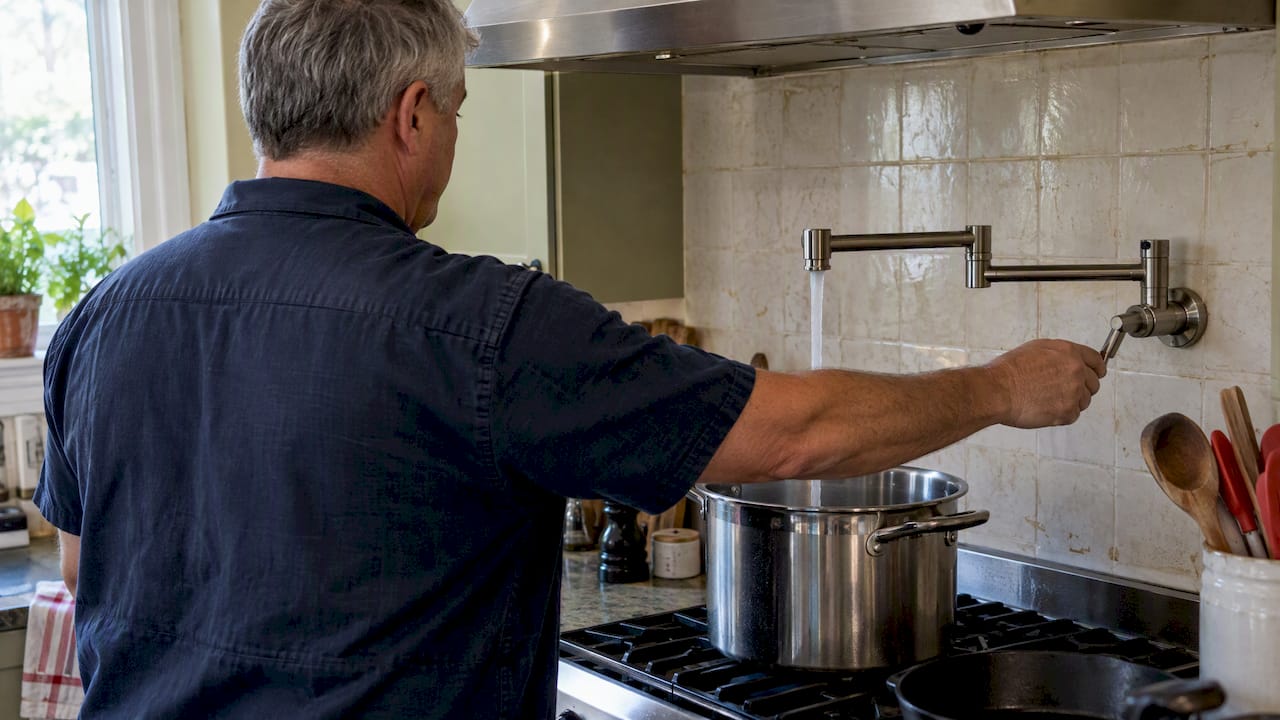
Two points to keep in mind. A pot filler needs its own water supply line to the wall behind the stove, which usually means opening the wall, so it is far easier to plan during a renovation than to add later. And it is an addition, not a replacement: you still need a main faucet at the sink.
If you are planning a larger refresh, our look at kitchen design trends worth bringing home shows where fixtures like this fit into a bigger plan.
Wall-mounted faucets
A wall-mounted kitchen faucet comes out of the backsplash rather than the counter. It frees up deck space and makes counters easy to wipe. It also leaves a clean line under a window or against a tiled wall.
The flip side is installation. The plumbing must be set inside the wall, the spout length has to reach the center of the sink, and any later repair means access through the wall. It is a design-led choice that suits a full renovation more than a quick swap.
Touchless kitchen faucets: pros and cons
Touchless faucets turn on with a wave of the hand or a tap on the spout. Anyone who has tried to turn a handle with raw chicken on their fingers understands the appeal.
Pros
- Cleaner handling: you do not smear handles with messy hands.
- Convenient when your hands are full, wet or covered in flour.
- Helpful for children and for people with limited grip strength.
- Can reduce water running while you pause, since many models stop on their own.
Cons
- They need power, either batteries or an adapter, so you need to plan for a battery pack under the sink.
- Sensors can trigger by accident, for example when you reach over the sink for something.
- Repairs can be more involved than with a basic faucet.
- Most models still need a manual handle to set the temperature.
If you like the idea but fear a faulty sensor, look for a model that lets you operate it manually as well. For more on tech-forward kitchens, see our piece on why smart kitchens boost convenience and efficiency.
Bar and prep faucets
A bar or prep faucet is a smaller, usually single-handle faucet for a secondary sink on an island, in a butler’s pantry or at a wet bar. It is compact, easy to fit in a small basin, and works well for rinsing vegetables, filling a glass or washing a coffee pot. If your kitchen has a main sink plus a secondary one, the two do not have to match, but sharing a finish keeps the room looking calm.
Design for every user in the household
Good kitchen design takes everyone into account. Experts often point to universal design: faucets with a single, light motion are practical for a wider range of people, including children and anyone with limited mobility, compared with knob-style handles that need a strong grip. Lever handles are an easy win, and ADA-compliant options are worth a look even if you do not strictly need them, since the people who live in or visit your home change over time.
If you want to read more about how hardware choices play into usability across a home, this guide to architectural hardware for designers and builders covers the thinking behind handles, levers and everyday touchpoints.
Canadian rules and what to check on the box
If you are shopping in Canada, there are two practical points.
Flow rate. Natural Resources Canada states that, as of July 2026, kitchen faucets must not exceed 7.0 L/min (1.8 US gpm) at 414 kPa (60 psi). Some models include a temporary boost mode of up to 8.5 L/min (2.2 US gpm) for jobs like filling a pot. That means marketing about stronger pressure is really about spray patterns and aerator design, not extra water. A pull-down with several spray modes can feel more powerful at the same flow.
Certification. Look for a recognized certification mark, such as CSA, on the faucet or box. Faucets bought cheaply from overseas sellers may not have been tested to North American standards, and that could cause trouble with a plumbing inspection or an insurance claim after a leak. If your project needs a permit, ask your local building department what it expects, because requirements vary by province and municipality.
How to choose: a step-by-step checklist
- Count the holes in your sink and counter, and decide whether you will use a deck plate.
- Measure height and depth. Note the distance from the sink rim to any window, cabinet or shelf above it, and the distance from the faucet position to the backsplash.
- Check handle swing. Make sure a handle can rotate fully from hot to cold without hitting the backsplash or windowsill, because a faucet that cannot turn freely is a faucet you will regret.
- Think about your sink’s depth. Deep sink, high arc is usually fine. Shallow sink, lower spout or a pull-out is safer.
- Pick the operation style: single lever for speed, two handles for tradition, touchless if convenience is your priority.
- Check the hose and dock. Prefer a magnetic dock over a plain counterweight if you can.
- Confirm certification and flow rate on the box or product page.
- Plan the under-sink space, including supply lines, a disposal, a filter or a battery pack.
- Choose a finish that matches your hardware, and one that hides fingerprints and water spots if your kitchen is busy.
Matching a faucet to a kitchen
Here are a few common situations and how we would think through them.
A small kitchen with a window over the sink. Choose a low pull-out with a single handle. It clears the window, keeps visual weight down, and the lever is easy to reach. Our small kitchen makeover examples show how compact layouts can still feel generous.
A family kitchen with a large single-bowl sink. A pull-down with a magnetic dock and a few spray modes handles pots, baking sheets and the end-of-day pile of dishes. A touchless option makes sense if kids are helping.
A farmhouse or traditional kitchen with a three-hole sink. A bridge or two-handle faucet with a separate side sprayer fits the look. Be ready for the extra cleaning around the base.
A serious cook’s kitchen. A pull-down at the sink and a pot filler at the stove. If you are already opening walls, add the pot filler line while you can.
A rental or budget refresh. Keep to the sink you have. Identify the hole count, pick a single-handle pull-out or pull-down that fits, and hold on to the old parts in case you need to put them back.
Pairing the faucet with the right counter matters too. Stone, quartz and laminate each have different thickness and cutout needs, and our guide to types of kitchen countertops can help you plan the two together.
Where to buy, and what to expect from the shopping process
You can buy a kitchen faucet from a big-box home centre, a plumbing supply store, a kitchen showroom or an online seller. Showrooms and independent shops let you feel the handle, lift the sprayer and check the weight, which tells you more than a product photo. If you are weighing where to shop, our piece on independent kitchen retailers versus big chains lays out the trade-offs.
Whichever route you choose, a few habits save trouble:
- Read the spec sheet for hole count, deck thickness, spout height and reach.
- Confirm the supply line connections match your plumbing, or buy the adapters you need.
- Keep the box until you have tested the faucet for leaks and handle movement.
- Check the return policy before you open the packaging.
If you are replacing the faucet yourself, turn off the shut-off valves under the sink, run the old faucet to release pressure, and take photos of the plumbing before you disconnect anything. If you see corroded valves, an old galvanized line or a leak you cannot trace, a licensed plumber is worth the call.
Our perspective: fit first, features second
We have seen a pattern in how people shop for kitchen fixtures. They begin with finish and style, move to features, and only at the end remember to measure. By then the options have narrowed, and they may settle for something that nearly fits.
Our advice is to flip it. Start with your sink and the way you cook. Do you fill big pots, or mostly rinse plates? Is there a window behind the sink? Is anyone in your home small, tall or unable to grip a knob? Those answers pick the type for you. After that, finish and features are the fun part, and you can choose them with confidence.
We also think retraction systems, handle swing and under-sink clearance deserve more attention than they get, because they are the details that decide whether a faucet is a pleasure or an annoyance in year three. A gorgeous faucet that cannot rotate freely, or a sprayer that droops, will bother you every single day.
The best kitchen faucet is the one that disappears into your routine.
— Alexander
For brands and writers in the home space
If you make or sell home products and want to reach readers who are planning a kitchen, our team at Lizard’s Lunch accepts banner ads and guest posts. You can see the options on our advertise with us page.
Frequently asked questions
What is the difference between a pull-down and a pull-out faucet?
A pull-down faucet has a tall, arched spout, and its spray head pulls straight down into the sink. A pull-out faucet has a lower spout, and its head pulls toward you. Pull-down suits deep sinks and big pots, while pull-out suits lower windowsills and shallower sinks.
Is a single-handle or double-handle faucet better?
Single-handle faucets are easier to use when your hands are full, and they need fewer holes. Double-handle faucets offer a traditional look and often simpler washer repairs. Your sink’s hole count and your style usually decide it.
Are touchless kitchen faucets worth it?
They can be, if you often handle raw food or work with messy hands, or if someone in your home finds handles hard to grip. They need power and can trigger by accident, so choose a model with a manual override. If you rarely feel the need to avoid touching a handle, a good single-lever faucet may serve you just as well.
How do I know which faucet fits my sink?
Count the mounting holes in the sink or counter, and check the faucet’s spec sheet for the number of holes it needs. A single-hole faucet can go on a three-hole sink with a deck plate, but a three-hole faucet cannot go on a single-hole sink. Also measure the clearance behind and above the faucet.
Do kitchen faucets in Canada have a flow limit?
Yes. Natural Resources Canada sets a maximum of 7.0 L/min for kitchen faucets at 414 kPa, with some models allowing a temporary boost mode of up to 8.5 L/min. The details are on the Natural Resources Canada faucet page.
Sources
- Faucets, Natural Resources Canada
- Best Kitchen Faucets for Your Home, The Home Depot
- Pull Down vs Pull Out Faucet: Kitchen Clearance Guide, SANIKB
- Single-Handle vs. Double-Handle Faucet: Which Is Better?, Angi
- Choosing the Right Faucet: A Complete Comparison of Types, Jaquar
- Faucet Hose-Retractable, Moen Solutions


















Leave a Comment
Your email address will not be published. Required fields are marked with *