
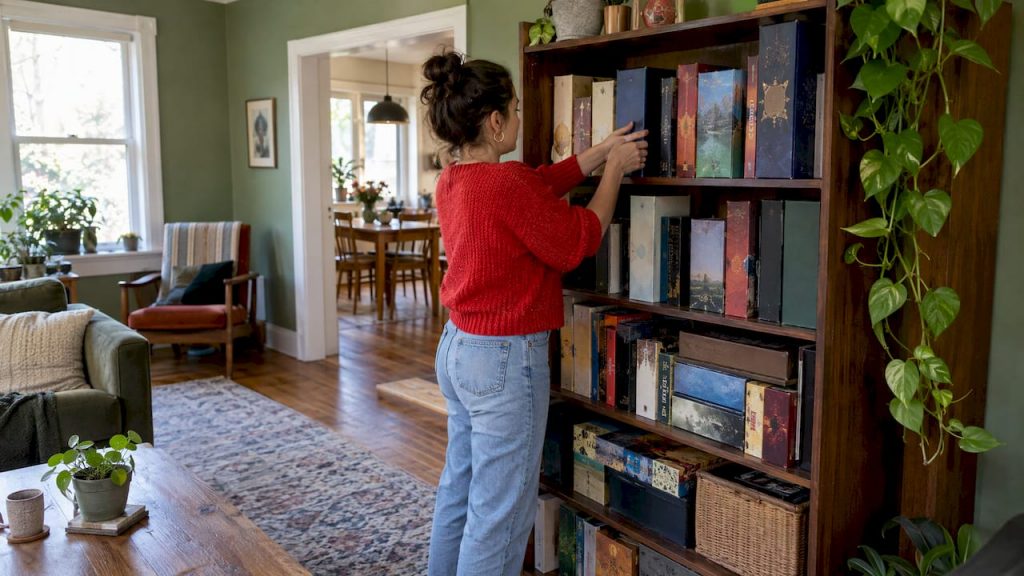
Board game storage made simple: how deep shelves should be, vertical or flat stacking, bins, labels, and safe anchoring, with a plan by collection size.
The best board game storage is a sturdy, wall-anchored shelf about 13 inches deep. It holds boxes upright with small parts bagged, and it keeps the games you play most at eye level. Everything else, from bins to labels to card-game consolidation, is a refinement of that setup. Below we walk through how to choose shelves, how to arrange them, and what to do when the collection outgrows the room.
Whether you own 20 games or 200, the goal is the same: you can find a game in seconds, pull it down without a crash, and set it up before everyone loses interest.
TL;DR
- Choose shelves with openings about 13 inches square and enough depth for large boxes. Anchor tall units to the wall before loading them.
- Store boxes upright like books only if you bag loose components. Flat stacks protect contents better but make bottom games hard to reach.
- Put quick-to-start games at eye level and long campaign games high up or under a bed. Frequency of play beats alphabetical order.
- Match the system to the collection: one open shelf under 25 games, zoned shelves and bins for 25 to 75, and an inventory sheet beyond that.
- Keep games in living space, not a garage or basement, where temperature and humidity swing too much.
Table of Contents
- Start With How You Play
- Vertical or Flat: Which Way Should Boxes Sit?
- Choosing Board Game Shelves
- Anchor the Shelf to the Wall
- Arrange by Frequency, Not the Alphabet
- Containers and Methods for Different Box Sizes
- Where to Keep the Collection
- Making Games Easy to Play
- Our Perspective
- Want to Reach Readers Who Love Home and Hobby Ideas?
- A Simple Step-by-Step Setup
- FAQ
- Sources
Start With How You Play
Before buying anything, spend ten minutes sorting. Pull every game off the shelf and make three piles: games you play monthly, games you play a few times a year, and games that have not hit the table in two years. That last pile is your first free storage upgrade. If a game is not coming back, a donation, a trade or a sale gives you shelf space without spending a dollar.
The reason to sort first is that storage should follow behavior. A collection of 40 games where six get played weekly needs a very different layout from a collection of 40 where all of them rotate. Our general approach to this kind of purge is the same one in our guide on how to declutter your home fast: decide by use, not by guilt.
A quick plan by collection size
A useful rule of thumb comes from Board Game Storage Lab’s plan by collection size, which breaks it down like this:
| Collection size | What works |
|---|---|
| Under 25 games | One open shelf near the play area |
| 25 to 75 games | Zoned shelves plus a bin for small boxes |
| 75 to 150 games | Labeled shelf zones plus an inventory sheet |
| 150+ games | Separate active play, archive storage, trade or sell candidates, and oversized boxes |
Treat those as starting points. A family with young kids will want fewer top-shelf games than a pair of adults who play heavy strategy titles on weekends.
Vertical or Flat: Which Way Should Boxes Sit?
This is the question behind most searches for how to store board games, and the honest answer is that both work if you manage the trade-offs.
Horizontal stacking. BoardGameHelpers.com notes that stacking games in piles of four or five keeps components sitting in their trays. The downside is access: the game you want is always on the bottom.
Vertical storage. Boxes standing like books are much easier to organize and browse. The same source points out that contents can slide down to one end unless components are bagged.
Our recommendation for most homes is vertical storage with a few habits that remove the downside:
- Bag cards, tokens, dice and small pieces in resealable bags so nothing migrates.
- Fill empty space in the box with a folded sheet of paper or a light foam block so the contents cannot slump.
- Keep heavy, many-component games flat on a lower shelf if you have the room.
- Store one-deck card games upright without worry; there is little to shift.
If you prefer to keep everything flat, that is a fine choice too. Just limit stacks to four or five boxes and put your most-played games on top.
Choosing Board Game Shelves
Shelves are where most storage plans succeed or fail, and the problem is almost always depth or strength.
Depth and opening size
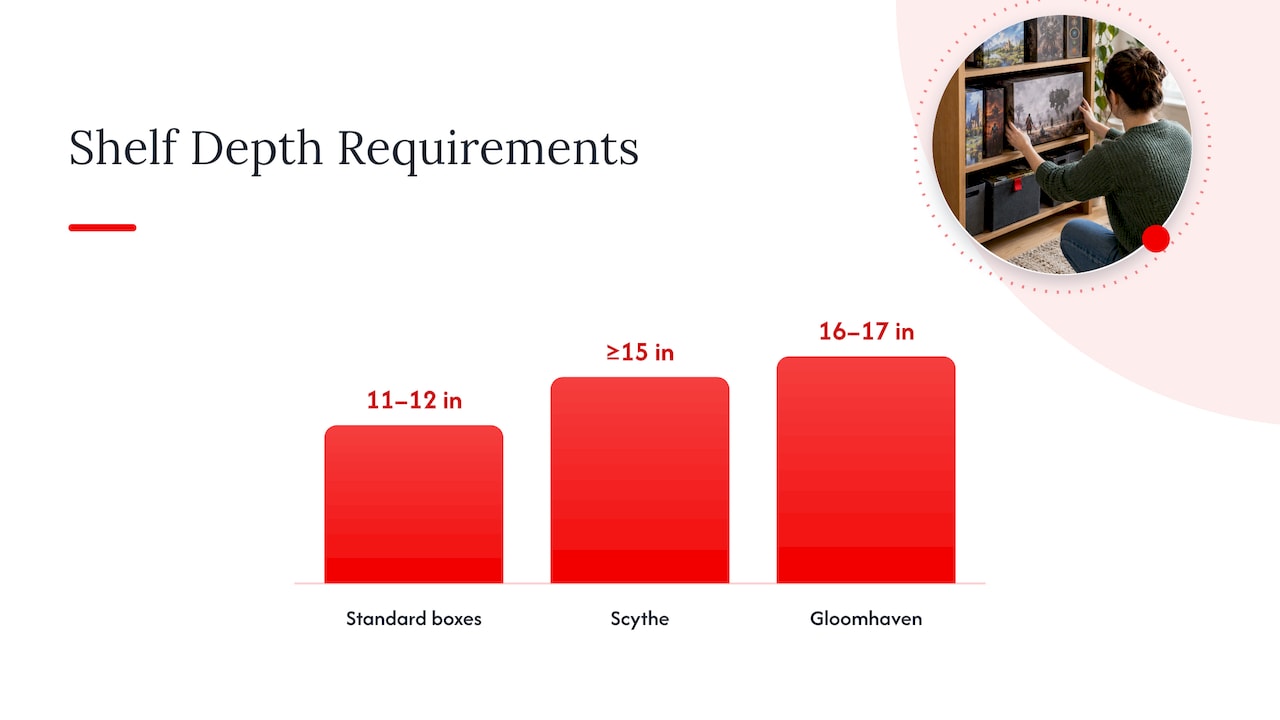
Standard bookcases are often too shallow for game boxes. The UD5 shelf calculator states that a depth of 11 to 12 inches is enough for most standard boxes stored vertically, while larger games such as Scythe (14.5 inches) or Gloomhaven (16.3 inches) need at least 15 to 17 inches to avoid sticking out.
Cube shelves are popular for a reason. Kids Play Board Games reports that a cube opening of about 13 inches square fits almost every full-size game box, and that each cube holds roughly 29 pounds. That is a handy number when you are deciding how many dense, heavy boxes to stack into one compartment.
Open shelves, cube units and closed cabinets
| Option | Best for | Things to know |
|---|---|---|
| Open shelving | Collections you want to see and reach quickly | Spines are visible, so a tidy color or size system looks like decor |
| Cube shelf | Mixed sizes in a living room or playroom | Uniform openings make large boxes easy to fit and rows easy to count |
| Closed cabinet | A concealed look or homes with lots of visual clutter | Doors hide the collection but add a step every time you play |
| Adjustable shelving in a spare closet | Collections with many odd sizes | Lets you set one tier tall for big boxes and another short for card games |
Interior designer Nina Lichtenstein, quoted by Homes and Gardens, recommends open shelving such as the IKEA KALLAX to display games within reach, or a cabinet with doors for a more hidden look. She also suggests installing adjustable shelves in a spare closet to suit different box sizes. If you are working with a closet, our guide on how to declutter a closet without making a mess will help you clear it first.
Pick shelves that last
Game boxes are heavier than they look. A loaded shelf carries a lot of weight, so choose solid shelving with proper supports. Check the maximum load for each shelf, spread heavy boxes across several bays and avoid cramming one cube with the dense games. Adjustable pins are worth having so you can set one bay tall for big boxes and another short for small card games.
Anchor the Shelf to the Wall
This one is not optional. A full cube shelf is heavy and top-heavy, and the guidance from Kids Play Board Games is to anchor any tall shelf to the wall before it holds games, because a climbing child can tip it over.
In Canada, Health Canada’s guidance on furniture tip-overs says the same thing in official terms. It advises using anti-tip devices such as angle braces or safety straps, and fastening furniture to a wall stud or using heavy-duty drywall anchors made for the furniture type. It also lists heavy objects in or on furniture as a cause of tip-overs, which describes a game shelf exactly.
A practical routine:
- Anchor the unit before you load the first box.
- Put the heaviest games on the lowest shelves.
- Keep little ones’ climbing routes clear of the unit.
- Re-check the anchor when you move or reconfigure the shelf.
If kids share the space
Keeping games within a child’s reach while keeping heavy or small-piece games out of it is a balance. Organized-ish suggests storing games in a central, easy-to-reach spot and avoiding top shelves for children’s games, since a dropped box spills pieces everywhere. For a broader look at giving kids safe, reachable access to their supplies, see this safe storage system for kids, which translates well to a family games corner. We also cover family routines in Parenting in 2026.
Arrange by Frequency, Not the Alphabet
The best-looking shelf is not always the most useful one. Two arrangement rules do most of the work.
Eye level is for quick starters. Kids Play Board Games suggests giving the eye-level shelf to games you can start in about five minutes, and moving long campaign boxes high up or under the bed. If you are short on closet space, a bed with built-in drawers can double as an archive, and we compare those in our guide to the best types of storage beds.
Heavy and frequent go low. The Spruce recommends sorting by frequency of use: games played regularly sit on lower, easier shelves, rarely played games go higher, and bins corral small games in one place.
Professional organizer Ashley Hines, quoted by Homes and Gardens, adds that if you keep original boxes, you should choose a clear system, whether color, size or game type, and file games rather than stack them. Filing them makes them easier to reach and maintain.
A simple layout for a five-shelf unit:
- Top: seasonal and once-a-year games, plus long campaign boxes.
- Upper middle: games for adults and older kids.
- Eye level: weeknight favorites and anything under 30 minutes.
- Lower middle: family games and party games.
- Bottom: the heaviest boxes and a bin of small card games.
Containers and Methods for Different Box Sizes
Not every game needs its original box, and not every box needs its own slot.
Small games and card games
Store dice, cards and tiny pieces in small plastic containers inside the box. Jim Christy of Midwest Cards, quoted by Homes and Gardens, recommends this to keep everything together, and also suggests storing games upright in clear, labeled bins so you can see and reach them without making a mess.
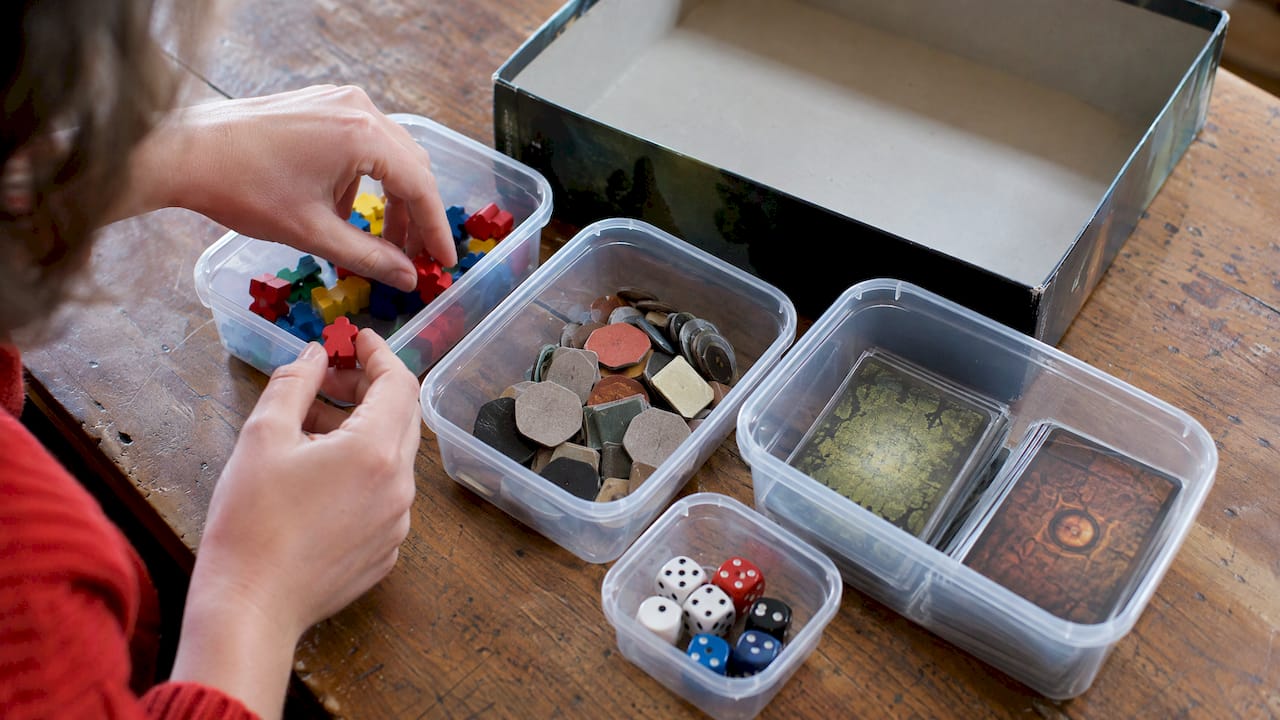
A bin is the right home for the small stuff. Group by type, for example “party games,” “two-player” and “travel,” and label the front of each bin so no one has to dump it out to look.
Consolidation for tight spaces
If shelf space is the limit, consolidation can reclaim a surprising amount of it:
- Fit a base game and its expansions into one box.
- Move single-deck card games into labeled small containers, keeping the rules and a photo of the box cover.
- Group three or four small games in one standard box and label it on the outside.
- Use foam or printed inserts so components sit snugly instead of rattling.
Keep the rulebook with each game, and keep a photo of the original box so you remember what it contains. Consolidating is best for games you know well. For a game you play twice a year with a complicated setup, the original box and insert are usually worth keeping.
Bags, binders and trays
- Resealable bags work for card decks, tokens and player components, and cost very little.
- Bead organizers and tackle boxes suit games with many small parts.
- Sleeves and binders work for card-heavy games that rarely need the board.
- Counter trays keep setup quick because everything lives in labeled compartments.
Where to Keep the Collection
Store games inside the living space. Kids Play Board Games recommends keeping them in conditioned rooms at roughly 45 to 50 percent humidity and treating garages and basements as poor choices because temperature and humidity swing too far. That matters in Canada, where an unheated garage can go from deep winter cold to summer humidity within a year.
If the garage is your only option for overflow, keep it to games you are happy to let go, or sort the space properly first with our garage organization ideas and tips on organizing garage tools. For anything you truly value, the hall closet, the bedroom or under the bed is the better home. A small bedroom can hold more than you expect, as in our guide to making a small bedroom look bigger.
A few more habits that protect games:
- Keep boxes out of direct sunlight, which fades covers.
- Avoid stacking heavy games on top of thin ones.
- Do not overfill a box so the lid bows.
- Keep food and drinks away from the shelf.
Making Games Easy to Play
Storage is not only about tidiness. A game that is easy to reach is a game that gets played. If you want a reminder of why that matters, read about the benefits of playing board games, then set up your shelf so the games you want to play most are the easiest to grab.
If you enjoy mental challenges beyond the table, our roundup of popular brain training games pairs nicely with a game-night shelf.
Two small finishing touches help a lot:
- An inventory sheet. For collections over 75 games, a simple spreadsheet with the game, location and number of players saves arguments and duplicate purchases.
- A play-next basket. Keep a basket with the three games you plan to play this week, so nobody is digging through shelves.
Our Perspective
We think the best game storage is the kind you stop thinking about. After looking at what specialists and everyday organizers recommend, our team at Lizard’s Lunch keeps coming back to three ideas: choose shelves that fit the boxes, anchor them to the wall, and arrange by how often you play.
We like cube shelves and adjustable units because they grow with a collection, and we like bagging small parts because it makes upright storage practical. Most of all, we encourage readers to treat a collection as something to enjoy, not hide. A shelf that looks good in your living room invites a game night.
Our aim with this guide is to point you toward the opportunities that fit your home, whether that is a closet conversion, a shelf upgrade or a few new bins.
Alexander
Want to Reach Readers Who Love Home and Hobby Ideas?
If you run a business or write about home organization, hobbies or family life, we welcome you to explore banner ads and guest posts on our site. It is a way to put your ideas in front of readers who come to us for practical guides.
A Simple Step-by-Step Setup
Put it all together with this weekend plan:
- Sort. Pull everything out and divide into monthly, yearly and never-played piles.
- Measure. Measure your biggest boxes and your available wall space. Aim for openings about 13 inches high and wide, and depth to match your largest game.
- Choose and anchor. Pick sturdy shelving, set it up and anchor it to a wall stud or with heavy-duty anchors made for the wall type.
- Prepare the games. Bag small parts, add fill so contents cannot slide, and consolidate expansions.
- Load by weight. Heavy boxes low, light boxes high.
- Zone by use. Eye level for quick starters, upper shelves for campaigns, a bin for small card games.
- Label. Label bins and keep an inventory sheet if the collection is large.
- Review twice a year. Retire games you no longer play and rebalance the shelves.
FAQ
How do you store board games without damaging them?
Keep them in a climate-controlled room, not a garage or basement, and out of direct sunlight. Bag loose components, avoid tall stacks that crush bottom boxes, and do not overfill boxes so the lids stay flat.
Should board games be stored vertically or horizontally?
Vertical storage is easier to browse and organize, but contents can slide to one end unless you bag them. Horizontal stacks of four or five keep components in their trays but make bottom games hard to reach. Most households do well with vertical storage and bagged parts.
What depth of shelf do you need for board games?
Most standard boxes fit on shelves 11 to 12 inches deep, while bigger games need 15 to 17 inches. A cube opening of about 13 inches square fits nearly every full-size box.
How do you make a game shelf safe for kids?
Anchor the unit to the wall using angle braces or safety straps fastened to a stud or heavy-duty anchors, and keep the heaviest boxes on the bottom. Health Canada advises this for any furniture a child might climb.
How can you store board games in a small space?
Go vertical, use walls rather than floor area, and consolidate: combine expansions into base boxes, move single-deck card games into small labeled containers, and keep long campaign games under a bed or high in a closet.
Sources
- Board Game Storage Lab
- BoardGameHelpers.com: Organizing Your Collection
- UD5 Board Game Storage Calculator
- Kids Play Board Games: Small Space Board Game Storage
- Homes and Gardens: The 15 best ways to organize board games
- Health Canada: Furniture, appliance and television tip-overs
- The Spruce: 25 Board Game Storage Solutions to Stay Organized
- Organized-ish: How To Organize And Store Board Games

















Leave a Comment
Your email address will not be published. Required fields are marked with *