

How much creatine monohydrate to take: the 3–5 g daily dose, whether loading is worth it, side effects, and how to buy safely in Canada.
For most healthy adults, the creatine monohydrate dosage that works is 3 to 5 grams a day, taken every day. You can add a short loading phase of about 20 grams a day for a week if you want faster results, but you don’t have to. Health Canada’s own monograph for adults lists the same 3 to 5 g range, and the research behind it is some of the deepest in sports nutrition.
This guide walks you through the numbers, with worked examples. It covers loading or not, how body size and age change the picture, how to take creatine day to day, how monohydrate compares with HCl, what side effects to expect, and how to choose a safe product in Canada.
TL;DR
- A daily dose of 3 to 5 g of creatine monohydrate is the standard for healthy adults, and Health Canada’s monograph lists it for adults 18 and older.
- Loading (about 20 g a day for 5 to 7 days, split into 5 g servings) fills your muscles faster. Skipping it gets you to the same place in a few weeks.
- Weight gain is the main side effect. Stomach upset is mostly a big-single-dose problem, so split larger amounts.
- Monohydrate has the strongest evidence. HCl has not shown clear superiority.
- Check that any creatine product sold in Canada carries a Health Canada licence number, and talk to a health professional first if you have a kidney disorder or are pregnant or breastfeeding.
Table of Contents
- The standard creatine monohydrate dose
- Should you do a loading phase?
- Does your dose depend on body weight, age or training?
- How to take creatine day to day
- What creatine can and can’t do for training
- Creatine monohydrate vs HCl
- Creatine side effects and safety
- Buying creatine safely in Canada
- Our perspective
- Reach readers who care about health and training
- FAQ
- Sources
The standard creatine monohydrate dose
The number to remember is 3 to 5 g per day. Health Canada’s adult monograph lists 3 to 5 g/day of creatine monohydrate, taken for at least four weeks, when you don’t load. It describes the purpose as supporting muscle mass when combined with resistance training, and supporting performance in repetitive, brief, highly intense activity (Health Canada).
Why that range? Ordinary food leaves your muscles only partly stocked. The International Society of Sports Nutrition (ISSN) position stand notes that diet typically leaves creatine stores about 60 to 80% saturated, so supplementing can raise muscle creatine and phosphocreatine by roughly 20 to 40% (ISSN position stand, 2017). Once the tank is full, a small daily top-up keeps it there. The same position stand says 3 to 5 g a day maintains stores after saturation, while larger athletes may need 5 to 10 g a day.
Think of it like this: creatine isn’t a stimulant that you feel working an hour after a scoop. It is a stock you build and maintain. That’s why consistency matters far more than the exact minute you take it.
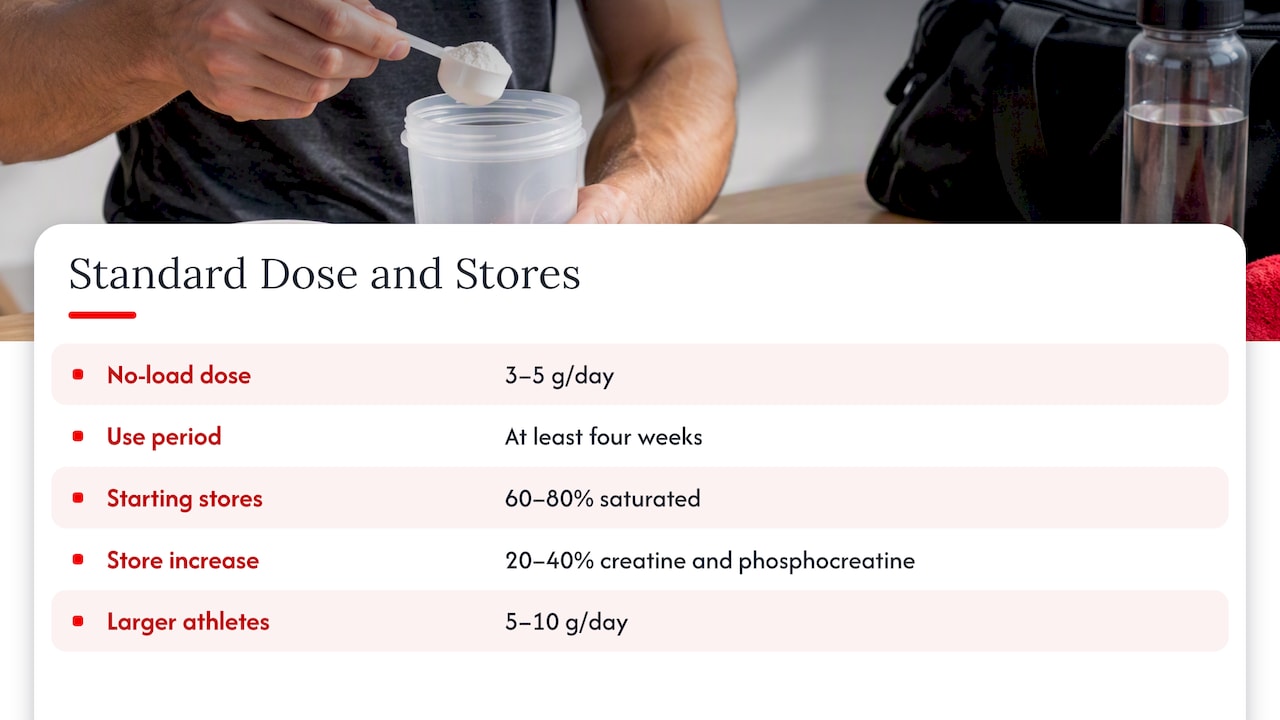
Where 3 g, 5 g and “a scoop” fit
You’ll see 3 g recommended in some places and 5 g in others. Both sit inside the studied range. A smaller person who eats meat regularly may do fine at 3 g. A larger person, or someone who eats little meat or fish, often lands closer to 5 g. If you are unsure, 5 g is a sensible default for an adult who trains regularly.
Scoop sizes vary from brand to brand, so read the label for how many grams one serving holds. If the label says a serving is 5 g, one serving a day is your full dose. Don’t assume a heaping scoop equals 5 g.
Should you do a loading phase?
Loading means taking a high dose for the first week so your muscles saturate quickly. It is optional. Here are the protocols that carry the strongest backing.
| Approach | Daily amount | Duration | Source |
|---|---|---|---|
| Rapid loading (ISSN) | 5 g four times a day (20 g), about 0.3 g/kg | 5 to 7 days, then 3 to 5 g/day | ISSN, 2017 |
| Rapid loading (Health Canada) | 15 to 20 g/day in doses of no more than 5 g | 5 to 7 days, then 2 to 5 g/day | Health Canada |
| Slow loading | 3 to 5 g/day | At least four weeks | Health Canada |
| No loading | 3 g/day | About 28 days to build stores gradually | ISSN, 2017 |
A 2021 review in the Journal of the International Society of Sports Nutrition defines loading as 20 to 25 g/day for 5 to 7 days, usually in 5 g servings, then 3 to 5 g/day. It also states plainly that loading is not necessary: 3 to 5 g/day still raises muscle creatine, it just takes longer to reach maximum storage (Kreider and colleagues, 2021).
A worked example
Say you weigh 80 kg and want to load. The ISSN’s roughly 0.3 g/kg works out to about 24 g a day, which in practice means four or five servings of about 5 g spread across the day. After a week you drop to 3 to 5 g daily.
Now say you skip loading and take 3 g a day. Over 28 days you will have taken 84 g in total, and your stores climb gradually toward the same saturation point.
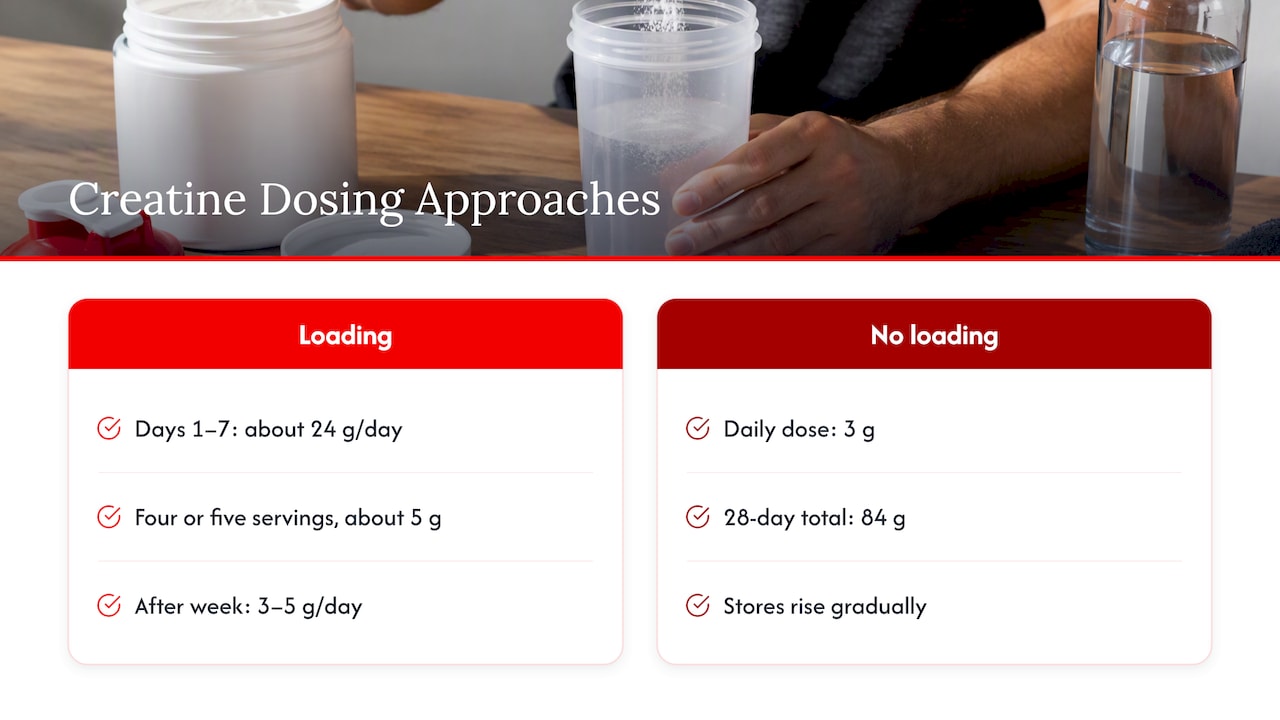
Which should you choose?
Load if you have a deadline, such as a training block starting next week, and you can tolerate several servings a day. Skip loading if you have a sensitive stomach, don’t like measuring multiple doses, or simply aren’t in a hurry. The end result is the same either way: full muscle stores and a daily 3 to 5 g habit.
If you do load, keep each serving at or under 5 g. Health Canada’s monograph caps single doses at 5 g during loading, and safety research (more on that below) links stomach trouble to big single doses.
Does your dose depend on body weight, age or training?
A flat 3 to 5 g works for most people, but it is not the whole story. A 2024 narrative review argues that no single dose fits every tissue or every person: body size, age, diet, activity level, baseline creatine status and the target tissue can all change the dose-response (Does one dose of creatine supplementation fit all?). The same review reports that 20 g/day for up to seven days followed by 3 to 5 g/day is generally enough for skeletal-muscle benefits, and floats 0.10 to 0.14 g/kg/day as a possible relative strategy, particularly in healthy older adults.
Do the math on that last figure and you see why it is a research idea rather than a label instruction. For a 70 kg adult, 0.10 to 0.14 g/kg works out to 7 to 9.8 g a day, above the usual 3 to 5 g range. Stay within the monograph’s range unless a health professional guides you otherwise.
Who may sit toward the higher or lower end
- Larger athletes: The ISSN says they may need 5 to 10 g a day to maintain stores.
- Smaller adults: 3 g a day is often enough to hold stores steady.
- Vegetarians and vegans: Diet shapes baseline creatine status, so people who eat little or no meat may start with lower stores and notice more change. Stick with the standard range and give it a few weeks.
- Older adults: Researchers are exploring weight-based dosing in this group, but the established range remains 3 to 5 g a day under Health Canada’s monograph. Because kidney function can decline with age, check with your doctor or pharmacist first.
Weights, ages and diets all differ, so if you have a medical condition, take prescription medication, or want a plan matched to your body and training, an online sports nutrition consultation can help you put a personal number on it.
How to take creatine day to day
The practical side is simple.
- Measure the dose. Use the scoop that came with your tub and check how many grams it holds.
- Mix it into liquid or food. Water, juice, a smoothie, yogurt or oatmeal all work. Creatine monohydrate dissolves better in warm liquid, but it doesn’t have to be hot.
- Take it every day. Training days and rest days alike. The aim is to keep muscle stores topped up, not to time a spike.
- Pick a time you will remember. With breakfast, after a workout, or with an evening meal. Habit beats clock precision.
- Give it time. Without loading, expect around three to four weeks before stores are fully built, based on the gradual 28-day pattern in the ISSN position stand.
Does timing matter?
For most people, no. The research that supports the dose is built around daily intake over weeks, not minutes before the gym. If you are loading, spread your servings through the day, for example four doses of 5 g with meals.
What if you miss a day?
Skip the guilt. Once your stores are full, one missed day barely dents them. Just take your normal dose the next day rather than doubling up, which would raise your odds of stomach upset for no extra benefit.
What creatine can and can’t do for training
Creatine helps muscles recycle energy quickly in short, intense efforts, which is why the evidence centres on lifting, sprinting, and repeated high-effort intervals. The ISSN’s view is that creatine monohydrate remains the best-supported ergogenic form for increasing high-intensity exercise capacity and lean mass during training (ISSN, 2017). Health Canada ties the muscle-mass claim specifically to use alongside resistance training.
That last point matters for beginners. Creatine is a support act. If you are new to lifting, the biggest gains come from a good program, enough protein, enough sleep, and consistent effort over months. Training volume is a big part of that; a guide to hypertrophy training volume explains how weekly sets drive muscle growth, and creatine slots in underneath it.
Creatine is also being studied beyond muscle. If you’re curious about how it might fit with strength work for skeletal health, read about creatine and bone health alongside your own doctor’s advice.
Creatine for beginners: a simple plan
- Choose plain creatine monohydrate powder with a Health Canada licence number.
- Take 3 to 5 g a day with any meal.
- Train with resistance exercise two to four times a week.
- Expect a possible small bump on the scale in the first weeks (see below) and judge progress by how your lifts and energy feel over two to three months.
Creatine monohydrate vs HCl
Creatine HCl (hydrochloride) is marketed as more soluble, gentler on the stomach, and effective at smaller doses. The evidence doesn’t back those claims as clearly as the marketing does.
A 2022 critical review found creatine monohydrate is the only form with substantial evidence for bioavailability, efficacy and safety, and that no other form has data showing greater increases in tissue creatine. It concluded that alternative compounds, including HCl, have not demonstrated clear superiority for efficacy or safety (Bioavailability, efficacy, safety and regulatory status of creatine, 2022).
| Question | Monohydrate | HCl |
|---|---|---|
| Evidence base | Largest by far | Much smaller |
| Typical studied dose | 3 to 5 g/day | Often sold at lower doses, with less supporting data |
| Proven advantage over the other | Strong record of safety and efficacy | No clear superiority shown |
| Cost per effective dose | Generally low | Usually higher |
The sensible path: start with monohydrate. If it upsets your stomach even after splitting the dose, speak with a pharmacist or dietitian before swapping to a form with a thinner evidence trail.
Creatine side effects and safety
Creatine is among the most studied supplements, and the safety picture for healthy adults is reassuring, with a few honest caveats.
Weight gain
This is the one effect that turns up again and again. The ISSN position stand identifies weight gain as the only consistently reported side effect and reports no compelling evidence of harmful short- or long-term effects in otherwise healthy people using creatine monohydrate (ISSN, 2017). Health Canada’s monograph also warns that creatine may cause weight gain. If you are in a weight-class sport or track your scale weight closely, plan for it.
Stomach trouble and bloating
A 2025 safety review says gastrointestinal symptoms such as diarrhea, stomach discomfort and bloating are more likely with high single doses, particularly above 10 g, and recommends splitting larger daily amounts into smaller doses (short review of creatine safety concerns, 2025). Its perspective is that this is mainly a dose-per-serving issue, not an inevitable effect of creatine. That’s why a first fix is easy:
- Keep each serving at 5 g or less.
- Take it with food.
- If you load, spread the servings across the day.
- If symptoms persist, drop loading and use 3 g a day.
Women and creatine
A systematic review and meta-analysis of female participants found no significant increase in total adverse events, gastrointestinal events, weight gain, or renal and hepatic complications with creatine monohydrate. The authors still note that evidence specific to pregnancy remains limited (Risk of adverse outcomes in females taking oral creatine, 2020).
When to talk to a professional first
Health Canada says pregnant or breastfeeding people and people with a kidney disorder should ask a health professional before use. If that is you, talk to your doctor or pharmacist before buying a tub. The same goes if you take medication that affects your kidneys, since your doctor knows your lab results and we don’t.
Buying creatine safely in Canada
In Canada, creatine sold as a supplement is regulated as a natural health product, which means a legal product should carry a Natural Product Number (NPN) on the label. You can look the number up in Health Canada’s Licensed Natural Health Products Database before you buy.
It’s worth the thirty seconds. Health Canada suspended the licence of one creatine product, recalled all lots, and said it could no longer legally be sold after vitamin D contamination and Good Manufacturing Practice non-compliance were identified (Health Canada recall notice, 2021). The department’s database entry for that product states that products with suspended, cancelled or stop-sale licences cannot legally be sold in Canada (Health Canada product information). A separate 2022 recall of a creatine-related product found out-of-specification dihydrotriazine in specific lots (Health Canada recall, 2022).
A quick buying checklist
- Confirm an eight-digit NPN on the label and look it up in the federal database.
- Choose a single-ingredient creatine monohydrate rather than a blend with a long list of extras.
- Check the serving size in grams, so you know what a scoop means.
- Look at recall notices on the Government of Canada site if a brand’s name rings an alarm bell.
- Be wary of online listings from outside Canada that show no licence number.
Our perspective
When readers ask us about creatine, the question underneath is usually “What do I actually need to do?” Our answer is wonderfully boring: pick plain monohydrate, take 3 to 5 g a day, and be patient. The supplement aisle loves novelty, with new forms, new blends and new loading protocols, but the dose that the evidence supports hasn’t changed in years.
We also think the most useful advice is the least glamorous. Training consistently, eating enough protein and sleeping well will outweigh any scoop. Creatine is a small, well-tested helper, and it does its job best when you pair it with those habits. And if a kidney condition, pregnancy or medication is in the picture, the right next step is a conversation with your health professional, not another internet search.
— Alexander
Reach readers who care about health and training
If you run a fitness, wellness or nutrition brand and want to reach people who read guides like this one, we offer banner ads and guest posts. You can see the options on our advertise with us page.
FAQ
How much creatine monohydrate should I take per day?
Most healthy adults should take 3 to 5 g a day. Health Canada’s monograph lists that range for adults 18 and older, taken for at least four weeks without loading. Take it daily, including rest days.
Do I need a creatine loading phase?
No. Loading, about 20 g a day split into 5 g servings for 5 to 7 days, saturates muscles faster, but a 2021 review states that loading is not necessary. Taking 3 to 5 g daily gets you to the same level over a few weeks.
Is 10 g of creatine a day too much?
It is above the usual maintenance range, and a 2025 safety review links stomach discomfort and bloating to single doses above 10 g. The ISSN says larger athletes may need 5 to 10 g a day to maintain stores, so if you do take that much, split it into servings of 5 g or less.
Is creatine HCl better than monohydrate?
The evidence doesn’t show that. A 2022 review found monohydrate has the largest evidence base and that HCl hasn’t demonstrated clear superiority for efficacy or safety. Monohydrate is also usually cheaper per effective dose.
Can I take creatine if I have kidney problems or am pregnant?
Ask a health professional first. Health Canada specifically advises people with a kidney disorder, and people who are pregnant or breastfeeding, to do so before using creatine. Studies in women show no significant rise in adverse events, but pregnancy-specific evidence is still limited.
Sources
- Health Canada creatine monohydrate monograph
- ISSN position stand on safety and efficacy of creatine, 2017
- Does one dose of creatine supplementation fit all?
- Common questions and misconceptions about creatine, 2021
- Bioavailability, efficacy, safety and regulatory status of creatine, 2022
- A short review of creatine safety concerns, 2025
- Risk of adverse outcomes in females taking oral creatine, 2020
- Health Canada recall notice, 2021
- Health Canada product information
- Health Canada recall, 2022


















Leave a Comment
Your email address will not be published. Required fields are marked with *