
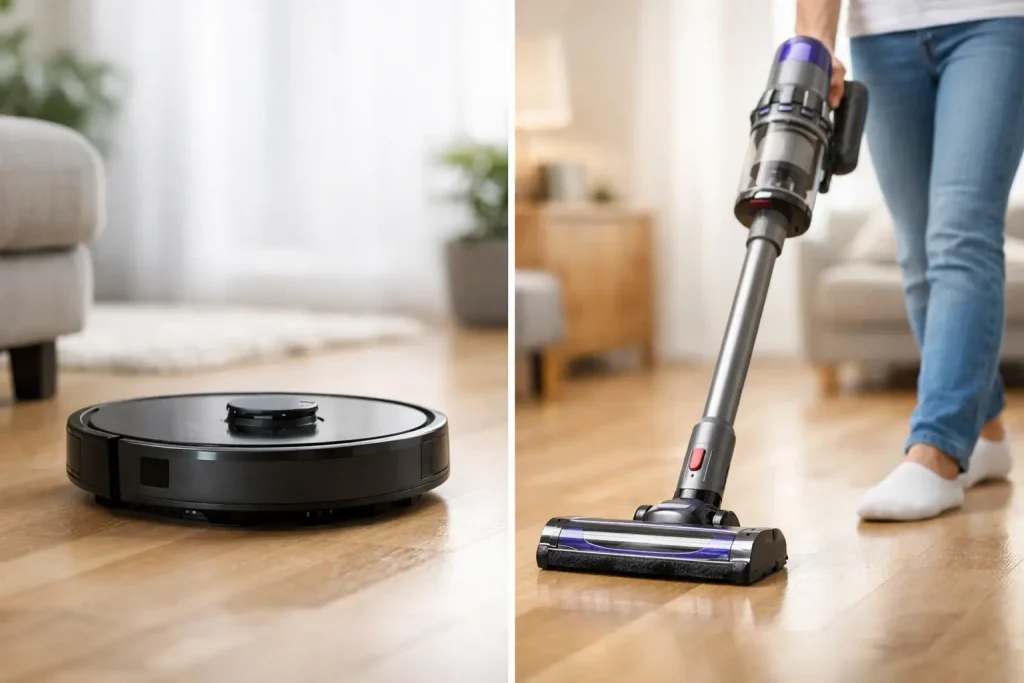
Robot vacuum vs cordless vacuum: compare cleaning power, convenience, cost, and upkeep to choose the best fit for your home and routine.
Saturday morning usually reveals the truth about your cleaning habits. If crumbs are hiding under the kitchen stools, pet hair is collecting along the baseboards, and you want the floors handled with as little effort as possible, the robot vacuum vs cordless vacuum question gets very real very fast. Both can save time. They just save it in different ways.
This is one of those home decisions where the best choice depends less on raw specs and more on how you actually live. A robot vacuum can quietly chip away at daily mess while you work, cook, or leave the house. A cordless vacuum gives you fast, hands-on control when cereal hits the floor, the stairs need attention, or the couch is covered in dog hair. The right pick comes down to your layout, your mess level, and how much involvement you want in the cleaning process.
Robot vacuum vs cordless vacuum: the core difference
A robot vacuum is built for automation. You charge it, schedule it, and let it patrol your floors with minimal input. Many models map rooms, avoid obstacles, and return to the dock on their own. The appeal is obvious: less manual work and more frequent floor maintenance.
A cordless vacuum is built for active cleaning. It is lightweight, grab-and-go, and usually easier to maneuver than a full-size upright. You are still doing the vacuuming yourself, but the process is quicker and less annoying than dragging a cord from room to room.
That difference matters because these machines solve different problems. Robot vacuums reduce how often dirt builds up. Cordless vacuums help you remove dirt exactly when and where you want.
Which one cleans better?
If you are judging pure cleaning power, cordless vacuums usually win. They tend to have stronger suction, better edge cleaning, and more control over carpets, corners, stairs, upholstery, and spot messes. If your home has area rugs, thicker carpet, or frequent debris like litter, snack crumbs, or tracked-in dirt, a good cordless model is often more satisfying.
Robot vacuums have improved a lot, especially on hardwood, tile, and low-pile rugs. For daily dust, hair, and fine debris, many do a solid job. But they are still limited by their size and design. They may miss tight corners, struggle with tangled cords, get tripped up by socks, or pass over heavier debris that a cordless vacuum would grab in one pass.
That does not make robot vacuums weak. It just means they are maintenance cleaners more than deep cleaners. If your floors mostly need steady upkeep, they can feel surprisingly effective. If you want one machine to tackle everything from baseboards to stairs, cordless is the stronger all-around tool.
Convenience looks different for each one
This is where the comparison gets interesting. Robot vacuums are convenient before the mess bothers you. Cordless vacuums are convenient after it does.
A robot vacuum is ideal for people who want cleaning to happen in the background. You can schedule daily runs, keep pet hair under control, and reduce the sense that your floors are constantly getting away from you. In busy households, that kind of passive help is a big selling point.
A cordless vacuum is more useful in the moment. You spill coffee grounds, the kids destroy a cracker in the living room, or dirt appears by the back door, and you can handle it immediately. There is no waiting for a cleaning cycle or hoping a robot gets to that area soon.
If you hate cleaning, a robot vacuum often feels more liberating. If you hate waiting on machines that cannot think like you can, a cordless vacuum feels more practical.
Robot vacuum vs cordless vacuum for pet hair
Pet owners often assume a robot vacuum is the automatic winner because it can run every day. Sometimes that is true. If your dog or cat sheds constantly, a robot can keep fur tumbleweeds from taking over the house. That steady maintenance is hard to beat.
Still, cordless vacuums are usually better when pet hair gets embedded in rugs, clings to furniture, or gathers on stairs. Many come with motorized attachments that are more effective on upholstery and problem areas. A robot cannot jump onto the couch, clean the car, or chase hair out of stair corners.
For homes with one shedding pet and mostly hard floors, a robot vacuum may cover most of the need. For multi-pet households, mixed flooring, or heavy shedding seasons, a cordless vacuum gives you more muscle and flexibility.
What works best for apartments, houses, and multi-level homes?
In smaller apartments with open floor plans, robot vacuums make a lot of sense. They can cover the space quickly, navigate fewer obstacles, and keep daily dust under control with little effort. If you do not have many stairs and your furniture is easy to move around, the automation feels especially worthwhile.
Cordless vacuums are often the better fit for multi-level homes. Carrying one upstairs is easy, and you can clean steps, landings, bedrooms, and corners without thinking about where a robot might get stuck. They also work better in homes with more varied surfaces and room layouts.
Robot vacuums can still be useful in larger homes, but they are not always as hands-off as they sound. Some need help crossing thresholds, untangling from cords, or finding areas blocked by clutter. If your house is busy, layered, and full of furniture, convenience may come with more babysitting than expected.
Cost, maintenance, and long-term value
Price matters, but so does what you are paying for. Robot vacuums often cost more upfront, especially if you want smart mapping, obstacle avoidance, self-emptying docks, or mopping features. Budget models exist, but performance can be hit or miss.
Cordless vacuums range widely in price too, though you can often find a strong midrange option without paying for premium automation. If your main goal is cleaning effectiveness rather than novelty or app controls, cordless can offer better value per dollar.
Maintenance is another piece of the puzzle. Robot vacuums need regular brush cleaning, bin emptying unless they self-empty, sensor wipe-downs, and occasional rescue missions when they jam. Cordless vacuums need dustbin emptying, filter care, and battery awareness, but they are usually more straightforward.
Battery life matters more on cordless vacuums because it directly limits your session. A short runtime can be frustrating in larger homes. Robot vacuums also rely on batteries, but because they recharge themselves, the inconvenience is less immediate.
Smart features: useful or just extra?
Robot vacuums tend to win on features. App scheduling, room mapping, no-go zones, voice control, and automatic dirt disposal can make them feel modern and efficient. For some households, those tools genuinely improve the experience. Being able to send the vacuum to the kitchen after dinner is not nothing.
Cordless vacuums are usually simpler, and that is not a drawback for everyone. Some have different suction modes, removable batteries, and useful attachments, but they are not trying to become part of your smart home. They are trying to clean well and get out of the way.
If you love automation, data, and remote control, robot vacuums are more appealing. If you prefer less setup and fewer moving parts, cordless keeps things simple.
Who should buy a robot vacuum?
A robot vacuum is a strong choice if you have mostly hard floors, want help with daily maintenance, and like the idea of scheduled cleaning. It also makes sense for busy professionals, lighter mess households, and anyone who would rather reduce manual vacuuming than optimize every cleaning session.
It is especially appealing if your biggest frustration is visible dust and pet hair returning too quickly. Running a robot every day can keep floors looking consistently better, even if it does not replace occasional deep cleaning.
Who should buy a cordless vacuum?
A cordless vacuum is the better pick if you want stronger suction, faster spot cleaning, and one tool that can handle floors, stairs, furniture, and tight spaces. It is usually the more versatile option for families, multi-level homes, mixed flooring, and unpredictable messes.
It is also the smarter buy for people who care more about cleaning performance than automation. If you do not mind doing the work yourself, the results are often better.
The real winner might be both
This is the part many shoppers realize after comparing models for too long: robot vacuum vs cordless vacuum is not always an either-or decision. In homes with pets, kids, or heavy daily traffic, the two machines complement each other well. The robot handles routine floor upkeep. The cordless handles everything the robot misses.
If your budget only allows one, choose based on your pain point. Buy the robot if your problem is keeping up. Buy the cordless if your problem is cleaning thoroughly.
A cleaner home is usually less about owning the fanciest device and more about choosing the one you will actually use. The best vacuum is the one that fits your routine closely enough that clean floors stop feeling like a project.















Leave a Comment
Your email address will not be published. Required fields are marked with *