

Discover what is work life balance and practical steps to achieve it. Boost energy, maintain relationships, and improve job performance.
Work-life balance is the sustainable fit between your work responsibilities and the rest of your life so you can meet both without chronic stress. According to the CDC, balance is not about splitting your hours equally between work and personal time. It exists when the demands of one role do not make meaningful participation in the other genuinely difficult. You know you have found a good fit when your energy recovers overnight, your relationships stay intact, and your job performance holds steady week after week.
Table of Contents
- What work-life balance actually means and the models people use
- Why work-life balance matters for your health and output
- What genuine recovery looks like for your nervous system
- Practical warning signs your work-life balance is unhealthy
- Concrete steps to improve your work-life balance starting this week
- How to measure whether your balance is actually improving
- How managers and organizations can support their teams
- Key Takeaways
- Our team’s perspective on balance as a practice, not a destination
- Useful sources and further reading
What work-life balance actually means and the models people use
The phrase gets misunderstood constantly. Most people picture a perfect 50/50 clock split, but that framing sets you up to fail. Wikipedia’s overview of the work-life interface describes two distinct dynamics: work-family conflict, where one role actively undermines the other, and work-family enrichment, where skills and energy from one domain strengthen the other. The goal is to minimize conflict and build enrichment, not to count hours.
Three practical models give you a framework to choose from:
| Model | Definition | Strengths | Tradeoffs | Best for |
|---|---|---|---|---|
| Segmentation | Strict separation between work and personal time | Clear mental boundaries; easier to detach | Rigid; hard to sustain in variable jobs | Shift workers, office-based roles |
| Integration | Work and life blend throughout the day | Flexible; suits caregiving duties | Risk of “always-on” creep | Freelancers, remote workers |
| Life-domain harmony | Needs-based crafting across roles by season | Adapts to life changes; psychologically grounded | Requires self-awareness and regular review | Anyone in a variable life stage |
The Psyche Guides harmony model treats your life roles like an orchestra: each section plays louder or softer depending on the season, and the conductor adjusts. A new parent will naturally weight caregiving heavily for a period. A project manager during a product launch will weight work. Neither season is failure.
Pro Tip: If you work remotely, a dedicated workspace helps enforce segmentation even inside an integration lifestyle. Our guide on optimizing your home workspace walks through the physical setup that makes mental separation easier.
Why work-life balance matters for your health and output
Chronic imbalance is not just uncomfortable. It carries real physiological costs. Research published in PMC shows that cognitive abilities and decision-making quality decline after a sustained threshold of working hours, and that persistent overwork links to burnout, immune suppression, and cardiovascular risk. Sleep suffers first, then memory, then judgment.
The productivity angle is equally clear. Harvard Business Review’s analysis found that long hours backfire for both individuals and organizations, with diminishing returns setting in well before most people expect. More time at the desk does not equal more output; it often means slower, lower-quality work that costs the organization in errors and turnover.
| Outcome | What the evidence shows | Source |
|---|---|---|
| Cognitive decline | Decision quality drops after sustained overwork | PMC / work hours research |
| Cardiovascular risk | Chronic stress raises heart disease markers | Public health literature |
| Productivity loss | Long hours reduce effective output and raise error rates | Harvard Business Review |
| Burnout | Persistent imbalance predicts emotional exhaustion | Occupational health research |
The core finding: Working beyond a sustainable threshold does not just harm you personally. It reduces the quality of the work itself, making overwork a losing strategy for everyone involved.
What genuine recovery looks like for your nervous system
Rest and recovery are not the same thing. Stopping work tasks but staying mentally tethered to your inbox, your Slack notifications, or your project worries does not allow your nervous system to reset. PubMed research on recovery and burnout distinguishes active rest, which involves deliberate engagement in activities that detach you from work stimuli, from passive inactivity that still carries cognitive load.

Practical recovery happens at three levels:
Micro-recovery (during the workday): A five-minute walk away from your screen, a brief breathing exercise, or a non-work conversation resets your attention and reduces cortisol buildup. These small breaks compound across a day.
End-of-day rituals: A consistent shutdown routine, closing your laptop, writing tomorrow’s top three tasks, and changing out of work clothes if you work from home, signals to your brain that the work period is closed. This transition is especially important for remote workers whose physical environment does not change.
Full rest days: At least one day per week with no work-related tasks or mental rehearsal. Physical activity, social connection, and time in nature all qualify as active rest because they engage your attention in ways that crowd out work rumination.
Pro Tip: Schedule recovery the same way you schedule meetings. Block “no-work” time on your calendar and treat it as a nonnegotiable appointment. Our team at Lizard’s Lunch recommends treating Friday evenings and Sunday mornings as protected recovery windows before the week begins.
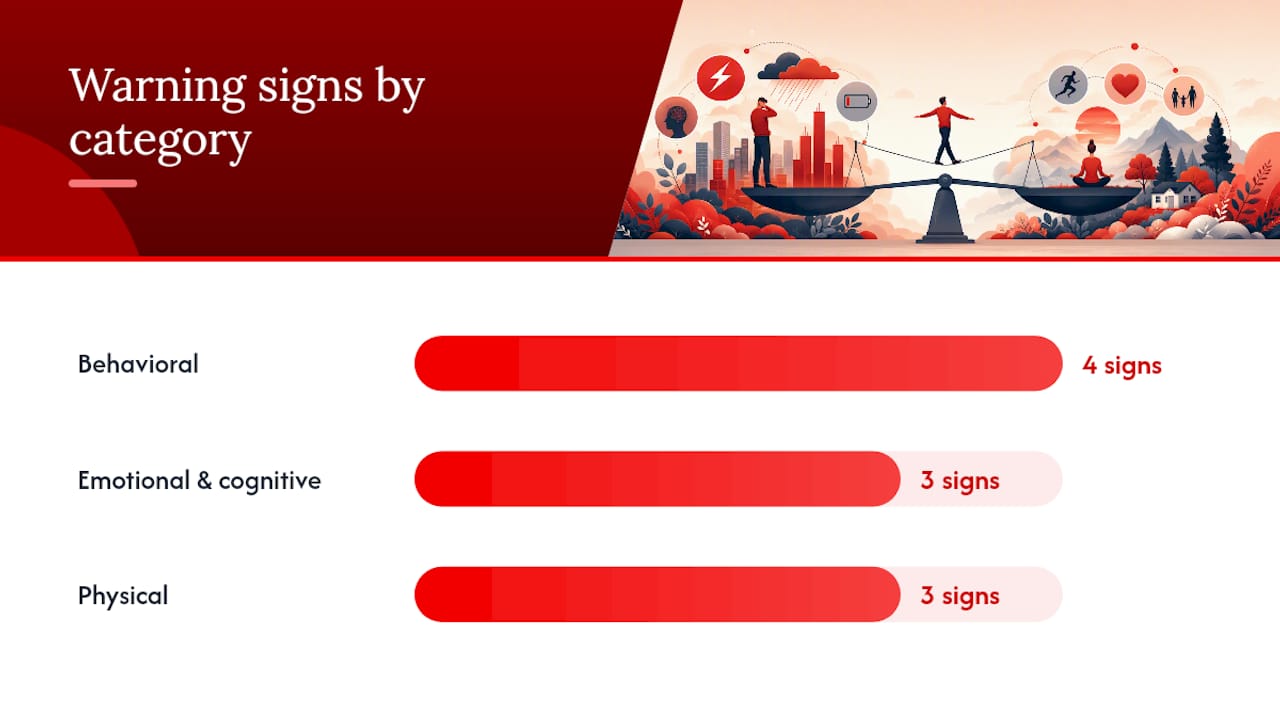
Practical warning signs your work-life balance is unhealthy
Some signals are easy to rationalize away. Recognizing them early is what separates a correctable imbalance from full burnout.
Behavioral signals:
- Checking work messages during meals, evenings, or weekends reflexively
- Canceling personal plans repeatedly to cover work demands
- Difficulty starting tasks that once felt easy (a sign of decision fatigue)
- Skipping exercise, sleep, or meals to create more work time
Emotional and cognitive signals:
- Persistent irritability or low mood that lifts only briefly on weekends
- Constant mental rehearsal of work problems during personal time
- Feeling that nothing you do at work is ever enough
Physical signals:
- Chronic fatigue that sleep does not fully resolve
- Frequent headaches, muscle tension, or digestive disruption
- Getting sick more often than usual
Mental Health America notes that realistic workloads and a sense of personal control over your schedule are two of the most protective factors against work-related stress. When both are absent, the physical symptoms above tend to appear first, often weeks before emotional burnout becomes obvious.
Any single sign lasting two or more weeks and affecting your daily function is a red flag worth acting on. Persistent physical symptoms alongside emotional exhaustion warrant a conversation with a healthcare provider.
Pro Tip: Keep a simple five-day mood and energy log. Rate both on a 1–5 scale each evening. A downward trend across five consecutive days is a reliable early signal, not a bad week.
Concrete steps to improve your work-life balance starting this week
The most effective changes are not the most dramatic ones. Start with quick wins that reduce friction, then build structural habits.
Set a hard stop time
Choose a specific time to end work each day and honor it for five consecutive days. Coursera’s work-life balance guidance identifies clear boundaries, including not answering work messages after set hours, as one of the most reliable indicators of healthy balance. Put the stop time in your calendar as a recurring block.
Time-block your personal priorities first
Most people schedule work and fit life around what remains. Reverse it. Block sleep, exercise, and one meaningful personal activity before filling in work tasks. This is not idealism; it is energy management. A home office setup that physically separates your work zone from living areas reinforces this boundary without willpower.
Audit and renegotiate your workload
List every recurring commitment and estimate its weekly time cost. Identify two tasks you can delegate, defer, or drop. Then have an honest conversation with your manager about sustainable output. This single step, done once per quarter, prevents the slow accumulation of obligations that causes chronic overwork.
Budget your energy, not just your time
High-focus work (writing, analysis, complex decisions) costs more than low-focus work (email, scheduling). Cluster demanding tasks in your peak-energy window, typically mid-morning for most people, and protect that window from meetings. Use afternoons for lighter tasks. For remote productivity tactics that reinforce this rhythm, our team has a dedicated guide worth bookmarking.
Pro Tip: If you have caregiving duties, build a “transition buffer” of 15–20 minutes between work and caregiving. Use it for a short walk or quiet activity. It prevents emotional spillover from work into family time.
How to measure whether your balance is actually improving
Tracking does not need to be complex. Three lightweight metrics give you a sensitive signal:
- Sleep quality (rate 1–5 each morning based on how rested you feel)
- Focused work hours (count hours of genuine deep work, not total hours logged)
- Fully detached evenings (count evenings with zero work contact per week)
Run a five-question weekly review every Sunday evening:
- Did I hit my hard stop time at least four out of five days?
- Did I get at least one full rest day this week?
- How did my energy feel by Friday afternoon compared to Monday?
- Did I spend meaningful time on at least one personal priority?
- What one thing would make next week feel more balanced?
| Metric | What to record | Green trend | Red flag |
|---|---|---|---|
| Sleep quality | Morning rating (1–5) | — | Declining three or more days in a row |
| Focused work hours | Daily count | Stable or rising | Dropping while total hours rise |
| Detached evenings | Count per week | Three or more | Zero or one for two consecutive weeks |
Small, consistent improvements across all three metrics over three to four weeks confirm that your changes are working.
How managers and organizations can support their teams
Individual effort only goes so far. Manager behavior and organizational policy shape the environment in which individual choices are made.
What managers can do:
- Model boundaries visibly: send messages during work hours, take your own vacation, and leave on time
- Calibrate workloads in one-on-ones by asking directly about capacity, not just progress
- Create psychological safety so employees can say “I’m at capacity” without fear
- Protect focus time by keeping at least two meeting-free blocks per week on team calendars
That kind of script, used consistently in one-on-ones, normalizes capacity conversations before burnout becomes visible.
Policy levers that actually move the needle:
Organizations that pair written policy with manager training and employee consultation report better uptake and longer-lasting results. Effective policies include async-first communication norms (no expectation of instant replies outside core hours), protected focus-time blocks on shared calendars, and explicit guidance on after-hours messaging. The key is designing policies with employee input rather than announcing them top-down.
Key Takeaways
Work-life balance is not a 50/50 time split but a sustainable fit where work and personal demands coexist without chronic stress or role conflict.
| Point | Details |
|---|---|
| Balance is needs-based, not hours-based | Good balance means energy recovers, relationships hold, and job performance stays steady. |
| Overwork reduces output | Research shows cognitive quality and effectiveness decline after a sustained threshold of long hours. |
| Recovery must be deliberate | Active rest that detaches you from work stimuli protects your nervous system and prevents burnout. |
| Three metrics track progress | Sleep quality, focused work hours, and fully detached evenings give a reliable weekly signal. |
| Managers shape the environment | Modeling boundaries and normalizing capacity conversations matter as much as individual habits. |
Three things to try this week:
- Set a hard stop time today and block it in your calendar for the next five workdays.
- Rate your sleep and energy each evening for seven days to establish your baseline.
- Schedule one fully work-free activity this weekend and protect it from cancellation.
For a deeper look at the lifestyle habits that support balance, including sleep, movement, and nutrition, our healthy lifestyle guide is a natural next step.
Our team’s perspective on balance as a practice, not a destination
Our team at Lizard’s Lunch has covered health, productivity, and lifestyle topics long enough to notice a pattern: the people who struggle most with balance are usually the ones holding the strictest definition of what it should look like. They expect a calm, even week every week, and when a crunch period arrives, they conclude they have failed.
The more honest framing is that balance is a practice with seasons. A product launch, a family illness, a move: these will tip the scales temporarily, and that is not failure. What matters is whether you have the habits and the self-awareness to notice the tilt and correct it before it becomes chronic. The warning signs, the weekly review, the recovery rituals: none of them are about achieving perfection. They are about catching drift early.
If you take nothing else from this article, try the seven-day experiment: hard stop time, nightly energy rating, one protected rest day. Seven days of data will tell you more about your actual balance than any amount of reflection.
Useful sources and further reading
These resources are worth bookmarking if you want to go deeper on any section of this article.
- CDC Stacks: Work-life balance definition
- PMC article on work hours and cognitive performance
- Work-Life Balance: What It Is and 5 Ways to Improve Yours — Coursera
- Work–life balance — Wikipedia
- PubMed: study on recovery and burnout indicators
- Work Life Balance | Mental Health America
This article is for general informational purposes only and is not a substitute for professional medical, psychological, or occupational health advice. If you are experiencing symptoms of burnout or chronic stress, consult a qualified healthcare provider.


















Leave a Comment
Your email address will not be published. Required fields are marked with *