
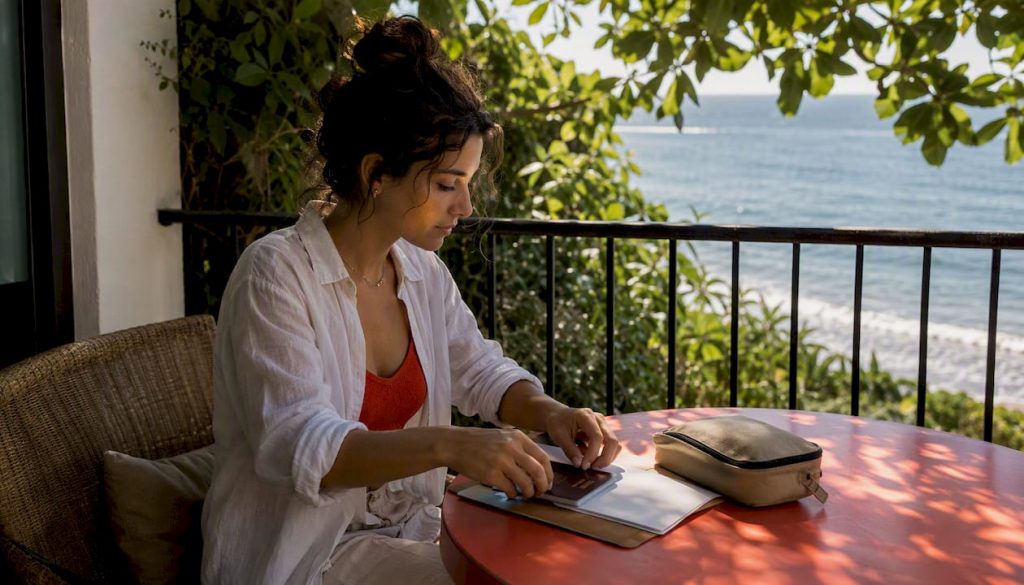
Prepare for your trip with essential travel safety tips. Use our complete checklist to minimize risks and travel confidently abroad.
The most effective travel safety tips fit on a single checklist you can act on before you leave home. According to the U.S. Department of State’s best practices, travelers who prepare documents, enroll in government programs, and plan transport and lodging in advance face dramatically lower risk of serious incidents abroad. Here is the core checklist:
- Enroll in the Smart Traveler Enrollment Program (STEP)
- Check Travel.State.Gov advisories for your destination
- Make physical and digital copies of all critical documents
- Buy travel medical insurance with evacuation coverage
- Book vetted lodging and pre-arranged transport
- Practice defensive alertness throughout your trip
- Share your full itinerary with a trusted contact at home
Following this checklist does not guarantee a perfect trip, but it closes the most common gaps that turn minor incidents into serious emergencies.
Table of Contents
- What travel safety tips should you complete before departure?
- How should you prepare your health and travel insurance before a trip?
- How do you choose and secure safe lodging while traveling?
- What are the most effective crime prevention tactics for travelers?
- How do you stay safe during nightlife and evenings out?
- What should you do when something goes wrong on a trip?
- Expert-backed tactics that most travelers overlook
- How do you stay healthy and hydrated while traveling?
- How should you manage your money safely while traveling?
- Why does cultural awareness keep you safer abroad?
- How do you stay safe on public transportation and in crowds?
- Key Takeaways
- Our team’s take on making safety part of every trip
- Authoritative sources for up-to-date travel safety guidance
What travel safety tips should you complete before departure?
Your safety abroad is largely determined by decisions you make at home. Start with Travel.State.Gov, which consolidates passport requirements, visa rules, local laws, and country-specific advisories in one place.
Enroll in STEP first. The Smart Traveler Enrollment Program is a free U.S. government service that sends you security, health, and event-based alerts for your destination and makes it easier for the nearest embassy to reach you in an emergency. Registration is quick and takes only a few minutes.
Check your passport’s expiration date. Many countries require at least six months of validity beyond your travel dates, and passport renewals currently take several weeks. Confirm visa and entry requirements on the destination’s country page, and pick up an International Driving Permit (IDP) if you plan to drive overseas.
Pro Tip: Start the paperwork process at least three months before departure. Passport renewals, some visa applications, and travel insurance purchases all have lead times that catch travelers off guard.
| Document | Store Original | Store Backup | Notify If Lost |
|---|---|---|---|
| Passport | Secure hotel safe | Cloud storage + printed copy left at home | Local police + nearest U.S. embassy |
| Visa / ETA | Travel folder | Email to yourself | Embassy or consulate |
| Travel insurance card | Wallet | Phone photo + email | Insurance emergency line |
| Prescriptions | Carry-on bag | Copy at home with trusted contact | Local pharmacy or clinic |
| IDP (if driving) | Travel folder | Scanned copy in cloud | Local traffic authority |
Share your complete itinerary, including hotel addresses and flight numbers, with someone you trust at home. That single step can cut emergency response time significantly if something goes wrong.
How should you prepare your health and travel insurance before a trip?
The CDC recommends scheduling a pre-travel health appointment at least 4–6 weeks before departure. That window gives your provider time to prescribe destination-specific vaccines, malaria prophylaxis, altitude sickness medication, or other targeted treatments that require a full course before you leave.
Pack a travel health kit that includes:
- All prescription medications in original, labeled bottles
- Copies of immunization records and prescriptions
- Over-the-counter pain relievers, antidiarrheal medication, and antihistamines
- Insect repellent with DEET or picaridin, sunscreen, and hand sanitizer
- A basic first-aid kit (bandages, antiseptic wipes, blister treatment)
The CDC’s Survival Guide for Safe and Healthy Travel also recommends checking your destination’s specific health page for vector-borne disease risks, water safety, and food hygiene warnings before you pack.
Travel medical insurance deserves its own line item in your budget. Most U.S. health plans provide little to no coverage outside the country, and a medical evacuation from a remote location can cost tens of thousands of dollars. When comparing policies, confirm that yours covers emergency evacuation, pre-existing conditions (if relevant), and trip interruption.
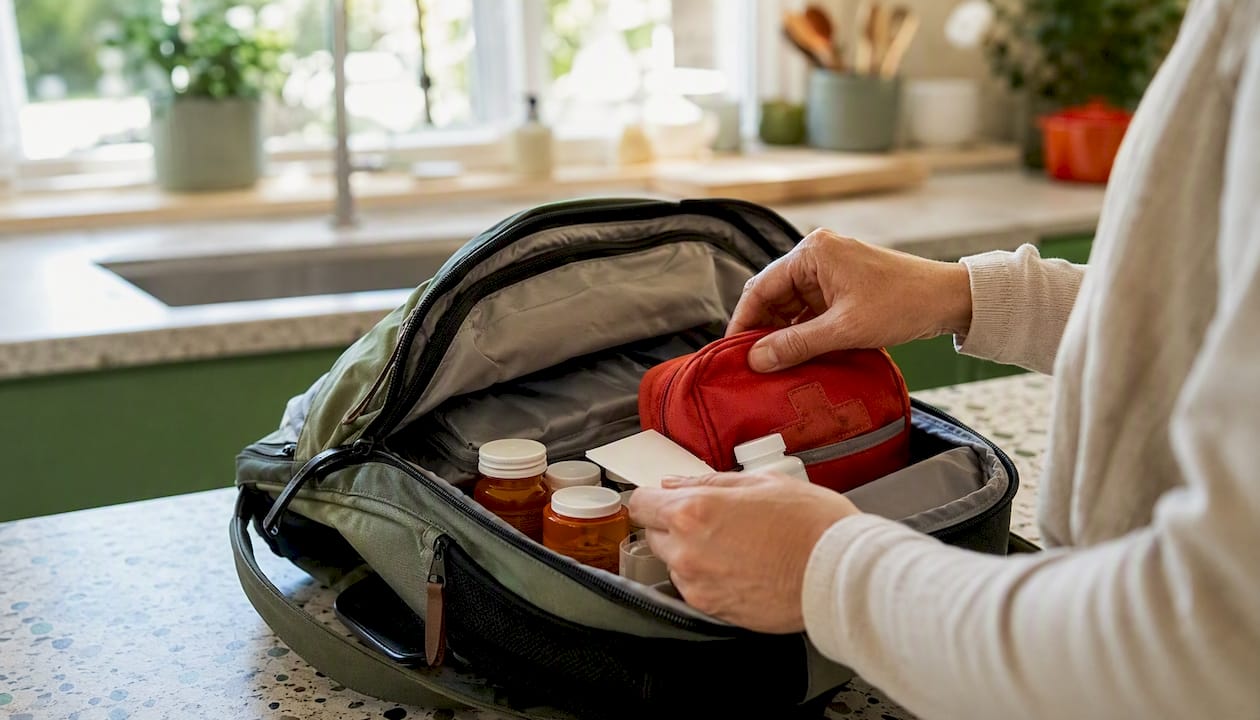
Pro Tip: If you take controlled medications, carry a letter from your prescribing physician on official letterhead and check the legal status of those substances at your destination. Some common U.S. medications are restricted or outright banned in certain countries.
How do you choose and secure safe lodging while traveling?
Location matters as much as price. Before booking, read recent reviews specifically for mentions of security, neighborhood safety, and staff responsiveness. Rooms on mid-level floors offer a practical balance between security and emergency accessibility.
Lock every entry point the moment you arrive. Use the deadbolt, engage the chain or secondary latch, and prop a door-stop alarm under the door if the locks feel flimsy. Store your passport, extra cash, and backup cards in the room safe or a locked bag — never in an unlocked suitcase.
On arrival, spend two minutes on a quick safety audit: test that the door lock works, locate the nearest emergency exit, confirm the in-room phone functions, and note the address of the nearest hospital and police station. That small investment pays off under stress.
Vary your daily routine. Leaving and returning at the same time each day makes your movements predictable. Avoid advertising your tourist status with branded luggage tags, loud conversations about your itinerary in public spaces, or maps held open at street corners.
Pro Tip: For short-term rentals, verify the host’s identity and reviews on the platform before arrival, and confirm that the listing matches the photos. On arrival, check for any hidden cameras in private spaces — a flashlight scan of unusual objects is a reasonable precaution.
What are the most effective crime prevention tactics for travelers?
Criminals who target tourists look for distraction, not confrontation. The traveler checking their phone at a busy intersection, the one with a camera bag hanging loosely off one shoulder, the group loudly consulting a paper map — these are the targets. Blend in, stay alert, and you remove most of the appeal.
— U.S. Department of State, Crime and Safety Abroad
The DOS guidance on crime abroad is clear: defensive alertness and blending in are the most effective, lowest-cost crime-prevention tactics available. Wear modest, locally appropriate clothing. Leave flashy jewelry and expensive watches at home. Carry only the cash you need for the day.
Use concealed storage. A money belt worn under clothing, a neck wallet, or pants with hidden zip pockets keeps your passport and emergency cash safe even if your bag is snatched. Keep a small amount of “decoy cash” in an accessible pocket so you can hand something over quickly if confronted without revealing your real wallet.
If you suspect you are being followed or scammed:
- Change your route immediately and walk toward a busy, well-lit public space.
- Alert a travel companion if you have one.
- Step into a shop, hotel lobby, or police station.
- Do not confront the person directly.
- Note a description of the individual for a police report.
If confronted in a robbery, give up valuables without resistance. No possession is worth physical harm.
How do you stay safe during nightlife and evenings out?
Nighttime social settings carry specific risks that deserve direct attention. Never accept a drink from a stranger, and keep your drink in your hand or covered when you are not actively drinking. Watch for sudden dizziness, confusion, or disorientation that feels disproportionate to what you have consumed — these are warning signs of drink spiking.
- Travel in groups after dark whenever possible.
- Pre-book a trusted rideshare or taxi home before you go out, not after.
- Share your live location with a trusted contact for the evening.
- Carry only minimal cash and a single card; leave your passport locked at the hotel.
- If you suspect drugging or assault, get to a safe location immediately, call local emergency services, and contact the nearest U.S. embassy or consulate if you are abroad.
Avoid publicly intoxicated behavior. Beyond the obvious health risk, visible intoxication marks you as a vulnerable target for theft and scams.
What should you do when something goes wrong on a trip?
Stay calm and work through the steps below. Most travel emergencies are manageable when you have the right contacts and documentation ready.
Lost or stolen passport:
- File a police report immediately and get a copy of the report number.
- Contact the nearest U.S. embassy or consulate — find the address at Travel.State.Gov.
- Request an emergency passport or travel document.
- Notify your travel insurance provider.
- Contact your bank if financial cards were also taken.
Medical emergency:
- Call local emergency services (research the number before you travel — it is not always 911).
- Contact your travel insurance emergency line for guidance on approved facilities.
- For serious cases, request medical evacuation coverage activation.
Crime victim:
- Move to a safe location first.
- Call local police and document the incident with a written report.
- Photograph any injuries or damage.
- Contact the nearest U.S. embassy or consulate for additional support.
U.S. embassies and consulates can help you replace a stolen passport, connect you with local legal resources, and notify your family in a crisis. Save the embassy contact number for your destination in your phone before you leave home. Find every embassy address at Travel.State.Gov.
Expert-backed tactics that most travelers overlook
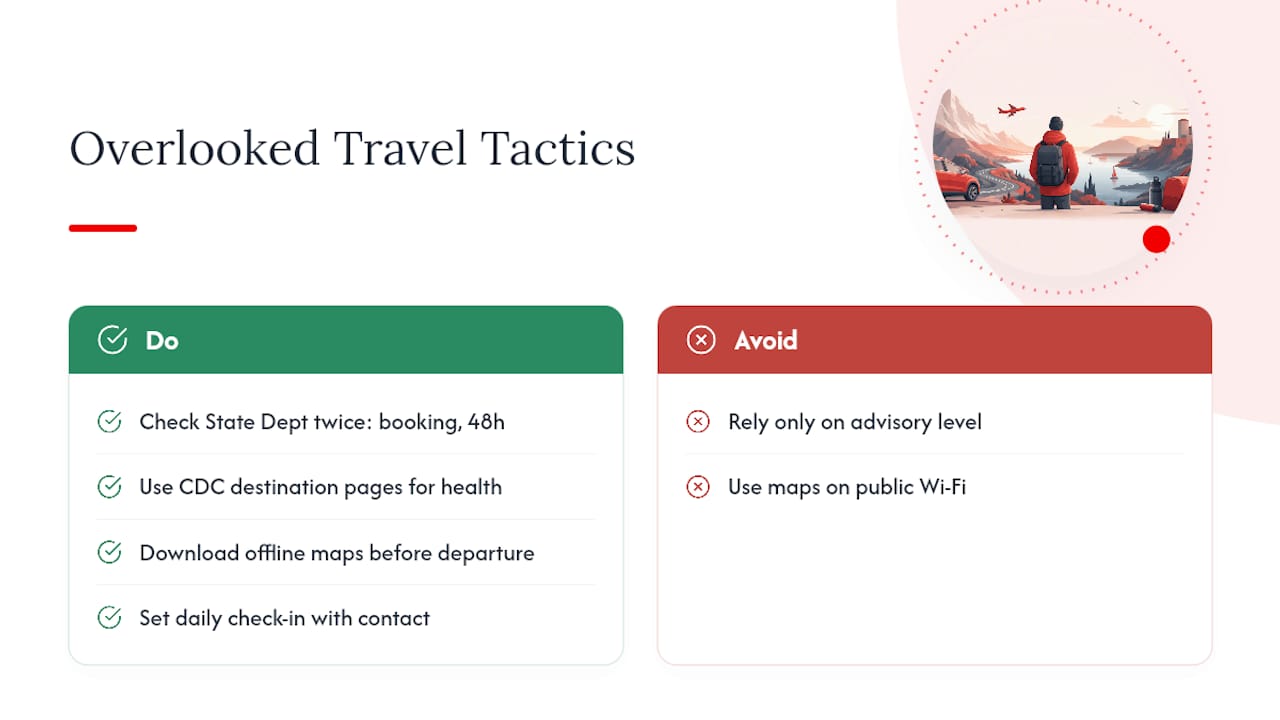
The U.S. Department of State’s travel advisory system uses four levels: Level 1 (Exercise Normal Precautions) through Level 4 (Do Not Travel). Beyond the level, look for event-based alerts, which flag specific incidents like civil unrest or disease outbreaks in real time. Checking advisories once at booking and again 48 hours before departure catches most late-breaking risks.
The CDC advises all travelers to research destination-specific health risks, prepare a health kit tailored to those risks, and see a clinician before departure. Destination pages on the CDC Travelers’ Health site list current vaccine recommendations, food and water safety warnings, and insect-borne disease risks by country.
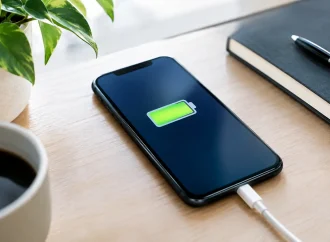
Offline maps (downloaded via Google Maps or Maps.me before you leave your hotel’s Wi-Fi) mean you can navigate without exposing your location on public networks. A portable battery pack keeps your phone alive during long transit days. For wearable safety tech like GPS trackers and emergency-alert devices, Lizardslunch has a dedicated guide worth bookmarking.
Set a daily check-in schedule with someone at home — a simple text at a fixed time each day. If the check-in is missed, your contact knows to escalate.
Pro Tip: On Travel.State.Gov, use the country information page rather than just the advisory level. The country page lists local emergency numbers, entry requirements, common scams, and the nearest embassy address — all in one place.
How do you stay healthy and hydrated while traveling?
Food and water safety vary enormously by destination. In countries where tap water is not reliably safe, drink bottled or filtered water, use it to brush your teeth, and avoid ice in drinks unless you know it was made from purified water. Street food can be excellent and safe, but prioritize stalls with high turnover and food cooked to order in front of you.
Wash your hands frequently, especially before eating and after using public transport. Carry a small bottle of hand sanitizer for moments when soap and water are not available. Dehydration sneaks up on travelers who are busy sightseeing, so set a reminder to drink water regularly, particularly in hot climates or at altitude.
How should you manage your money safely while traveling?
Notify your bank and credit card providers before you leave. A foreign transaction that triggers a fraud alert can freeze your card at the worst possible moment. Most banks allow you to set travel notifications through their app in under a minute.
Carry minimal cash — enough for one day’s expenses plus a small emergency reserve. Split that cash between two locations (wallet and a concealed pocket or money belt) so a single theft does not leave you stranded. Credit cards with no foreign transaction fees are your best spending tool abroad; they offer fraud protection and a favorable exchange rate compared to airport currency kiosks.
Avoid using ATMs at night or in isolated locations. Use machines attached to banks or inside hotel lobbies, and shield the keypad when entering your PIN. For budget tips that stretch your travel dollar further, the vacation budget guide on Lizardslunch covers practical strategies worth reading before you book.
Why does cultural awareness keep you safer abroad?
Respecting local customs is not just good manners — it actively reduces your risk of conflict. Dress codes at religious sites, photography restrictions near government buildings, and local norms around public behavior vary widely. Violating them can draw unwanted attention, result in fines, or escalate into confrontations.
Research basic etiquette for your destination before you go: appropriate greetings, tipping customs, and any topics considered sensitive or offensive. Learning a few words of the local language signals respect and often opens doors that stay closed to tourists who make no effort.
How do you stay safe on public transportation and in crowds?
Crowded spaces are where pickpockets work. Keep your bag zipped and worn in front of your body on metros, buses, and in markets. Avoid placing your phone or wallet in a back pocket. If someone bumps into you or creates a distraction, check your belongings immediately.
On public transit, sit near other passengers rather than in isolated cars, especially at night. Know your stop before you board so you are not visibly consulting your phone at every station. In very crowded spaces like festivals or busy transit hubs, keep one hand on your bag at all times and stay aware of anyone who lingers unusually close.
Key Takeaways
Safe travel comes down to preparation: travelers who enroll in STEP, secure their documents, buy travel medical insurance, and practice defensive alertness before and during a trip remove the majority of preventable risks.
| Point | Details |
|---|---|
| Enroll in STEP | Register at step.state.gov before every international trip to receive embassy alerts. |
| Secure your documents | Carry physical and digital copies of your passport, insurance, and prescriptions separately. |
| Buy travel medical insurance | Confirm your policy covers emergency evacuation — most U.S. plans do not cover care abroad. |
| Practice defensive alertness | Blend in, vary routines, use concealed storage, and trust your instincts in unfamiliar areas. |
| Know your emergency contacts | Save your destination’s U.S. embassy number and local emergency services number before you leave. |
Our team’s take on making safety part of every trip
Our team at Lizard’s Lunch approaches travel safety the same way we approach any good plan: it works best when it is built in from the start, not bolted on as an afterthought. The travelers who run into serious trouble are rarely unlucky — they are usually underprepared. The checklist in this article is short enough to complete in an afternoon and covers the scenarios that matter most.
Use the opening checklist as your quick scan before you pack, then dig into the sections that apply to your specific destination and trip style. And when you are ready to go deeper on tech, gadgets, and tools that make travel smoother and safer, Lizardslunch has guides across all of it.
This article provides general travel safety information and does not constitute professional legal, medical, or security advice. Confirm current entry requirements, health recommendations, and local laws with official sources or a qualified professional before you travel.
Authoritative sources for up-to-date travel safety guidance
These are the primary official resources every U.S. traveler should bookmark:
- Travelers’ Checklist – Travel.State.Gov
- Crime and safety abroad – Travel.State.Gov
- Survival Guide to Safe and Healthy Travel | Travelers’ Health – CDC
- Before you travel – CDC
- Travel Advisories – Travel.State.Gov
- Best practices for traveler safety – Travel.State.Gov
- STEP – Smart Traveler Enrollment Program
- TSA Travel Tips
| Agency | What to Look Up | When to Check |
|---|---|---|
| Travel.State.Gov | Advisory level, entry requirements, local laws, embassy address | At booking and 48 hours before departure |
| STEP | Enrollment and alert preferences | As soon as trip is confirmed |
| CDC Travelers’ Health | Vaccines, food/water safety, disease risks | 4–6 weeks before departure |
| TSA | Carry-on rules, liquid limits, prohibited items | When packing |
| U.S. Embassy (destination) | Emergency contact number, passport replacement process | Save to phone before departure |
For urgent help abroad, U.S. embassies and consulates operate 24-hour emergency lines for American citizens. If you face a crisis, call the embassy directly — do not wait for business hours. Find every embassy contact at Travel.State.Gov.










Leave a Comment
Your email address will not be published. Required fields are marked with *