

Discover what passive income is and how you can earn money effortlessly through investments, royalties, and rental properties.
Passive income is money earned from a stream that keeps paying after the initial setup, whether that stream is returns on invested capital, royalties from creative work, or managed rental activity. It differs from active income, where you trade hours for a paycheck and the money stops the moment you stop working. A dividend deposit from an index fund, rent collected through a property manager, or royalty checks from a self-published e-book are all classic examples. None of them are free, though. Most passive streams demand real capital, real labor, or both before they ever pay out.
- Dividends and interest: money your investments generate without you clocking in
- Rental income with a manager: a property that pays you while someone else handles tenants
- Royalties: ongoing payments from a book, song, or course you built once
Key Takeaways
Passive income requires upfront capital, time, or both, and the biggest mistake beginners make is expecting a hands-off payout from day one.
| Point | Details |
|---|---|
| Definition matters | Passive income spans capital returns, royalties, and managed rentals, each with different effort levels. |
| No stream is truly free | Every option demands upfront work, capital, or ongoing maintenance to keep paying out. |
| Track costs closely | Management fees typically run 8% to 12% of gross rental income and directly affect your taxable net. |
| Start with a foundation | Build an emergency fund and clear high-interest debt before committing money to a new stream. |
| $1,000/month takes scale | Reaching that target often needs $30,000 to $300,000 invested or two to three rental doors. |
Before starting your first digital product, a resource like the 12 best side hustles to start from home can help you test an idea without much upfront cost, and if you plan to promote it, choosing the right digital marketing agency is worth researching early. For readers weighing whether a small-business structure fits their savings plan, the Solopreneur Funding Checklist walks through early-stage cashflow planning, while The Passive Income Blueprint offers a fuller framework once you’re past the pilot stage. And since building any income stream is easier when your daily habits are dialed in, our guide to what a healthy lifestyle actually looks like is worth a read too.
Table of Contents
- What Passive Income Is (and What It Isn’t)
- Popular Passive Income Ideas People Actually Use
- How to Choose an Idea and Get Started
- Tax and Legal Basics Every Canadian Should Know
- What It Actually Takes to Earn $1,000 a Month
- Risks, Maintenance, and Common Misconceptions
- Frequently Asked Questions
- Sources
What Passive Income Is (and What It Isn’t)
Picture passive income as a spectrum, not a light switch. On one end sits low-effort capital income like a savings account that pays interest whether you check it daily or once a year. On the other end sits a rental property that mostly runs itself but occasionally demands your attention when a furnace dies or a lease renews. Both count as passive income in everyday conversation, but they ask very different things of you.
Tax authorities draw the line more narrowly than the rest of us do. In everyday usage, passive income covers dividends, interest, rent, and royalties, but some tax systems separate “portfolio income” (dividends and interest) from “passive activity” (a rental or business where you don’t materially participate). That distinction matters when losses come into play, since passive losses usually offset only passive income, not your salary.
Two myths trip up almost everyone starting out:
- “No work at all”: even index funds require research, account setup, and periodic rebalancing.
- “It pays off instantly”: most streams follow a curve of upfront work, a slow ramp, ongoing maintenance, and eventual scaling, often stretched across many months.
Understanding passive income as a spectrum rather than a binary helps you set expectations before you commit money or time.
Popular Passive Income Ideas People Actually Use
Financial-education resources consistently point to the same core vehicles for building passive income: investment funds, real estate, and digital products. Here’s how the most common options stack up.
- Index funds and dividend ETFs: Low effort once purchased, and Canadian investors can hold them inside a TFSA or RRSP to shelter growth from tax. The tradeoff is that returns move with the market, so a downturn cuts your payout right when you might need it most.
- REITs (real estate investment trusts): These give you rental-style income without buying a building, and they trade like stocks so you can sell quickly. Yields are usually modest and interest-rate swings hit REIT prices harder than most people expect.
- High-yield savings accounts and GICs: About as close to zero-effort as passive income gets, with predictable and often insured returns. The catch is that yields rarely beat inflation over the long run.
- Rental property with a property manager: Real estate can produce strong monthly cash flow and long-term appreciation. It also demands a large down payment, and even “managed” properties need your input at renewal time or during a major repair.
- Short-term rentals: Platforms can generate higher nightly income than long-term leases, but local licensing rules and seasonal demand make this one of the more hands-on options on this list.
- Digital products and online courses: Once built, an e-book or course can sell for years, but creating one typically takes months of upfront work, and ongoing customer support isn’t optional.
- Royalties from creative work: Music, photography, and writing can pay out long after the original project ends, though income is often unpredictable and concentrated among a small share of creators.
- Affiliate content and blogging: Traffic-driven income can scale well but usually needs a year or more of consistent publishing before it produces meaningful revenue.
- Peer-to-peer lending and crowdfunding: A handful of platforms operate in Canada, offering higher yields than savings accounts in exchange for less liquidity and real default risk.
How to Choose an Idea and Get Started
The right starting point depends on four honest answers: how much capital you have, how much time you can spend upfront, how much risk you can stomach, and what skills you already bring. Someone with $500 and no free evenings should look very different from someone with a $60,000 down payment and weekends to spare.
Run through these criteria before you pick a lane:
- Capital required: from a few dollars for an ETF to tens of thousands for a rental down payment
- Time upfront: hours for a savings account versus months for a course or book
- Risk tolerance: market risk, tenant risk, and platform risk all feel different in practice
- Liquidity needs: can you access the money quickly if life throws a curveball?
- Skill fit: writing, teaching, or property management each favor different strengths
- Tax implication: some income streams are taxed and reported very differently than others
Once you’ve picked a direction, follow a simple sequence. Start by building an emergency fund and paying down high-interest debt, since no passive stream outperforms a 20% credit card rate. Then research your chosen idea for a week or two, run a small pilot (a $100 ETF purchase, a single low-cost digital product), and track every dollar in and out from day one.
A rough timeline: in the first 30 days, research and pilot. By 90 days, you should have your first real revenue or dividend deposit, however small. By year one, you’ll know whether the idea is worth scaling or worth abandoning. Costs vary sharply: dividend ETFs can start with $25 monthly contributions, a digital product might cost only your time plus a few hundred dollars in software, and a rental property often requires a five-figure down payment before you collect your first check.

Tax and Legal Basics Every Canadian Should Know
Tax treatment depends heavily on the type of income, and that treatment is genuinely complex: dividends, rental income, and business income each follow different reporting rules and allow different deductions. Interest and eligible dividends get reported on specific lines of your return, while rental income requires tracking both revenue and deductible expenses.
Keep clean records from the start:
- Save every receipt for repairs, platform fees, and management costs
- Track capital expenses (a new roof) separately from operating expenses (lawn care)
- Log the exact dates income was received, since timing affects which tax year it falls into
Statistic Callout: Professional property managers typically charge 8% to 12% of gross rental income, a cost that directly reduces your taxable net and needs to be tracked separately from repairs and vacancy reserves.
If you hold investments inside a corporation, pay close attention: passive investment income can reduce a corporation’s access to the small-business deduction under federal rules, which can meaningfully change the math on incorporating versus investing personally. Tax policy also shifts. The federal government canceled a proposed capital gains tax increase in 2025, a reminder that the rules you plan around today can change before your investment matures.
What It Actually Takes to Earn $1,000 a Month
Rough math beats vague optimism here. These scenarios use conservative, rounded assumptions.
- Dividend portfolio: At a 4% annual yield, reaching $1,000 monthly ($12,000 a year) requires roughly $300,000 invested. A more realistic starter goal of $100/month needs about $30,000.
- REIT or dividend ETF mix: Blended yields around 5% to 6% get you to $1,000 monthly with roughly $200,000 to $240,000 invested, before accounting for tax on non-registered accounts.
- Rental property: A property netting $400/month after mortgage, taxes, and an 8% to 12% management fee needs two to three doors to clear $1,000, depending on your local market and financing costs.
- Digital product: Selling a $30 e-book at 35 copies monthly clears $1,000 in gross revenue, though platform fees and any paid promotion cut into that number quickly.
Every scenario assumes stable markets and ignores taxes, which will reduce your real take-home in each case.
Risks, Maintenance, and Common Misconceptions
Every passive stream carries a downside that rarely appears in the pitch. Watch for these:
- Liquidity risk: real estate and some lending platforms can lock up your money for months or years
- Market risk: dividend cuts and price swings happen even in “boring” funds
- Tenant and platform risk: a bad tenant or a policy change on a rental platform can wipe out a quarter’s profit
- Scams: guaranteed high returns with no risk is the clearest red flag in the entire category
Pro Tip: Budget 8% to 12% of gross rental income for management and another 5% to 10% for maintenance and vacancy, then treat any month without a surprise expense as a bonus, not the baseline.
Our Team’s Short Perspective
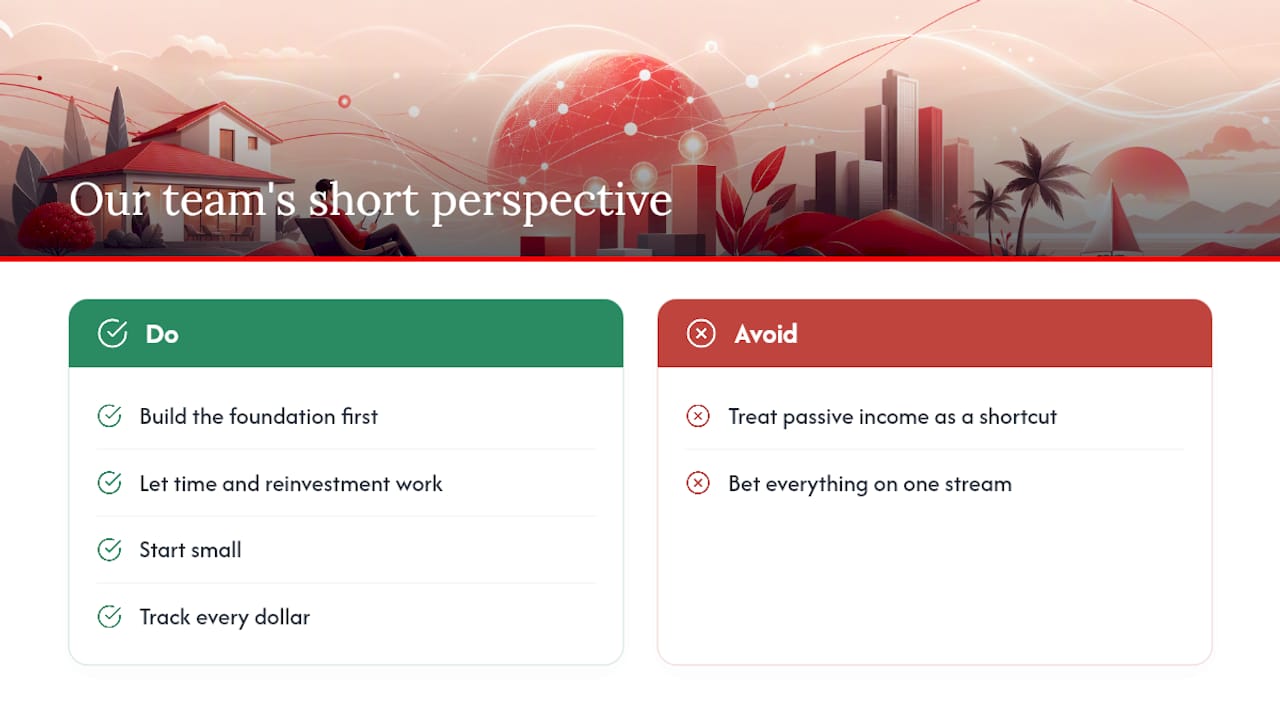
Our team at Lizard’s Lunch sees passive income get sold as a shortcut when it’s really a long game: build the foundation first, then let time and reinvestment do the heavy lifting. Start small, track every dollar, and diversify across two or three streams rather than betting everything on one.
Frequently Asked Questions
What is passive income, in the simplest terms?
It’s money earned from a stream, such as investments, rentals, or royalties, that keeps paying with minimal ongoing effort after the initial setup.
Is passive income taxable in Canada?
Yes. Dividends, interest, rental income, and royalties are all reportable, though the specific rules and deductions vary by income type.
What is residual income, and is it the same as passive income?
Residual income usually refers to money left over after expenses, often used in the context of commissions or royalties that continue after the initial sale. It overlaps heavily with passive income but isn’t always identical.
How much money do I need to start earning passive income?
It depends on the vehicle. Dividend ETFs can start with $25 monthly contributions, while rental property typically requires a five-figure down payment.
Can passive income really replace a full-time salary?
For most people, it starts as a supplement rather than a replacement, growing slowly as streams get reinvested and diversified over years, not months.
This article is general information, not a substitute for advice from a qualified financial advisor. Consult a qualified financial professional about your own circumstances before acting on anything here.


















Leave a Comment
Your email address will not be published. Required fields are marked with *