
Discover the transformative role of smart luggage in modern travel. Explore how these innovative bags enhance convenience and ease for travelers.
The global smart luggage market was valued at approximately USD 3 to 3.8 billion in 2024 and 2025, and analysts expect it to surge past USD 11 to 12 billion by 2034 and 2035. That is not the growth story of a passing gadget craze. It is the story of an industry responding to travelers who want more control, more confidence, and more ease every time they head to an airport. Smart luggage is redefining what a suitcase can do, and in this guide, we will break down everything you need to know, from core technology and real benefits to market trends, honest challenges, and how to choose the right bag for your lifestyle.
Table of Contents
- What defines smart luggage?
- Smart luggage advantages: Efficiency and convenience
- Smart luggage in the travel industry: Market trends and adoption
- Challenges and considerations with smart luggage
- Why smart luggage matters: Beyond the gadgets
- Explore next-generation travel resources
- Frequently asked questions
Key Takeaways
| Point | Details |
|---|---|
| Smart luggage innovations | Features like GPS tracking and mobile integration are transforming travel convenience. |
| Real-world advantages | Efficiency and security improvements help travelers save time and reduce stress. |
| Industry impact | Market trends show smart luggage is now a mainstream expectation, not a niche trend. |
| Watch for regulations | Battery and privacy rules require careful attention to maximize benefits safely. |
What defines smart luggage?
Smart luggage is not simply a suitcase with a USB port tacked on. It is a thoughtfully engineered travel companion that integrates digital technology directly into its structure, giving you capabilities that a standard bag simply cannot offer. Think of it as the intersection of your favorite computer technology and your most trusted travel gear, designed to work together seamlessly so you can focus on the journey rather than the logistics.
At its core, smart luggage combines several technologies into one sleek, rolling package. These features work together to create a genuinely different travel experience rather than a collection of isolated novelties.
Core features of smart luggage include:
- GPS tracking: Real-time location data sent to your smartphone, so you always know exactly where your bag is, whether it is in the overhead bin or circling the baggage carousel.
- USB charging ports: Built-in battery packs allow you to charge your phone, tablet, or earbuds directly from your luggage while you wait at the gate.
- Digital locks: TSA-approved electronic locks that can be controlled via Bluetooth or a companion app, eliminating the need to remember combination codes or carry keys.
- Weight sensors: Built-in scales that measure your bag’s weight and send an alert to your phone when you are approaching airline limits, helping you avoid surprise fees at check-in.
- Proximity alerts: Notifications that warn you if your bag moves out of Bluetooth range, acting like a safety net for distracted moments in busy terminals.
- Removable batteries: Most modern smart bags include batteries designed to be easily removed for checked baggage compliance, a critical feature we will explore in more detail later.
To understand how far this category has traveled in just a few years, here is a snapshot of the market evolution:
| Year | Estimated market value | Key drivers |
|---|---|---|
| 2022 | USD 2.1 billion | Post-lockdown travel rebound |
| 2024 | USD 3 to 3.8 billion | Tech integration, frequent flyer demand |
| 2026 | USD 4.5 to 5.2 billion (est.) | App ecosystems, airline partnerships |
| 2030 | USD 7 to 8 billion (proj.) | AI features, biometric security |
| 2035 | USD 11 to 12 billion (proj.) | Full travel ecosystem integration |
The technology driving this category is evolving rapidly. Brands are now layering artificial intelligence, voice control, and even biometric locking into their product pipelines. But the fundamentals, GPS, weight sensing, charging, and digital security, remain the pillars that most travelers look for first. Understanding these basics sets the stage for appreciating why so many frequent flyers consider smart luggage a genuine upgrade rather than an expensive gimmick.
Smart luggage advantages: Efficiency and convenience
With an understanding of the basics, let’s explore why smart luggage genuinely enhances the travel experience. The benefits are tangible, measurable, and often noticed within the first trip. Whether you fly twice a year or twice a month, these advantages translate into real time saved and real stress eliminated.
Here is a step-by-step look at how smart luggage transforms a typical travel day:
- Before you pack: The built-in weight sensor connects to your phone. You pack your bag and weigh it in real time, adjusting before you even leave your house. No more lifting your bag onto airport scales with your heart in your throat.
- At the airport: Your digital lock is already armed via your companion app. You drop your bag at check-in, and the lock status is visible on your phone. You know it is secure without touching it again.
- During your layover: GPS tracking shows your bag loaded on the plane. You grab coffee without that nagging worry about whether your luggage made the connection.
- At the gate: Your phone battery is running low from four hours of work in the lounge. You plug directly into your luggage’s charging port and arrive at your destination with a full battery.
- Baggage claim: If there is a delay or your bag is rerouted, your GPS tracker shows its exact location. You can report it to the airline with precise data rather than relying on vague descriptions.
- Leaving the terminal: Your proximity alert fires if you accidentally leave your bag more than 30 feet away. It is like having a digital tether on your most important travel companion.
The convenience factor is especially important for people who treat travel as one of their most cherished travel hobbies, whether that means weekend escapes, international adventures, or work trips that feel like mini-vacations when done right.
Statistic spotlight: With the smart luggage market growing at a compound annual rate of 11.85 to 16 percent, adoption is accelerating faster than nearly any other travel accessory category. Consumer demand is clearly not slowing down.
Beyond individual trips, smart luggage also changes how you organize your travel gear over time. Built-in apps often let you log what you packed, set reminders for next trips, and track your bag’s travel history. It sounds small, but for frequent travelers, that kind of data becomes genuinely useful over dozens of trips.
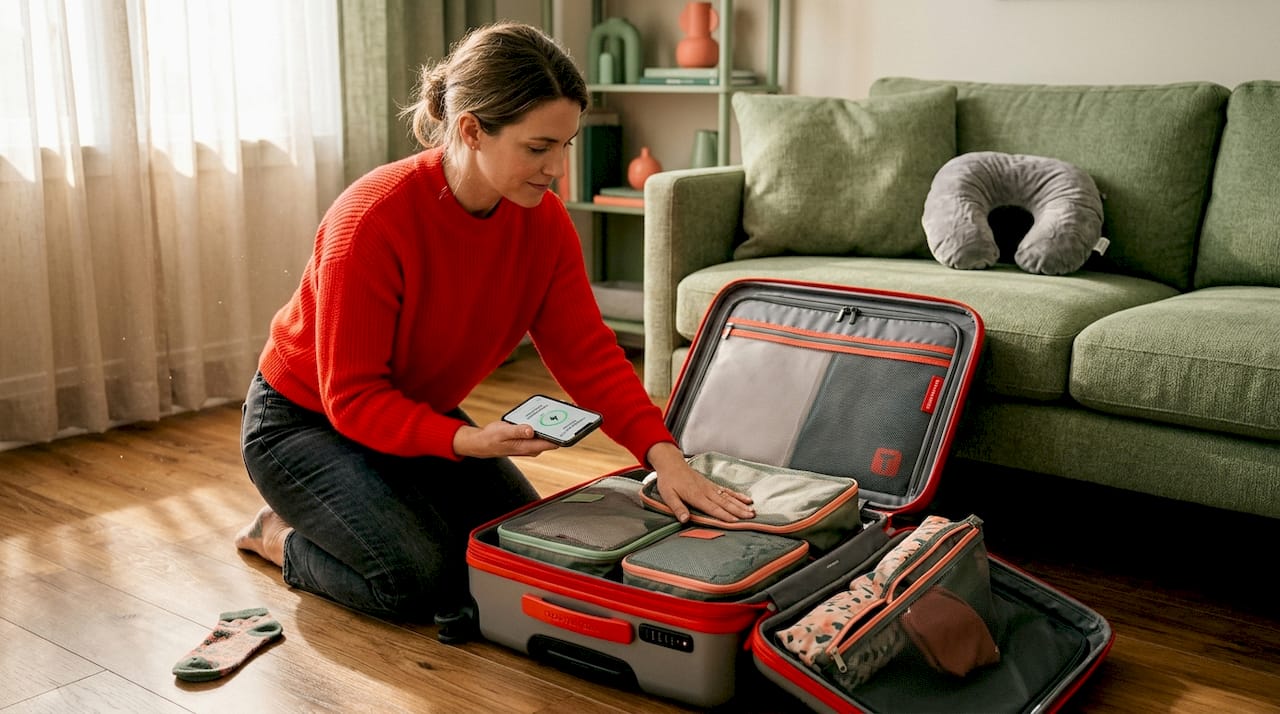
Pro Tip: Charge your smart luggage battery fully the night before a trip and keep a portable cable in your carry-on pouch. That way, if you need to remove the battery for a checked bag, you can still charge devices from the separate battery pack during your flight. It is also worth considering smart luggage as a standout option among smart luggage gifts for travel-loving friends and family who have everything else already.
The efficiency gains are not just about time. They are about the mental bandwidth you reclaim when you stop worrying about lost bags, dead phone batteries, and mystery baggage fees. That mental clarity is genuinely one of smart luggage’s most underrated advantages.
Smart luggage in the travel industry: Market trends and adoption
Beyond individual benefits, smart luggage is impacting the industry as a whole, and the numbers tell a fascinating story. Travel recovery after 2020 created a powerful tailwind, but the real momentum comes from a broader shift in consumer expectations. Travelers are now conditioned to expect connectivity and intelligence from every device they own. Their luggage is simply the next frontier.
Here is how smart luggage compares across two generations of product design:
| Feature | Traditional luggage | Smart luggage |
|---|---|---|
| Location tracking | None | Real-time GPS via app |
| Security | Manual combination lock | Bluetooth digital lock |
| Weight awareness | Airport scale only | Built-in sensor, phone alert |
| Device charging | None | USB-A and USB-C ports |
| Theft protection | None | Proximity alert, app notification |
| Airline compliance | Always compliant | Removable battery required |
| Price range | USD 50 to 400 | USD 250 to 1,200 |
The contrast is striking. Traditional luggage has remained largely unchanged for decades, while smart luggage has packed in a decade’s worth of innovation in just a few years.
“The convergence of travel demand and consumer technology has created a new standard for what luggage should do. Smart bags are no longer a luxury category. They are becoming the expectation.”
The airline industry has also played a complex but ultimately positive role in shaping smart luggage adoption. Regulatory challenges around lithium batteries pushed manufacturers to innovate removable battery designs, which actually made the bags more airline-friendly and more consumer-friendly at the same time. Airlines like Delta and United have updated their policies to accommodate removable battery smart bags in checked luggage, a sign that the industry is adapting rather than resisting.
Key industry trends driving smart luggage adoption:
- Post-pandemic travel boom: Global air passenger numbers rebounded sharply after 2022, and new travelers entering the market are disproportionately tech-savvy and device-dependent.
- Business travel modernization: Corporate travel managers increasingly specify smart luggage in travel policies because the GPS and security features reduce liability and expense report disputes.
- Sustainability integration: Several brands now incorporate recycled materials and solar-charging panels into their smart bags, appealing to eco-conscious travelers.
- App ecosystem expansion: Companion apps now integrate with airline apps, hotel check-in systems, and even Google Maps, creating a genuinely connected travel experience.
You can track many of these shifts through global travel trends and the latest developments in travel industry news as the sector continues to evolve rapidly.
The market’s projected growth to USD 11 to 12 billion by 2034 and 2035 reflects more than consumer enthusiasm. It reflects structural changes in how the travel industry operates and what it expects from accessory brands. Smart luggage brands that align with airline policies, invest in app development, and maintain strong customer service are positioned not just to survive but to lead a genuinely new category.

Challenges and considerations with smart luggage
Despite its promise, adopting smart luggage does require overcoming a few practical challenges. The category is exciting, but going in with eyes open will save you frustration, money, and potentially a major headache at the airport gate.
The biggest challenges travelers encounter with smart luggage:
- Airline battery regulations: This is the most critical issue. The U.S. Department of Transportation and the FAA classify lithium-ion batteries above a certain watt-hour rating as hazardous materials. Airlines require that smart luggage batteries either be removed and carried in your carry-on or that the bags feature easily accessible battery compartments. If your bag’s battery cannot be removed, many airlines will refuse to check it. Always confirm before you buy.
- Battery watt-hour limits: Most airlines allow lithium batteries up to 100 watt-hours in carry-on without prior approval. Batteries between 100 and 160 watt-hours require airline approval. Anything above 160 watt-hours is typically banned. Check your specific bag’s battery rating against your airline’s policy before every international trip, since rules vary by carrier and country.
- Cost and value equation: Quality smart luggage starts around USD 250 and can easily exceed USD 600 for premium options. That is a significant investment compared to a reliable traditional suitcase. The value proposition is strongest for frequent flyers who will use the GPS tracking and charging features regularly. Occasional travelers may find the features less justifiable at that price point.
- Tech dependency and failure points: A smart suitcase has more components that can fail than a traditional bag. Batteries degrade over two to four years. App updates can sometimes disrupt lock functionality. GPS tracking drains battery faster in areas with poor cellular coverage. These are real risks that deserve consideration.
- Data privacy: GPS-enabled bags collect location data. Companion apps often request access to your phone’s Bluetooth, location services, and sometimes contacts. Read privacy policies carefully and choose brands that store data securely and transparently. Some apps allow data-sharing with third parties, which may feel uncomfortable for security-conscious travelers.
- Repair and support: Smart luggage has electronic components that require specialized repair. Standard luggage repair shops often cannot fix a malfunctioning digital lock or replace a proprietary battery. Choose brands with strong warranty programs and accessible customer support.
When you are weighing your shopping tips for the perfect smart bag, it helps to think of the purchase like buying a tech device, not just luggage. Research the brand’s support ecosystem, read app reviews, and check for long-term battery availability. The best smart bags also double as travel gear fashion, designed to look sharp at the carousel while packing serious technology under the shell.
Pro Tip: Before purchasing any smart luggage, visit your primary airline’s website and search specifically for their smart luggage or lithium battery policy. Print or screenshot the policy and carry it with you on your first trip. If any gate agent questions your bag, having the official policy on hand saves considerable time and stress.
The regulatory landscape is one reason the smart luggage market has pushed strongly toward removable battery designs as a universal standard. Brands that resisted this shift early, offering non-removable batteries, found themselves at a serious disadvantage. Today’s leading brands have made removable batteries a baseline feature rather than a premium option.
Why smart luggage matters: Beyond the gadgets
Here is the perspective that most reviews of smart luggage miss entirely. The conversation around smart bags tends to get stuck on features, GPS, USB ports, weight sensors, as if the list itself is the point. But the list is not the point. The shift in traveler mindset is the point.
Consider what it means when a suitcase connects to your phone. It means the bag is no longer a passive object you wrestle with. It becomes an active participant in your trip. That is a profound change in how we relate to our travel tools, and it mirrors a broader pattern we see in every other area of modern life, from smart home devices to connected cars to wearable health monitors. The luggage is simply catching up.
The data supports this view. The projected market surge from USD 3 to 3.8 billion to USD 11 to 12 billion is not driven by gadget enthusiasts alone. It is driven by mainstream travelers who have experienced the anxiety of lost luggage, the frustration of an overweight bag, and the helplessness of a dead phone battery at the worst possible moment. Smart luggage speaks directly to those pain points in a way that no traditional bag ever could.
We also see something more subtle happening. Consumer expectations around travel are evolving in the same direction as expectations around every other service. People now expect their ride-sharing app to track their driver in real time. They expect their food delivery to show them where their meal is, block by block. Why would the bag containing everything valuable they own be any different? Smart luggage is the natural answer to a question travelers have been asking for years, even if they could not always articulate it.
The brands that recognize this, and that invest in success through innovation rather than simply copying features from competitors, will be the ones that define the next decade of travel accessories. And for you as a traveler, choosing smart luggage is not just a gear decision. It is a statement about how you want to travel, confidently, efficiently, and with the kind of calm that comes from actually knowing where your things are.
The challenge is to look past the feature list and ask a deeper question: does this bag change how I experience travel? For many frequent flyers who have made the switch, the answer is an enthusiastic yes. Not because of any single feature, but because of the cumulative effect of never having to guess, worry, or scramble in quite the same way again. That is not a gadget trend. That is a genuine upgrade to the travel experience.
Explore next-generation travel resources
If you are ready to make your travel smarter, we have put together a collection of resources designed to help you go deeper on every aspect of tech-enhanced adventure. Our dedicated section on travel resources covers everything from packing strategies and destination guides to the gear that makes every trip feel effortless. If you love the technology side of travel as much as we do, our technology guides break down the innovations shaping how we move, connect, and explore the world. And if you are shopping for a fellow traveler, our curated list of travel gift ideas includes smart luggage picks and accessories that any frequent flyer will genuinely love. Start exploring and let your next journey be your best one yet.
Frequently asked questions
How much has the smart luggage market grown recently?
The smart luggage market was valued at USD 3 to 3.8 billion in 2024 and 2025 and is projected to reach USD 11 to 12 billion by 2034 and 2035, fueled by post-pandemic travel recovery and rapid technology integration across the category.
What are the main features of smart luggage?
Smart luggage typically includes GPS real-time tracking, built-in USB charging ports connected to a removable battery pack, digital Bluetooth locks, and weight sensors that sync directly to your smartphone for instant alerts.
Are there battery rules for smart luggage with airlines?
Most major airlines require that smart luggage batteries be removable and either carried separately in your carry-on or stored in an accessible compartment during checked baggage flights, following FAA and DOT lithium battery safety regulations.
Why is smart luggage worth considering for frequent travelers?
Smart luggage removes the three biggest travel stressors, lost bags, overweight fees, and dead devices, by giving you real-time data and connectivity that a standard suitcase simply cannot provide, making every trip measurably smoother and more efficient.


















Leave a Comment
Your email address will not be published. Required fields are marked with *