

Discover why energy efficiency matters for your home in 2026. Save money, reduce emissions, and enjoy a healthier living space today!
Energy efficiency is the practice of performing the same everyday tasks using less energy through smarter technology and better habits, and it directly reduces your utility bills, lowers your home’s carbon footprint, and improves the air you breathe indoors. The importance of energy efficiency has never been clearer: the average American household spends roughly $1,700 to $1,850 annually on energy, and strategic conservation measures can cut that bill by 25 to 30 percent, saving you $425 to $555 every year. Beyond your wallet, buildings account for 37% of global CO2 emissions, meaning the choices you make at home ripple outward in ways that genuinely matter. Whether you are motivated by savings, sustainability, or simply a more comfortable living space, understanding why energy efficiency matters is the first step toward doing something about it.
Why energy efficiency matters for homeowners
The benefits of energy savings for homeowners fall into three clear categories: financial, environmental, and health related. Each one is compelling on its own. Together, they make a strong case for treating efficiency as a year-round priority rather than a seasonal project.
Financial savings you can count on
The numbers are straightforward and motivating. Household energy bills drop by 25 to 30 percent when homeowners apply consistent efficiency measures, which translates to real money back in your pocket every month. That kind of return rivals many home improvement investments in terms of speed and reliability.
Beyond your monthly bill, energy-efficient homes carry higher resale values. Buyers increasingly factor utility costs into purchase decisions, and a home with upgraded insulation, ENERGY STAR appliances, and a smart thermostat signals lower operating costs from day one. The financial upside compounds over time rather than fading.
Environmental impact that starts at home
Every kilowatt you save is a kilowatt that does not need to be generated, transmitted, or paid for. That insight, highlighted by the Alliance to Save Energy, reframes efficiency from a personal choice into a structural contribution. When millions of homeowners reduce demand simultaneously, the effect on national emissions becomes measurable and significant.

Reducing residential energy use cuts greenhouse gas emissions, lowers air pollution from power plants, and conserves fossil fuel reserves. These are not abstract environmental benefits. They translate into cleaner air in your neighborhood and a more stable climate for the decades ahead.
Health and comfort improvements inside your home
This is the benefit most homeowners overlook, and it may be the most personally rewarding. Energy-efficient upgrades correlate with a 40 percent reduction in asthma and respiratory issues, largely because better insulation and ventilation control humidity and reduce allergens. That figure comes from real residential data, and it reflects how tightly indoor air quality connects to the physical condition of your home’s envelope.
Beyond respiratory health, households participating in efficiency programs report 15% lower stress levels and improved sleep quality. Stable indoor temperatures, quieter HVAC systems, and reduced financial anxiety about energy bills all contribute. Efficiency upgrades do not just change your home’s performance. They change how you feel inside it.
Here is a quick summary of the core advantages:
- Lower utility bills: Save $425 to $555 per year on average through consistent efficiency measures
- Higher home value: Energy-efficient features attract buyers and support stronger resale prices
- Reduced emissions: Cutting residential energy use directly lowers your household’s carbon footprint
- Better indoor air quality: Proper ventilation and moisture control reduce allergens and respiratory triggers
- Improved comfort: Consistent temperatures and humidity levels make every room more livable
- Reduced stress: Lower bills and a healthier home environment contribute to measurable wellbeing gains
How does energy efficiency compare to energy conservation?
These two terms are often used interchangeably, but they describe different approaches. Understanding the distinction helps you decide where to focus your time and money first.
| Approach | Definition | Example | Upfront Cost |
|---|---|---|---|
| Energy efficiency | Using better technology to do the same task with less energy | Replacing incandescent bulbs with LED lighting | Low to moderate |
| Energy conservation | Changing behavior to use less energy overall | Turning off lights when leaving a room | Zero |
| Combined approach | Technology upgrades paired with behavioral habits | Smart thermostat plus scheduled appliance use | Low to moderate |
Energy efficiency focuses on hardware and systems. Swapping out an old HVAC unit for a high-efficiency model, installing insulation for home comfort, or upgrading to ENERGY STAR-rated appliances all fall into this category. The improvement happens automatically once the upgrade is in place, requiring no ongoing behavioral change from you.
Energy conservation, by contrast, relies on active participation. Running your dishwasher only when full, shifting laundry to off-peak hours, and turning down the thermostat at night are all conservation habits. They cost nothing to implement but require consistent attention. Neither approach is superior on its own. The most effective homeowners combine both, using technology to reduce baseline consumption and habits to reduce unnecessary use on top of that.
Pro Tip: Before spending money on smart home technology or new appliances, address energy leaks first. Phantom loads and insulation gaps offer fast returns on investment and should be fixed before any costly upgrade. Sealing gaps around windows and doors can cost under $50 and deliver savings within the first billing cycle.
What are the most effective energy efficiency improvements?
Knowing where to start is half the battle. The strategies below are ranked roughly by cost and return, so you can build a plan that fits your budget and your home’s specific needs.
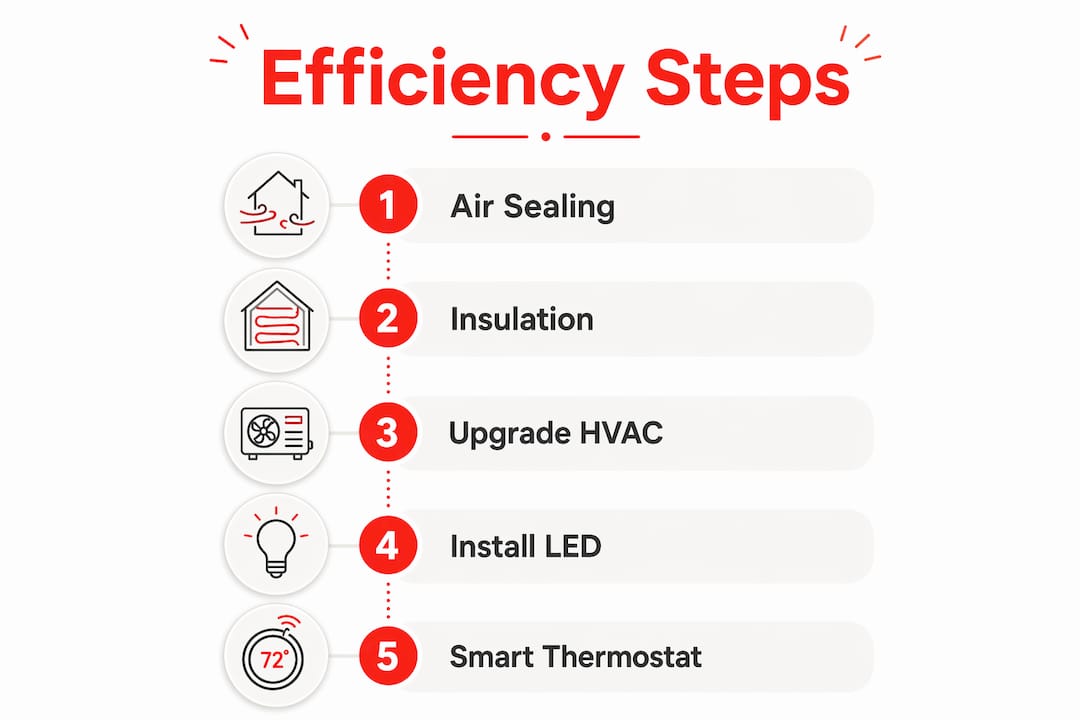
- Seal air leaks and add insulation. Professionals consistently prioritize sealing envelope leaks around windows, doors, and attic hatches before recommending any other upgrade. These fixes are low cost, require no special equipment, and deliver quick, measurable savings. Proper insulation keeps conditioned air inside during summer and winter, reducing how hard your HVAC system has to work.
- Switch to LED lighting throughout your home. LED bulbs use up to 75 percent less energy than incandescent bulbs and last significantly longer. This is one of the fastest payback upgrades available, with most households recouping the cost within months rather than years.
- Upgrade to ENERGY STAR appliances. The ENERGY STAR certification, managed by the U.S. Environmental Protection Agency, identifies products that meet strict efficiency standards. Refrigerators, washing machines, dishwashers, and water heaters with this label use substantially less energy than standard models without sacrificing performance.
- Install a smart thermostat. Devices like the Google Nest Thermostat or Ecobee SmartThermostat learn your schedule and adjust heating and cooling automatically. Smart thermostats for efficient homes can reduce HVAC energy use by 10 to 15 percent annually, which is significant given that heating and cooling typically account for nearly half of a home’s total energy bill.
- Practice load shifting. Running appliances during off-peak hours reduces utility bills without any capital investment. Many utility companies charge lower rates during evenings and weekends. Running your dishwasher or washing machine at 9 p.m. instead of 6 p.m. costs you nothing to implement and reduces strain on the grid during peak demand periods.
- Schedule routine HVAC maintenance. Reducing HVAC runtime through efficiency upgrades lowers maintenance costs and extends equipment lifespan. A well-maintained system runs more efficiently, breaks down less often, and lasts years longer than a neglected one. Annual tune-ups typically cost $80 to $150 and can prevent repairs that run into the thousands.
- Monitor usage with a smart meter or energy monitor. Devices like the Sense Energy Monitor or utility-provided smart meters show you exactly where your energy goes. Seeing real-time data on which appliances draw the most power is one of the fastest ways to identify waste and prioritize your next upgrade.
Pro Tip: Treat your efficiency upgrades as a sequence, not a single project. Start with air sealing and insulation, then lighting, then appliances, then smart controls. Each layer builds on the last, and your savings grow with every step.
What is the broader impact of home energy efficiency?
Individual homeowner decisions, when multiplied across millions of households, produce effects that reach far beyond any single utility bill. The scale of that impact is worth understanding.
Buildings account for 37% of global energy-related CO2 emissions. Residential efficiency improvements reduce this figure directly and substantially. When demand drops across a region, utilities need fewer power plants running at full capacity, which cuts emissions from the generation side as well as the consumption side.
The American Council for an Energy-Efficient Economy (ACEEE) found that utility efficiency programs save energy at a median cost of $21 per megawatt-hour. That is less than half the cost of building new natural gas power plants, which run between $45 and $108 per megawatt-hour. This means that every dollar invested in home efficiency programs is more than twice as effective as building new generation capacity. The savings benefit every ratepayer, not just those who upgraded.
“Energy efficiency is the fastest, cheapest way to stabilize grid reliability amid rising demand from AI, data centers, and electrification.” — American Customer Satisfaction Index, 2026
The national security dimension is real as well. Efficiency reduces dependence on energy imports by approximately 19 percent, which insulates the economy from geopolitical price shocks and supply disruptions. Research published in PLOS Climate confirms that efficiency acts as a hedge against energy market volatility more reliably than fossil fuel subsidies. When you upgrade your home’s efficiency, you are participating in something larger than your own utility bill.
| Scale | Impact |
|---|---|
| Individual household | $425 to $555 in annual savings, improved air quality, better comfort |
| Community and grid | Reduced peak demand, fewer peaker plants needed, lower infrastructure costs |
| National | 19% reduction in energy import dependence, greater economic stability |
| Global | Meaningful reduction in the 37% of CO2 emissions attributed to buildings |
Key takeaways
Energy efficiency reduces household energy costs by 25 to 30 percent annually while cutting emissions, improving indoor health, and strengthening grid stability at a national scale.
| Point | Details |
|---|---|
| Immediate financial savings | Consistent efficiency measures save the average household $425 to $555 per year. |
| Health and comfort gains | Efficient homes reduce asthma and respiratory issues by 40% through better ventilation and moisture control. |
| Start with air sealing | Fixing insulation gaps and phantom loads delivers fast returns before any costly tech upgrade. |
| Grid and national benefits | Efficiency programs save energy at half the cost of new gas plants, reducing demand and emissions at scale. |
| Conservation amplifies efficiency | Pairing behavioral habits like load shifting with hardware upgrades maximizes savings with no added cost. |
Why I think efficiency is the smartest home investment you can make right now
I have spent years covering home improvement and energy topics, and the conversation around efficiency has shifted dramatically in the past two years. It used to be framed as an environmental obligation. Now it is a financial necessity, and the data backs that up completely.
What strikes me most is how the rise of AI infrastructure and widespread electrification has changed the grid math. Demand for electricity is climbing faster than new generation can be built, and efficiency has become the fastest, cheapest stabilizer available. That means your decision to seal a drafty window or install a smart thermostat is not just a personal financial win. It is a contribution to a system that everyone depends on.
What I find most underappreciated is the health angle. Homeowners focus on bills and emissions, which makes sense. But the 40 percent reduction in respiratory issues tied to efficiency upgrades is the kind of outcome that changes daily life in ways you feel every morning. Better sleep, fewer sick days, less anxiety about the next utility bill. These are not small things.
My honest advice: do not wait for a perfect plan or a large budget. Start with the cheapest fixes, air sealing, LED bulbs, and load shifting, and build from there. The energy efficiency industry employed 2.3 million Americans in 2024, which means the products, contractors, and expertise you need are widely available and increasingly affordable. Treat efficiency as a year-round habit, not a one-time project, and the benefits compound in ways that genuinely transform how your home feels and performs.
— Alexander
Upgrade your home with comfort and efficiency in mind
If this article has you thinking about where to start, the good news is that the most rewarding upgrades are also the most practical ones. From better insulation to smart home controls, the right improvements deliver savings you feel on your bill and comfort you feel every day. Explore home upgrades that boost comfort and value for a curated look at the changes that deliver the strongest returns. You can also browse energy-efficient home upgrades for 2026 to find specific products and strategies matched to today’s market. Lizardslunch covers the full range of home improvement ideas that make your space more livable, more sustainable, and more valuable over time.
FAQ
What does energy efficiency mean for a homeowner?
Energy efficiency means performing everyday tasks like heating, cooling, and lighting using less energy through better technology and smarter habits. For homeowners, this translates directly into lower utility bills, a more comfortable home, and a reduced environmental footprint.
How much money can energy efficiency save me each year?
Strategic efficiency measures can reduce the average household energy bill by 25 to 30 percent annually, saving between $425 and $555 per year based on typical U.S. energy spending of $1,700 to $1,850.
What is the difference between energy efficiency and energy conservation?
Energy efficiency uses improved technology to do the same tasks with less energy, such as LED bulbs or high-efficiency HVAC systems. Energy conservation reduces overall energy use through behavioral changes, like turning off lights or shifting appliance use to off-peak hours. Both approaches lower bills and emissions, and they work best when combined.
Where should I start with home energy efficiency improvements?
Start by sealing air leaks around windows, doors, and the attic, since these low-cost fixes deliver fast returns before any expensive upgrade. From there, switch to LED lighting, then upgrade to ENERGY STAR appliances, and consider a smart thermostat to automate heating and cooling optimization.
How does home energy efficiency affect the environment?
Buildings account for 37 percent of global energy-related CO2 emissions, and residential efficiency improvements reduce that figure directly. When homeowners collectively lower demand, utilities need fewer power plants running at capacity, which cuts emissions from both the consumption and generation sides of the energy system.
















Leave a Comment
Your email address will not be published. Required fields are marked with *