

Discover the true meaning of the word science. Explore its origins, methods, and how understanding it can enhance your thinking.
Science is defined as the systematic study and organized body of knowledge acquired through observation, experimentation, and reasoning. The meaning of the word science goes far deeper than a school subject or a lab coat. It describes a method of thinking that humans have refined over centuries to understand the world around them. The scientific method, rooted in empirical observation and logical analysis, sits at the heart of this definition. Whether you are a student encountering the term for the first time or an educator looking for sharper clarity, understanding what science truly means opens a door to thinking more clearly about nearly everything.
What is the origin and etymology of the word “science”?
The word “science” traces directly to the Latin root scientia, meaning knowledge or understanding. That Latin term itself descends from Proto-Indo-European roots connected to the idea of cutting or separating, suggesting the act of distinguishing one thing from another through careful observation. This linguistic ancestry tells you something important: science has always been about making clear distinctions based on evidence.

English usage since the 14th century places “science” among the oldest borrowed Latin terms in the language. That is nearly 700 years of continuous use, which means the word has had plenty of time to shift in meaning.
In its earliest English appearances, “science” referred broadly to any organized body of knowledge. Theology, philosophy, rhetoric, and even music were all called sciences. The word simply meant a field of disciplined study. This broad usage persisted well into the Renaissance, when scholars called themselves “natural philosophers” rather than scientists.
The professional identity of the scientist is actually a modern invention. The term “scientist” was coined in 1834 by William Whewell, who introduced it to describe practitioners of science as a distinct professional group. Before that, figures like Isaac Newton and Galileo Galilei would never have called themselves scientists. They were natural philosophers, a title that reflected the older, broader meaning of the word.
Key milestones in the word’s evolution:
- 14th century: “Science” enters English from Latin scientia, meaning general knowledge
- 15th–17th century: Used broadly to describe any organized field of study, including theology and the arts
- 18th century: Increasingly associated with natural philosophy and systematic observation of the physical world
- 1834: William Whewell coins “scientist,” creating a new professional identity
- 20th century: “Science” narrows in common usage to refer primarily to natural, social, and formal sciences
Pro Tip: When you read historical texts and encounter the word “science,” check the date. Before the 19th century, the author likely meant any organized body of knowledge, not just physics or biology.
How is science defined and categorized in modern education?
Modern education divides science into two broad categories: basic science and applied science. Understanding this distinction helps you see why some research feels abstract and theoretical while other work produces immediate, practical results.
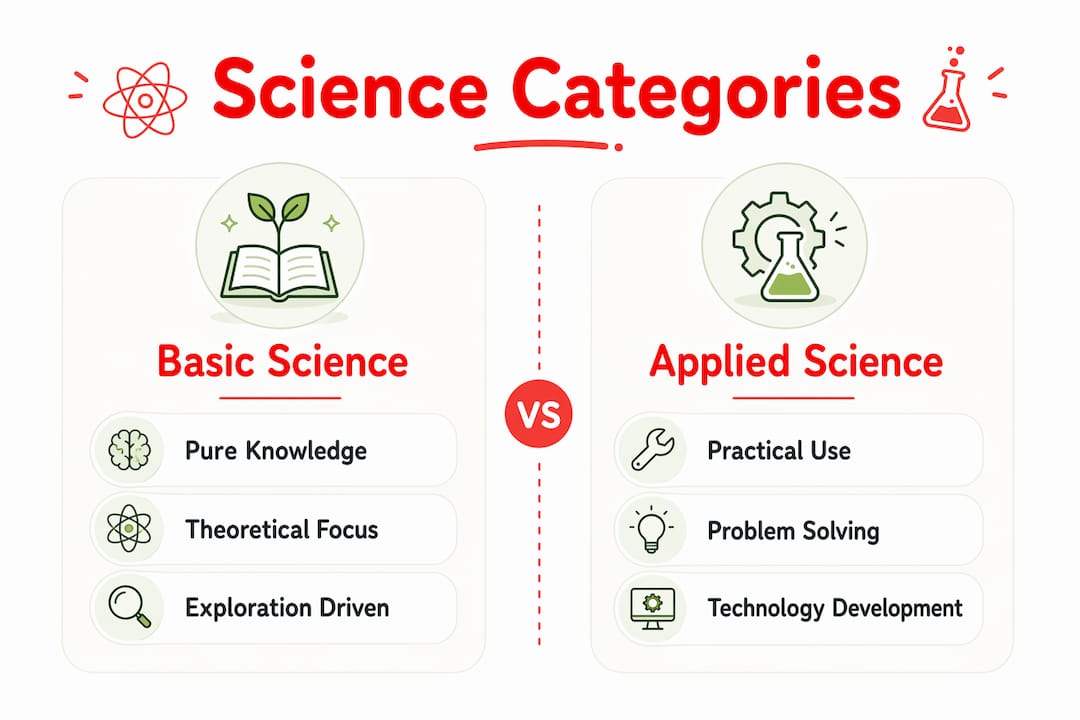
Basic science focuses on expanding knowledge for its own sake, without a specific application in mind. Applied science uses that accumulated knowledge to solve real-world problems. Both are equally valid and deeply connected. The discoveries of basic science almost always feed into applied science eventually, sometimes decades later.
Here is how modern science breaks down into its major branches:
- Natural sciences study the physical world through observation and experiment. Biology, chemistry, physics, astronomy, and geology all fall here. These fields follow the strictest version of the scientific method.
- Social sciences apply scientific methods to human behavior and society. Psychology, sociology, economics, and anthropology are social sciences. They use data, observation, and hypothesis testing, though human behavior is harder to control than a chemical reaction.
- Formal sciences include mathematics and logic. These fields rely on deduction and internal consistency rather than empirical observation. Mathematics serves as the essential language for quantifying data and testing hypotheses across all other sciences.
- Applied sciences translate findings from natural and social sciences into practical tools. Engineering, medicine, and computer science are prime examples. They exist at the intersection of knowledge and utility.
- Interdisciplinary fields blend two or more categories. Biochemistry, environmental science, and cognitive science all cross traditional boundaries. These fields have grown rapidly because the most interesting questions rarely fit neatly into one box.
The role of the scientific method ties all these categories together. Regardless of the field, reproducibility and validation of scientific knowledge depend on following a consistent process of inquiry. A psychology study and a physics experiment both require a testable hypothesis, controlled conditions, and repeatable results.
Pro Tip: When evaluating a claim labeled as “scientific,” ask which category it belongs to. A finding from a formal science like mathematics carries different implications than a finding from a social science, where human variables are harder to control.
What are the key principles and methods that define science?
The scientific method is the engine that drives all scientific inquiry. It is an empirical cycle built on four core steps, and every branch of science relies on it.
The four steps of the scientific method:
- Observation: You notice a phenomenon and ask a question about it. This is where curiosity becomes structured inquiry.
- Hypothesis formulation: You propose a testable explanation for what you observed. A good hypothesis makes a specific, falsifiable prediction.
- Testing: You design and conduct experiments to test your hypothesis. Controls and variables must be carefully managed.
- Conclusion: You analyze your results and determine whether they support or refute your hypothesis. You then share your findings so others can replicate them.
Science assumes an objective reality governed by natural laws that can be discovered through systematic experimentation. This assumption is what makes science trustworthy. If reality were not consistent, experiments could not be repeated and results could not be verified.
Evidence and logic are the two pillars of scientific reasoning. Evidence comes from observation and measurement. Logic connects evidence to conclusions in a way that can be checked and challenged. Neither pillar works without the other.
| Principle | What it means | Why it matters |
|---|---|---|
| Empiricism | Knowledge comes from observation and experience | Grounds science in the real world |
| Falsifiability | A claim must be testable and potentially provable wrong | Separates science from belief |
| Reproducibility | Results must be repeatable by independent researchers | Builds trust in findings |
| Objectivity | Personal bias must be minimized | Keeps conclusions reliable |
| Mathematics | Quantifies and models phenomena precisely | Enables precise predictions |
Science is limited to phenomena observable or measurable by current technology. This is not a weakness. It is a defining boundary that keeps scientific claims honest. Supernatural entities, unfalsifiable beliefs, and unobservable phenomena fall outside the scope of science. Science does not claim they do not exist. It simply cannot test them.
How has the meaning of “science” changed over time?
The semantic shift in the word “science” is one of the most dramatic in the English language. Historically, science encompassed theology, humanities, and arts before narrowing significantly by the mid-20th century. That narrowing reflects a cultural decision about what counts as rigorous knowledge.
The shift from broad knowledge to primarily natural sciences happened gradually through the 18th and 19th centuries. The rise of natural sciences in common language during the 20th century cemented the modern meaning. Today, when someone says “science says,” they almost always mean findings from natural or social sciences, not philosophy or theology.
| Era | Meaning of “science” | Typical practitioners |
|---|---|---|
| Medieval period | Any organized body of knowledge | Scholars, clergy, philosophers |
| Renaissance | Natural philosophy and classical learning | Natural philosophers, theologians |
| 18th century | Systematic study of the natural world | Natural philosophers |
| 19th century | Empirical study; “scientist” coined in 1834 | Scientists, researchers |
| 20th–21st century | Natural, social, and formal sciences | Scientists across specialized fields |
The inclusion of social sciences in the modern definition was not automatic. For much of the 19th century, fields like sociology and psychology fought for recognition as legitimate sciences. Their eventual inclusion expanded the science concept to cover human behavior, not just the physical world.
Formal sciences like mathematics and logic occupy an interesting position. Mathematics and logic rely on deduction rather than empirical observation, which makes them different from natural sciences. Yet they are indispensable to every other scientific field. Most educators now include them under the science umbrella because of how deeply they support empirical inquiry.
The emergence of the word “scientist” in 1834 did more than create a job title. It signaled that science had become a profession, not just a pastime for wealthy gentlemen. This professionalization accelerated specialization, which is why today you have neuroscientists, astrophysicists, and behavioral economists rather than a single class of natural philosophers. Understanding why education matters in this context helps explain how the professionalization of science shaped modern institutions.
The public understanding of science also shifted with these changes. When the word narrowed, it gained authority. Calling something “scientific” became a powerful endorsement. That authority carries responsibility, because it means the public relies on the word to signal trustworthiness.
Key Takeaways
Science is defined as the systematic pursuit of knowledge through empirical observation, hypothesis testing, and reproducible experimentation, with its meaning evolving from broad scholarship to specialized natural, social, and formal sciences over seven centuries.
| Point | Details |
|---|---|
| Latin origin | “Science” derives from scientia, meaning knowledge, and has been used in English since the 14th century. |
| Two main categories | Basic science expands knowledge for its own sake; applied science uses that knowledge to solve real-world problems. |
| Scientific method | Observation, hypothesis, testing, and conclusion form the four-step cycle that validates all scientific knowledge. |
| Scope and limits | Science covers only observable and measurable phenomena; supernatural claims fall outside its testable boundaries. |
| Evolving meaning | The word once covered theology and the arts but narrowed to natural, social, and formal sciences by the 20th century. |
Why the definition of science matters more than you think
Our team at Lizard’s Lunch has spent a lot of time thinking about how words shape understanding. The word “science” is a perfect case study in how a single term can carry enormous weight while quietly shifting meaning beneath our feet.
What strikes us most is how the narrowing of the word created both clarity and confusion at the same time. Clarity, because “science” now signals a specific method of inquiry with real standards. Confusion, because many readers assume that anything outside that narrow definition is therefore unreliable or unimportant. That is a mistake worth correcting.
The professionalization of science in the 19th century was genuinely exciting. It meant that knowledge production became accountable, repeatable, and open to challenge. Those are good things. But it also created a cultural gap between scientific communities and the general public. When people feel that science is something done by experts in labs rather than a way of thinking available to everyone, they disengage from it.
The most useful insight we can offer is this: the scientific method is not a gatekeeping tool. It is a thinking framework that anyone can apply. You observe, you hypothesize, you test, and you revise. That process works whether you are studying climate data or deciding which diet actually helps you feel better. The formal definition of science belongs to institutions. The spirit of science belongs to everyone.
We also think the inclusion of mathematics and formal logic in the science umbrella is underappreciated. These fields prove that not all scientific thinking requires a test tube. Deductive reasoning, when applied rigorously, produces knowledge just as reliable as any experiment. That is a liberating idea for students who love logic but feel alienated by lab work.
— Our team at Lizard’s Lunch
Curious minds deserve great guides
Science teaches us to ask better questions about the world. That same curiosity applies beautifully to how we live, what we eat, how we move, and how we take care of ourselves. At Lizardslunch, we believe that understanding concepts like science is just the beginning of a richer, more informed life.
If the spirit of inquiry has you thinking about your own habits and choices, our complete healthy lifestyle guide is a great next read. It applies the same evidence-based thinking to everyday wellness decisions, from nutrition to sleep to movement. Clear information, no jargon, and practical takeaways you can actually use.
FAQ
What is the simplest definition of science?
Science is the systematic study of the natural world through observation, experimentation, and reasoning. It produces organized, reproducible knowledge governed by the scientific method.
Where does the word “science” come from?
The word comes from the Latin scientia, meaning knowledge or understanding, and has been in English use since the 14th century.
What is the difference between basic and applied science?
Basic science expands knowledge for its own sake, while applied science uses that knowledge to solve specific real-world problems. Both rely on the same scientific method.
Does science cover everything?
Science covers only phenomena that are observable or measurable by current technology. Supernatural or unfalsifiable claims fall outside its scope, not because they are dismissed, but because they cannot be empirically tested.
When was the word “scientist” first used?
William Whewell coined the term “scientist” in 1834 to describe practitioners of science as a distinct professional group, replacing the older term “natural philosopher.”


















Leave a Comment
Your email address will not be published. Required fields are marked with *