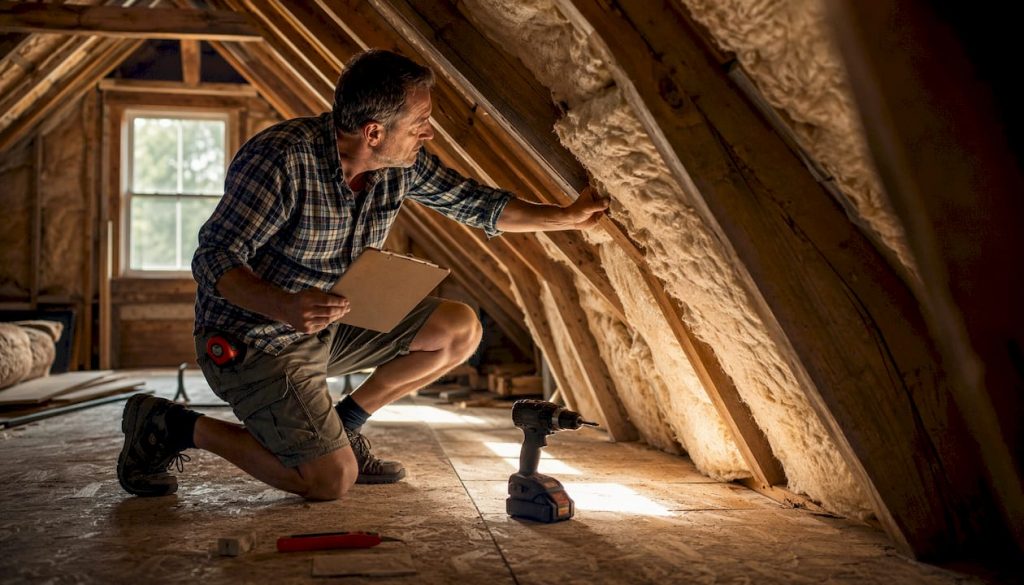
Explore the best types of home insulation for your needs. Learn what to use, where to insulate, and how to save on energy costs.
The most practical insulation options for U.S. homes are fiberglass, cellulose, mineral wool, spray foam (open- and closed-cell), rigid foam board, radiant/reflective barriers, and insulated concrete systems. Choosing among them comes down to four things: where in the house you’re insulating, your climate zone, moisture exposure, and budget.
Here’s a quick-pick guide for the most common jobs:
- Attic top-up: Loose-fill cellulose or fiberglass blown over existing insulation is the most cost-effective move for most homeowners.
- Wall retrofit (finished walls): Dense-pack cellulose or open-cell spray foam injected through small holes avoids major demolition.
- Basement and crawlspace: Closed-cell spray foam or rigid foam board wins here because moisture resistance matters more than R-value per dollar.
- Soundproofing or fire-rated assemblies: Mineral wool (rock or slag wool) is the go-to for both.
- Hot-climate attic: A radiant/reflective barrier reduces summer heat gain before bulk insulation even comes into play.
The selection principle never changes: match the material to the location, climate, and moisture risk first, then optimize for budget.
Pro Tip: Air sealing and insulation are a team. Insulation resists conductive heat transfer, but it does not stop air leakage on its own. Seal bypasses, gaps around pipes, and top-plate penetrations before you add any bulk insulation for the best real-world results.
Table of Contents
- How do the main insulation types compare at a glance?
- A closer look at each major insulation type
- How do you choose the right insulation for your home?
- What you need to know about installation and safety
- R-value and cost reference by material
- Key Takeaways
- Our team’s take: what actually moves the needle on home comfort
- Authoritative sources and further reading
How do the main insulation types compare at a glance?
The table below covers the practical dimensions homeowners care about most. Use it to narrow your shortlist before diving into the detailed entries.
| Material | Best for | R-value per inch | Cost shape | Moisture resistance | DIY ease | Environmental/IAQ notes | Fire resistance |
|---|---|---|---|---|---|---|---|
| Fiberglass batts | Walls, attic floors, floors | R-3.0–R-4.3 | Low material cost | Low–moderate; needs vapor retarder | Easy | Glass fibers; wear PPE | Noncombustible |
| Fiberglass loose-fill | Attic floors (blown) | R-3.0–R-4.3 | Low–moderate | Low; needs vapor retarder | Moderate (blower rental) | Same PPE caution | Noncombustible |
| Cellulose loose-fill | Attic floors, dense-pack walls | R-3.2–R-3.8 | Moderate | Moderate; can absorb moisture | Moderate (blower rental) | Recycled paper; low VOC | Treated with borate |
| Mineral wool | Fire-rated walls, sound assemblies | R-3.0–R-3.3 | Moderate–high | Good; naturally water-repellent | Moderate | Recycled slag/rock; low VOC | Excellent; melts above 1,800°F |
| Open-cell spray foam | Interior walls, sound control | R-3.5–R-3.6 | High (labor + material) | Low; permeable, needs vapor retarder | Pro recommended | Off-gasses during cure; low after | Requires intumescent coating |
| Closed-cell spray foam | Rim joists, basements, rooflines | R-6–R-7 | Highest | Excellent; acts as vapor barrier | Pro required | Higher embodied carbon | Requires intumescent coating |
| Rigid foam (EPS/XPS/polyiso) | Exterior continuous, below-grade | R-3.8–R-6.5 | Moderate–high | Good–excellent | Moderate | Blowing agents vary; check GWP | Requires thermal barrier |
| Radiant/reflective barrier | Hot-climate attics | N/A (reduces radiant gain) | Low | N/A | Easy | Foil; minimal IAQ concern | Noncombustible |
| ICFs/concrete block | New construction foundations, walls | R-17–R-26 (whole assembly) | High (structural system) | Excellent | Pro only | Concrete + foam; durable | Excellent |
Two high-impact callouts:
- Best for attics: Blown-in cellulose or fiberglass over the attic floor is the highest-ROI upgrade for most existing homes. It’s accessible, relatively inexpensive, and you can often DIY with a rented blower.
- Best for below-grade: Closed-cell spray foam or rigid XPS board on the interior of basement walls resists moisture and doubles as a vapor barrier, which permeable materials cannot do reliably in that environment.
Insulation resists conductive heat transfer, but air sealing paired with insulation is what delivers durable energy savings. Bypasses and gaps around pipes, wires, and top plates can undermine even a perfectly installed R-38 attic.
A closer look at each major insulation type
1. Fiberglass batts and rolls
Fiberglass is the most common insulation material in U.S. homes, sold as pre-cut batts or continuous rolls sized to fit standard 16-inch and 24-inch stud cavities. R-value runs R-3.0–R-4.3 per inch depending on density. It’s noncombustible, widely available at every home center, and the cheapest option per square foot for new-construction wall cavities.
The catch is fit. Fiberglass batts lose meaningful R-value when compressed, cut around obstructions poorly, or left with gaps at edges. Wear gloves, safety glasses, and an N95 respirator during installation; the fine glass fibers irritate skin and lungs. Fiberglass does not resist moisture on its own, so pair it with an appropriate vapor retarder in cold climates.
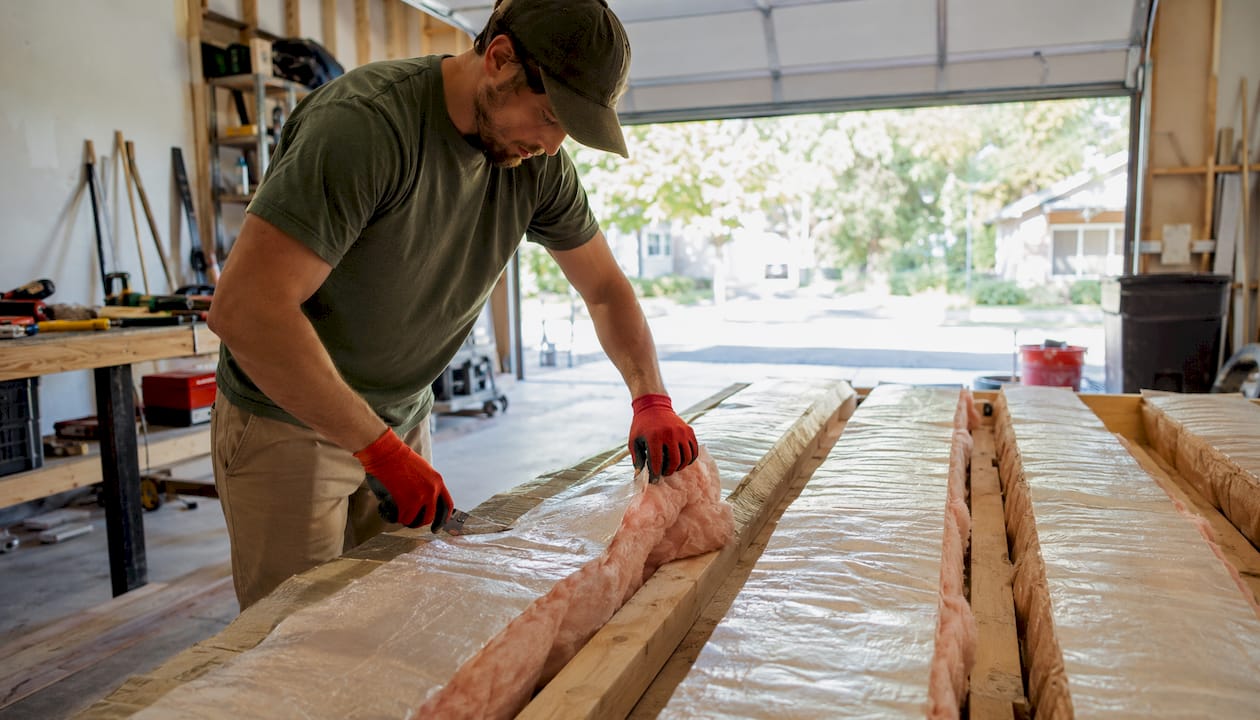
Pros: Low cost, widely available, noncombustible, easy to cut and fit in open cavities.
Cons: Performance drops sharply with poor fit; no air-sealing value; requires PPE.
2. Cellulose loose-fill and dense-pack
Cellulose is made from roughly 80% recycled newsprint treated with borate for fire and pest resistance. Blown loose-fill in open attic floors delivers R-3.2–R-3.8 per inch and settles slightly over time, so installers typically overshoot the target depth. Dense-pack cellulose, injected into closed wall cavities at higher density, resists air movement better than batts and is a popular choice for wall retrofits in older homes.
It has the lowest embodied energy of any common insulation material and a strong recycled-content story. The borate treatment is low-toxicity and does not off-gas. One caution: cellulose can absorb moisture if exposed to bulk water, so it’s not ideal for below-grade applications without careful moisture management.
Pros: High recycled content, good R-value per dollar, effective dense-pack for retrofits, low VOC.
Cons: Can absorb moisture; settles in attics; requires blower equipment.
3. Mineral wool (rock wool and slag wool)
Mineral wool is made from volcanic rock or steel-mill slag spun into fibers. It delivers R-3.0–R-3.3 per inch, but its real advantages are fire resistance (it doesn’t melt until above 1,800°F) and sound attenuation. It’s the preferred choice for party walls, mechanical rooms, and any assembly where a fire-rated detail is required by code.
Mineral wool is naturally water-repellent, which gives it a durability edge over standard fiberglass in humid conditions. It costs more per square foot than fiberglass batts but less than spray foam. Brands like Rockwool (formerly Roxul) have made it increasingly available at retail.
Pros: Excellent fire and sound performance, moisture-resistant, high durability.
Cons: Higher cost than fiberglass; heavier and stiffer to cut; some fiber irritation during install.
4. Open-cell spray foam
Open-cell spray foam expands dramatically on application, filling irregular cavities and sealing air leaks simultaneously. R-value is modest at R-3.5–R-3.6 per inch, but the air-sealing benefit is significant. It’s vapor-permeable, which means walls can dry to the interior, but that also means it needs a vapor retarder in cold climates.
Open-cell foam is softer and less expensive than closed-cell, making it a reasonable choice for interior wall cavities and cathedral ceilings where air sealing matters more than maximum R-value per inch. Professional installation is strongly recommended: the two-component chemistry requires precise mixing ratios and temperature control, and the foam off-gasses during cure. Occupants should vacate during application and for the period the installer specifies.
Pros: Excellent air sealing, fills irregular shapes, good sound dampening.
Cons: Low moisture resistance; requires pro install; off-gasses during cure; needs intumescent coating for fire code compliance.
5. Closed-cell spray foam
Closed-cell spray foam is the highest R-value-per-inch option available at R-6–R-7 per inch, and it acts as both an air barrier and a vapor barrier. That combination makes it the top choice for rim joists, basement walls, rooflines, and any location where moisture intrusion is a real risk. A 2-inch layer on a rim joist delivers roughly R-13 while sealing every gap in one pass.
The trade-off is cost. Closed-cell foam carries the highest installed cost of any insulation material, driven by material price and the specialized equipment required. It also has a higher embodied carbon footprint than fiber-based options because of the blowing agents used. For small, high-moisture areas like rim joists, the performance premium is usually worth it. For large open attic floors, it rarely is.
Pros: Highest R-value per inch, excellent vapor and air barrier, durable, structural stiffening effect.
Cons: Most expensive option; high embodied carbon; professional installation required; requires thermal barrier per fire code.
6. Rigid foam boards (EPS, XPS, and polyiso)
Rigid foam boards come in three main chemistries. EPS (expanded polystyrene, the white beadboard) runs R-3.8–R-4.0 per inch and is the most vapor-permeable of the three, making it a good choice for below-grade applications where some drying potential is desirable. XPS (extruded polystyrene, typically pink or blue) delivers R-5 per inch and resists moisture absorption well, though its blowing agents carry a higher global warming potential. Polyiso reaches R-6–R-6.5 per inch near 75°F but derates in cold climates, so cold-climate designers often use a derated R-5 value for exterior applications.
All three are used for exterior continuous insulation, which eliminates thermal bridging through studs. That’s a significant performance gain in cold climates that cavity-only insulation cannot achieve. Rigid boards require a thermal barrier (typically ½-inch drywall) on the interior side per fire code.
Pros: High R-value per inch, excellent for exterior continuous layers, good moisture resistance.
Cons: Requires thermal barrier; cutting and fitting around details takes skill; cost varies by type.
7. Radiant and reflective barriers
Radiant barriers are foil-faced materials installed in attics to reflect radiant heat before it enters the living space. They work best in hot, sunny climates where summer cooling loads dominate. The DOE notes that the reflective surface must face an air space to function, so installation orientation matters. They do not have an R-value in the traditional sense and are not a substitute for bulk insulation in cold climates.
In the right application, a radiant barrier installed on attic rafters or over attic floor insulation can meaningfully reduce summer cooling costs. In mixed or cold climates, the benefit is much smaller and the money is better spent on additional bulk insulation.
Pros: Low cost, easy to install, effective at reducing summer heat gain in hot climates.
Cons: No cold-climate benefit; not a substitute for bulk insulation; requires proper air-space orientation.
8. Insulating concrete forms and concrete block insulation
Insulating concrete forms (ICFs) are hollow foam blocks stacked to form walls, then filled with reinforced concrete. The resulting assembly delivers whole-wall R-values in the R-17–R-26 range, along with excellent air tightness, thermal mass, and structural strength. They’re a new-construction or major-renovation product, not a retrofit option.
Concrete block walls in existing homes can be insulated by filling the cores with loose-fill insulation or applying rigid foam to the interior or exterior surface. Neither approach matches ICF performance, but both improve on uninsulated masonry.
Pros: Exceptional whole-wall R-value, durable, excellent air tightness, strong thermal mass.
Cons: New-construction or major-renovation only; high cost; professional installation required.
9. Natural and eco-friendly insulation materials
Sheep’s wool, recycled denim (cotton) batts, and cork board are available as lower-embodied-carbon alternatives to conventional materials. Sheep’s wool naturally manages moisture and resists mold; recycled denim batts are safe to handle without PPE and perform similarly to fiberglass batts at R-3.5–R-3.8 per inch. Cork board offers moderate R-value with excellent durability and is vapor-permeable.
These materials typically cost more than conventional options and have more limited availability. For homeowners prioritizing greener insulation choices, they’re worth pricing out, especially for smaller projects like interior wall cavities where the premium per square foot is manageable.
Pros: Low embodied carbon, safe handling, renewable sources, good IAQ profile.
Cons: Higher cost, limited availability, fewer certified installers familiar with them.
How do you choose the right insulation for your home?
Start with location and climate, not material. The DOE’s guidance frames it clearly: know where you’re insulating and what R-value you need before comparing materials. Here’s a practical checklist:
- Identify your climate zone. The DOE’s climate zone map sets recommended R-values by zone. Zone 1–2 (hot/humid South) targets R-30–R-49 in attics; Zone 5–7 (cold North) targets R-49–R-60.
- Name the building component. Attic floor, sloped roofline, exterior wall, basement wall, rim joist, and crawlspace each have different moisture dynamics and access constraints.
- Assess moisture exposure. Below-grade and high-humidity spaces need vapor-resistant materials (closed-cell foam, XPS). Above-grade, well-ventilated spaces tolerate permeable materials.
- Set your fire and sound goals. Fire-rated assemblies and party walls call for mineral wool. Standard residential walls do not require it.
- Decide on DIY vs. professional. ENERGY STAR guidance confirms that fiberglass batts and blown-in attic insulation are DIY-accessible; spray foam and dense-pack wall injection require certified installers.
- Set a realistic budget. Attic top-ups are the highest-ROI insulation upgrade for most existing homes and the easiest to phase in. Wall retrofits and exterior continuous insulation cost more and often require permits.
Decision flow by project type:
- Retrofitting finished walls: Dense-pack cellulose or open-cell spray foam injected through small holes. Minimal demolition, good air-sealing benefit.
- Open attic floor (new or top-up): Blown-in cellulose or fiberglass. Fast, cost-effective, DIY-possible with a rented blower.
- New construction walls (cold climate): Cavity fill (fiberglass or mineral wool) plus exterior rigid foam continuous layer to eliminate thermal bridging.
- Basement or crawlspace walls: Closed-cell spray foam or rigid XPS board. Moisture resistance is the deciding factor.
- Hot-climate attic: Radiant barrier plus bulk insulation on the attic floor.
Pro Tip: Before adding any bulk insulation, spend time air sealing. Foam-gun every gap around pipes, wires, and top-plate penetrations. A well-sealed attic with R-38 outperforms a leaky attic with R-60 in real-world energy use. Check your home improvement workflow to sequence the work correctly.
Watch for these warning signs that your current insulation needs attention: high energy bills, cold or damp walls, uneven room temperatures, frozen pipes, or ice dams on the roof edge. Consumer Reports flags all of these as reliable indicators that an insulation upgrade is overdue.
What you need to know about installation and safety
DIY-friendly vs. professional-only projects
Some insulation work is genuinely approachable for a careful homeowner. Other work is not, and attempting it without the right equipment creates both safety and performance risks.
DIY-accessible:
- Fiberglass batts in open wall or floor cavities
- Blown-in loose-fill in open attic floors (rented blower, two-person job)
- Rigid foam board cut-and-fit in accessible basement walls
- Radiant barrier stapled to attic rafters
Hire a professional:
- Any spray foam application (open- or closed-cell)
- Dense-pack cellulose in closed wall cavities
- Exterior continuous insulation requiring flashing and weather-barrier integration
- Insulation on or near HVAC ducts, flues, or recessed lights without IC ratings
Safety and health precautions
Wear an N95 respirator, safety glasses, and long sleeves for any fiber-based insulation (fiberglass, mineral wool, cellulose). Spray foam requires a full respirator with organic vapor cartridges during application; occupants must vacate and stay out until the foam has fully cured per the installer’s specification. Some foam facings and vapor retarders off-gas VOCs initially, so ventilate the space well after installation.
Closed-cell spray foam and certain rigid boards act as vapor barriers. Installing them on the wrong side of an assembly can trap moisture and cause mold. Always confirm your vapor control strategy with a building professional before sealing a wall or roofline.
Contractor questions worth asking
Before signing any insulation contract, ask:
- What is the air-sealing scope, and is it included in the quote?
- What vapor control strategy are you using for this assembly?
- What R-value will the finished installation achieve (not just the material R-value)?
- Are permits required, and who pulls them?
- What certifications do your spray foam installers hold?
Pro Tip: A thermal imaging camera or a blower-door test before and after installation is the most reliable way to confirm the work was done correctly. Many contractors offer this as part of a home energy audit. Pairing insulation with smart home diagnostics gives you ongoing visibility into performance.
R-value and cost reference by material
R-value per inch tells you how thick you need to go to hit your target. Installed cost depends on labor, equipment, access, and retrofit complexity.
| Material | R-value per inch | Typical installed cost shape | Primary cost drivers |
|---|---|---|---|
| Fiberglass batts | R-3.0–R-4.3 | Low | Material cost; labor minimal if DIY |
| Fiberglass loose-fill | R-3.0–R-4.3 | Low–moderate | Blower rental or contractor labor |
| Cellulose loose-fill | R-3.2–R-3.8 | Moderate | Blower equipment; densification for walls |
| Mineral wool batts | R-3.0–R-3.3 | Moderate–high | Higher material cost than fiberglass |
| Open-cell spray foam | R-3.5–R-3.6 | High | Specialized equipment; labor-intensive |
| Closed-cell spray foam | R-6–R-7 | Highest | Material cost; blowing agents; equipment |
| EPS rigid board | R-3.8–R-4.0 | Moderate | Cutting, fastening, thermal barrier |
| XPS rigid board | R-5 | Moderate–high | Material premium over EPS |
| Polyiso rigid board | R-6–R-6.5 (derated in cold) | Moderate–high | Material cost; cold-climate derate |
| Radiant barrier | N/A | Low | Material only; easy DIY install |
R-value figures above are per inch of material thickness. Installed R-value for an assembly can differ because of compression (batts squeezed into shallow cavities lose R-value), settling (cellulose in attics), and thermal bridging through studs. Always calculate the assembly R-value, not just the material R-value, when checking against DOE climate-zone targets.
Cost context: Attic top-ups consistently deliver the best return on investment of any insulation project. Wall retrofits and exterior continuous insulation cost significantly more because of labor complexity, potential permit requirements, and the need to integrate with windows, flashing, and weather barriers. Regional labor rates vary widely, so get at least two to three quotes for any project above a basic attic blow-in. For a broader view of home upgrades with strong ROI, it helps to see insulation in the context of your full improvement plan.
Key Takeaways
Choosing the right insulation comes down to matching the material to the location, moisture risk, and climate zone, then pairing it with thorough air sealing for real-world performance.
| Point | Details |
|---|---|
| Air sealing comes first | Seal gaps around pipes, wires, and top plates before adding bulk insulation for maximum energy savings. |
| Match material to location | Use closed-cell foam or rigid XPS below grade; blown-in cellulose or fiberglass for open attic floors. |
| R-value per inch vs. assembly R-value | Compression, settling, and thermal bridging reduce real-world performance; calculate assembly R-value, not just material R-value. |
| Attic upgrades offer the best ROI | Attic top-ups are the most cost-effective and accessible insulation project for most existing homes. |
| Hire pros for spray foam and dense-pack | Certified installers are required for spray foam applications and closed-wall dense-pack injection. |
Our team’s take: what actually moves the needle on home comfort
Most homeowners focus on R-value as the headline number, and it matters. But the single biggest performance gap our team at Lizard’s Lunch sees in real homes is not insufficient R-value. It’s air leakage that bypasses the insulation entirely. A well-sealed attic with a moderate R-value will outperform a leaky attic with a high one, every time. That’s where we’d put the first dollar.
The second thing worth saying plainly: no single material is universally best. Closed-cell spray foam is extraordinary for rim joists and basement walls, but using it across an entire attic floor is expensive and environmentally costly when blown-in cellulose does the job at a fraction of the price. The most effective approach is layered and location-specific. In cold climates, combining cavity fill with exterior rigid foam continuous insulation eliminates thermal bridging through studs in a way that cavity-only solutions never can.
When should you call a professional without hesitation? Spray foam, dense-pack wall injection, and any exterior insulation that requires integrating with windows and weather barriers. These are not projects where a small mistake is easily fixed. For everything else, a motivated homeowner with the right PPE and a rented blower can handle more than most people think. Start with the attic, seal the bypasses first, and you’ll feel the difference before the next utility bill arrives. For more on pairing insulation with broader energy efficiency upgrades, there’s a lot more ground to cover.
Authoritative sources and further reading
The following sources were used in researching this guide. Each is worth bookmarking for your own project planning.
- U.S. Department of Energy: Insulation — The primary reference for R-value targets by climate zone, insulation types, and installation guidance. Start here before any project.
- DOE: Types of Insulation (Building Science Education) — Clear explanations of how each material type works, including how radiant barriers differ from bulk insulation.
- DOE Consumer Guide to Home Insulation (PDF) — A concise printable reference covering insulation forms (batts, loose-fill, spray, rigid, reflective) and their benefits.
- ENERGY STAR: Certified Insulation Overview — Covers certification criteria, DIY vs. professional guidance, and how to find certified products and contractors.
- U.S. EPA: Identifying Greener Insulation — Useful for homeowners evaluating recycled content, VOC emissions, and environmental impact across insulation categories.
- Consumer Reports: How to Shop for Home Insulation — Practical shopping guidance including warning signs that insulation needs upgrading and what to look for in contractor quotes.
- Insulation Institute: Comparing Insulation Options — Side-by-side comparison of materials with notes on fire resistance, sound performance, and moisture behavior.
“To choose the best insulation for your home from the many types of insulation on the market, you’ll need to know where you want or need to install the insulation, and what R-value you want the installation to achieve.” — U.S. Department of Energy


















Leave a Comment
Your email address will not be published. Required fields are marked with *