
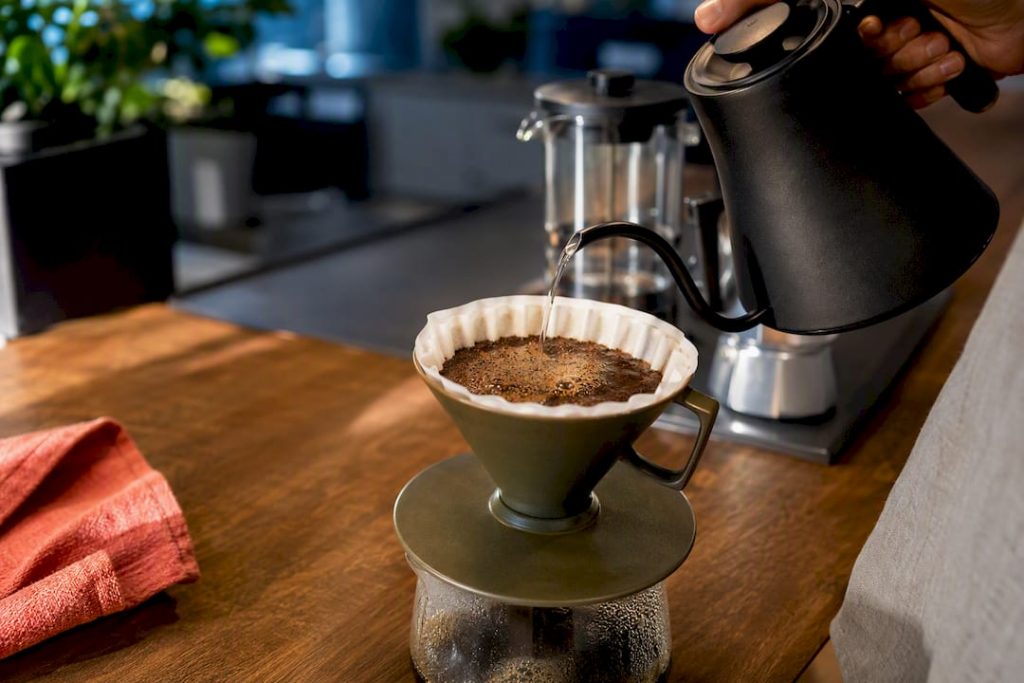
Explore 10 common coffee maker types and pick the one that fits your routine, whether a solo cup, family pot, or iced coffee batch. Includes upkeep and…
Coffee makers split into roughly ten common families: drip, single-serve pod machines, espresso, French press, pour-over, AeroPress, Moka pot, percolator, cold brew, and siphon. Every one of the draws on just two brewing principles, gravity or pressure, and the choice between them comes down to one question: do you want speed and volume, or flavor and control? Everything below breaks down which type answers that question best for your routine.
TL;DR:
- Pod machines are the most expensive per cup but require no grinding or measuring, making them ideal for quick, solo use.
- French presses and percolators produce full-bodied coffee with sediment, requiring immediate grounds disposal to avoid staining or bitterness.
- Coffee brewing mechanics predominantly rely on gravity for drip and pour-over methods, or pressure for espresso and Moka pots, affecting flavor and extraction quality.
- For households of four or more, automatic drip machines or large percolators are the most practical, while solo drinkers benefit from AeroPress or pour-over setups.
- Proper grinder quality and temperature control significantly influence flavor, often more than the choice of brewing device itself.
Table of Contents
- Coffee Maker Types at a Glance
- How Each Coffee Maker Type Actually Brews
- How to Choose the Right Coffee Maker for Your Routine
- Practical Tips and Common Mistakes to Avoid
- Our Editorial Take: Routine Beats Ritual for Most Buyers
- Sources
Coffee Maker Types at a Glance
Before you commit to a brewing ritual, it helps to see how the major categories stack up side by side. The table below compares convenience, the skill involved, what you’ll spend, and who each style suits best.
| Type | Convenience | Complexity | Cost range | Best for |
|---|---|---|---|---|
| Drip (automatic) | High | Low | affordable price range | Families, offices, daily volume |
| Single-serve pod | Very high | Very low | moderate price range with ongoing pod costs | Solo drinkers, mixed households |
| Espresso (pump) | Medium | High | wide price range including premium models | Milk drinks, espresso purists |
| French press | Medium | Low | budget-friendly to moderately priced | Full-bodied fans, small batches |
| Pour-over (V60, Chemex) | Low | Medium to high | affordable to moderate cost | Ritual brewers, flavor seekers |
| AeroPress | Medium | Low to medium | inexpensive | Travelers, single cups, campers |
| Moka pot | Medium | Medium | affordable to moderate cost | Stovetop espresso fans |
| Percolator | Medium | Low | budget-friendly | Camping, strong hot coffee |
| Cold brew device | Low (manual) to high (automatic) | Low | affordable to moderate cost | Iced coffee drinkers |
| Siphon/vacuum | Low | High | moderate to premium cost | Theatrical, clarity-focused brewers |
Running costs diverge more than the sticker price suggests. Pods cost more per cup than bagged or ground coffee, and Consumer Reports notes that trade-off in convenience comes with a real environmental footprint tied to pod recyclability. Cleanup varies just as much: rinse-and-go for AeroPress and pods, a full disassembly and grounds disposal for percolators and some espresso machines, and a quick basket dump for drip and French press.
- Pod machines cost more per cup than any other method on this list, but they eliminate grinding and measuring entirely.
- French press and percolators both leave behind wet grounds that need immediate disposal, or they’ll stain the carafe.
- Espresso machines with steam wands need daily wipe-downs and monthly descaling to avoid clogged lines.
How Each Coffee Maker Type Actually Brews
Every method on this list traces back to one of two mechanics: gravity pulling water through grounds, or pressure forcing it through. That single distinction explains most of the flavor differences you’ll taste between cups, according to the technical history of coffeemakers.
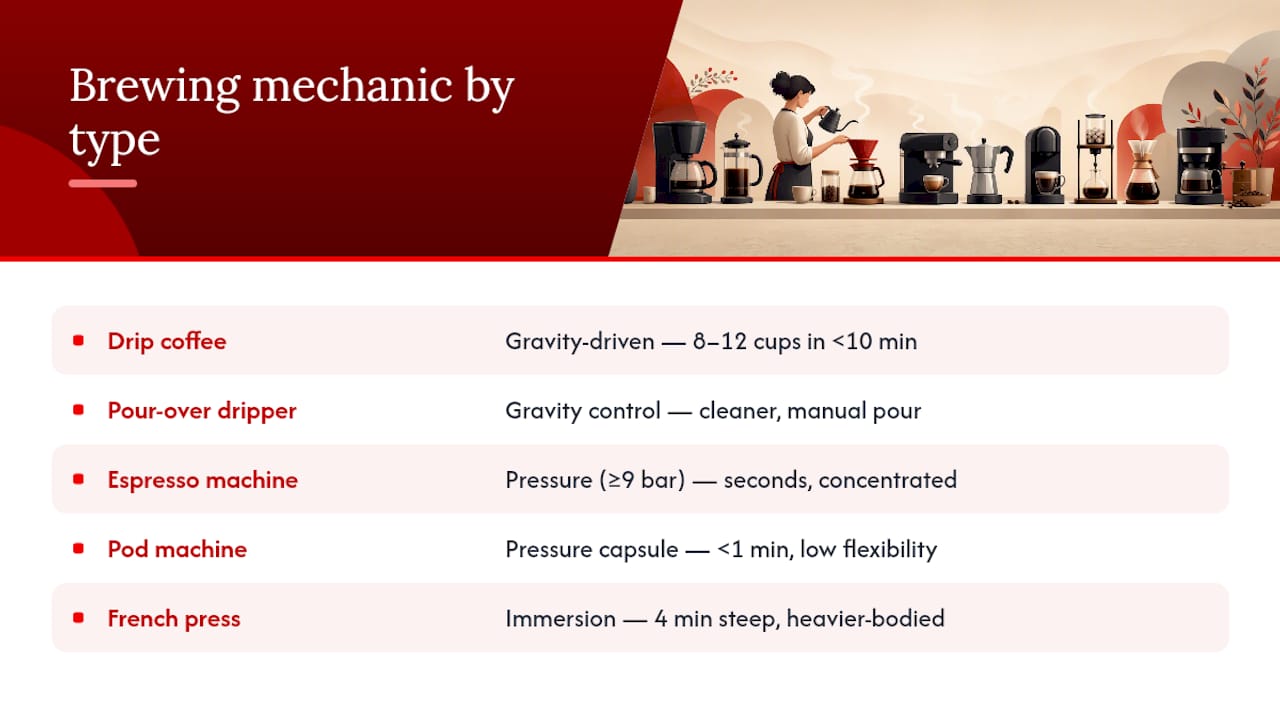
Drip coffee makers heat water and release it over grounds in a paper or mesh filter, letting gravity do the rest. They’re the default appliance in most kitchens because they brew 8 to 12 cups in under ten minutes with almost no hands-on effort. The catch: many budget drip machines skip a bloom cycle, the brief initial pour that lets trapped carbon dioxide escape before full extraction begins. Skipping bloom is a big reason drip coffee can taste flatter than a careful pour-over, though Consumer Reports found that premium drip machines with proper bloom and temperature control can rival pour-over quality. Look for programmability, a built-in grinder if you want fewer steps, and a thermal carafe instead of a hot plate that scorches coffee left sitting too long.
Single-serve pod machines use pressurized water forced through a sealed capsule, giving you a cup in under a minute with zero mess. They’re the easiest option for households where everyone drinks something different, but they’re the priciest per cup and the least flexible if you like adjusting strength or trying new beans.
Espresso machines rely on nine bars of pressure or more, forcing hot water through finely ground, tightly packed coffee in seconds. Manual lever machines demand real technique; pump-driven semi-automatics do the pressure work for you but still require you to grind, dose, and tamp correctly. Fully automatic bean-to-cup machines handle everything, at a steep price premium. A steam wand is the feature that separates casual espresso machines from ones built for lattes and cappuccinos.
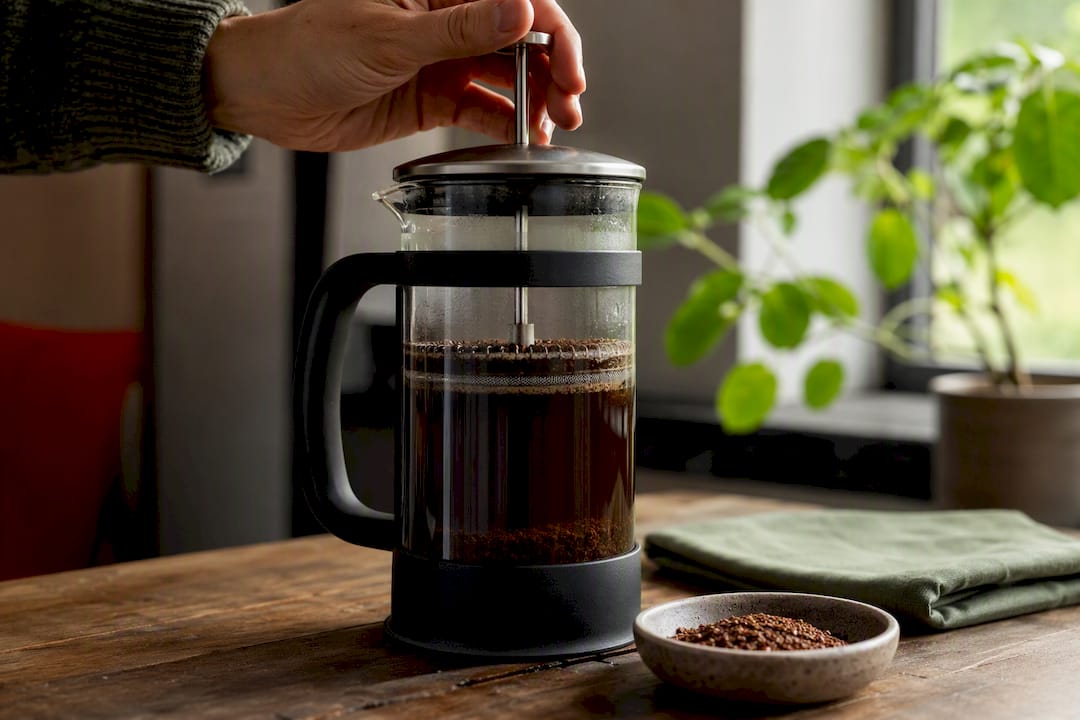
French press brews by full immersion: coarse grounds steep in hot water for four minutes before a metal mesh plunger separates them. The result is a heavier-bodied cup with more oils and some sediment, since the mesh filter lets fine particles through where paper wouldn’t. It’s ideal for two to four cups at once and needs almost no gear beyond the carafe itself, though French press technique matters more than most people assume when it comes to grind size and steep time.
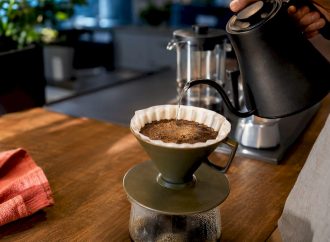
Pour-over drippers, like the V60 or Chemex, give you total control over water temperature, pour rate, and saturation, producing a cleaner, brighter cup than most drip machines manage. That control is exactly why pour-over enthusiasts swear by it and why casual drinkers find it tedious. Comparisons between pour-over and drip consistently point to the same trade-off: pour-over rewards patience with clarity, drip rewards convenience with volume.
AeroPress combines immersion and light pressure. You steep grounds briefly, then press the mixture through a paper filter with a plunger. It’s fast, produces a clean cup close to drip in clarity, and travels well since it’s plastic, unbreakable, and easy to rinse clean in seconds. Compared to French press, AeroPress wins on portability and cleanup, while French press wins if you’re brewing for more than two people at once.
Moka pots sit on a stovetop and use steam pressure to push water up through grounds and into an upper chamber, producing a concentrated, espresso-like shot without an actual espresso machine. The mechanics are simple, but getting the pressure and heat right takes a few tries before you stop scorching the coffee.
Percolators cycle boiling water repeatedly through grounds in a loop, and that repetition is both their strength and their flaw. You get a strong, very hot cup, but leave it percolating too long and it turns bitter fast. They’re a camping and cabin staple for good reason: no electricity required, just a heat source.
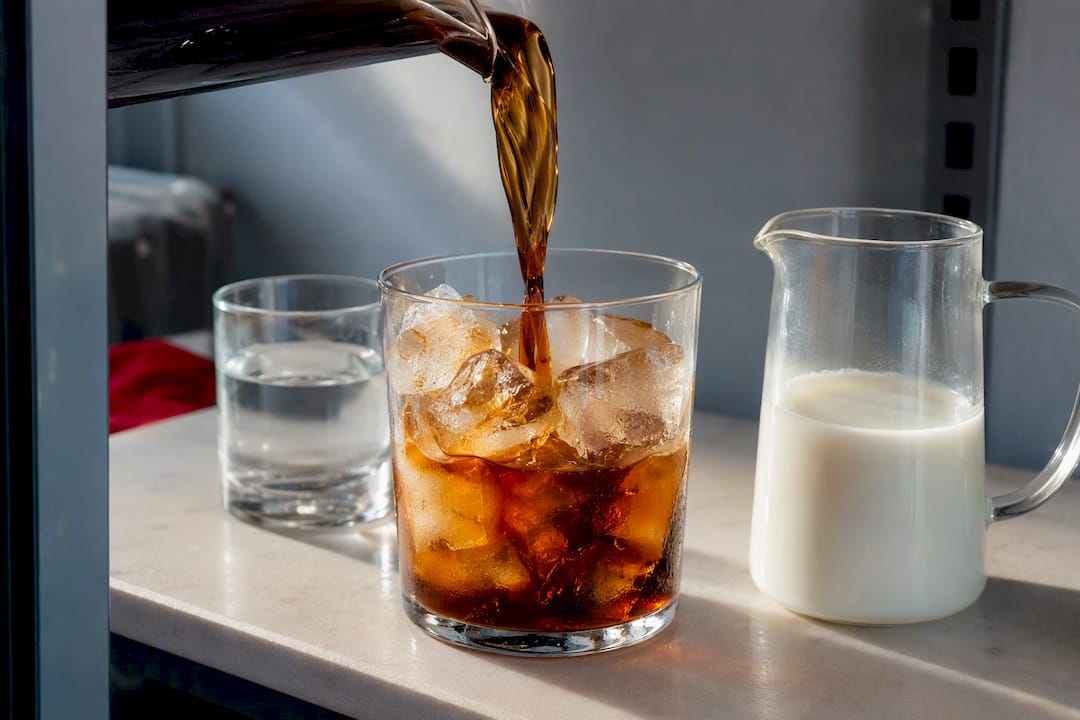
Cold brew devices steep coarse grounds in room-temperature or cold water for hours, producing a smooth, low-acid concentrate you dilute with water, milk, or ice. Manual steeping can take up to 24 hours; automatic cold-brew machines shorten that dramatically, some brewing in as little as four minutes using warmer water and different extraction methods.
Siphon (vacuum) brewers use vapor pressure to push water from a lower chamber into an upper one filled with grounds, then a vacuum pulls the brewed coffee back down through a filter once heat is removed. It’s the most theatrical method on this list and produces a remarkably clean, tea-like cup, but it demands patience and careful heat control.
Pro Tip: If you brew manually, don’t skip the bloom, a 30-second pre-soak that lets grounds release trapped gas before the real pour starts. Skipping it is the single most common reason home pour-over tastes sour or flat, even with good beans.
How to Choose the Right Coffee Maker for Your Routine
Start with volume, not flavor preference. If your household drinks four or more cups at once, manual single-cup methods simply aren’t practical; an automatic drip machine or a large percolator is your only realistic option. If you’re brewing for one or two people, AeroPress and pour-over open up.
Run through this checklist before you buy:
- How many cups do you need brewed at the same time, and how often per day?
- How much time are you willing to spend on technique versus pressing a button?
- How much counter space can you dedicate to the machine?
- What’s your upfront budget, and are you comfortable with ongoing costs like pods or filters?
- Do you want milk-based drinks, which points you toward espresso with a steam wand, or straight black coffee?
A useful reference point: Consumer Reports advises matching brewer size and features to actual household needs rather than buying the machine with the most features. A single person who wants one careful cup a day is better served by a $30 AeroPress than a $200 twelve-cup drip machine that sits half empty.
Quick recommendations: solo drinkers do well with AeroPress or a pour-over dripper; couples split between one taste and one speed preference often land on a mid-size drip machine with a built-in grinder; families of three or more should default to drip or a large percolator; iced-coffee habits are best served by a dedicated cold-brew device rather than pouring hot coffee over ice.
Practical Tips and Common Mistakes to Avoid
We see the same buying mistakes over and over: people choose based on price alone, then get frustrated when a French press leaves sediment in every cup or an AeroPress can’t keep up with a four-person household.
Cleaning habits matter more than most buying guides admit. French press mesh traps oils and fine grounds that turn rancid if you don’t rinse it immediately after each use. AeroPress, by contrast, rinses clean in under a minute since the used puck pops out in one piece.
The gap between a mediocre pour-over and a great one usually isn’t the equipment. It’s a grinder that produces consistent particle size and a kettle that lets you control pour rate.
Pro Tip: A $40 burr grinder and a $20 gooseneck kettle will improve your manual coffee more than upgrading your dripper ever will.
Our Editorial Take: Routine Beats Ritual for Most Buyers
Most buying advice fixates on flavor ceilings, which drip machine can almost taste like pour-over, whether espresso beats Moka pot. That’s the wrong starting question for most people. The right one is: what does your Tuesday morning actually look like?
Some industry opinions suggest that manual methods may be overestimated for users who do not continue using them long-term. A gooseneck kettle bought after watching a pour-over video usually ends up in a cabinet once the alarm clock reasserts itself. If you already know you’re not a ritual person, buy the drip machine or the pod system and stop feeling guilty about it.
Where we’d push back on conventional wisdom: capacity matters more than technique for almost every household we’d advise. Get your volume right first, solo cup, family pot, or iced-coffee batch, then worry about whether you want to learn pour rate. Buy the grinder before you buy the fancy dripper; it does more for your cup than any brewer swap will.
— Alexander
Sources
For deeper technical and buying detail, see the Consumer Reports coffee makers buying guide, the Wikipedia entry on coffeemakers, and independent brewing comparisons covering extraction and technique.













Leave a Comment
Your email address will not be published. Required fields are marked with *