
Epoxy flooring vs tile compared for Canadian homes: 2026 cost per square foot, durability, cure times, drawbacks and which rooms suit each surface.
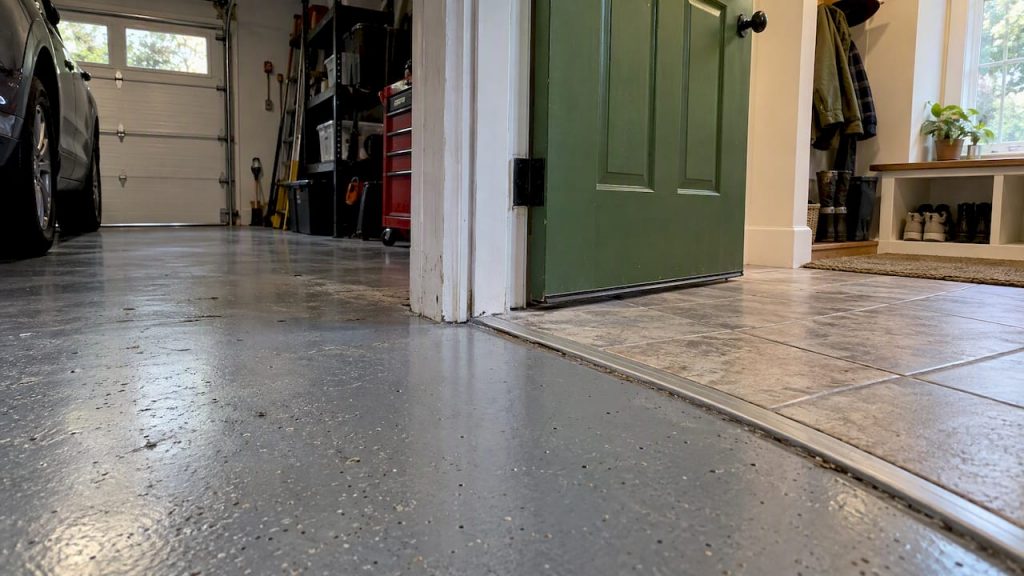
Epoxy is the better pick for a sound concrete slab that takes a beating, such as a garage, workshop or utility room. Tile is the better pick when you want pattern, texture and the option to replace one damaged piece. On price, neither wins every time. Canadian planning figures overlap heavily, and the condition of your floor often decides the result.
We pulled together current Canadian cost ranges, what the technical guidance says about performance, and the drawbacks that sales pages tend to skip. Use it to decide which surface fits your room, then to ask better questions when quotes arrive.
TL;DR
- Cost is close. Calgary estimates put installed epoxy at $5–$12 per sq. ft. and ceramic tile at $6–$10. Toronto estimates run $8–$15 for epoxy and $6–$12 for ceramic. Concrete condition tips the balance.
- Epoxy wins on seamless, stain- and chemical-resistant surfaces over a suitable slab. Tile wins on design range, texture and single-piece repair.
- Epoxy is not always faster. One Toronto guide estimates about 72 hours before you can walk on epoxy, against 24–48 hours for tile. Always follow the product’s instructions.
- Preparation decides epoxy’s lifespan. Poor substrate prep is the leading cause of coating failure, so ask what is in the quote.
- There is a middle path: tile finished with epoxy grout.
Table of Contents
- What you are actually comparing
- Epoxy flooring vs tile cost in Canada
- Durability and performance
- Cleaning and maintenance
- Installation time and downtime
- Where each one wins, room by room
- The disadvantages of epoxy flooring
- The middle path: tile with epoxy grout
- What about vinyl?
- A simple way to decide
- Our perspective
- Work with us
- FAQ
- Sources
What you are actually comparing
The two names hide a lot of variety. Epoxy flooring is a resin and a hardener mixed on site. Angi explains that mixing the two parts creates a hard, solid surface that bonds to the material underneath, usually concrete. Strength and durability depend on the type of resin and hardener. A thin hardware-store garage kit and a professionally installed, multi-coat system are very different floors.
Tile is just as varied. Ceramic and porcelain behave differently, and the grout between the pieces matters as much as the tile. Ordinary cement grout is porous. Epoxy grout is a different product altogether, which we cover below.
So compare the whole assembly, not the material name. That means the substrate, the product, the installer and the warranty. Technical guidance on seamless epoxy versus vinyl and tile makes the same point: the specifications are not interchangeable.
Epoxy flooring vs tile cost in Canada
A common assumption is that epoxy is the budget option. In Canada’s 2026 planning guides it is not that simple.
| Surface | Calgary (installed, per sq. ft.) | Toronto (installed, per sq. ft.) |
|---|---|---|
| Epoxy | $5–$12 | $8–$15 |
| Ceramic tile | $6–$10 | $6–$12 |
| Porcelain tile | $8–$12 | $8–$16 |
The Calgary figures come from a 2026 Calgary installation cost guide. The Toronto figures come from a 2026 Toronto flooring guide. For a 500 sq. ft. Toronto room, that guide gives epoxy at $4,000–$7,500, ceramic at $3,000–$6,000 and porcelain at $4,000–$8,000.
Treat these as screening numbers, not bids. They are local estimates and they come from two different sources with different assumptions.
Why the ranges are so wide
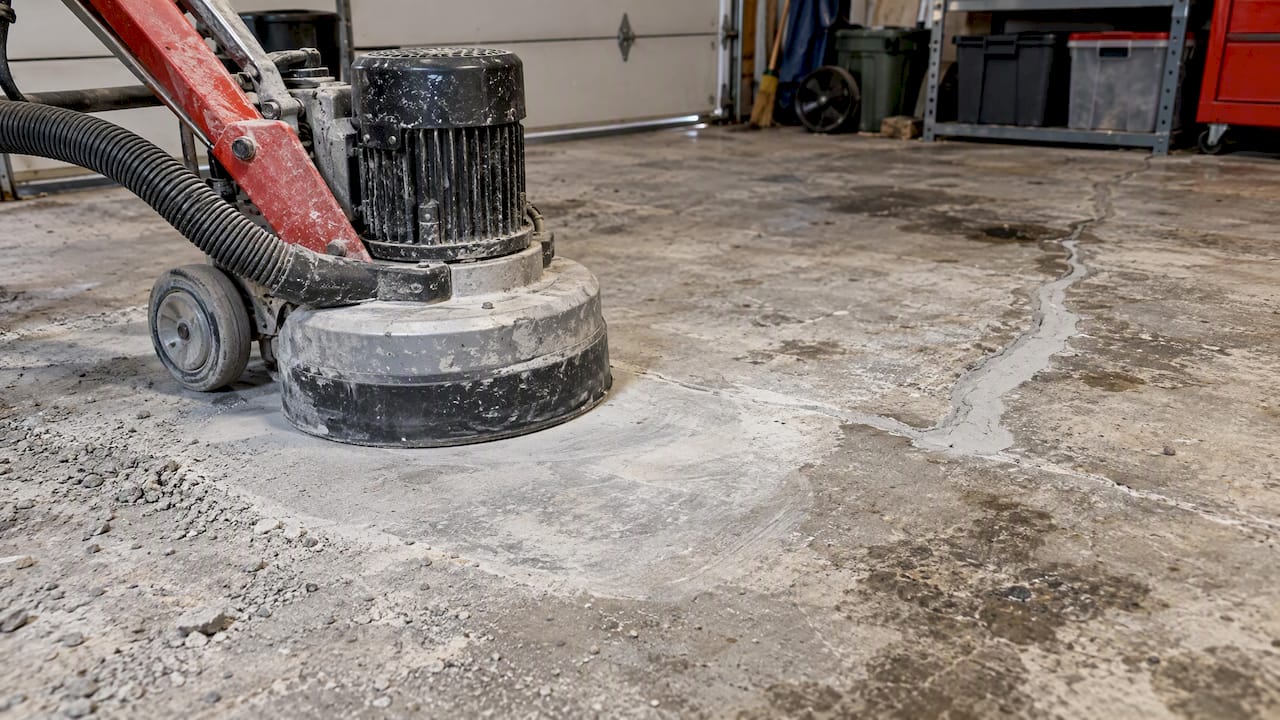
The Calgary guide notes that epoxy is prep-heavy and that its price depends heavily on concrete condition and system type. That is the hidden variable. A clean, flat, sound slab is cheap to coat. A cracked, oil-stained or uneven slab needs grinding, crack repair and possibly moisture treatment before any resin goes down. Those steps can push epoxy past tile.
Tile has its own swing factors. The same Calgary source says complex patterns cost more. Tile also needs a flat, stable base, so an uneven floor may need levelling first.
How to read the numbers for your project
- Existing, sound concrete (garage, basement, workshop): epoxy tends to be competitive or cheaper.
- A floor that is already tile-ready, or a design-heavy room: tile can come out ahead.
- A slab that needs major repair: get both quotes before you assume anything.
Whatever you choose, ask each contractor to itemize removal, preparation, materials, labour and timeline. The Calgary guide recommends exactly that. A single lump sum makes it impossible to see where one quote is thin.
If the room is part of a larger project, our step-by-step home renovation guide helps you sequence flooring against the other trades. For wet rooms, our look at what Canadian bathroom remodels cost at different budgets shows where flooring fits in the total.
Durability and performance
Where epoxy shines
Sherwin-Williams’ technical guide lists the benefits of resinous floors: strong durability, protection of the substrate from chemicals and abuse, and a better-looking facility. At home, that translates into a seamless surface. Oil, salt-laden slush from the car, cleaning products and spilled paint do not have a joint to creep into.
That seamlessness is the core advantage over tile. There is no grout to stain, no joint to trap dirt, and nowhere for moisture to settle in between pieces.
Where tile holds its own
Tile’s weak points are practical ones: grout joints and impact. A dropped tool can chip or crack an individual piece. Grout lines can discolour and need upkeep. In return, tile is a finished-room surface with real texture underfoot, and it can be repaired one piece at a time. With epoxy, a localized repair is difficult, and a patch rarely blends in perfectly.

Tile also gives you a design range epoxy cannot match easily: shapes, patterns, borders, and colour combinations built piece by piece.
A note on performance claims
Epoxy’s performance depends on its formulation and installation. A coating that is mixed incorrectly or applied outside its working time will not behave like the brochure. The Sherwin-Williams guidance stresses that the final chemistry is mixed on site, so preparation, mixing accuracy, conditions and installer skill are part of the floor system. Judge a quote on the process, not only the brand on the bucket.
Cleaning and maintenance
Epoxy is the simpler floor to keep clean. A smooth, non-porous surface wipes down quickly, which is why it is popular in garages and workshops. The tile route takes more attention. Grout is where grime accumulates, and cement-based grout is typically sealed to resist staining.
Tile’s maintenance cost is mostly time. You scrub grout lines, reseal as needed, and replace cracked pieces. Epoxy’s maintenance cost shows up differently: if the coating is damaged or wears through, you are usually looking at recoating rather than a quick fix.
Installation time and downtime
It is tempting to say epoxy is fast and tile is slow. The numbers do not support that so neatly. The Toronto guide estimates 1–2 days of epoxy installation after 1–2 days of preparation, then roughly 72 hours before you can walk on it. It estimates tile at 2–3 installation days after about 1 day of preparation, with 24–48 hours before walking on it.
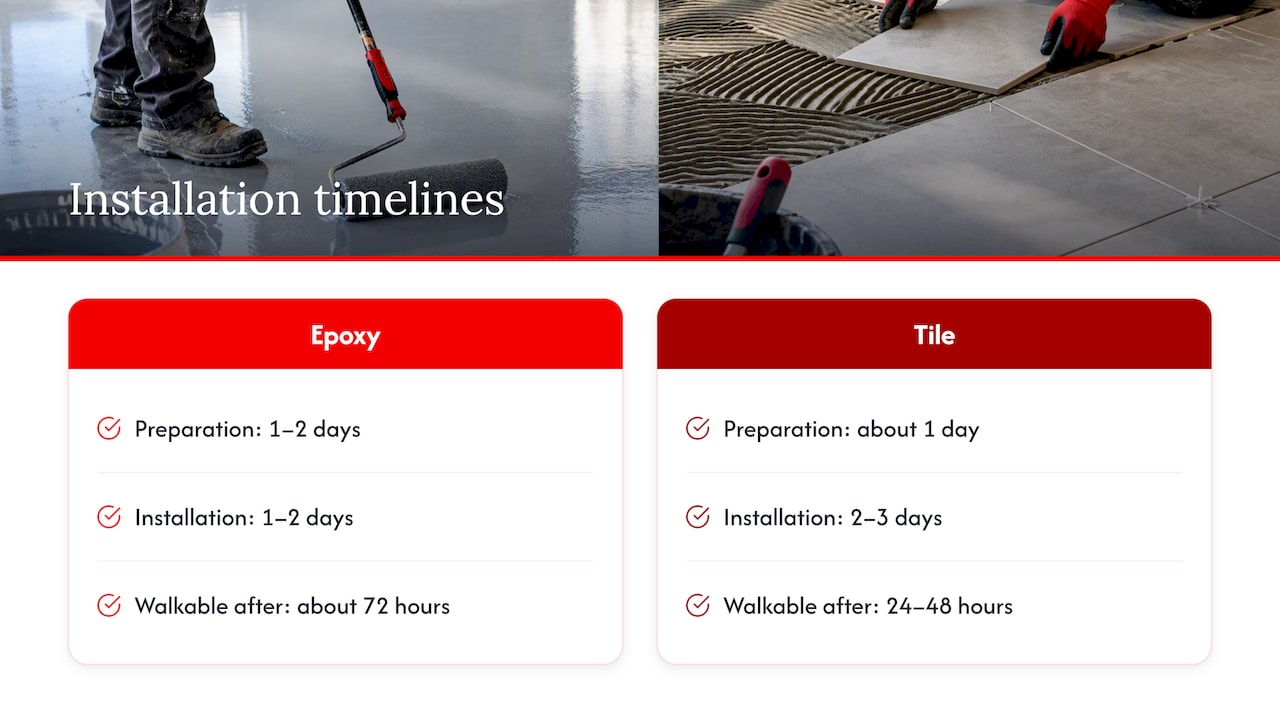
So epoxy can have the longer wait before the room is usable. Angi adds that epoxy mixtures may need 24–72 hours to cure, and some need up to a week to reach full strength.
Those are planning figures, not instructions. Actual re-entry depends on the exact product, temperature, humidity, substrate repairs and the manufacturer’s directions. Do not schedule vehicles, furniture or heavy loads from a generic internet timeline. If you need the garage back for a specific date, ask the installer for the product’s cure schedule in writing.
Where each one wins, room by room
| Room | Better fit | Why |
|---|---|---|
| Garage | Epoxy | Seamless, stain- and chemical-resistant over a concrete slab |
| Workshop or utility room | Epoxy | Easy to clean, handles abuse |
| Basement | Epoxy, or vinyl plank | The Toronto guide lists vinyl plank or epoxy for basements |
| Entryway | Porcelain tile | Durable and easy to replace by the piece |
| Bathroom | Tile | Pattern, texture and repairability |
| Kitchen | Tile | Finished-room look and design range |
The basement and entryway pairings echo the Toronto guide’s room-by-room table. The rest follows the general trade-offs above.
If you are setting up a garage as a proper workspace, pair the floor decision with storage. Our garage organization systems for homeowners cover how to lay out the room so the new floor is not buried under shelving the day it cures.
The disadvantages of epoxy flooring
The pros are well advertised. These are the drawbacks worth knowing before you commit.
Preparation is demanding
The most common cause of failure is not the resin. Sherwin-Williams identifies inadequate substrate preparation as the number-one cause of resinous floor coating failure. Before you accept a quote, ask these questions:
- Will the concrete be mechanically profiled?
- Will it be checked for contaminants and moisture?
- Will cracks and damage be repaired before coating?
A low price that skips these steps is false economy. The coating can peel, and you will pay twice.
Cure time and downtime
As covered above, you may wait days before normal use, and longer for full strength. Plan for the room to be out of service.
Hard to repair or remove
Tile lets you swap one piece. Epoxy does not. Localized repair is awkward and removal is a job in itself.
Slipperiness
A smooth, non-porous surface can be slippery when wet. One industry blog lists slipperiness as a possible disadvantage. If the floor will see wet boots or snowmelt, ask about a textured finish or anti-slip additive.
UV sensitivity
Some formulations are sensitive to ultraviolet light unless they are protected by a suitable topcoat. A garage with a big south-facing door is worth mentioning to your installer.
Fumes and ventilation
This one matters most for DIYers. Health Canada advises choosing low-emission or low-VOC renovation products because volatile organic compounds can cause breathing problems, headaches, and eye, nose and throat irritation. Plan people, kids, pets and anyone sensitive out of the area during application and curing.
Low VOC reduces emissions. It does not remove the need to read the label, ventilate and control access. Follow the product’s safety data sheet rather than assuming your basement or attached garage is adequately ventilated. If anyone in the household has asthma or another respiratory condition, check with your doctor before scheduling the work and consider having a professional do it while you stay elsewhere.
The middle path: tile with epoxy grout
If your worry about tile is the grout, you do not have to switch to epoxy flooring. The Tile Council of North America says epoxy grout meeting ANSI A118.3 is extremely hard, durable and nearly stain proof. The trade-offs: it is harder to install, slower to cure and typically costs three to eight times as much as cement-based grout.
That makes it a targeted choice. It makes sense for a shower floor, a busy kitchen or an entryway where staining is the real problem. It is not an automatic upgrade for every room. You keep tile’s pattern and replaceable pieces, and you cut down on grout staining and sealing.
What about vinyl?
Many readers weigh vinyl as a third option. The technical comparison of seamless epoxy and vinyl points to a pattern. Seamless epoxy generally offers stronger chemical and abrasion resistance and avoids seams in the field. Vinyl usually costs less up front but can be vulnerable to punctures, gouges, seam problems and adhesive failure.
Tile differs from both by offering individual-piece replacement and extensive patterns, though grout joints add maintenance. If vinyl is on your shortlist for living areas, our comparison of vinyl flooring versus laminate covers that decision in more depth.
A simple way to decide
Work through these questions in order.
- Is the surface a concrete slab in good shape? If yes, epoxy is a strong candidate.
- Will the room face oil, chemicals, salt or heavy traffic? Epoxy’s seamless surface suits that.
- Do you want patterns, texture or a finished-room look? Lean toward tile.
- Do you want to be able to fix one damaged spot? Tile.
- Can you live without the room for several days? If not, ask for exact cure times before choosing epoxy.
- Is grout staining your main concern? Look at epoxy grout before abandoning tile.
Then get at least two itemized quotes for your top choice. Compare preparation steps line by line, not just the bottom number.
Our perspective
We read a lot of flooring advice, and the same mistake shows up again and again: people shop the material and ignore the floor underneath it. The surface you walk on is the last, most visible layer of a system. The slab, the prep, the mixing and the installer carry just as much weight.
Our team at Lizard’s Lunch tends to steer readers toward a short list of honest questions rather than a winner. Epoxy for a sound garage slab is an easy call. Tile for a room you want to feel finished is an easy call. The tough cases sit in between, such as basements with moisture concerns or kitchens where staining is the worry, and those deserve a real look at moisture, ventilation and your own tolerance for downtime.
We would also say this to any DIYer: the fumes and the cure window are not footnotes. Pick the product, read its safety data sheet, and plan the week around it. A floor you can enjoy for years is worth a slower start.
— Alexander
Work with us
Do you run a home improvement business, or write about renovation? We welcome guest posts and banner placements that help our readers make practical decisions like this one. Reach out through that page to see what fits.
FAQ
Which is better, epoxy flooring or tile?
It depends on the room. Epoxy usually suits garages, workshops and utility rooms with a suitable concrete slab, because it is seamless and resists stains and chemicals. Tile usually suits rooms where you want patterns, texture and the option to replace a single damaged piece.
Is epoxy flooring cheaper than tile?
Not always. Calgary estimates list epoxy at $5–$12 per sq. ft. installed against $6–$10 for ceramic tile. Toronto estimates list epoxy at $8–$15 against $6–$12 for ceramic. Sound concrete favours epoxy, while heavy preparation can erase the savings.
What are the disadvantages of epoxy flooring?
The main ones are demanding surface preparation, downtime while it cures, difficult repair or removal, fumes during installation, slipperiness when wet without texture, and UV sensitivity in some formulations. Choose low-VOC products where you can, ventilate, and follow the safety data sheet.
How long before I can walk on a new epoxy floor?
One 2026 Toronto guide estimates about 72 hours, compared with 24–48 hours for tile. Full strength can take longer, up to a week for some mixtures. Your installer’s product instructions override any general estimate.
Can I put epoxy over tile?
Possibly, but it is not a shortcut. One installer notes that epoxy adds only around 1 mm and will not fill the grout lines on its own, so the joints would need to be addressed first. Ask a qualified installer to assess your specific floor.
Sources
- Flooring Installation Cost Calgary 2026
- Flooring Guide Toronto 2026
- Epoxy Flooring: The Complete Guide, Sherwin-Williams
- Epoxy Mortar, Tile Council of North America
- Chemical safety for DIY projects and renovations, Canada.ca
- The Pros and Cons of Epoxy Flooring, Angi
- Seamless Epoxy vs Vinyl and Tile Flooring, Epoxy.com
- The Pros and Cons of Epoxy Floors in Your House














Leave a Comment
Your email address will not be published. Required fields are marked with *