
Set a realistic Canadian bathroom budget: $3K powder rooms, $15K–$25K typical full baths, Toronto/Vancouver markups, and a simple step by step estimating…
In Canada, most standard full bathroom remodels cost roughly $15,000 to $25,000, with the national average landing around $13,000 to $20,000 once you factor in smaller updates. A simple powder-room refresh can run $3,000 to $6,000, while a luxury primary ensuite often clears $35,000 to $50,000 or more. Your actual number depends heavily on where you live, whether plumbing moves, and how far you push finishes upmarket.
TL;DR:
- Most bathroom renovations in Canada for a full room cost between $15,000 and $25,000, with luxury upgrades exceeding $35,000.
- Smaller projects like powder-room refreshes can be done for $3,000 to $6,000, while full gut renovations for larger bathrooms may reach $30,000 in total.
- Keeping plumbing in the existing footprint is the most effective way to avoid costs that can add $2,000 to $10,000, especially if fixtures need relocation.
- Labor accounts for about 25 to 35 percent of the total cost, with tile and fixtures also representing large portions of the budget; regional differences can raise prices by 10 to 25 percent in cities like Toronto and Vancouver.
- Accurate budgeting requires measuring your space, collecting multiple written quotes, and allowing a 10 to 20 percent contingency for unexpected expenses.
Table of Contents
- National Averages and What Each Budget Tier Actually Buys
- Cost by Bathroom Size: What $8,000, $15,000, and $30,000 Actually Get You
- Where the Money Actually Goes: A Line-Item Breakdown
- How Location Changes Your Bathroom Renovation Price
- Building Your Own Budget: A Step-by-Step Estimating Workflow
- Smart Ways to Cut Costs Without Cutting Corners
- Hiring a Contractor vs. Going DIY: What to Watch For
- How We Put These Numbers Together
- Sources
- FAQ
National Averages and What Each Budget Tier Actually Buys
Bathroom renovation prices in Canada fall into three fairly distinct tiers, and knowing which one applies to your project saves you from sticker shock halfway through demolition. A basic refresh, think new paint, updated hardware, a swapped vanity, and maybe new flooring, typically runs $5,000 to $10,000. A standard full bathroom renovation, where you’re replacing the tub or shower, retiling, and installing a new vanity and toilet, generally lands between $15,000 and $25,000 according to RenoCalc’s 2026 cost guide. Push into luxury territory, custom tile work, heated floors, a freestanding tub, high-end fixtures, and you’re looking at $35,000 to $50,000 or beyond.
Size and function matter as much as finish level. A powder room or half-bath (usually 20 to 30 square feet, just a toilet and sink) is the cheapest room in the house to renovate because there’s no tub or shower to plumb. A standard full bathroom, the classic 5×7 or 5×8 layout with tub, toilet, and vanity, is what most Canadian homes have and what most contractors quote against. A master ensuite, often 10×10 or larger with a separate shower, soaker tub, and double vanity, is where costs climb fastest because you’re multiplying every line item.
By the numbers: HomeStars puts the average bathroom renovation cost in Canada at roughly $13,393, with most homeowners spending between $7,785 and $19,338. Smaller cosmetic updates can come in as low as $4,587, while a powder room refresh averages closer to $1,834.
That HomeStars range and the RenoCalc bands agree on the broad strokes even though they measure slightly different project mixes. RenoPlanner’s 2026 estimator offers a broad national cost spectrum for bathroom renovations, illustrating significant variation dependent on project type and scope. If your contractor’s quote falls outside these bands in either direction, that’s worth a second look before you sign anything.
Cost by Bathroom Size: What $8,000, $15,000, and $30,000 Actually Get You
Matching your bathroom’s footprint to a realistic budget band is the fastest way to sanity-check a contractor’s quote. Here’s how the numbers typically break down by size and scope:
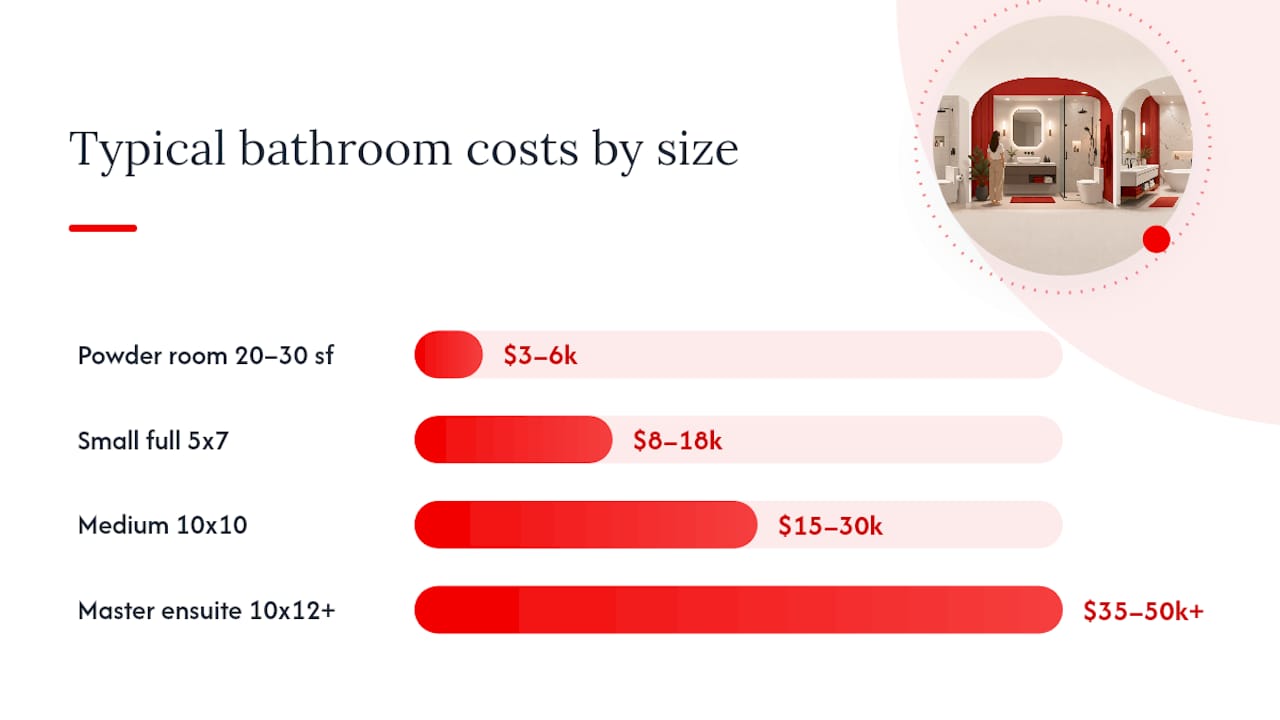
- Powder room / half-bath (20 to 30 sq ft): $3,000 to $6,000 for a full refresh, per RenoCalc. No tub or shower means labor and plumbing costs stay low.
- Small full bathroom, 5×7 (35 sq ft): $8,000 to $18,000 depending on tile grade and whether you keep the existing tub/shower footprint. This is the most common bathroom size in Canadian homes built before the 2000s.
- Medium bathroom, 10×10 (100 sq ft): $15,000 to $30,000, since the larger floor area means more tile, more labor hours, and often a bigger vanity or double-sink setup.
- Master ensuite (10×12 or larger): $35,000 to $50,000+ for a full renovation with a separate shower, soaker tub, and premium finishes, according to RenoCalc’s premium-tier estimate.
Here’s what those numbers actually translate to on the ground. An $8,000 budget typically covers a same-footprint 5×7 refresh: new tub or shower surround, standard ceramic tile, a builder-grade vanity, and a new toilet, with no plumbing relocation. Step up to $15,000 and you can afford mid-range tile, a quality vanity with stone countertop, better fixtures, and possibly a small layout tweak. At $30,000, you’re generally in full-gut territory for a 10×10 space: custom tile work, a curbless shower, in-floor heating, and higher-end plumbing fixtures throughout.
City matters too. HomeStars’ Vancouver-focused data shows individual fixture installs running higher than the national floor, with bathtub installation alone ranging $1,179 to $2,490 and toilet installation between $602 and $1,271. If you’re pricing a Vancouver or Toronto project, nudge every band above upward by roughly 10 to 25 percent.
Where the Money Actually Goes: A Line-Item Breakdown
Labor and tile consistently eat the largest share of any bathroom renovation budget in Canada. Industry breakdowns from RenoCalc and RenoPlanner put labor at roughly 25 to 35 percent of total project cost, with tile and flooring close behind at 20 to 35 percent depending on material choice. Fixtures (toilet, vanity, tub, shower) typically account for another 20 percent, and plumbing and electrical work combined usually run 15 to 20 percent.
Individual fixture prices help you spot-check a contractor’s line items against market norms:
- Toilet: $602 to $1,271 installed, per HomeStars.
- Sink: $415 to $695 installed.
- Bathtub: $1,179 to $2,490 installed.
- Vanity with countertop: $1,500 to $6,000, depending on material and size.
- Shower installation (tile, base, glass): $3,000 to $8,000 for a mid-range custom shower.
- Flooring (tile, per project): $2,000 to $5,000 for a standard-size bathroom.
Labor billing in Canada generally involves hourly rates varying by trade and location, per-square-foot pricing for specific tasks like tiling, or flat quotes encompassing the full project; exact rates depend on region and contractor. Flat quotes are more common for full renovations because contractors can price the whole job against their own crew costs rather than tracking hours. One line item deserves special attention: moving plumbing drains or relocating fixtures. RenoPlanner notes this single change can add $2,000 to $10,000 depending on your home’s foundation type and how far pipes need to travel, which is why keeping your existing plumbing footprint is one of the single most effective way to control cost.
How Location Changes Your Bathroom Renovation Price
Geography shifts your bathroom renovation cost more than almost any other single variable outside of scope. Labor markets, transportation costs for materials, and local permit requirements all stack up differently from city to city, and Canada Construction Network’s cost data shows provincial ranges for a mid-range full bathroom commonly spanning $15,000 to $40,000 depending entirely on where the work happens.
Rough city-level adjustments look like this:
- Toronto and Vancouver: Expect national averages to run 10 to 25 percent higher, driven by higher labor rates and denser permit processes.
- Calgary: Generally tracks close to the national average, with slightly lower labor costs offset by higher material transport in some areas.
- Montreal: Often comes in at or below the national average for labor, though Quebec-specific permit rules can add time and cost to larger projects.
- Winnipeg and Halifax: Tend to sit below the national midpoint, reflecting lower regional labor rates.
One factor that catches condo owners off guard: renovating in a condo or heritage building frequently requires additional fees and specialty trades, elevator booking fees, board approvals, or heritage-restoration specialists, that can effectively double standard labor and permit costs, according to Canada Construction Network. If you live in a multi-unit building or a designated heritage home, build that extra layer into your estimate from day one rather than discovering it mid-project.
The most reliable way to translate a national number into your local reality is to combine a published city index with two or three actual contractor quotes from your area. National guides tell you the ballpark; local bids tell you the truth.
Building Your Own Budget: A Step-by-Step Estimating Workflow
Getting an accurate bathroom remodel cost estimate starts with a tape measure, not a contractor’s business card. Here’s a workflow that keeps you grounded in real numbers before anyone sets foot in your bathroom:
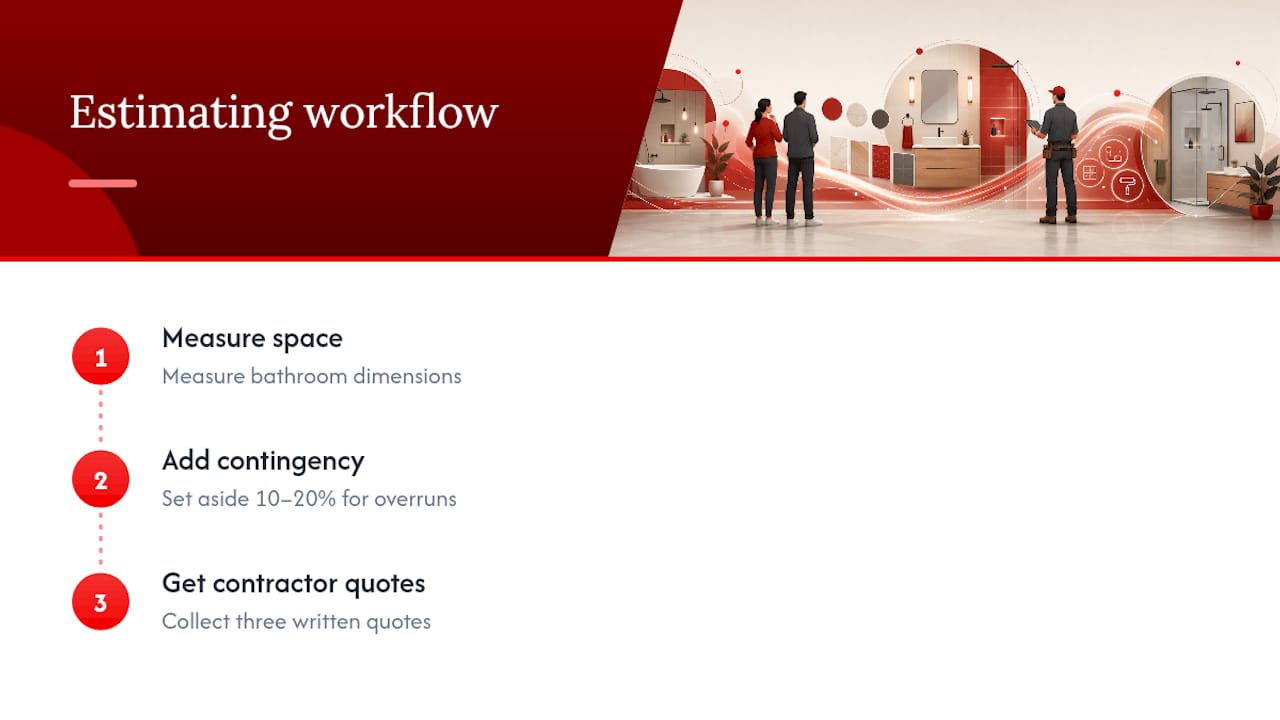
- Measure the space and classify the scope. Note square footage and decide upfront whether you want a cosmetic refresh, a partial renovation (new fixtures, same layout), or a full gut with layout changes.
- Build a simple worksheet. List size, desired fixtures, material grade (budget, mid-range, premium), and whether plumbing will move. This becomes your negotiating baseline with contractors.
- Add a contingency line. Set aside 10 to 20 percent of your total budget for surprises, old homes almost always have at least one.
- Collect at least three written quotes. Never rely on a single bid; pricing for identical scopes can vary by thousands of dollars between contractors in the same city.
- Ask each contractor the same questions: Is the quote itemized? Does it include permits? What’s the payment schedule? What happens if hidden damage is found behind the walls?
- Require a detailed contract before work starts, one that specifies materials, timeline, payment milestones, and how change orders are priced.
Our step-by-step home renovation guide walks through the broader project management side of this if you’re tackling more than just the bathroom.
Pro Tip: Bring your worksheet to every contractor meeting and ask them to quote against it line by line. Contractors who resist itemizing a bid are often the ones padding it.
Smart Ways to Cut Costs Without Cutting Corners
The single biggest lever you control is your plumbing layout. Keeping toilets, sinks, and showers in their existing locations avoids the $2,000 to $10,000 premium that comes with relocating drains, and it’s the difference between a $15,000 project and a $25,000 one more often than any material choice.
Beyond that, a few strategies consistently save money in Canadian markets without compromising durability:
- Choose mid-range tile and fixtures instead of premium lines. The visual difference is often minor; the price difference rarely is.
- Refinish existing cabinetry instead of replacing it outright. A professional cabinet refinish can run a fraction of full vanity replacement cost while giving your space a genuinely fresh look.
- Shop Canadian suppliers directly for tile and fixtures rather than relying solely on contractor markups.
- Time your purchases around seasonal sales, late winter and early spring often bring discounts on fixtures as retailers clear inventory before renovation season.
- Phase the project if your budget is tight: cosmetic updates now, tub/shower replacement next year, rather than financing everything at once.
DIY is reasonable for painting, hardware swaps, and even some tile work if you’re handy. It stops being reasonable the moment electrical, gas lines, or structural walls are involved. Those trades require licensed professionals in every Canadian province, both for safety and for insurance and resale purposes. Our guide on budgeting for remodeling projects has more on sequencing a phased renovation without losing momentum.
Hiring a Contractor vs. Going DIY: What to Watch For
Canadian labor rates for bathroom renovation work typically run $65 to $144 per hour depending on trade and region, though most full-project contractors quote a flat price rather than billing hourly. That flat-quote model makes it easier to compare bids, but it also makes it easier for a vague quote to hide problems.
Watch for these red flags before signing anything:
- No mention of permits. Any project involving plumbing or electrical changes should include permit costs in the quote.
- A single lump-sum number with no breakdown. You should be able to see roughly what you’re paying for labor, materials, and fixtures separately.
- A bid dramatically lower than the other two you collected. It usually means corners will get cut somewhere, often in materials or licensed subcontractor work.
- No written contract or payment schedule. Verbal agreements leave you with no recourse if the timeline or scope shifts.
Build a 10 to 20 percent contingency into your total budget regardless of how detailed the quote looks. Hidden costs like water damage behind old tile, outdated wiring that needs upgrading, or subfloor rot are common enough in older Canadian homes that they should be expected, not treated as a rare surprise. Our piece on avoiding costly renovation mistakes covers more of the contract details worth locking down before demolition day.
How We Put These Numbers Together
Our team at Lizard’s Lunch built this guide by cross-referencing Canada-specific industry cost guides, city-level price indices, and per-item fixture tables rather than relying on a single source. The goal was giving you numbers you can actually plan against, not a vague range pulled from generic renovation content.
If you’re starting your own project, the workflow stays simple: measure your space, set aside a 10 to 20 percent contingency, and collect three written quotes before committing to anyone. For financing options if your bathroom project is part of a larger home renovation, resources like The Texas Mortgage Pros’ guide to funding renovation projects walk through general funding strategies worth understanding, even though mortgage products vary by lender. For the ROI side of the equation, our home improvement tips for maximizing resale value is worth a read before you finalize scope.
If your business serves Canadian homeowners researching renovation costs and you’d like to reach this audience, Lizardslunch offers banner ad placements and guest post opportunities for brands in the home improvement space.
Sources
These are the primary guides we drew on for the figures in this article:
- Guide to Bathroom Renovation Costs & Estimates in Canada
- Bathroom & Vanity Renovation Cost Canada 2026: $5K–$45K | RenoCalc
- How Much Does a Bathroom Renovation Cost in Canada? 2026 | RenoPlanner
- Bathroom Renovation Costs Across Canada | Canada Construction Network
Every one of the these sources reports ranges, not fixed prices. Only written quotes from contractors in your specific city will give you a number you can actually budget against.
This article is general information, not a substitute for advice from a qualified financial advisor. Consult a qualified financial professional about your own circumstances before acting on anything here.
FAQ
What is the biggest expense in a bathroom remodel?
Labor is typically the single largest expense, consuming roughly 25 to 35 percent of total project cost, with tile and flooring close behind at 20 to 35 percent depending on material grade.
Can you renovate a bathroom for $10,000?
Yes, for a small full bathroom (around 5×7) or an upgraded powder room, provided you keep the existing plumbing layout and choose mid-range materials rather than custom tile or premium fixtures.
How much does labor typically cost for a 5×7 bathroom remodel?
Labor for a 5×7 bathroom generally runs $65 to $144 per hour, or is bundled into a flat project quote that often totals $3,000 to $8,000 for labor alone within an $8,000 to $18,000 total project budget.
How much does it cost to remodel a 10×10 bathroom?
A 10×10 bathroom renovation typically costs $15,000 to $30,000 in Canada, with the higher end reflecting premium tile, a double vanity, or a full layout change.
















Leave a Comment
Your email address will not be published. Required fields are marked with *