
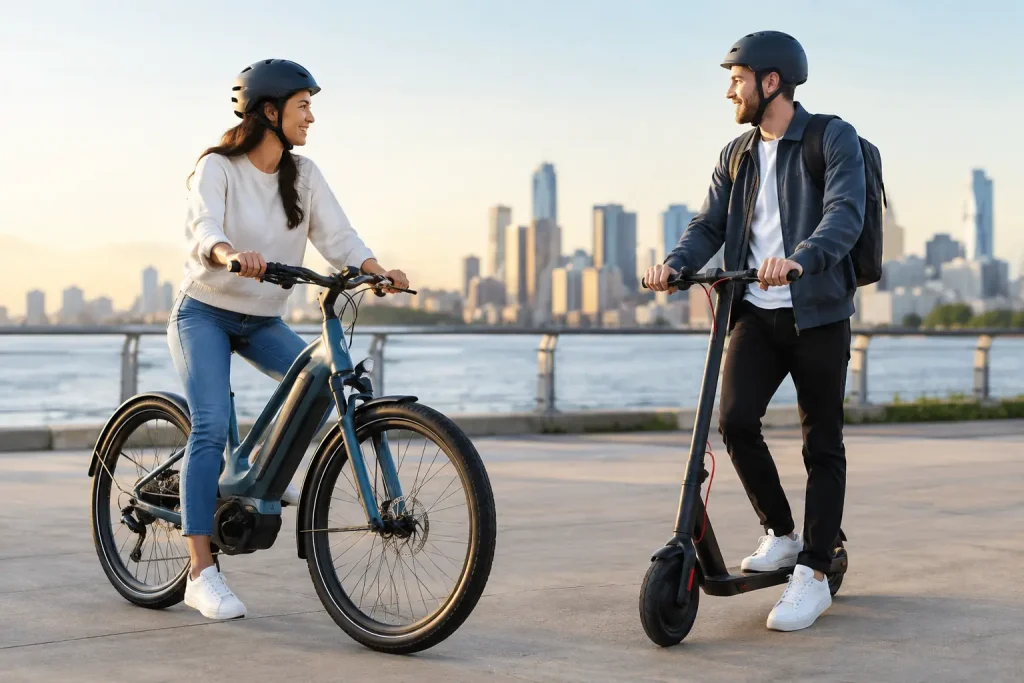
Electric bike versus scooter comes down to range, storage, cost, and local rules. Compare both options to choose a ride that fits your commute comfortably.
A three-mile trip can feel completely different depending on what is under your feet. In the electric bike versus scooter decision, an e-bike may make a grocery run easy, while a stand-up electric scooter may be the faster choice for getting from an apartment to a train station. Both can cut down on car trips, parking headaches, and fuel costs. The better pick comes down to your route, what you carry, where you store it, and how comfortable you want to be when you arrive.
For this comparison, “scooter” means a stand-up electric scooter, not a moped-style scooter or motorcycle. That distinction matters because their capabilities, regulations, and price ranges are very different.
Electric Bike Versus Scooter at a Glance
Electric bikes and electric scooters solve a similar problem: they add motor-assisted mobility to short and medium-length trips. But they do it with very different riding positions and practical limits.
An e-bike is typically the more versatile vehicle. It has larger wheels, a seated position, pedals, and room for useful accessories such as racks, baskets, panniers, and child seats. Pedal assist can also stretch battery range because you contribute some of the power yourself.
An electric scooter is generally more compact and more convenient to carry or tuck away. Most riders stand on a small deck and use a thumb throttle, although some models include a small seat. Scooters work especially well for smooth, short trips where portability matters more than cargo capacity or all-day comfort.
Neither choice wins for everyone. A commuter riding five miles each way over uneven pavement will usually appreciate an e-bike. Someone traveling a mile to campus, the office, or a transit stop may find a foldable scooter much easier to live with.
Ride Comfort and Road Confidence
The biggest difference shows up after the first few blocks. E-bikes are built around familiar bicycle geometry: a seat, handlebars, bigger tires, and more stable handling. That setup is forgiving on cracked pavement, shallow potholes, painted crosswalks, and moderate hills.
Larger wheels also roll over surface imperfections more easily. Many e-bikes have wide tires or front suspension, and some have both front and rear suspension. For riders with longer commutes, joint discomfort, or less confidence balancing at low speeds, those details can make a major difference.
Scooters can feel lively and convenient, but their smaller wheels react more sharply to bad pavement. A small crack or loose gravel that barely registers on a bike can demand immediate attention on a scooter. Models with pneumatic tires and suspension improve the experience, yet they rarely match the stability of a decent e-bike on rough streets.
Weather is another practical consideration. Rain, leaves, ice, and high winds make either option more challenging, but standing on a narrow scooter deck leaves less margin for error. If your ride cannot wait for perfect conditions, an e-bike is usually the more confidence-inspiring option.
Range, Speed, and Hills
Published range numbers are useful starting points, not promises. Rider weight, hills, wind, tire pressure, temperature, cargo, and assist settings all affect how far a battery actually goes.
Many entry-level electric scooters offer roughly 10 to 25 miles of real-world range, while higher-end commuter models can travel farther. E-bikes commonly deliver 20 to 50 miles or more, particularly when the rider pedals along. A bike with a removable battery can also be easier to recharge at work or in an apartment.
Speed limits vary by state and city, but many consumer e-bikes and scooters top out around 20 mph. Some e-bikes fall into classifications that permit pedal-assisted speeds up to 28 mph, depending on local rules. Faster is not automatically better. A 20 mph trip on a route full of driveways, pedestrians, and broken pavement can require more awareness than riders expect.
Hills favor e-bikes in most cases. Their larger motors, better traction, gears, and option to pedal make climbing more manageable. A scooter may handle gentle grades well, but steep climbs can drain its battery quickly and reduce speed dramatically.
Storage, Portability, and Everyday Errands
A scooter’s strongest argument is often what happens when the ride ends. A folding model can fit under a desk, in a closet, or in many car trunks. If theft is a major concern, being able to bring your ride indoors is a serious benefit.
E-bikes are bulkier and heavier, often weighing 40 to 75 pounds or more. Folding e-bikes exist, but even they can be awkward to carry up stairs. Secure bike parking, an approved lock, and battery removal become part of the ownership routine. Apartment dwellers should measure elevators, hallways, storage rooms, and stair landings before ordering one.
For carrying things, though, the e-bike pulls far ahead. A rear rack and panniers can handle a work bag, groceries, takeout, or a change of clothes without turning the ride into a balancing act. Cargo e-bikes can replace many local car errands, especially for families or pet owners.
Scooters offer limited cargo options. A backpack works for light loads, but hanging bags from the handlebars is unsafe because it can interfere with steering and stability. If your regular trip includes a laptop, gym gear, or a few grocery bags, the extra capacity of an e-bike is more than a nice-to-have.
Cost Is More Than the Purchase Price
Electric scooters usually have the lower entry price. Basic models often cost a few hundred dollars, while durable commuter scooters with stronger motors, better brakes, suspension, and longer range can cost considerably more. E-bikes tend to start higher, and well-equipped commuter models can reach into the low thousands.
The cheaper vehicle is not always the cheaper ownership experience. Low-cost scooters can have solid tires, limited weather resistance, weak brakes, or hard-to-find replacement parts. A bargain e-bike can present similar problems, especially if its battery, charger, or controller comes from a brand without reliable support.
Budget for a helmet, lock, lights if they are not included, and routine maintenance. E-bikes need familiar bicycle upkeep such as brake pads, chains, tires, and occasional tune-ups. Scooters have fewer moving drivetrain parts, but tire repairs, brake adjustments, battery wear, and folding-mechanism issues can still add up.
Battery support deserves special attention. Buy from a reputable retailer or manufacturer that clearly identifies the battery system, provides replacement parts, and offers safety guidance. Use the original charger, avoid damaged batteries, and charge on a hard, open surface away from exits and flammable materials.
Local Rules Can Make the Decision for You
Before buying either vehicle, check the rules in your state, city, neighborhood, and workplace. Regulations may cover maximum speed, helmet requirements, age limits, sidewalk riding, bike-lane access, lighting, registration, and where devices can be parked.
In many places, e-bikes are treated more like bicycles than motor vehicles, but classification rules vary. Scooters may be allowed in bike lanes but prohibited on sidewalks, or they may face local restrictions in busy downtown areas. A campus, apartment complex, or transit agency may also set its own storage and battery policies.
Rules are only part of the equation. Consider the route itself. Protected bike lanes, slower neighborhood streets, and smooth paths favor both options. High-speed roads, poor pavement, frequent curb cuts, and aggressive traffic make an e-bike’s stability more appealing, though neither vehicle is a substitute for a safe route.
Who Should Choose an E-Bike?
Choose an e-bike if you want one vehicle to handle commuting, errands, recreational rides, and occasional longer trips. It is the stronger choice for hills, uneven roads, carrying cargo, and riders who prefer a seated position. It also makes sense if you want some exercise without arriving sweaty, since pedal assist lets you control the effort.
A step-through frame can make mounting easier, while a commuter e-bike with integrated lights, fenders, and a rack is especially practical for daily transportation. For many suburban riders, an e-bike can turn a car-only errand into a realistic ride.
Who Should Choose an Electric Scooter?
Choose an electric scooter if your trips are short, mostly flat, and easy to store. It is a smart fit for first-mile and last-mile travel, compact urban apartments, office commutes, and anyone who needs to carry their ride onto public transportation when allowed.
Look beyond top speed. Prioritize dependable brakes, adequate range for a round trip with reserve power, tire quality, water-resistance rating, rider weight limit, and a realistic folded weight. A scooter that weighs 45 pounds may fold, but it will not feel effortless to carry up two flights of stairs.
The best test is not which option looks more fun in a product photo. Picture your actual Tuesday: the weather, the hill near home, your backpack, the parking situation, and where the vehicle will sleep at night. The ride that fits those details is the one you will use often enough to make the purchase worthwhile.

















Leave a Comment
Your email address will not be published. Required fields are marked with *