

A HELOC is a reusable credit line, a home equity loan is a fixed lump sum. See Canadian limits, costs, risks and a $100,000 payment example before you borrow.
A HELOC (home equity line of credit) is a revolving credit line secured by your home: you borrow what you need, repay it, and borrow again. A home equity loan is a one-time lump sum with fixed payments on a set schedule. If your costs arrive in stages and you want flexibility, a HELOC usually fits. If you have one defined expense and want a predictable payment, a home equity loan usually fits. Either way, your home is the collateral, so the right choice depends on how you will repay, not just how much you can borrow.
This guide explains how each product works in Canada, the borrowing limits that apply, what each costs, a worked payment example on $100,000, the tax question, and how to decide.
TL;DR
- A HELOC is a reusable credit line with interest charged only on what you borrow. A home equity loan is a lump sum repaid in fixed amounts over a fixed term.
- In Canada, a HELOC is capped at 65% of your home’s appraised value. A home equity loan may reach up to 80%, according to the Financial Consumer Agency of Canada (FCAC).
- Most HELOCs carry variable rates tied to the lender’s prime rate, so your cost can change. Both products carry set-up fees and put your home at risk if you cannot repay.
- Interest is generally deductible only when the money is used to earn income from a business or property.
- Choose based on your need, your income stability and a repayment plan you can name before you sign.
Table of Contents
- How a HELOC works
- How a home equity loan works
- HELOC vs home equity loan: side by side
- Canadian borrowing limits: why 65% and 80%
- Who qualifies
- What each one costs
- Pros and cons of a HELOC in Canada
- Pros and cons of a home equity loan
- Which should you choose?
- Is there a tax on home equity in Canada?
- Before you apply: a short checklist
- Our perspective
- Share your expertise with our readers
- FAQ
- Sources
How a HELOC works
The FCAC describes a HELOC as a revolving credit product secured by your home. You are approved for a credit limit. You can borrow any amount up to that limit, repay it, and borrow it again. Interest applies only to the amount you have actually drawn.
Think of it as a credit card with a much larger limit and a much lower rate, backed by your house. That backing is what makes the rate lower, and it is also what makes the risk higher.
A few features shape how a HELOC feels in daily life:
- Variable rate. The FCAC says most HELOCs have variable rates based on the lender’s prime rate. A rate of prime plus 1% would be 6.85% if prime were 5.85%. The lender may change the rate at any time, with written notice within 30 days.
- Flexible payments. Many HELOCs let you pay interest only. That keeps the monthly cost low, but you will not pay down the balance unless you add principal yourself.
- Reusable limit. Once you repay, the room opens up again. That is convenient for staged projects and a temptation for everyday spending.
How a home equity loan works
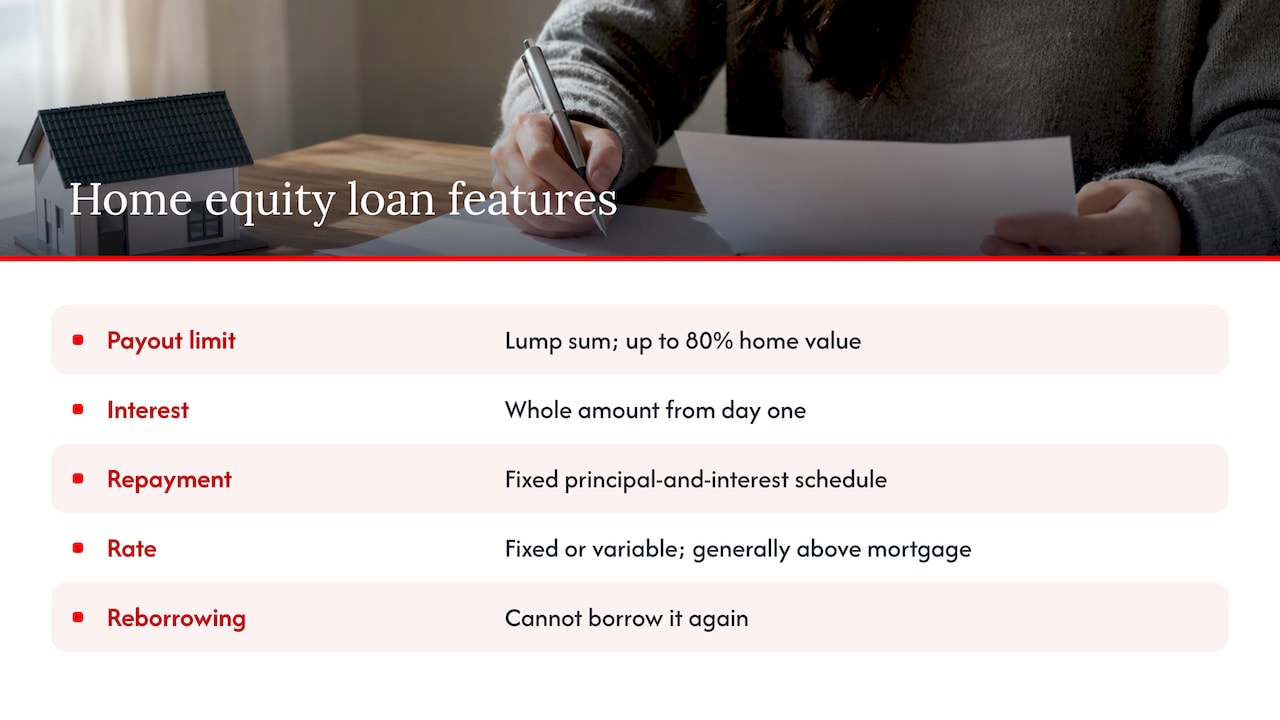
A home equity loan is the simpler product. According to the FCAC, it is a one-time lump sum that may be up to 80% of the home’s value. You pay interest on the whole amount from day one, and you repay it in fixed principal-and-interest amounts on a fixed term and schedule. When it is repaid, it is finished. You cannot borrow it again.
The rate can be fixed or variable, and the FCAC notes it is generally higher than the rate on a mortgage. In everyday Canadian conversation this kind of borrowing is often called a second mortgage or an equity takeout, so you may see those terms when you shop around.
The main appeal is certainty. With a fixed rate and a fixed schedule, you know the payment, and you know the date the debt ends.
HELOC vs home equity loan: side by side
| Feature | HELOC | Home equity loan |
|---|---|---|
| How you get the money | Credit line you draw as needed | One lump sum |
| Maximum borrowing | Up to 65% of appraised value | Up to 80% of appraised value |
| Interest charged on | Only the amount you have borrowed | The full amount borrowed |
| Rate | Usually variable, often prime plus a margin | Fixed or variable, generally higher than a mortgage |
| Repayment | Flexible, often interest only | Fixed principal and interest on a set schedule |
| Reuse the money | Yes, as you repay | No |
| Fees | Appraisal, title search, legal and registration, plus possible administration and monthly fees | Appraisal, title search, title insurance and legal fees |
The limits and fee categories in this table come from the FCAC’s borrowing against home equity comparison and its HELOC guide.
Canadian borrowing limits: why 65% and 80%
The two percentages in the table are not marketing. They come from federal lending rules for banks and other federally regulated lenders.
The Office of the Superintendent of Financial Institutions (OSFI), the federal regulator, sets the standard. Its Guideline B-20 clarification says the legal maximum loan-to-value for uninsured mortgages is 80%. It also says that any lending above 65% in a combined loan plan must be amortizing and non-readvanceable. In plain words: the reusable credit line stops at 65%, and anything above that must be repaid on a schedule and cannot be borrowed again.
OSFI’s stated reason is that combined plans carry a heightened risk of borrowers staying in debt for a long time. Requiring the upper slice to amortize limits how much and how long you can be indebted.
This is why you see a HELOC at 65% and a loan at 80%. The FCAC’s research report adds that the 2012 cap on HELOCs at 65% helped moderate market growth by limiting persistent debt.
A worked example with your mortgage balance
Borrowing limits are calculated against your home’s value, then reduced by what you already owe. The FCAC gives this example: on a $250,000 home, the maximum home-equity borrowing is $200,000 (80%). With a $150,000 mortgage balance, the most you could still borrow is $50,000.
Now apply the HELOC’s 65% cap to the same home. Sixty-five percent of $250,000 is $162,500. Subtract the $150,000 mortgage and only $12,500 of credit line room remains. That gap is why many Canadians with a recent, high-ratio mortgage find a HELOC offers much less than they expected, while someone who has paid their mortgage down has far more room.
Who qualifies
The FCAC says a standalone HELOC generally requires more than 35% equity, while a HELOC combined with a mortgage requires 20%. You must also pass a stress test, which means showing you could afford the payments at a higher qualifying interest rate than the one you will actually pay.
Equity is simply the part of your home you own: its value minus what you owe on it. A home worth $600,000 with a $300,000 mortgage has $300,000 in equity, or 50%.
Lenders also look at your income, your debts and your credit history. If your score is holding you back, our 90-day credit score plan for Canada lays out the two priorities that move it most.
What each one costs
The rate is only part of the cost. The FCAC lists HELOC fees that can include appraisal, legal registration, title search, administration, monthly, cancellation and discharge fees. For a home equity loan, it lists appraisal, title search, title insurance and legal fees.
Before you compare lenders, ask for every fee in writing and add them up. A lower rate with a monthly fee and a cancellation charge can cost more than a slightly higher rate with none.
A $100,000 payment example
The figures below are an illustration, not a quote. They assume a 6% rate for both products so you can see the effect of the structure. Your rate will differ, and a HELOC’s rate can move.
| Scenario | Monthly payment | What happens to the balance |
|---|---|---|
| HELOC, $100,000 drawn, interest only at 6% | About $500 | Balance stays at $100,000 |
| Home equity loan, $100,000 at 6% over 10 years | About $1,110 | Balance reaches zero in 10 years |
The HELOC payment looks far friendlier, and that is the trap the FCAC warns about: if you only pay interest you will not pay off the loan. The loan’s higher payment is doing real work, because every month it retires some of the debt.
The HELOC example is also sensitive to rate changes. At 7%, the interest-only payment on the same $100,000 would be about $583. A one-point move adds roughly $83 a month. Rate moves can be sharp: Canadian Money Help, a calculator site, notes the Bank of Canada raised its policy rate from 0.25% to 5.00% between March 2022 and July 2023, with later cuts in 2024 and 2025 only partly reversing that.
The smart way to use a HELOC is to set your own repayment amount above interest only, as though it were an amortizing loan.
Pros and cons of a HELOC in Canada
What works in your favour
- You borrow only what you need. Interest applies only to the drawn balance, so a staged renovation costs less than a lump sum borrowed on day one.
- Flexibility. You can repay and reuse the limit without reapplying.
- Lower minimum payments. Interest-only options keep cash flow comfortable during a project.
What to plan for
The FCAC lists the risks plainly:
- If rates rise, you may struggle to repay, especially after large withdrawals.
- If you do not repay, you could lose your home.
- Borrowing reduces your home equity and your future options.
- Easy access can tempt you into more debt than you can repay.
- Paying only interest means the balance never shrinks.
The FCAC’s research report on HELOC trends adds two points. It says interest-only and non-amortized features can encourage persistent borrowing, and it recommends a realistic repayment plan rather than using a HELOC for routine expenses. It also notes that if the housing market falls, lenders may revise limits downward or call in loans.
When you treat these as safe-use rules, they become a checklist: borrow for a defined purpose, stress-test your own budget at a higher rate, and set a payoff date.
Pros and cons of a home equity loan
What works in your favour
- A predictable payment. With a fixed rate, the amount does not change.
- A built-in finish line. The schedule retires the debt, which suits a one-time expense with a known cost.
- Access to a higher share of value. The limit can reach 80%, compared with 65% for a HELOC.
What to plan for
- Interest on the whole sum from day one, even if you spend it gradually.
- A rate generally higher than a mortgage, per the FCAC.
- Fees for appraisal, title search, title insurance and legal work.
- Home as collateral. Missed payments put the property at risk.
Which should you choose?
Start with the shape of your need.
A HELOC tends to fit when:
- Costs arrive over months or years, such as a phased renovation or a course of study.
- You have stable income and the discipline to repay above the minimum.
- You want a standing reserve and are comfortable with a variable rate.
A home equity loan tends to fit when:
- You have one defined expense with a known price, such as a single large repair or addition.
- You want to know exactly what you will pay each month and when you will be done.
- You prefer a structure that forces repayment.
A Canadian credit counselling organization, Credit Canada, says borrowing against home equity makes more sense when you have a defined need, stable income, affordable repayments and a clear plan for paying off the debt. It suggests comparing total borrowing costs, repayment terms, risks, appraisal and closing costs, and alternatives that are not secured by your home.
Debt consolidation deserves extra care
Moving credit card balances onto home-secured credit can lower the rate, but it also changes unsecured debt into debt your house backs. The same Credit Canada guidance points out that consolidation only helps if the new payment is sustainable and the cause of the debt is addressed. If you are consolidating, write down the payment, the payoff date and what will change in your spending.
Is there a tax on home equity in Canada?
No. Borrowing against your equity is not income, so you do not pay tax on the money you receive. The separate question is whether the interest you pay can be deducted.
The Canada Revenue Agency’s Income Tax Folio explains that interest is deductible only on borrowed money used to earn income from a business or property. You must be able to trace the borrowed funds to that specific eligible use. A renovation of your own home, a vacation or paying off a credit card does not qualify. If you plan to use the money for investing or a business, talk to an accountant before you draw funds, so you keep the paper trail the rule requires.
Before you apply: a short checklist
- Define the purpose and the amount. Vague needs lead to over-borrowing.
- Calculate your equity. Value minus mortgage balance, then apply the 65% or 80% limit.
- Test your budget at a higher rate. Add one or two percentage points to a variable-rate quote and check the payment still works.
- Collect all fees in writing. Appraisal, legal, title and any monthly or cancellation charges.
- Set your own repayment plan. Pick a monthly amount and a payoff date, not just the minimum.
- Look at your mortgage timeline. If your term is ending, read our mortgage renewal action plan, since renewal is a natural moment to review your whole borrowing structure.
- Compare alternatives. A mortgage refinance may be the better route in some cases, and our guide to refinancing a mortgage for lower payments explains how it works.
If you are still saving for your first home rather than borrowing against one, our guides to first-time home buyer grants in Canada and the First Home Savings Account cover that stage.
Our perspective
Most of the questions we get about home equity are really questions about discipline. The product matters less than the plan behind it.
We think a good guide should help you picture the whole journey: the day the money arrives, the monthly payment you will live with, and the day the debt ends. A HELOC rewards people who set their own payoff schedule. A fixed loan rewards people who want the schedule set for them. Both reward borrowers who read the fee list before signing.
That is why our team at Lizard’s Lunch keeps publishing practical Canadian money guides, from credit scores to renewals to refinancing. We want you to see the full picture, so you can use your equity for something that improves your life and still sleep well at night.
Alexander
Share your expertise with our readers
Do you write about home finance, renovation or Canadian money topics? Our team welcomes guest contributions and offers banner placements for brands that serve homeowners. You can see the options on our advertise with us page.
FAQ
Should I do a HELOC or a home equity loan?
Choose a HELOC if your costs come in stages and you can repay above the minimum. Choose a home equity loan if you have one known expense and want a fixed payment and end date. In both cases, borrow only for a defined purpose and have a repayment plan before you sign.
How much is a HELOC payment on $100,000?
It depends on the rate. At an illustrative 6%, interest only on $100,000 is about $500 a month, and at 7% it is about $583. Because most HELOC rates are variable, the lender can change the rate with written notice, so your payment can change too.
How much can I borrow against my home in Canada?
The FCAC says up to 65% of your home’s appraised value with a HELOC, and up to 80% with a home equity loan, in each case reduced by what you still owe on your mortgage. On a $250,000 home with a $150,000 mortgage, the FCAC’s example leaves $50,000 of room at the 80% limit.
Is HELOC interest tax-deductible in Canada?
Only when you use the borrowed money to earn income from a business or property, and you can trace the funds to that use. Using it for a personal renovation or to pay off personal debt does not qualify. An accountant can confirm how the rule applies to your situation.
Can I lose my home if I cannot repay?
Yes. Both products are secured by your home, so the FCAC warns that failing to repay could cost you the property. If payments become hard, contact your lender early and consider speaking with a non-profit credit counsellor.
Sources
- Home equity lines of credit, Financial Consumer Agency of Canada
- Borrowing against home equity, Financial Consumer Agency of Canada
- Clarification on the treatment of innovative real estate secured lending products under Guideline B-20, OSFI
- Home Equity Lines of Credit: Market Trends and Consumer Issues, FCAC
- Income Tax Folio S3-F6-C1, Interest Deductibility, Canada Revenue Agency
- When Does a Home Equity Loan Make Financial Sense?, Credit Canada
- Canadian HELOC Calculator, Canadian Money Help


















Leave a Comment
Your email address will not be published. Required fields are marked with *