
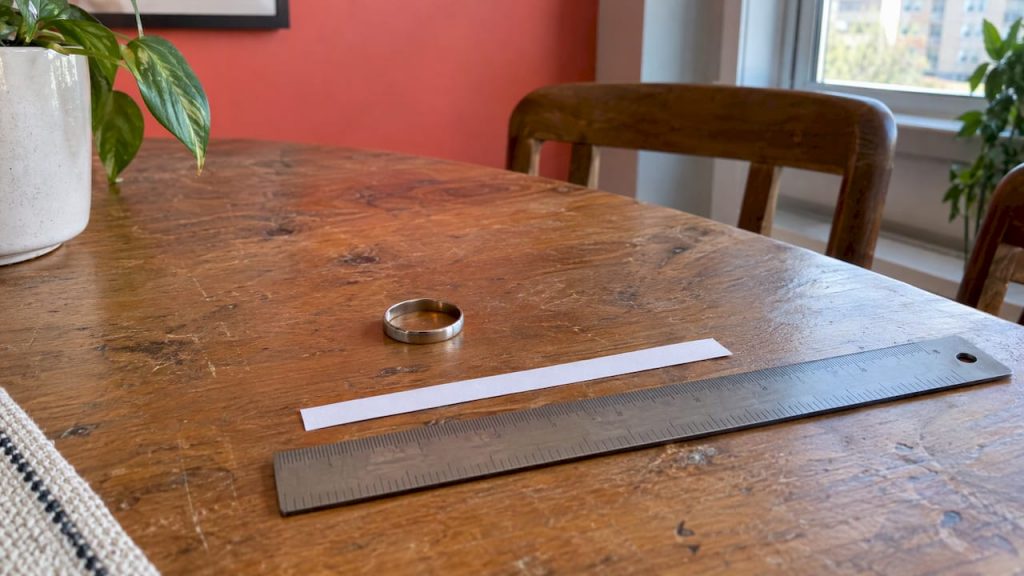
Find your ring size at home with a string, paper strip or a ring you own. Includes a US and Canada size chart in mm, tips for between sizes, and shoe size notes.
You can find your ring size at home in about five minutes with a strip of paper, a ruler and a little patience. In Canada, rings use the same scale as the United States, so a size 7 here is a size 7 there. The trick is to measure at the right time of day, on the right finger, and to match the number to a chart in millimetres. Below you get the methods, a chart, fixes for the in-between sizes and a short note on how all of this differs from shoe sizing.
TL;DR
- Canada uses the American ring scale, so US charts work as they are.
- Two reliable home methods: wrap a strip of paper around your finger, or measure the inside width of a ring that already fits.
- Measure when your hands are warm and relaxed, and repeat on two or three different days before you decide.
- Between two sizes? Go with the larger one if the knuckle is wide, and the smaller one if the band will sit loosely at the base.
- Ring sizes and shoe sizes are separate systems: never use a shoe chart for a ring.
Table of Contents
- What a ring size really measures
- Before you measure: set yourself up
- Method 1: the string or paper strip
- Method 2: measure a ring that already fits
- Method 3: printable sizers, apps and a phone
- US and Canadian ring size chart in millimetres
- Converting to UK, European and other scales
- What to do when you fall between sizes
- Wrist, bracelet and chain sizes
- Does the stone or setting change the fit?
- Ring sizes versus shoe sizes
- Common mistakes and quick fixes
- Promo
- Our perspective
- FAQ
- Sources
What a ring size really measures
A ring size is a number for the inside of the band. Jewelers describe it either as the inside diameter (the width straight across the opening) or the inside circumference (the distance around). The two are linked by simple geometry: circumference equals diameter multiplied by pi, about 3.14.
The US and Canadian scale is evenly spaced. According to the formula published for the Canadian scale, inside diameter in millimetres equals 0.8128 times the size plus 11.63. Each full size therefore adds roughly 0.81 mm to the width of the opening, and about 2.55 mm to the distance around. Half sizes sit exactly halfway between.

That is why a tiny error matters. Measure your finger 1 mm too tight around its circumference and you are already about half a size off.
Before you measure: set yourself up
A few minutes of preparation prevents most sizing mistakes.
- Choose the finger. Rings sit differently on each finger, and most people have a slightly larger dominant hand. Measure the exact finger and hand the ring will go on.
- Pick the right time. Fingers shrink in the cold and swell with heat, salty food, long walks and alcohol. Measure when your hands are comfortably warm, ideally late in the day and not straight after a workout or a cold commute.
- Have your tools ready. You need a ruler with millimetre markings (or a soft sewing tape), a thin strip of paper or a piece of non-stretch string, a fine pen and scissors.
- Think about the band. A wide band feels tighter than a thin one because more of the finger is covered. If you are choosing a wide style, plan to measure with that in mind.
Method 1: the string or paper strip
This is the method most people use, and it works well when you are careful.
- Cut a strip of paper about 15 cm long and 5 mm wide. Non-stretch string or dental floss works too.
- Wrap it once around the base of the finger, the spot where the ring will sit.
- Mark the exact point where the end meets the rest of the strip with a pen.
- Lay the strip flat along a ruler and read the length in millimetres. This is your inside circumference.
- Find that number in the chart below and note the size.
Where it goes wrong: paper that is pulled too tight, string that stretches and a strip that overlaps unevenly. The strip should be snug but not squeezing, and you should be able to slide it over your knuckle with a little resistance. If the paper is thick, the overlap adds a fraction of a millimetre, so use a thin strip such as printer paper rather than card.
A worked example
Say your paper strip measures 54.5 mm. In the chart, 54.4 mm corresponds to a size 7. Your size is 7. If it measures 55.7 mm, you sit exactly between a 7 and a 7½, and the section on in-between sizes below will help you choose.
Method 2: measure a ring that already fits
If you own a ring that fits the right finger well, this method is more accurate than wrapping a strip, because you measure a rigid object.
- Choose a ring that is a comfortable fit on the finger you care about, with a plain round inside.
- Place it on a flat surface and lay the ruler across the opening.
- Measure from one inner edge to the opposite inner edge at the widest point, in millimetres. Do not include the metal of the band.
- Match that figure to the diameter column in the chart.
Where it goes wrong: measuring from the outside edge, which adds the thickness of the band, and using a comfort-fit ring whose inside is curved, which can make the opening look smaller than it feels. Take the measurement twice, and rotate the ring a quarter turn the second time in case it is slightly oval.
This method is also the quiet way to size someone for a surprise: borrow a ring they already wear on the same finger and measure the inside.
Method 3: printable sizers, apps and a phone
Many people ask whether a phone can do the job. A printed ring sizer or a phone app can give you a starting point, but they carry two weaknesses. Printers often scale the page slightly, so a printed circle may not be the size it claims. Screens vary too, so an on-screen circle is rarely true to scale. If you use a printable sizer, check the scale first by measuring the printed test line with your ruler. If it is not exactly the stated length, the sizer is not accurate and you should use the paper strip or a ring you own instead.
US and Canadian ring size chart in millimetres
The chart below follows the formula for the Canadian and US scale. Circumferences are calculated from the diameters and rounded to one decimal place, so very small differences against other charts are normal.
| Size (US and Canada) | Inside diameter (mm) | Inside circumference (mm) |
|---|---|---|
| 4 | 14.88 | 46.7 |
| 5 | 15.70 | 49.3 |
| 5½ | 16.10 | 50.6 |
| 6 | 16.51 | 51.9 |
| 6½ | 16.92 | 53.2 |
| 7 | 17.32 | 54.4 |
| 7½ | 17.73 | 55.7 |
| 8 | 18.13 | 57.0 |
| 8½ | 18.54 | 58.2 |
| 9 | 18.95 | 59.5 |
| 10 | 19.76 | 62.1 |
How big is a size 7 ring? It has an inside opening of about 17.3 mm across, with a distance around of about 54.4 mm. That is a common size for women’s rings, while many men’s rings fall higher on the scale, but the chart works the same for everyone. There is no separate women’s or men’s scale, only different typical ranges.
Converting to UK, European and other scales
Canada uses the American scale, but you may shop from a brand overseas. The UK, France, Germany, Japan and others each have their own numbering. Whole sizes in one system rarely land exactly on whole sizes in another. The most reliable approach, as the Canadian size reference advises, is to send the inside diameter in millimetres rather than translating the number yourself. If a seller asks for a size on its own scale, use its chart and match your millimetre figure, never a rounded conversion from memory.
What to do when you fall between sizes
This is the most common frustration, and it has a practical answer: think about your knuckle, not just the number.
- If your knuckle is larger than the base of your finger, the ring has to pass over it. Choose the larger size so it goes on without a struggle, and if it spins, a small ring adjuster or a snug-fitting band worn beside it can steady it.
- If your knuckle is about the same as the base, go with the smaller size, since the ring will stay put.
- If the band is wide (6 mm or more), go up by a quarter to half a size, because a wide band presses on more of the finger.
- If the band is thin and delicate, stay with the closer size.
The test is simple: the ring should slide over the knuckle with slight resistance, sit comfortably at the base, and need a gentle twist to remove. If it slips off when you shake your hand, it is too loose. If it leaves a deep mark or your finger feels tight within the hour, it is too snug.
What can throw your measurement off
- Temperature. Cold hands read small and hot hands read large. Measure when your hands are at normal temperature.
- Time of day. Fingers are often slimmer in the morning and fuller later.
- Diet and fluid. Salty meals, alcohol and plenty of water can all change how your fingers feel.
- Changes in life. Weight changes, pregnancy and some medical conditions can alter finger size. If your size seems to shift often or your finger swells without a clear cause, talk to your doctor.
- Your dominant hand. The hand you use most is often slightly larger.
- Which finger. A size 7 on the ring finger is not necessarily a 7 on your index.
For the best result, measure three times across different days and use the middle result.
Wrist, bracelet and chain sizes
Rings are only one part of jewelry sizing. If you are planning a gift set or sizing for a bracelet or chain, the same principles apply: measure the body part with a flexible tape, add ease for comfort and compare to the style you prefer. A guide to chain and bracelet sizing explains length, fit and comfort for men’s chains and bracelets, which is a useful companion if you are sizing more than a ring.
Does the stone or setting change the fit?
Sometimes. A ring with a large stone or a raised setting can sit differently, and some shapes press on the neighbouring finger more than others. If you are comparing stone styles for an engagement ring, a diamond shapes guide shows the eight common cuts side by side, so you can think about how the shape will look and feel on your hand before settling on the size.
Ring sizes versus shoe sizes
If you landed here from a shoe size conversion chart, the two systems are very different, and mixing them up is a common mistake.
| Ring sizing | Shoe sizing | |
|---|---|---|
| What is measured | Inside of a band (diameter or circumference) | Length of the foot (and sometimes width) |
| Unit | Millimetres, converted to a numbered scale | Centimetres or inches, converted to a numbered scale |
| Canada | Same as the US scale | Same as the US scale for adults |
| Conversions | UK, EU and Japan scales differ, so send millimetres | UK and EU numbers differ by brand |
In Canada, adult shoe sizes are US sizes, so a Canadian size 8 is a US size 8. The same guide gives an example of a women’s Canada 8 as UK 5.5 and EU 39, with a foot length of 24.6 cm (9.7 in). It also notes that EU numbers vary by brand, for instance a women’s US 9 may be EU 40 in one brand and EU 40.5 in another.
Canadian retailers publish their own charts too. One Canadian shoe store lists, for women, EU 36 as US 5.5 to 6, EU 38 as US 7.5 to 8 and EU 40 as US 9.5 to 10. Another guide published in January 2026 shows a women’s US and Canada chart from size 4 (21.2 cm) up to size 12 (27.9 cm), and treats any conversion chart as a starting point to be checked against the maker’s own chart.
That last point applies to sneakers as well. If you are sizing sneakers, measure the length of your foot at the end of the day, compare to the brand’s chart, and remember that running shoes are often fitted a little longer than everyday shoes. Do not carry a ring number over to a shoe or the reverse: the numbers are unrelated.
Common mistakes and quick fixes
- Measuring the knuckle instead of the base. Measure the base for comfort, and check the knuckle separately.
- Using a stretchy tape. Cloth tapes that stretch give a falsely small reading. Use paper or non-stretch string.
- Reading the outside of a ring. Always measure the inside edge to inside edge.
- Trusting one measurement. Take three on different days.
- Converting by memory. Use the millimetre figure when you shop across countries.
Promo
We publish practical guides like this one for travelers, homeowners, tech fans and lifestyle readers across Canada and beyond. If you run a jewelry, lifestyle or consumer brand and want to reach this audience, we offer banner ads and guest posts. You can see the options on our advertise with us page.
Our perspective
Sizing guides look simple, and that is exactly why they are worth doing carefully. A reader who types this query usually wants one thing: a number they can trust, in the next ten minutes, without a trip to a store.
At Lizard’s Lunch we write guides for a broad audience, from travelers to DIYers, and we keep returning to the same principle: explain the measurement, show the worked example, and point out where people go wrong. For rings that means millimetres over guesswork, the same finger at the same time of day, and a plain statement of what to do when the answer lands between two sizes.
Our team believes a good guide should leave you more confident, not more confused. If this article helps you pick the right size the first time, it has done its job.
Our team at Lizard’s Lunch
FAQ
How do I figure out my ring size at home?
Wrap a thin strip of paper around the base of the finger, mark where it overlaps and measure the length in millimetres. Match that circumference to the chart above. Alternatively, measure the inside width of a ring that already fits and use the diameter column.
Is a Canadian ring size the same as a US ring size?
Yes. Canada uses the American scale without modification, so a size 7 in Canada is the same as a size 7 in the US. If you buy from a seller using another scale, give them your inside diameter in millimetres.
Should I size up or down if I am between sizes?
It depends on your knuckle and the band. Go up if your knuckle is large or the band is wide, and go down if the base of your finger is the narrowest part and the band is slim. Test that the ring slides over the knuckle with slight resistance and does not slip off when you shake your hand.
When is the best time of day to measure?
Measure when your hands are warm and relaxed, not right after exercise or in the cold. Many people find the late afternoon gives a representative result. Repeat the measurement on two or three days and use the middle figure.
Can I use a shoe size chart for rings?
No. Shoe charts convert foot length, while ring charts convert the inside of a band. Even though Canada uses US numbering for both, the numbers are unrelated, so a size 8 shoe is not a size 8 ring.
















Leave a Comment
Your email address will not be published. Required fields are marked with *