
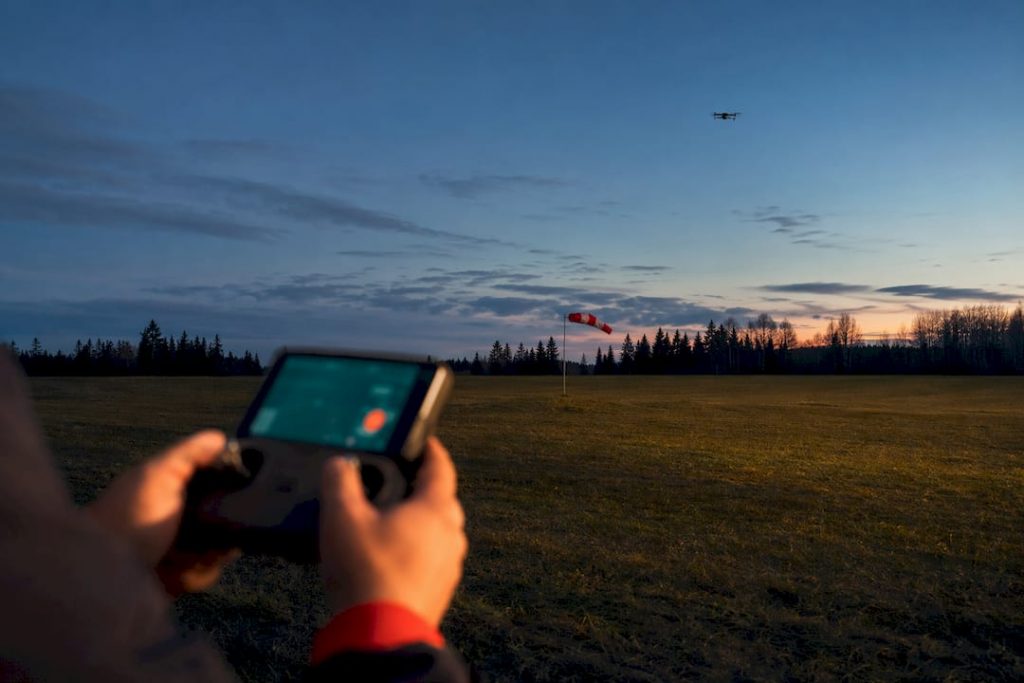
How to comply with Canada drone laws: register at 250 g, hold the right certificate, get NAV Drone approval and avoid fines from the 2025 rule changes.
Yes, flying a drone in Canada is legal, but drones count as aircraft under federal law. Before your first flight, you need to register any drone weighing 250 g or more, hold the matching Transport Canada pilot certificate, and follow airspace and distance rules through NAV Drone. The 2025 regulatory overhaul also opened the door to medium drone operations and lower-risk beyond visual line of sight flights for pilots who complete the new certification tiers.
TL;DR:
- Drones weighing 250 g or more must be registered with Transport Canada and clearly marked on the aircraft before flight; refusal or oversight can lead to heavy penalties.
- A pilot must hold at least a Basic certificate to fly beyond 30 meters from bystanders or outside controlled airspace, with advanced or complex certificates required for closer or more risky operations.
- Operating within 5.6 km of airports or 1.9 km of heliports, and respecting minimum distances from individuals, are mandatory, with additional permissions needed for controlled airspace or near sensitive zones.
- NAV Drone platform requires careful planning and submission at least two weeks in advance for complex flights or BVLOS operations, especially when flying in restricted or busy airspace.
- Even with federal compliance, privacy laws limit drone photography; hovering over private property or capturing identifiable individuals without consent can result in civil or criminal legal actions.
Table of Contents
- What Do Canada’s Drone Regulations Actually Require?
- How Do You Register Your Drone in Canada?
- Which Pilot Certificate Do You Need?
- How Far Must You Stay From Airports and People?
- How Do You Get Permission to Fly Through NAV Drone?
- What Changed in Canada’s Drone Rules for 2026?
- What Are the Penalties for Breaking Drone Laws in Canada?
- Your Pre-Flight Checklist for Legal Drone Operations
- Do You Need Insurance to Fly a Drone in Canada?
- What Responsibilities Come With Flying a Drone Safely?
- What Privacy Laws Apply to Drone Photography in Canada?
- A Practical Note From Our Team
- Sources
- FAQ
What Do Canada’s Drone Regulations Actually Require?
Every drone in Canadian skies falls under Part IX of the Canadian Aviation Regulations, the same section of law that governs remotely piloted aircraft systems whether you are shooting a wedding video or mapping a farm field. That single legal framework applies whether you fly for fun on a Sunday afternoon or run a commercial inspection business.
Transport Canada sorts operations by weight, and the category you fall into determines almost everything else about your obligations:
- Micro: under 250 g, minimal federal requirements but still subject to safety rules
- Small: 250 g to 25 kg, the category covering most consumer and prosumer drones
- Medium: 25 kg to 150 kg, newly opened to civilian operators under the 2025 changes
A few baseline rules apply no matter what you fly. You cannot operate recklessly or negligently, violate someone’s reasonable expectation of privacy, or disturb wildlife or fly in a way that endangers other aircraft. Provincial trespass laws, municipal bylaws, and Parks Canada restrictions can layer additional limits on top of federal rules, so a flight that’s legal under the CARs might still get you in trouble in a specific park or municipality.
How Do You Register Your Drone in Canada?
Any drone with an operating weight of 250 g or more must be registered with Transport Canada before it ever leaves the ground. Registration happens through the Drone Management Portal, and once you complete the process, you’ll receive a registration number that must be marked clearly on the aircraft itself, not buried in a case or a manual.
Pro Tip: Label your drone before you forget, not after a bystander asks to see it. A visible registration number saves an awkward conversation with a Transport Canada inspector or a curious park ranger.
The registration fee is $10.17 per drone, a modest cost given the penalties for skipping it entirely, which we’ll get to shortly.
Here’s where things get interesting for hobbyists flying “micro” drones under 250 g: that exemption disappears the moment you add a payload. Strap on a camera mount, a light, or any accessory that pushes total operating weight to 250 g or above, and your featherweight toy suddenly needs registration, marking, and a pilot certificate to match. Foreign visitors face a separate wrinkle too. Non-Canadian pilots cannot register a drone in Canada at all and must instead apply for special foreign-pilot permissions before flying here.
Which Pilot Certificate Do You Need?
Transport Canada issues three certificates, and each one unlocks a different set of privileges while carrying its own age floor and testing requirements.
- Basic Certificate — minimum age 14, passed through an online exam alone. It covers flights outside controlled airspace, more than 30 m from bystanders, and away from advertised events.
- Advanced Certificate — minimum age 16, requiring an online exam plus an in-person flight review. It permits flying closer to people and inside controlled airspace once you have NAV CANADA authorization.
- Level 1 Complex Certificate — minimum age 18, the newest and most demanding tier, requiring 20 hours of ground school on top of an additional exam and flight review.
That Level 1 Complex tier didn’t exist before the 2025 changes, and it’s now the gateway to two things recreational flying never touched before: legally flying medium drones and running lower-risk beyond visual line of sight operations without applying for a one-off special permit.
Certificates don’t last forever, either. Transport Canada requires recurrent training within 24 months of your last exam or flight review, and you need to carry proof of current certification any time you fly. A common misconception trips up newer pilots here: holding an Advanced certificate does not automatically mean you’re cleared for every flight scenario. The specific operation, not just the certificate tier, determines whether you’re compliant.
How Far Must You Stay From Airports and People?
Distance rules in Canada are specific enough that you can check compliance with a map before you ever launch. Stay at least 5.6 km (3 nautical miles) from a certified airport and 1.9 km (1 nautical mile) from a heliport unless you’ve secured permission through NAV Drone.
Bystander distance matters just as much as airport proximity:
- Basic operations: minimum 30 m horizontal distance from any person not involved in the flight
- Closer approaches: require an Advanced certificate and, often, additional authorization
- Controlled airspace: always requires an Advanced certificate plus NAV CANADA sign-off, regardless of altitude
Airspace classification trips up more pilots than any other rule on this list. Flying in uncontrolled airspace does not automatically make an operation “Basic.” If you’re within 30 m of bystanders or inside a control zone, your flight shifts to Advanced requirements the instant those conditions apply, even if you started planning it as a casual Basic flight. Advertised public events, active emergency response sites, and sensitive zones like national parks or wildlife reserves carry their own extra layer of permission requirements on top of the standard distance rules.
How Do You Get Permission to Fly Through NAV Drone?
NAV CANADA’s NAV Drone platform is the single point of contact for requesting airspace authorization, and setting it up correctly before you plan any flight saves real headaches later.
- Create your NAV Drone profile and link your Transport Canada pilot certificate and registered drone.
- Plan the specific operation, altitude, and location inside the platform.
- Let the system check your request against a grid of altitude thresholds tied to nearby airspace.
- Requests within automatic thresholds get instant approval; requests that exceed them route to manual review.
- Manual reviews can take significant time depending on volume and complexity.
Pro Tip: If you’re planning a complex or time-sensitive shoot, submit your NAV Drone request at least two weeks out. A rushed manual review is the most common reason commercial pilots miss a shoot date.
NAV Drone can’t help everywhere. Military aerodromes and certain non-NAV CANADA-controlled heliports fall outside its authority entirely, so operators need to contact the controlling agency directly, whether that’s the Department of National Defence or a private operator, or apply for a Special Flight Operations Certificate when no other pathway exists.
What Changed in Canada’s Drone Rules for 2026?
The 2025 regulatory updates mark the biggest shift in Canadian drone law since the original Part IX rules took effect. Transport Canada phased the changes in deliberately: exams and applications for the new Level 1 Complex certificate and RPAS Operator Certificate (RPOC) became available starting April 1, 2025, while the operational privileges tied to those credentials, including expanded medium-drone and BVLOS flying, took effect November 4, 2025.
The RPOC functions as an operator-level authorization sitting alongside the pilot-level Level 1 Complex certificate. Together, they let qualifying operators run beyond visual line of sight missions and fly medium drones without a case-by-case Special Flight Operations Certificate application, which used to be the only path for either. New fees accompanied the changes, covering exams, the RPOC itself, and required declarations, and Transport Canada publishes the current fee tables directly on its site.
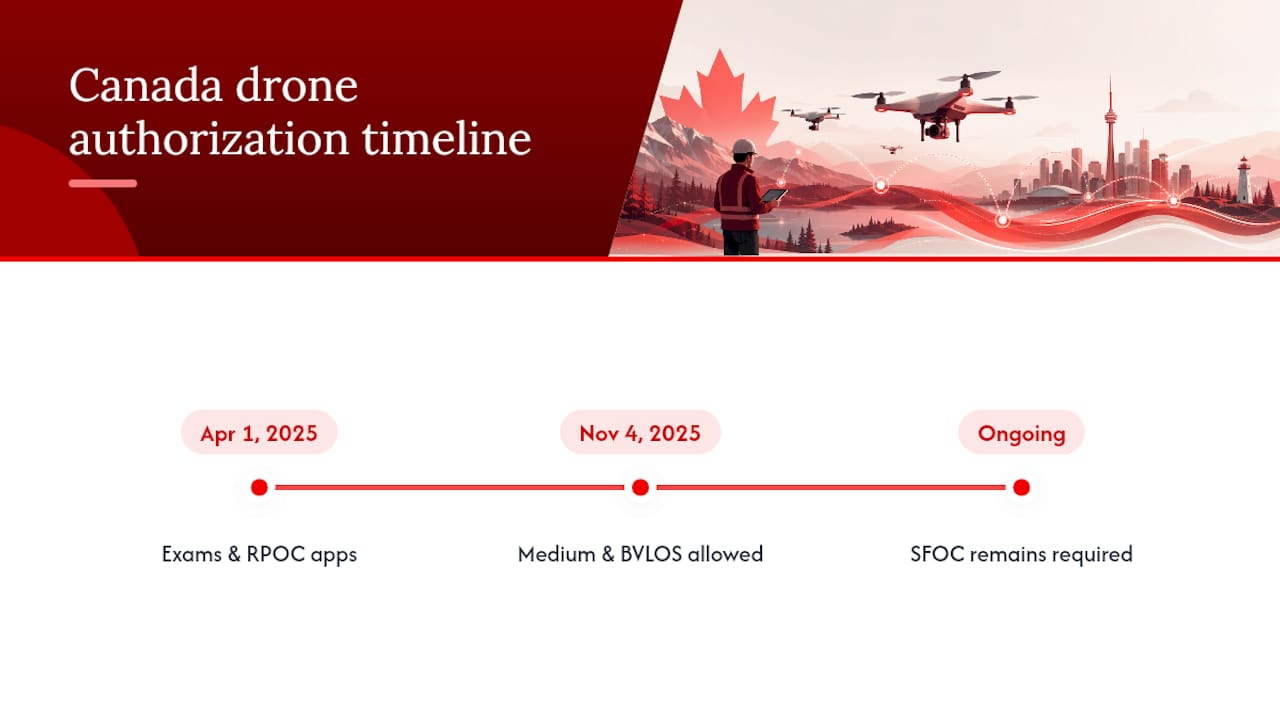
Not everything moved under the new declaration system. Higher-risk operations, unusual airspace, or anything outside the defined parameters of Level 1 Complex and RPOC still require a Special Flight Operations Certificate (SFOC), the older individualized permission route that predates this reform.
What Are the Penalties for Breaking Drone Laws in Canada?
Transport Canada doesn’t treat drone violations as a slap-on-the-wrist matter, and the fine schedule reflects that. Individuals face penalties up to $1,000 for flying without the required pilot certificate and up to $5,000 for operating an unregistered or unmarked drone.
- Individual fines: up to $1,000 (no certificate) or $5,000 (unregistered/unmarked)
- Corporate fines: up to $25,000 for serious violations
- Enforcement: Transport Canada inspectors, RCMP, and delegated municipal officers all have authority to investigate
- Stacking: multiple violations from a single flight, say flying unregistered and inside restricted airspace, can be charged together
Corporations face steeper consequences, with fines reaching $25,000 for serious infractions. An investigation into a single reckless flight can easily turn up two or three separate violations at once, and each gets charged independently rather than folded into one penalty.
Your Pre-Flight Checklist for Legal Drone Operations
Run through this sequence before every flight, not just your first one. Rules and airspace change, and a checklist habit catches problems before they become fines.
- Confirm your drone’s registration is current and the registration number is visibly marked.
- Verify you hold the pilot certificate matching your planned operation, and carry proof.
- Plan the flight in NAV Drone and check whether it clears automatic authorization or needs manual review.
- Double-check operating weight, any added payload, and the resulting bystander distance requirement.
- Scan for advertised events, active emergencies, or restricted zones near your flight path.
- Build a contingency plan for lost signal, low battery, or sudden airspace changes.
Pro Tip: Screenshot your NAV Drone approval before takeoff. If an officer or inspector asks for proof on-site, cell service near remote flight locations isn’t guaranteed.
Provincial and municipal rules layer on top of everything federal, so a quick check of local bylaws rounds out a solid pre-flight routine.
Do You Need Insurance to Fly a Drone in Canada?
Transport Canada’s regulations don’t mandate liability insurance for recreational drone pilots, but that gap in the law is exactly where a lot of operators get burned. If your drone damages property, injures someone, or clips another aircraft, you’re personally on the hook for those costs without coverage, and standard homeowner’s insurance policies frequently exclude aircraft-related claims entirely, drones included.
Commercial operators face a different reality. Many clients, from real estate agencies to construction firms, now require proof of liability coverage before they’ll hire a drone pilot for a shoot, and some municipal permits for filming or events build insurance proof directly into the approval process. Coverage amounts commonly range from $100,000 to $1,000,000 in liability protection, depending on the type of work and the client’s own risk tolerance.
If your drone work overlaps with travel, whether you’re flying across provincial lines for a job or heading somewhere remote for a shoot, it’s worth checking how travel medical insurance factors into your overall coverage picture, since equipment and liability policies rarely address personal medical costs on the road.
Treat insurance as a business decision rather than a legal checkbox. The cost of a policy is a rounding error compared to the potential liability from even one bad incident involving a drone that can weigh several kilograms and travel at highway speeds.
What Responsibilities Come With Flying a Drone Safely?
Holding the right certificate and registering your drone covers the paperwork, but Transport Canada’s rules also assign ongoing responsibility for how you actually fly. You’re required to inspect your aircraft before each flight, checking battery condition, propeller integrity, and firmware status, since a mechanical failure over a populated area isn’t a legal defense.
Weather judgment falls entirely on the pilot. Wind speed, precipitation, and visibility all affect whether a flight is safe, and no certificate substitutes for reading conditions accurately on the day. You’re also responsible for maintaining visual line of sight during Basic and Advanced operations unless you’re specifically certified and authorized for beyond visual line of sight work under the new Level 1 Complex framework.
Situational awareness extends beyond your own flight path. Other aircraft, including low-flying helicopters and small planes, always have the right of way over drones, and you’re expected to yield and land if a manned aircraft appears nearby. The Aviation Safety Letter Transport Canada publishes on remotely piloted aircraft systems walks through exactly this kind of scenario, where pilots assume uncontrolled airspace alone grants clearance when proximity to people or aircraft actually changes the category entirely.
Good habits around certification renewal echo something we cover often when writing about CPR and AED certification: a credential that sits unused for two years stops reflecting your actual readiness. Treat your drone recency requirement the same way.
What Privacy Laws Apply to Drone Photography in Canada?
Flying legally under Transport Canada’s rules doesn’t automatically protect you from a privacy complaint. Canada’s federal privacy framework, including the Personal Information Protection and Electronic Documents Act (PIPEDA), applies to commercial drone operators who collect images or data involving identifiable individuals, and provincial privacy statutes add further restrictions depending on where you fly.
Recreational pilots aren’t exempt from consequences either, just from PIPEDA’s specific commercial-data rules. Common law protections around a reasonable expectation of privacy still apply, meaning a drone hovering over someone’s backyard pool or peering through a window can trigger a civil complaint or even a criminal harassment charge, regardless of whether the pilot holds a valid certificate.
Flying over private property itself isn’t automatically illegal under federal aviation law, since airspace above a certain altitude isn’t the landowner’s to control. The trouble starts when the flight involves surveillance, low hovering, or repeated passes that a reasonable person would consider intrusive. Trespass laws also come into play if you land on private property or launch and recover from it without permission.
The safest approach treats any residential photography as sensitive by default. Avoid capturing faces, license plates, or identifiable details of people who haven’t consented, and if a neighbor asks you to stop, stop, whether or not you believe you’re technically within your legal rights.
A Practical Note From Our Team
We recommend a safety-first approach: check Transport Canada and NAV CANADA pages regularly, since rules keep shifting through 2026. Confirm your registration, complete the right exam, and run a test flight plan through NAV Drone before attempting anything complex. For deeper exam-prep breakdowns and step-by-step guides, explore more resources with Lizard’s Lunch.
— Alexander
Sources
FAQ
Is It Legal to Fly a Drone Over Private Property in Canada?
Flying over private property isn’t automatically illegal, since federal aviation law governs the airspace rather than the landowner. Problems arise when the flight involves hovering, surveillance, or repeated passes that violate someone’s reasonable expectation of privacy, which can trigger a civil or even criminal complaint.
Can I Fly My Drone Around My Neighborhood?
Yes, as long as you meet registration, certification, and distance requirements for your drone’s weight class. Stay at least 30 m from bystanders under Basic operations, avoid controlled airspace without authorization, and respect neighbors’ privacy even when you’re technically within your legal rights.
Can You Fly a 249 g Drone in Canada Without Registering It?
Yes, drones under 250 g qualify for the microdrone exemption and don’t require registration. That exemption disappears the moment you add a payload or accessory that pushes the total operating weight to 250 g or more, at which point registration and marking become mandatory.
Do I Need a Pilot Certificate for Recreational Flying?
Yes. Even recreational pilots flying a registered drone need at minimum a Basic certificate, obtainable at age 14 through an online Transport Canada exam. Flying closer to people or inside controlled airspace requires the Advanced certificate instead.
What Happens if NAV Drone Can’t Authorize My Flight Location?
Some locations, including military aerodromes and certain non-NAV CANADA-controlled heliports, fall outside NAV Drone’s authority entirely. In those cases, contact the controlling agency directly or apply for a Special Flight Operations Certificate (SFOC) if no other approval pathway applies.















Leave a Comment
Your email address will not be published. Required fields are marked with *