

Start macro tracking with a protein first plan aligned with Health Canada. Set calories, pick a tracking method, and check progress in 4–6 weeks.
Macro tracking helps you lose weight because it turns an abstract goal into measurable numbers, letting you run a calorie deficit while protecting the protein that keeps you from losing muscle along with fat. Start by estimating your maintenance calories, then set a modest deficit and a protein target before you touch carbs or fat. If you’re managing diabetes, kidney disease, pregnancy, or a history of disordered eating, talk to a healthcare provider before using generic macro targets.
TL;DR:
- Tracking macros is most effective when starting with a modest calorie deficit and prioritizing protein intake to preserve muscle mass.
- Weighing calorie-dense foods and cross-checking database entries against labels significantly improves tracking accuracy over time.
- Maintaining a balanced intake of vegetables, fruits, and whole grains ensures nutrient adequacy while hitting macro targets.
- Weekly weight trends and measurement comparisons provide a clearer picture of progress than daily fluctuations, reducing misinterpretation.
- Macro tracking is not suitable for everyone, especially those managing certain health conditions or with a history of disordered eating, requiring personalized guidance.
Table of Contents
- Quick Steps to Start Macro Tracking for Weight Loss Today
- How to Calculate Your Macros for Fat Loss
- Setting Protein, Fat, and Carb Targets That Actually Work
- Choosing a Tracking Method You’ll Actually Stick With
- Keeping Your Macros Nutritious, Not Just Numeric
- Reading Your Results Without Getting Fooled by Noise
- When Macro Tracking Isn’t the Right Tool
- Our Take: Treat It as a Trial, Not a Life Sentence
- Sources
- FAQ
Quick Steps to Start Macro Tracking for Weight Loss Today
You don’t need a nutrition degree to start. You need a calculator, a kitchen scale, and about fifteen minutes.
- Estimate your maintenance calories. Use an online calculator or the Mifflin St. Jeor equation to find how much energy your body burns at your current weight and activity level.
- Pick a modest deficit. Cut a modest percentage off that maintenance number to create a manageable calorie deficit.
- Set protein first. Lock in your protein target in grams before you touch anything else.
- Set a fat minimum, then fill the rest with carbs. Carbs become the flexible leftover category once protein and fat are covered.
- Choose a tracking tool and weigh calorie-dense foods. Oils, nut butters, and grains are easy to underestimate by eye.
- Verify database entries against the actual Nutrition Facts label whenever you log a packaged food.
- Check your weekly average, not daily swings, and adjust every one to two weeks.
That’s the whole system. Everything past this point is detail and troubleshooting.
How to Calculate Your Macros for Fat Loss
The math behind macro tracking for weight loss is simpler than most apps make it look. It runs in four steps: estimate maintenance calories, apply a deficit, split that number into protein, fat, and carbs, then convert grams to calories to check your work.
Start with the Mifflin St. Jeor equation to estimate your basal metabolic rate, then multiply by an activity factor (roughly 1.2 for sedentary, up to 1.9 for very active) to get maintenance calories. From there, a modest deficit typically produces a weight loss rate that clinicians consider sustainable without excessive muscle loss.
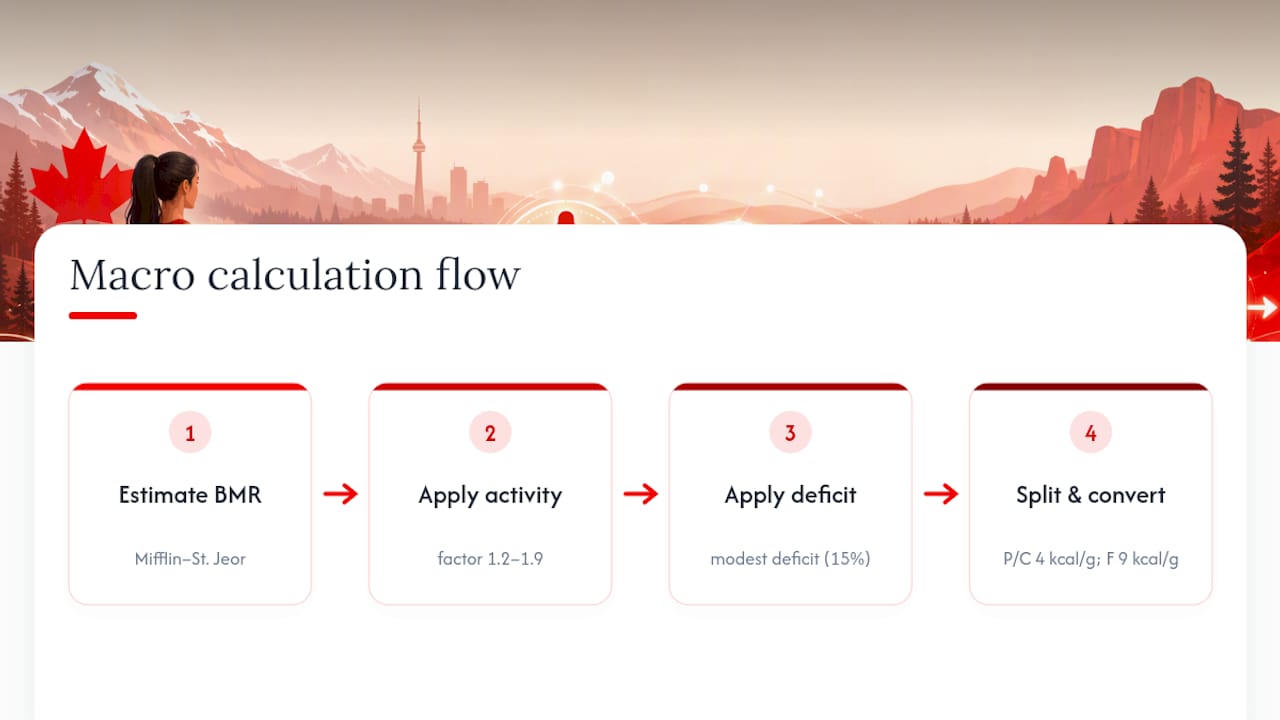
Converting macros to grams relies on three fixed numbers: protein and carbohydrate each provide 4 calories per gram, and fat provides 9 calories per gram. Here’s what that looks like for someone with 2,000 maintenance calories aiming for a 15 percent deficit, following the same step-by-step math Healthline outlines:
Run the same conversion with your own numbers and you’ll have a personalized starting point instead of a generic app default.
Setting Protein, Fat, and Carb Targets That Actually Work
Protein is prioritized as it helps preserve lean mass during a deficit and is satiating. A practical range supports most people’s needs, with higher amounts beneficial for those engaging in regular resistance training.
Fat intake should not be too low because it supports hormone production and vitamin absorption, so most guidance recommends maintaining a minimum fat intake as part of a healthy deficit.
Carbohydrates fill whatever calories remain once protein and fat are set. There’s no single best macro ratio for weight loss. A 40/30/30 split works fine for some people; others do better with higher carbs around training days and lower carbs on rest days. What matters more than the exact ratio is staying within ranges that support nutrient adequacy.
- Protein: 1.2 to 2.2g per kilogram of body weight, prioritized first
- Fat: rarely below 20 percent of total calories
- Carbs: the flexible remainder, adjusted around activity level
- All three checked against Health Canada’s Acceptable Macronutrient Distribution Ranges to avoid drifting into deficient territory
Pro Tip: If your carbohydrate intake seems very low, check whether fat or protein targets might be set too high before reducing carbs further.
Choosing a Tracking Method You’ll Actually Stick With
The best tracking method is the one you’ll still be using in week six, not the one with the most features. Apps with barcode scanners and food databases are fast, but user-submitted entries are often wrong, sometimes by a wide margin. Manual paper logs or spreadsheets are slower but force more deliberate portioning. Higher engagement with digital self-monitoring tools is linked to better weight-loss outcomes, but many people stop using them within weeks, which makes consistency the deciding factor over any single app’s feature list.
A few habits make any method more accurate:
- Weigh calorie-dense foods: oils, nut butters, cheese, and grains, where small volume errors create large calorie swings.
- Estimate visually for low-calorie bulk foods like leafy greens, where precision matters far less.
- Build and save recipes for meals you eat often, so you’re not re-entering ingredients every time.
- Cross-check any database entry against the actual Nutrition Facts panel on the package before trusting it.
Pro Tip: Weighing your oil for one week alone can reveal calorie errors of 100 to 200 calories a day. That single ingredient is one of the most common places accurate tracking quietly falls apart.
If full logging becomes too much, an abbreviated version, like tracking protein only or logging just on weekdays, still works. It won’t be as precise, but it beats abandoning tracking entirely.
Keeping Your Macros Nutritious, Not Just Numeric
Hitting your macro targets with candy and protein shakes is technically possible and practically counterproductive. Health Canada’s food guide still applies inside a macro framework: vegetables, fruit, whole grains, and varied protein sources should make up the bulk of your plate, deficit or not.
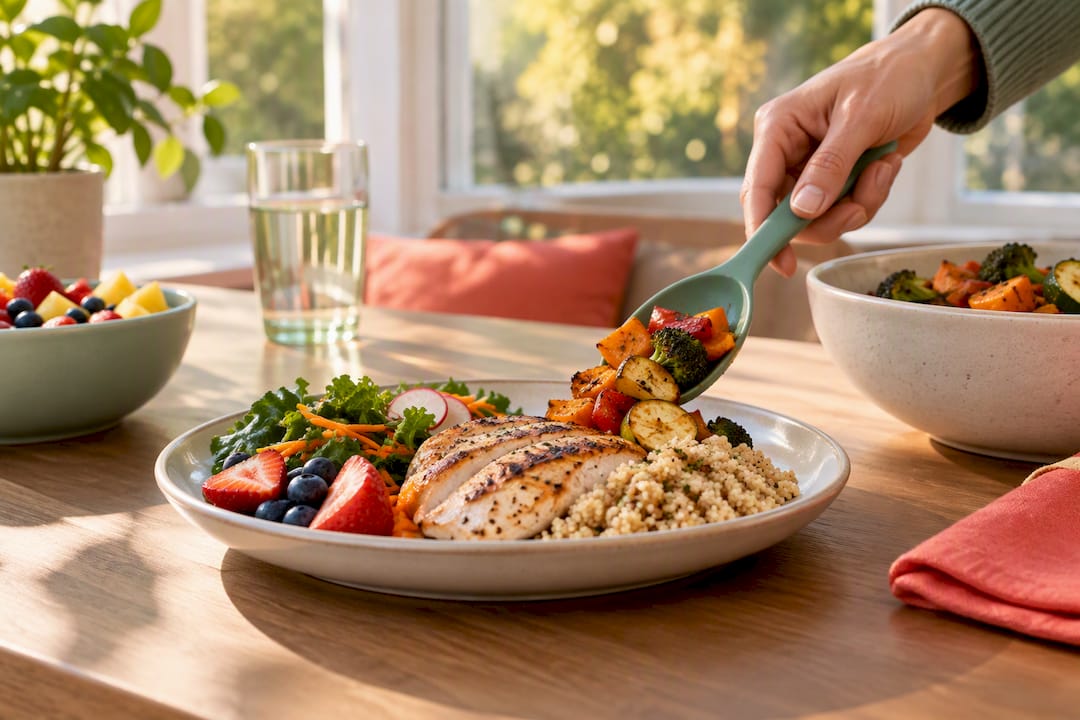
Fiber and micronutrients tend to disappear first when people get too focused on hitting exact numbers. A 1,700-calorie day built around chicken breast, white rice, and almonds hits the same macro numbers as one built around lentils, sweet potato, salmon, and mixed vegetables, but the second version delivers far more fiber, potassium, and B vitamins for the same calorie cost.
Sample combinations that hit macro goals without leaning on ultra-processed shortcuts:
- Greek yogurt with berries and a tablespoon of chia seeds for a protein-and-fiber breakfast
- A grain bowl with quinoa, black beans, roasted vegetables, and grilled chicken
- Salmon with a baked potato and steamed broccoli for a fat-and-fiber-forward dinner
- Cottage cheese and sliced apple as a low-effort, high-protein snack
Building meals this way is also where a structured meal-planning approach pays off, since repeating a handful of nutrient-dense combinations makes hitting targets automatic instead of a daily puzzle.
Reading Your Results Without Getting Fooled by Noise
Daily scale weight swings by a pound or two from water, sodium, and digestion alone, so judging progress off any single morning is a mistake. Trend-based tracking that averages weight over a full week, alongside waist measurements and how your clothes fit, gives a far clearer picture than daily fluctuation.
Most logging errors trace back to a handful of repeat offenders: guessing a portion instead of weighing it, trusting a mislabeled database entry, or forgetting to log cooking oil. A 2021 systematic review of weight-loss studies found that abbreviated self-monitoring, tracking less often or less thoroughly, produced weight loss comparable to full daily logging in many cases, which means a lighter routine doesn’t have to mean weaker results.
- Weigh your top 3 to 5 most-logged foods for one week to catch hidden errors.
- Wait at least two to three weeks of stalled weekly averages before cutting calories further.
- When you do adjust, drop by another 100 to 150 calories rather than making a drastic cut.
When Macro Tracking Isn’t the Right Tool
Generic macro calculators assume a healthy adult with no complicating conditions. If you’re managing diabetes, kidney disease, are pregnant, or have a history of disordered eating, a standard deficit-and-macro-split approach can do real harm, and Health Canada’s dietary reference values are explicitly built as population guardrails, not personalized medical prescriptions.
A registered dietitian can tailor targets to your actual health picture instead of a spreadsheet formula. Bring your last two to three weeks of food logs, your current weight trend, any relevant medical history, and a specific goal. Worthwhile questions to ask include how your targets should shift around medication, training, or menstrual cycle changes, and how often you should reassess.
Our Take: Treat It as a Trial, Not a Life Sentence
We recommend treating macro tracking as a four to six week experiment rather than a permanent commitment. If it sharpens your awareness of portions and protein, keep it. If it’s making you anxious about food or you’re abandoning it by week two, that’s useful data too, and it’s a sign to shift toward simpler habit-based approaches, like a protein-first plate and mostly whole foods, without the app.
Either outcome is a win. If you’re unsure which camp you fall into after a real trial, that uncertainty is exactly what a registered dietitian is for.
— Alexander
Sources
For readers who want the primary references behind this guide:
- Canada
- How to Count Macros: A Step-By-Step Guide – Healthline
- Study on digital self-monitoring engagement and outcomes – PubMed
If you’re weighing whether a wearable device belongs in your routine, our comparison of a smartwatch versus a dedicated fitness tracker breaks down which one actually fits a tracking workflow.
This article is general information, not a substitute for advice from a qualified doctor. Consult a qualified healthcare professional about your own circumstances before acting on anything here.
FAQ
Can I Lose Weight Just by Tracking Macros?
Tracking macros alone won’t cause weight loss. It works by making a calorie deficit visible and measurable, which helps most people eat less without guessing, and that deficit is what actually drives the loss.
What Is the 3-3-3 Rule to Lose Weight?
There’s no single agreed-upon definition of a “3-3-3 rule” in nutrition science, and it isn’t part of established dietary guidance. Treat any version you see online with caution and rely on a calculated deficit and macro targets instead.
What Macros Should I Track for Weight Loss?
Track protein, fat, and carbohydrates, with protein set first at roughly 1.2 to 2.2 grams per kilogram of body weight, fat kept above about 20 percent of total calories, and carbs filling the remainder based on your activity level.
Is a 40/30/30 Macro Split Good for Weight Loss?
A 40/30/30 split, meaning 40 percent carbs, 30 percent protein, and 30 percent fat, works well for many people, but it isn’t the only effective ratio. What matters more is hitting an adequate protein target and staying within Health Canada’s AMDR ranges for nutrient adequacy.


















Leave a Comment
Your email address will not be published. Required fields are marked with *