
Build strength at home with resistance band exercises grouped by muscle, plus beginner to advanced routines and ACSM guidance on sets, reps, and safety.
Resistance band exercises build real strength and muscle, and they work whether you are brand new or years into training. Start with a band squat, band row, chest press, glute bridge, and lateral band walk, then pick one mini-circuit below and try it this week. Bands are light, cheap, and ready wherever you are.
TL;DR:
- For muscle growth, aim for at least 10 weekly sets per muscle group, split across two or three sessions to keep each workout manageable.
- Choose a band that allows 10 to 15 controlled repetitions; increase resistance if you exceed 15, or lighten it if your form breaks earlier.
- Beginners can complete two rounds in 20 to 25 minutes, doing 10 to 15 repetitions per move and resting 30 to 60 seconds between exercises.
- When a band feels easy, shorten your grip, step farther from the anchor, slow the lowering phase, or add a pause at the hardest point.
- Inspect bands for tears or fraying before training, and test door anchors with a firm tug while keeping your face outside the band’s path.
Table of Contents
- Why do resistance bands work so well?
- How do you choose the right resistance band?
- Which upper-body resistance band exercises should you do?
- What are the best lower-body band exercises?
- How do you train glutes and core with bands?
- What does a complete resistance band workout look like?
- How many sets, reps, and days per week do you need?
- How do you keep band training safe?
- How did we put these routines together?
- Why consistency beats the perfect plan
- FAQ
- Sources
Why do resistance bands work so well?
Bands are not a lesser version of the gym. The 2026 American College of Sports Medicine position stand states that elastic-band training can increase strength and muscle size, and it points to roughly 10 sets per muscle group per week as the hypertrophy target. The key ingredients are effort and consistency, not fancy equipment.
ACSM target for muscle growth: about 10 sets per muscle group per week. Bands can deliver that volume, so you can build a plan around it.
A systematic review of variable elastic resistance found that band training improves muscle strength and functional capacity across the lifespan. It can match traditional methods when intensity and volume are matched. The review looked at people of different ages, which is good news if you are starting late.
The practical perks are easy to love. Bands travel in a pocket, cost little, and get harder as they stretch, so the end of each rep feels tougher than the start. Beginners, people returning to fitness after time off, and frequent travelers tend to get the most from them.
How do you choose the right resistance band?
Walk into any store and you will see a few families of bands. Each does a slightly different job.
- Loop (flat) bands: Long, continuous circles that suit rows, presses, and assisted pull-ups.
- Tube bands with handles: Easy on the hands and ideal for presses, curls, and rows.
- Mini loop bands: Short circles that sit around the thighs or ankles for glute and hip work.
- Therapy bands: Flat, wide strips with gentle tension, often used for rehab-style moves and mobility.
To test a band, choose a resistance that lets you finish 10 to 15 controlled reps. If you cruise past 15, go heavier. If form falls apart before 10, go lighter. You can also raise tension without buying anything new by shortening your grip or moving your anchor point.
Pro Tip: Check your band for nicks, thin spots, and frays before every session, and retire any band that looks worn.

Which upper-body resistance band exercises should you do?
These four moves cover your back, chest, shoulders, and arms. Keep a slow, steady tempo and stop each set with a rep or two in reserve.
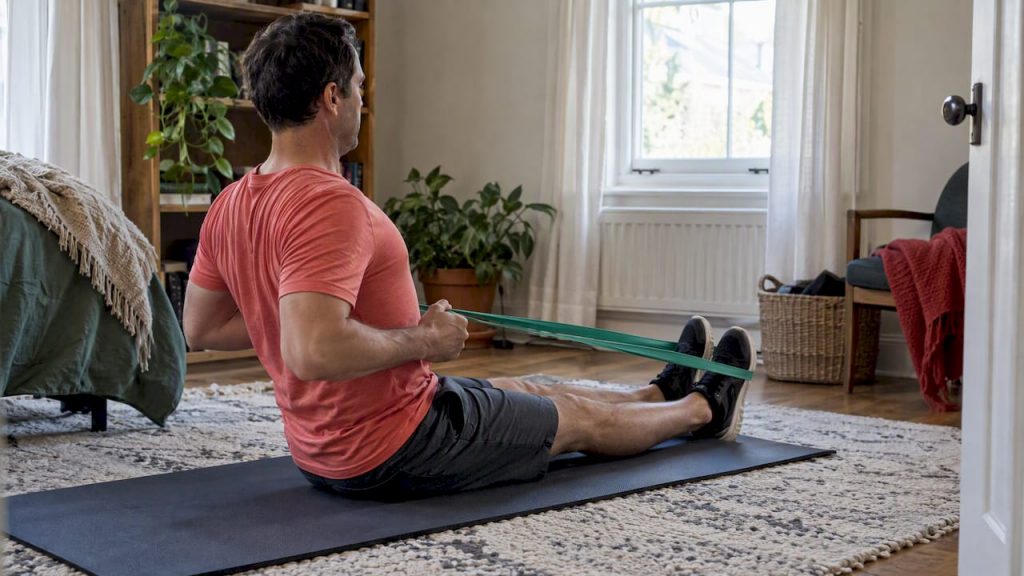
- Band row: Loop the band around your feet or a sturdy anchor, pull your elbows back, and squeeze your shoulder blades together. Try it one arm at a time to find and fix side-to-side differences. Aim for 2 to 3 sets of 10 to 15.
- Chest press: Anchor the band behind you at chest height, step forward into a staggered stance, and press your hands out as if you were on a bench. A door anchor works if it is secure. The same rep range applies.
- Pull-apart and lateral raise: Hold the band in front of you at shoulder height and pull your hands apart, keeping your shoulders down, away from your ears. For lateral raises, stand on the band and lift your arms out to the sides to about shoulder height. Both are gentle on the shoulders and build the small stabilizers that keep them healthy.
- Biceps curl and triceps extension: Stand on the band for curls, with elbows pinned at your sides and a slow lowering phase. For triceps, anchor the band overhead or behind you and straighten your elbows without letting your upper arms drift.
If you are just getting started with any kind of lifting, our first-month strength training plan pairs well with these moves.
What are the best lower-body band exercises?
Your legs are big muscles that respond fast to band work. Use a slightly stronger band here than you would for your arms.
- Band squat: Place the band above your knees or stand on it and hold the ends at your shoulders. Push your knees out in line with your toes, sit back, and lower until your thighs are about parallel to the floor if that feels comfortable. The band above the knees teaches you to keep them from caving in.
- Lunges and split squats: Step into a stance about hip-width wide, not a tightrope, so you stay balanced. Stand on the band with your front foot and hold the ends at your shoulders. Lower straight down and drive back up through the front heel.
- Leg-press-style movement: Lie on your back, loop the band around both feet, and press away with your knees bent. It is a handy leg press alternative when you have no machine.
- Single-leg Romanian deadlift: Stand on the band with one foot, hold the ends, and hinge at the hips while the other leg floats back. Keep your spine long and feel your hamstring stretch before you stand tall. It also trains balance.
How do you train glutes and core with bands?
Strong hips and a stable trunk make everything else easier, from climbing stairs to carrying groceries. The Hospital for Special Surgery shares several of these in its at-home band workout examples.
- Lateral band walk: Put a mini loop above your knees or around your ankles, sit into a quarter squat, and step sideways with control. Progress by using a stronger band or taking longer steps.
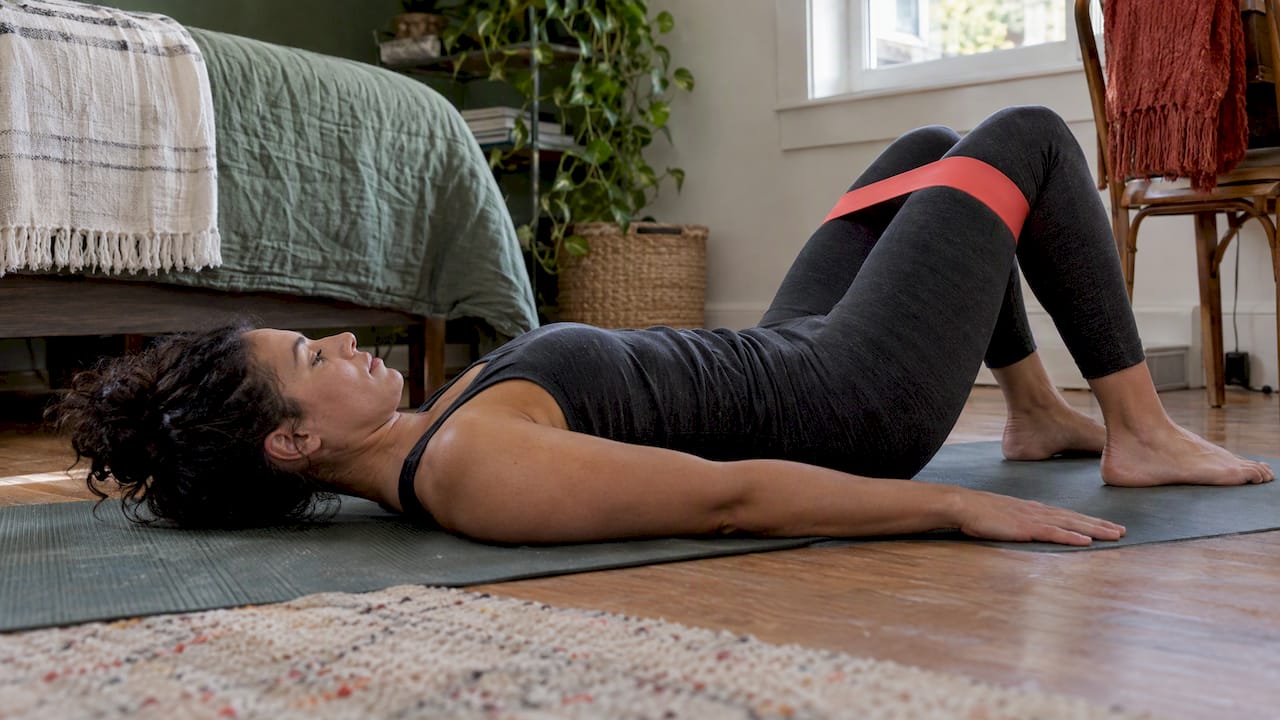
- Glute bridge and single-leg bridge: Lie on your back with a band above your knees, feet flat, and drive your hips up by squeezing your glutes. Keep your ribs down so your lower back does not do the work. Lift one foot off the floor once two legs feel easy.
- Pallof press: Stand sideways to an anchored band, hold it at your chest, and press your hands straight out without letting the band twist you. This anti-rotation drill builds a trunk that resists unwanted movement.
- Banded side plank with clamshell: In a side plank, open and close your top knee against a mini loop. It lights up the outer hip and the deep core at once.
Done regularly, these moves improve hip stability and posture, which can make daily movement feel smoother. For more ideas on controlled core work, the Pilates-based movement tips from MTLPILATES pair nicely with band training.
Pro Tip: Slow the lowering phase of each rep. It makes the same band feel noticeably harder.
What does a complete resistance band workout look like?
Pick the level that fits you today. You can move up when the current one feels easy.
- Beginner (20 to 25 minutes, 2 rounds): Do 6 to 8 moves such as band squat, row, chest press, glute bridge, pull-apart, and Pallof press, 10 to 15 reps each with a light band. Rest 30 to 60 seconds between exercises, and keep your form crisp, as WebMD advises beginners.
- Intermediate (30 to 35 minutes, 3 rounds): Use a stronger band and add lunges, single-leg bridges, curls, and triceps extensions. Do 3 sets of each major movement, and slow every lowering phase.
- Advanced: Use higher volume and supersets, such as rows paired with chest presses, plus faster, explosive concentric reps for power. Spread your work so each muscle group gets close to the 10 weekly sets ACSM links to hypertrophy.
How many sets, reps, and days per week do you need?
ACSM’s overview of reviews gives a clear framework. For strength, 2 to 3 sets per exercise at higher loads works well. For muscle size, aim for at least 10 sets per muscle group each week. For power, use moderate loads and move the band quickly on the way up.
For hypertrophy, the guidance is at least 10 sets per muscle group per week. Split them over two or three sessions so each one stays manageable.
Judging intensity with bands is simple. Use the 10 to 15 rep test, and rate your effort: the last two reps of a set should feel hard but doable. Bands have no printed weight, so effort is your guide.
When a band stops challenging you, try these tactics:
- Shorten your grip or step farther from the anchor.
- Double the band over itself.
- Move the anchor higher or lower to change the angle.
- Add one more session each week.
- Slow the tempo or add a pause at the hardest point.
How do you keep band training safe?
A few quick checks protect you and make each rep count.
- Inspect first: Stretch the band gently and look for tears, thin spots, and frays. Replace it if you see any.
- Test your anchor: Tug a door anchor firmly before loading it, and make sure the door is closed and locked. Start with a light pull, then build up.
- Fix rushed reps: Slow down and let the band return under control instead of snapping back.
- Set your shoulders: If your shoulders creep up toward your ears on rows or pull-aparts, lower them and lead with your shoulder blades.
- Keep the band clear of your face: Hold the ends firmly and keep your face out of the line of fire in case something slips.
How did we put these routines together?
Our team at Lizard’s Lunch built these routines from the sources linked throughout this guide. We used the ACSM position guidance for programming and weekly volume. Exercise examples come from the Hospital for Special Surgery and WebMD beginner resources. Adjust intensity to how you feel, and check with a health provider before starting a new routine if you have a medical concern or an injury.
Why consistency beats the perfect plan
We have a simple view: the best program is the one you will keep doing. ACSM’s own experts say consistency and effort matter more than advanced tricks, and that the biggest jump comes from moving from no training to regular training. Bands lower the barrier, since there is no commute, no membership, and no excuse to skip a Tuesday. They also stay useful for years, long after you have built a base.
FAQ
Can resistance band exercises build muscle?
Yes. The 2026 ACSM position stand states that elastic-band training can increase strength and muscle size. Keep the effort high and train consistently.
Is 20 minutes of resistance training enough?
For many people, yes, especially when you are starting out. A focused full-body circuit, repeated regularly, can build strength. Add sessions or sets over time as you adapt.
What are some exercises I can do with a resistance band for my arms?
Try band curls for biceps, overhead or anchored extensions for triceps, and lateral raises for shoulders. Band rows and pull-aparts also train the muscles around your upper arms. Use a band that allows 10 to 15 controlled reps.
What are some resistance exercises?
Common moves include squats, lunges, rows, presses, bridges, and Romanian deadlifts, all of which work with bands. WebMD’s beginner list adds pull-aparts, the Pallof press, and a band leg press alternative. Pick a few for each major muscle group.












Leave a Comment
Your email address will not be published. Required fields are marked with *