
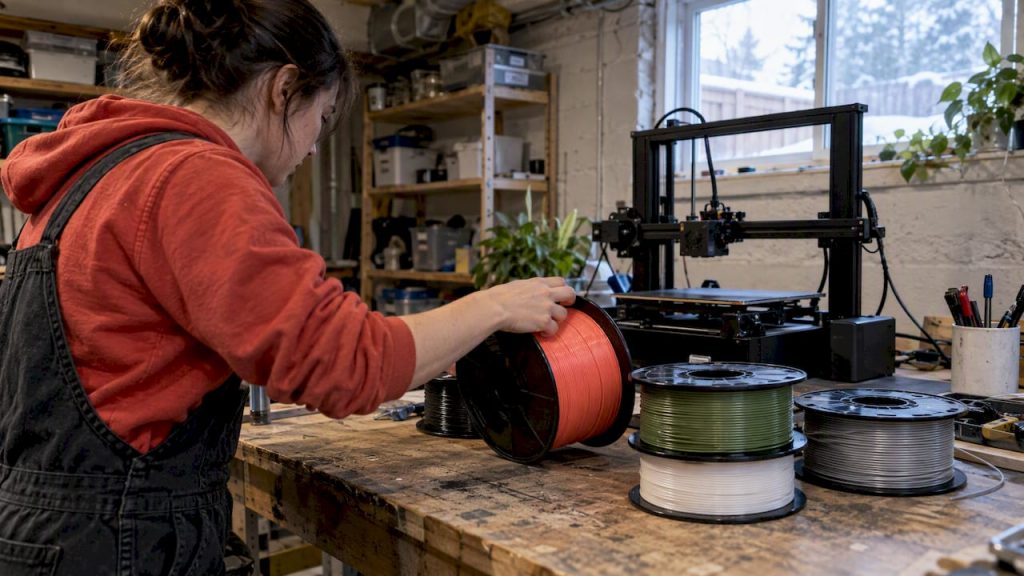
Choose among PLA, PETG, ABS, TPU, and nylon 3D printing filaments, then buy and store them well while following Canadian workplace safety advice.
PLA remains the easiest and most forgiving choice for most new printers, PETG or ABS step in when you need strength or heat resistance, and TPU covers anything that needs to bend. Most spools come in the 1.75 mm diameter, though settings and drying needs shift from one material to the next. Higher-temperature materials also call for decent ventilation, which we cover below.
TL;DR:
- Before buying, verify nozzle temperature, heated bed, enclosure, extruder drive, spool diameter, and tolerance; most consumer printers use 1.75 mm filament.
- Dry moisture sensitive nylon or TPU at the manufacturer’s specified temperature, then store opened spools airtight with desiccant and away from humid spaces.
- Higher temperature printing can produce up to 10 times more hazardous dust and plastic vapors; ventilate the room and check the filament’s Safety Data Sheet.
- If prints turn brittle, pop, or develop rough surfaces, dry the spool before changing slicer settings, since absorbed moisture is often responsible.
Table of Contents
- Comparing PLA, PETG, ABS, TPU, Nylon, and Composite Filaments
- Material Deep Dives: What Each Filament Actually Does
- How to Choose the Right Filament for Your Project
- Buying and Storing Filament So It Stays Print-Ready
- Printing Safely: Ventilation and Workplace Guidance
- Fixing the Most Common Filament Printing Problems
- Evaluating Filament Suppliers Before You Buy
- Our Team’s Starter Kit Picks for New Makers
- Advertise With Us: Reach Maker and Hobbyist Readers
- FAQ
- Sources
Comparing PLA, PETG, ABS, TPU, Nylon, and Composite Filaments
Picking a filament gets much easier once you see the main options side by side. Each material trades off ease of printing against strength, heat tolerance, or flexibility, and the right pick depends on what the finished part needs to survive.
Before buying, check your printer’s maximum nozzle temperature and confirm the spool’s diameter and tolerance match what your machine expects. Most desktop printers are built around 1.75 mm filament, though some larger industrial machines run 2.85 mm or 3 mm stock instead.
Material Deep Dives: What Each Filament Actually Does
PLA is where almost every new printer owner starts, and for good reason. It prints at lower temperatures, rarely warps, and produces a clean surface finish without a heated enclosure. It suits prototypes, decorative models, and classroom projects, though it softens in direct sunlight or a hot car and is only biodegradable under industrial composting conditions, not in a backyard bin.
PETG sits a step up in durability. It resists moisture and mild chemicals better than PLA, flexes slightly before breaking instead of snapping, and warps far less than ABS because it shrinks less as it cools. It needs a hotter nozzle and a heated bed, but most printers that handle PLA can manage PETG with modest tuning.
ABS has long been the standard for parts that need to survive heat or impact, like automotive trim or tool housings. It tolerates sanding, gluing, and acetone smoothing well, which makes it popular for finished functional parts. The tradeoff is a real one: ABS shrinks noticeably as it cools, so an enclosed printer and a heated bed can help reduce cracked corners and warped edges.
TPU and TPE bring flexibility into the mix, useful for phone cases, gaskets, or wearable parts that need to bend without breaking. Printing flexible filament rewards patience: slower print speeds, a direct-drive extruder rather than a bowden setup, and careful retraction settings keep the soft filament from buckling before it reaches the nozzle.
Nylon offers some of the highest strength and abrasion resistance of any common filament, which makes it a favorite for gears, hinges, and load-bearing brackets. It is highly hygroscopic, meaning it pulls moisture from the air and can affect print quality if left exposed. Drying may be needed before printing, depending on the filament and its storage conditions.
Specialty and composite filaments, such as carbon-fiber-reinforced PLA or metal-filled blends, add stiffness or a distinctive finish at the cost of being abrasive on standard brass nozzles. A hardened steel or ruby-tipped nozzle extends the life of your hotend considerably if you print these regularly. They suit parts where added rigidity or a specific look matters more than ease of printing.
How to Choose the Right Filament for Your Project
Matching material to project takes just a few checks before you add anything to a cart.
- Match the material to the job: decorative pieces favor PLA, functional or outdoor parts favor PETG or ABS, and anything that bends needs TPU.
- Confirm your printer’s maximum nozzle temperature, whether it has a heated bed, and whether it includes an enclosure.
- Check the drive type on your extruder, since flexible filaments print far more reliably on a direct-drive setup.
- Look at the spool’s listed diameter and tolerance, aiming for a tight tolerance rather than a loose one.
- Note the spool weight and core style so it fits your printer’s holder.
- Check whether the manufacturer lists an SDS and clear temperature specs, a sign of a well-documented product.
- Weigh budget against performance: a cheaper PLA spool is fine for a one-off print, but a functional part worth reprinting is worth a better material.
Pro Tip: Buy a small sample spool before committing to a larger roll of an unfamiliar material or brand.
Buying and Storing Filament So It Stays Print-Ready
Getting the right spool home is only half the job. Storage and drying habits decide whether that filament still prints well in a month.
- Choose 1.75 mm filament unless your printer’s documentation specifically calls for 2.85 mm or 3 mm stock, since 1.75 mm is the more widely supported diameter across consumer printers.
- Check the listed tolerance on the spool, looking for a clearly specified tolerance rather than an unspecified range.
- Dry hygroscopic filament like nylon or TPU in a filament dryer at the temperature the manufacturer specifies, or a low-temperature oven only if the manufacturer’s guidance explicitly allows it.
- Store opened spools in an airtight tub with desiccant packs, and vacuum-seal anything you will not use for weeks.
- Keep spools away from humid basements or garages, where moisture can work its way back into the plastic.
Pro Tip: Keep a cheap hygrometer inside your filament storage tub so you can see moisture creeping up before it ruins a print.
Printing Safely: Ventilation and Workplace Guidance
Printing at higher temperatures can push out more hazardous dust and plastic vapors than cooler materials like PLA, which is why ventilation matters more as you move toward ABS, nylon, or composite filaments. Printing at higher temperatures can produce up to 10 times more hazardous dust and plastic vapors than lower-temperature printing, so a well-ventilated space matters more than it might seem.
Before running an unfamiliar filament, check its Safety Data Sheet and follow WHMIS 2015 guidance if you are printing in a shared or workplace setting. Practical steps include printing in a ventilated room, adding local exhaust or HEPA filtration near the printer, and avoiding long print runs in small, closed spaces.
Fixing the Most Common Filament Printing Problems
Most filament frustrations trace back to one of three causes: moisture, temperature, or a mismatched setting.
Stringy, hair-like residue between parts usually points to a nozzle temperature that is slightly too high or retraction settings that need tightening. Dropping the nozzle temperature by 5°C to 10°C often clears it up on PLA and PETG alike.
Warping and lifted corners are nearly always a bed temperature or adhesion issue, especially with ABS. A heated enclosure, a brim around the print, or a stronger bed adhesive, such as a glue stick or specialty bed surface, solves most cases.
Brittle or weak prints often mean the filament absorbed moisture, which shows up as popping sounds and rough surface texture while printing. Drying the spool before the next print, rather than troubleshooting the slicer settings, usually fixes it.
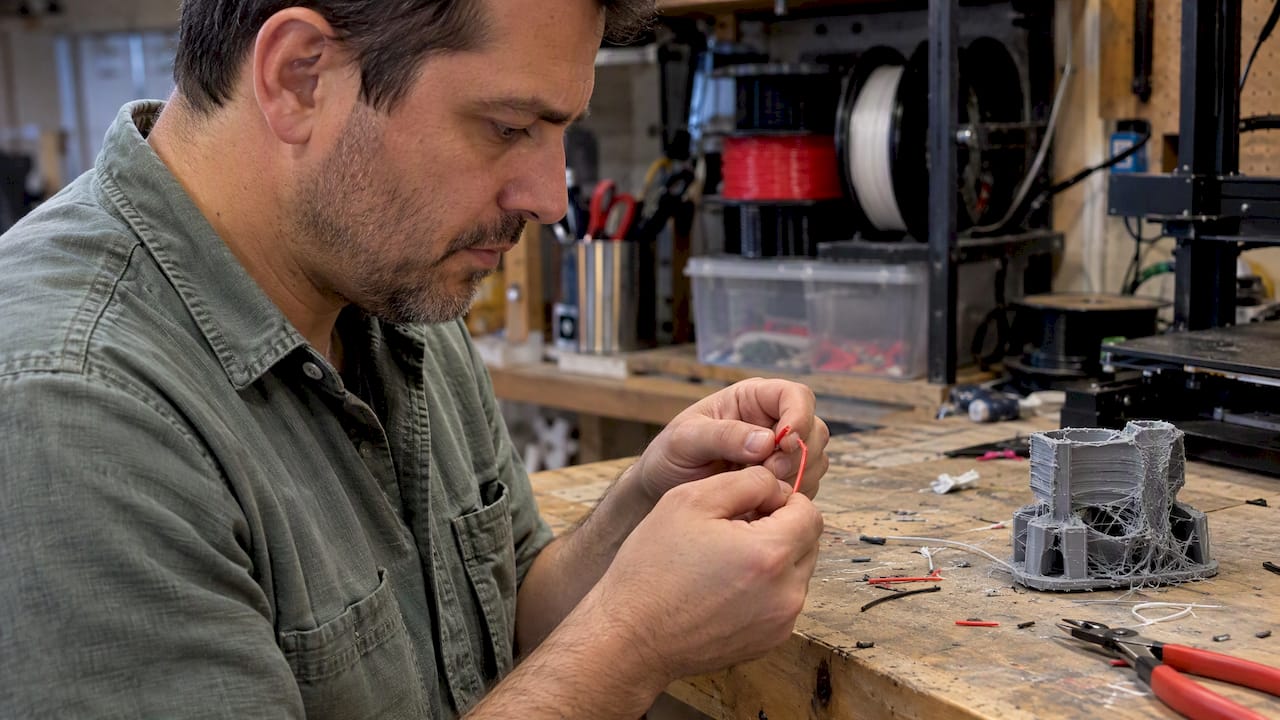
Clogged or inconsistent extrusion with abrasive composite filaments points to nozzle wear. Switching to a hardened steel nozzle resolves the problem permanently rather than temporarily.
Layer separation or weak Z-axis strength often comes from a nozzle temperature that is too low for the material, which prevents proper layer bonding. Checking the manufacturer’s specified temperature range, rather than guessing, is the fastest fix.
Evaluating Filament Suppliers Before You Buy
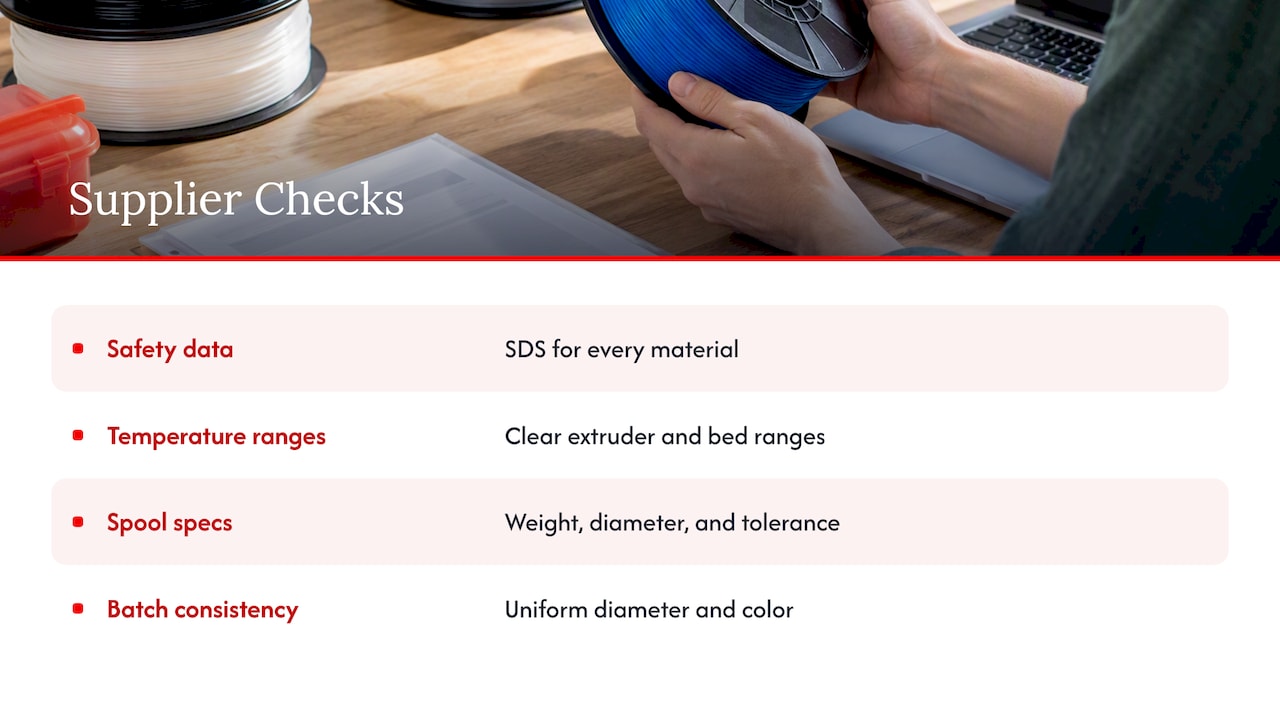
A filament’s listed specs only matter if the manufacturer actually backs them up. Reliable suppliers publish a Safety Data Sheet for every material, state clear extruder and bed temperature ranges rather than vague suggestions, and list spool weight, diameter, and tolerance plainly on the packaging or product page.
Consistency across batches is another signal worth checking in reviews: a supplier whose filament diameter and color stay uniform spool to spool is one worth repeat business. Bambu Lab PLA, Bambu Lab ABS, and Bambu Lab PETG are frequently chosen by newer printer owners partly because the specs printed on the spool match what shows up during an actual print. Matter3D filaments offer another option worth checking out for makers comparing PLA, PETG, ABS, and specialty blends.
Our Team’s Starter Kit Picks for New Makers
Our team recommends starting with a neutral PLA spool and a PETG roll for functional tests. Try small sample spools before buying in bulk, check the SDS first, and set up ventilation from day one.
Advertise With Us: Reach Maker and Hobbyist Readers
We connect advertisers with readers through editorial placements and display opportunities built around the topics they already search for. If your brand serves the 3D printing or wider maker community, our advertise with us page covers banner ad and guest post options for getting in front of this audience.
FAQ
What are all the filaments for 3D printing?
Common types include PLA, PETG, ABS, TPU and TPE for flexibility, nylon, and specialty composites like carbon-fiber or metal-filled blends. Each one balances strength, flexibility, heat resistance, and ease of printing differently, so the right choice depends on the finished part’s job.
Is it illegal to 3D print anything?
Printing itself is not illegal, but creating certain restricted items, such as unregistered firearms components or copyrighted designs without permission, can run afoul of existing laws depending on where you live. When in doubt about a specific design, check local regulations or consult a legal professional rather than assuming a print is automatically permitted.
What filament is used in 3D printing?
PLA and PETG are the most common materials for general desktop printing because they balance ease of use with decent strength, while ABS, TPU, and nylon cover tougher or more flexible applications. Most spools come in 1.75 mm diameter, which fits the majority of consumer printers on the market.
Can you 3D print your own filament?
Yes, filament extruders exist that let makers turn raw plastic pellets or recycled plastic into usable filament at home, though the process takes practice to hit consistent diameter and tolerance. For most hobbyists, buying pre-made spools from an established manufacturer remains the more reliable path to consistent prints.
















Leave a Comment
Your email address will not be published. Required fields are marked with *