
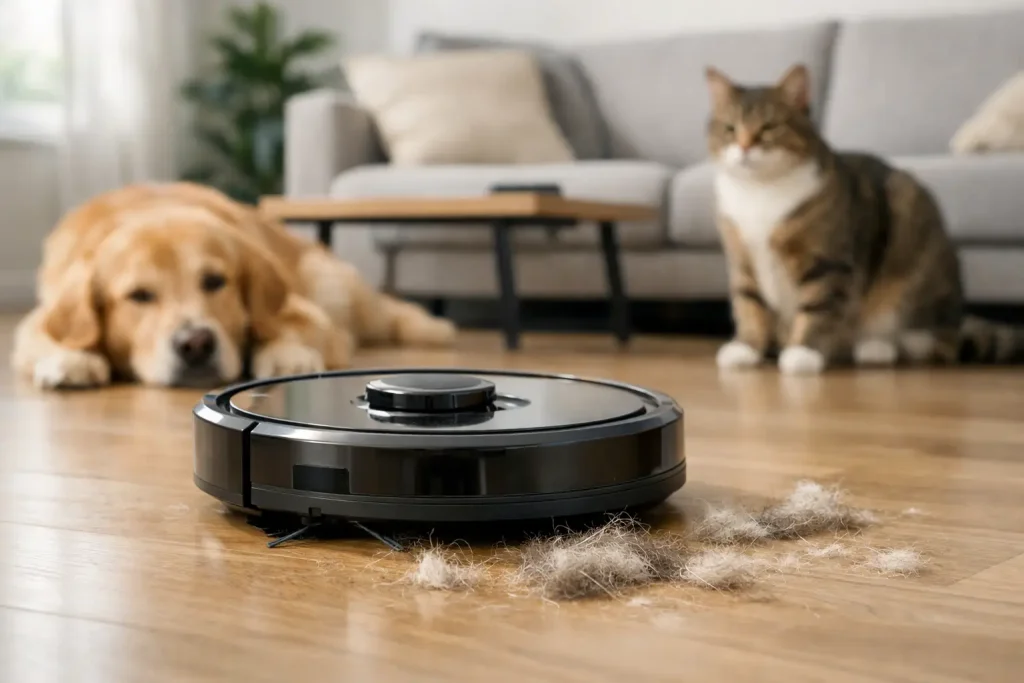
This robot vacuum review for pet hair explains what really matters, from suction and brush design to mopping, mapping, upkeep, and the right fit at home.
A robot vacuum can be a genuine sanity-saver when fur appears on the floor minutes after you vacuumed. But a good robot vacuum review for pet hair needs to look beyond a big suction number or a glossy dock. Pet homes create a tougher test: hair gathers along baseboards, clings to rugs, tangles around brush rolls, and travels under furniture where an upright vacuum rarely reaches.
The best choice is not always the most expensive model. It is the one that can run often, reach the areas your pet uses most, avoid becoming a maintenance project, and handle your mix of hard floors, carpet, shedding, and household clutter.
What Makes Pet Hair a Different Cleaning Job
Pet hair is light, stubborn, and surprisingly mobile. A robot may pick it up from open hardwood yet miss the clumps that collect at carpet edges or under a dining table. Dander and tracked-in grit add another layer, which is why strong pickup is about more than hair alone.
For homes with one short-haired cat and mostly hard flooring, a midrange robot with dependable scheduling can be plenty. A large dog that sheds heavily, several pets, or wall-to-wall carpet calls for better carpet performance, a larger dustbin or self-emptying dock, and a brush system designed to resist tangles.
Think about your floor as a route, not just a surface. The kitchen may need daily passes for kibble crumbs, while the sofa zone needs focused cleaning where fur collects. A machine that maps rooms and accepts no-go zones gives you more control than one that cleans in random patterns.
Robot Vacuum Review for Pet Hair: The Features That Matter
Suction helps, but brush design does the real work
Manufacturers often spotlight suction power, and it does matter for carpet and fine debris. Still, a vacuum with impressive specs can disappoint if its main brush wraps with hair after two or three runs. Look for a rubberized roller, split roller, or anti-tangle brush design that actively directs long hair toward the intake rather than letting it coil around an axle.
Side brushes deserve attention too. They sweep fur from corners and baseboards into the vacuum’s path, but long bristles can tangle easily. Models with easy-to-remove side brushes make routine cleanup less annoying.
If your pet has long hair or you have family members with long hair, plan on checking the roller occasionally no matter what the packaging promises. Anti-tangle technology reduces the work. It does not make hair disappear.
A self-emptying dock changes the ownership experience
A self-emptying robot is not essential, but it is one of the upgrades pet owners notice most. A standard onboard bin may fill after one or two runs in a heavy-shedding home. When that happens, the robot can leave debris behind or require constant emptying.
A dock lets the robot transfer debris into a larger bag or bagless container after cleaning. This is especially useful for busy households and allergy-sensitive users who would rather avoid opening a dusty bin every day. The trade-off is cost, floor space, and sometimes recurring bag purchases.
Bagless docks can reduce ongoing costs, though emptying the larger container may release more dust than tossing a sealed bag. For homes with allergies, a sealed-bag setup and a high-efficiency filter are often worth considering.
Mapping and obstacle avoidance are practical, not flashy
Pets leave more than fur behind. Toys, water bowls, charging cords, and the occasional unexpected mess can turn an automated cleaning session into a problem. Basic mapping helps the robot clean in orderly lines and return to the dock reliably. Advanced obstacle avoidance uses cameras, lasers, or sensors to recognize objects in its path.
No obstacle system is perfect. Small cords, dark objects, and low furniture can still cause trouble, especially in dim rooms. Before the first run, pick up cables and check for areas where the robot could become trapped. Good technology lowers the odds of a rescue mission. It does not replace a quick floor check.
The ability to label rooms, set no-go zones, and schedule specific areas is more valuable than a long list of app features. You want to tell the vacuum to clean the entryway after a muddy walk or run the living room every evening, not spend 20 minutes adjusting settings.
Mopping can help with paw prints, with limits
Vacuum-and-mop combos are appealing for homes with sealed hard floors. They can handle light dust, dried paw prints, and the fine film that collects around food bowls. Models that lift their mop pads over carpet are especially convenient in mixed-floor homes.
They are not a substitute for a real mop after a messy accident, sticky spill, or deep-cleaning day. Pet owners should also be cautious with cleaning solutions. Use only products approved for the machine and keep pet safety in mind, particularly if animals walk across freshly mopped areas.
Match the Robot to Your Home, Not the Hype
The right buying decision usually comes down to four household realities: how much your pet sheds, how much carpet you have, how cluttered your floors are, and how hands-off you want the process to be.
A smaller home with hard floors can do well with a reliable mapped robot that has a solid rubber brush and a standard charging dock. Spend more only if daily emptying sounds like a deal-breaker. In an apartment, dock noise may matter as much as suction, so check whether automatic emptying can be scheduled for daytime.
For mixed floors, prioritize strong carpet pickup, carpet detection, and the ability to increase power automatically when moving onto rugs. This prevents you from running the whole home at maximum power, which can shorten battery life and increase noise.
In a large home with multiple shedding pets, a self-emptying dock is close to a quality-of-life feature rather than a luxury. Look for long runtime, reliable mapping, room-by-room cleaning, and a dock capacity that does not demand attention every few days. If the home has multiple levels, remember that most robots will need to be carried between floors unless you buy separate units.
Households with anxious pets should consider noise and behavior. Some animals ignore a robot after a few days; others dislike the sudden movement or loud self-emptying cycle. Start with short supervised runs, keep the dock away from feeding and sleeping areas, and use scheduled cleaning while the pet is outside or in another room if needed.
How to Judge Real-World Performance
Marketing claims are useful only when they match the conditions in your house. A smart way to test a new robot is to run it in the same high-shed area for several days. Check the dustbin, inspect the brush roll, and look at carpet edges and under furniture afterward.
Pay attention to whether it completes a run without getting stuck. A robot that picks up slightly less fur but runs every day without intervention can outperform a stronger machine that regularly catches a cord or jams under a chair.
Also watch the app’s map after the first few cleaning cycles. It should become more accurate, not less. If room boundaries drift, the robot repeatedly misses a zone, or it cannot find the dock, those inconveniences can outweigh impressive cleaning specs.
Battery behavior matters most in larger spaces. Some robots recharge and resume automatically, which is useful, but a unit that needs two long cycles for a modest home may not fit a daily schedule. For pet hair, consistency usually beats occasional marathon cleaning.
The Maintenance Routine That Keeps It Working
Even the best pet-hair robot needs a little care. Neglecting it is the fastest route to weaker pickup, noisy operation, and unpleasant odors. Most owners can stay ahead of problems with a simple rhythm:
- Empty or check the dock and onboard bin before they become packed.
- Remove hair from the main roller and side brush as needed, especially after heavy shedding weeks.
- Wipe sensors and charging contacts with a dry, soft cloth so navigation and docking stay reliable.
- Clean or replace filters according to the manufacturer schedule, and allow washable filters to dry completely before reinstalling them.
Do not overlook the wheels and front caster. Pet hair can wind around these small moving parts and affect how well the robot travels. A two-minute inspection every couple of weeks is easier than troubleshooting a vacuum that suddenly moves in circles.
Common Buying Mistakes to Avoid
The biggest mistake is buying based on suction alone. A high-powered robot with a tiny bin, poor navigation, or a hair-wrapping brush can create more work than it saves. Another common mistake is expecting one machine to replace every form of floor care. Robot vacuums are excellent maintenance cleaners, but deep carpet cleaning, upholstery hair removal, and serious spills still call for other tools.
Avoid assuming a mop combo is automatically the better value, too. If your home is mostly carpet or you already prefer a traditional mop, putting the budget toward better navigation and a self-emptying dock may deliver a more noticeable improvement.
Finally, measure the space around the dock and the clearance under key furniture before buying. A robot that cannot reach beneath the couch or fit its dock where you need it will never deliver its full value.
The most satisfying robot vacuum is the one that quietly turns pet hair from a daily frustration into a background task. Choose for your floors and your pets’ habits, give it a sensible schedule, and let consistency do the heavy lifting.















Leave a Comment
Your email address will not be published. Required fields are marked with *