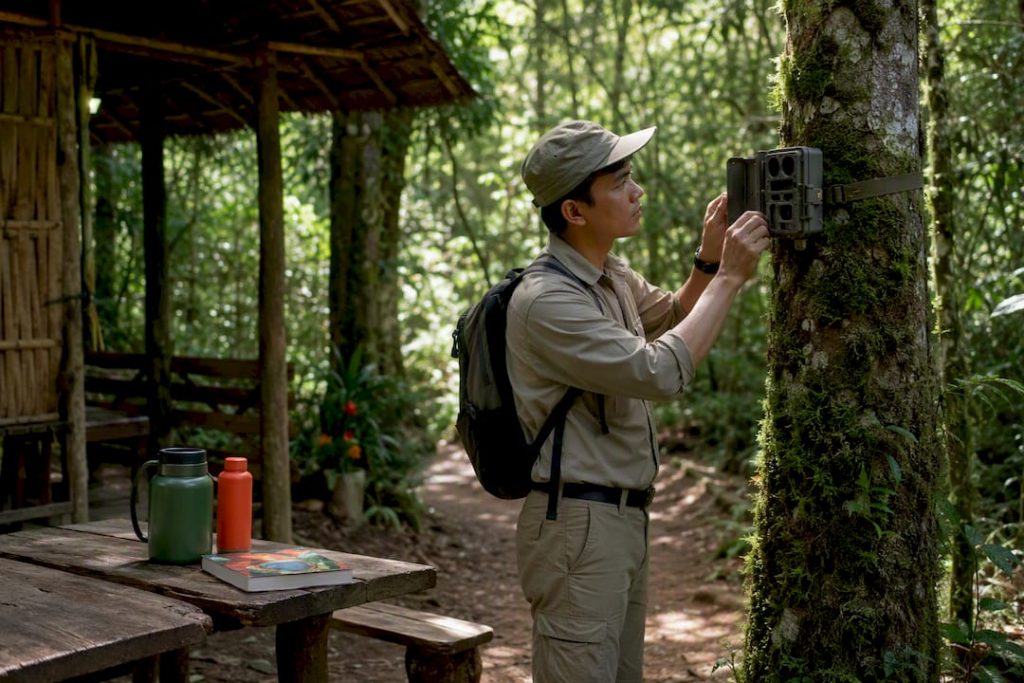
Discover how ecotourism funds conservation efforts, supports local economies, and protects our planet’s natural beauty. Explore the impact today!
Ecotourism is responsible travel to natural areas that conserves the environment and sustains the well-being of local people, according to The International Ecotourism Society (TIES). The role of ecotourism goes well beyond a nature walk with a good conscience. It channels tourism spending directly into conservation finance, local jobs, and education, turning wildlife and wild places into assets worth protecting rather than resources worth extracting.
The scale backs up the claim. Nature-based tourism drives roughly 8 billion visits to protected areas every year, and the broader travel sector was projected to contribute $11.7 trillion to global GDP and support 371 million jobs in 2025. The Global Sustainable Tourism Council (GSTC) treats ecotourism as a specific, accountable niche within that massive industry, one built around measurable outcomes instead of vague good intentions.
Three mechanisms explain most of what ecotourism actually does on the ground:
- Direct conservation finance — entrance fees, concession payments, and permit revenue that fund park rangers, anti-poaching patrols, and habitat monitoring.
- Local livelihood creation — guiding jobs, lodging, crafts, and food supply chains that give communities a financial stake in keeping ecosystems intact.
- Education and interpretation — guided experiences that shift visitor behavior and, often, shift what visitors support once they get home.
Key Takeaways
Ecotourism works because it ties tourism revenue directly to conservation finance, local governance, and measurable community benefit rather than treating environmental protection as a marketing afterthought.
| Point | Details |
|---|---|
| Definition anchors everything | TIES defines ecotourism as responsible travel that conserves nature, supports local well-being, and includes education. |
| Scale is enormous | Nature-based tourism drives about 8 billion visits to protected areas annually worldwide. |
| Local multipliers matter | Tourist spending generates multiple dollars in local income per dollar spent in some places like Madagascar and Uganda. |
| GSTC sets the baseline | GSTC criteria across four pillars distinguish credible sustainability claims from greenwashing. |
| Governance determines outcomes | Community-led benefit-sharing agreements prevent elite capture and keep conservation incentives aligned locally. |
Table of Contents
- What Is the Role of Eco Tourism, According to the Experts?
- Ecotourism vs. Sustainable Tourism vs. Responsible Travel
- The Core Principles That Define High-Integrity Ecotourism
- What Ecotourism Activities Actually Look Like
- How Ecotourism Benefits Conservation, Communities, and Development
- The Funding and Governance Mechanisms Behind Conservation Outcomes
- Checklists: How Travelers and Operators Get This Right
- Where Ecotourism Goes Wrong
- How Ecotourism Performance Gets Measured
- Evidence From the Ground: What the Numbers Actually Show
- How History Shaped Ecotourism’s Role in Conservation Policy
- Why Indigenous and Local Communities Have to Lead, Not Just Participate
- The Money Behind the Mission: Funding Models and Reinvestment
- Government Policy’s Role in Shaping Ecotourism
- What Comes Next for Ecotourism
- Where to Verify These Claims Yourself
- Frequently Asked Questions
- Sources
What Is the Role of Eco Tourism, According to the Experts?
Two organizations set the vocabulary everyone else borrows. TIES defines ecotourism as travel that conserves the environment, sustains local well-being, and includes interpretation and education. The United Nations World Tourism Organization (UNWTO) frames it similarly but places heavier emphasis on ecotourism as a tool for economic diversification in rural and often underdeveloped regions, where alternatives to farming, logging, or mining are scarce.
Break either definition down and you get four working components:
- Conservation outcome — the trip has to leave the ecosystem no worse off, and ideally funds active protection.
- Local well-being — money and decision-making power have to reach the community, not just a foreign-owned resort chain.
- Interpretation and education — a trained guide explaining why a wetland matters does more long-term good than a silent boat ride.
- Low-impact operations — small groups, efficient water and energy use, and waste systems built for fragile settings.
Ecotourism means responsible travel to natural areas that conserves the environment, sustains the well-being of local people, and involves interpretation and education, per TIES’s foundational definition.
In practice, these components show up as an ecolodge in Costa Rica that funds a private reserve’s ranger salaries, or a guided rainforest walk where the interpreter is a former subsistence hunter now employed to protect the same species he once tracked for other reasons. TIES also flags a practical note worth carrying with you: when flights are unavoidable, choosing direct routes and offsetting through vetted programs reduces the carbon cost of getting to these places at all, since long-haul travel remains ecotourism’s biggest environmental contradiction.
Ecotourism vs. Sustainable Tourism vs. Responsible Travel
These three terms get used interchangeably online, and that sloppiness causes real confusion. They are not the same thing, and the differences matter if you’re trying to evaluate a claim or a certification.
- Ecotourism is a specific, nature-focused segment: small-scale, conservation-linked, usually set in or near protected areas or fragile ecosystems.
- Sustainable tourism is a broader aspiration applied to any form of travel, from beach resorts to cruise ships, aimed at reducing negative impacts across environmental, social, and economic dimensions.
- Responsible travel describes traveler behavior and choices, like WWF’s guidance on picking certified destinations or following Leave No Trace, regardless of whether the trip is nature-based at all.
A beach resort that installs solar panels and cuts single-use plastic is practicing sustainable tourism. It is not ecotourism, because there’s no nature-conservation mechanism at its core. A traveler who researches an operator’s labor practices before booking a city hotel is practicing responsible travel, again without any ecotourism component. GSTC’s own criteria function as the baseline standard underneath all three: any operator, from a downtown hotel to a rainforest lodge, can be measured against the same sustainable-management, socioeconomic, cultural, and environmental pillars. That’s exactly why a “sustainable” label on a coral reef tour means very little without asking what specific conservation and community outcomes it produces. Not every sustainable claim is an ecotourism claim, and travelers who understand the distinction ask sharper questions.
The Core Principles That Define High-Integrity Ecotourism
TIES, GSTC, and UNWTO converge on a fairly consistent set of principles. Here’s what separates a genuine ecotourism operation from a nature-themed marketing exercise:
- Minimize physical, social, and psychological impact. Look for stated visitor caps, defined trail systems, and waste-management plans rather than open access to sensitive habitats.
- Build environmental and cultural awareness and respect. Guides should be trained interpreters, not just drivers with a script.
- Provide positive experiences for both visitors and hosts. The relationship should feel mutual, not extractive on either side.
- Deliver direct financial benefits for conservation. Check whether fees are publicly reported and tied to specific protection activities.
- Generate financial benefits for local people, empowering local ownership. Ask who owns the lodge or the tour company, not just who staffs it.
- Raise sensitivity to a destination’s political, environmental, and social climate. This includes respecting Indigenous land rights and traditional authority over resources.
- Support international human rights and labor agreements. Fair wages and safe working conditions are non-negotiable, not optional extras.
Each principle has a quick tell. A quality interpretation program, for instance, is usually visible in the marketing itself: operators proud of their education component tend to name their guides and describe training, not just list amenities.
Pro Tip: When evaluating a community-based project, ask specifically how decisions get made, not just how revenue gets split. Projects that give community members a formal vote in governance tend to avoid “elite capture,” where a small local elite absorbs most of the benefit while the broader community sees little change.
What Ecotourism Activities Actually Look Like
Ecotourism isn’t one activity type. It spans several settings, each with its own conservation logic:
- Guided wildlife viewing — safari drives or gorilla trekking, where permit fees fund habitat protection and anti-poaching enforcement.
- Community homestays — lodging with local families that puts tourism income directly into household hands rather than corporate accounts.
- Marine ecotours and snorkeling with conservation partners — trips that pair reef visits with coral monitoring or citizen science data collection.
- Birdwatching — a low-impact, high-spend niche that has funded habitat restoration in places from Costa Rica to the Philippines.
- Interpretive hikes — trail experiences led by trained naturalists who translate ecosystem behavior into something visitors remember.
- Citizen science and volunteer restoration — mangrove planting or invasive-species removal that turns visitors into short-term labor for real projects.
- Indigenous-led cultural experiences — tours designed and run by Indigenous communities on their own land and their own terms.
Group size tends to stay small across almost all of these, usually under 15 people, because both the ecological carrying capacity of fragile sites and the quality of interpretation degrade fast once groups scale up.
How Ecotourism Benefits Conservation, Communities, and Development
The economic case for ecotourism rests on three connected channels, and each one is measurable.
Direct finance for protected areas comes from entrance fees, concession contracts, and permits. Many national parks in East Africa and Central America rely on tourism revenue for a meaningful share of their operating budgets, funding everything from ranger salaries to habitat monitoring equipment. This is the most visible mechanism: money goes in at the gate, and it funds the infrastructure that keeps the ecosystem intact.
Livelihood creation and local multipliers are where the numbers get striking. World Bank analysis found that in Madagascar’s Nosy Be region, tourist spending generated roughly $2.48 in local income for every dollar spent, and Uganda saw about $2.03 per tourist dollar. In Fiji, tourism supports close to 13% of local employment. Those multipliers happen because tourist dollars ripple through guides, cooks, drivers, craft sellers, and farmers supplying lodges, rather than sitting in a single foreign account.

Awareness and education shape long-term conservation behavior in ways harder to quantify but well documented anecdotally. A visitor who spends three days with a naturalist guide in a cloud forest tends to make different consumer and political choices when they get home, from supporting habitat-protection policy to donating to the specific reserve they visited.
These three channels feed a set of downstream impacts worth naming directly:
- Employment in guiding, hospitality, transport, and craft production, often in regions with few other formal job options.
- Poverty reduction through diversified household income that reduces dependence on extractive activities like illegal logging or bushmeat hunting.
- Cultural preservation as traditional knowledge, crafts, and practices gain new economic and social value.
- Funding for conservation science, since park fees frequently underwrite the wildlife monitoring and research that management decisions depend on.
None of this happens automatically. It happens when the finance and governance mechanisms are built correctly, which is the harder, less photogenic part of the story.
The Funding and Governance Mechanisms Behind Conservation Outcomes
Money has to move through specific channels to turn tourist spending into measurable conservation results, and those channels vary more than most travelers realize.
Funding channels typically include park entrance fees, concession agreements with private tour operators, tourism-specific taxes at the national or regional level, and donor-matching programs where a conservation NGO multiplies tourism revenue with grant funding. Private-public partnerships, where a private operator manages a concession inside a public park under strict environmental conditions, have become increasingly common as governments look for ways to fund conservation without relying entirely on tax revenue.
Governance pathways determine who controls that money once it arrives. Co-management agreements split authority between government agencies and local communities. Community conservancies, widely used across parts of East and Southern Africa, put land-use decisions directly in the hands of the people living there, often converting former ranchland or subsistence-farming land into wildlife corridors because conservation now pays better than the alternative.
Uganda’s Bwindi Impenetrable National Park offers a concrete illustration. Gorilla permit fees fund a significant share of park management costs, and a portion is legally required to flow to neighboring communities through a revenue-sharing scheme, a structure that has measurably reduced illegal resource extraction inside the park boundary over time.
The pitfalls show up in reinvestment, not collection. Money raised without a transparent, long-term finance plan tends to get absorbed into general government budgets rather than reaching the specific conservation or community line items it was meant for. Research on clustered community ecotourism projects suggests that coordination between multiple neighboring initiatives produces landscape-level conservation benefits that isolated single-lodge projects can’t achieve alone, because connected habitat corridors matter more to wildlife than a single protected patch.
- Watch for: published annual reports showing exactly where park fees go, community revenue-sharing agreements with specific percentages, and evidence of coordination between neighboring conservation projects rather than one-off ventures.
Checklists: How Travelers and Operators Get This Right
For travelers, vetting an operator takes about ten minutes of research before booking:
- Confirm local ownership or, at minimum, majority local staffing and management roles.
- Look for independent certification through GSTC-accredited bodies rather than self-issued eco-labels.
- Favor small-group operations, generally under 15 people, over large-bus nature tourism.
- Check whether the operator publishes any sustainability reporting or impact data.
- Pack reef-safe sunscreen, follow Leave No Trace principles on trails, and pay guides and local vendors fairly rather than haggling reflexively.
For operators, the standards are more structural:
- Build formal governance and benefit-sharing agreements with the community before launch, not after complaints arise.
- Publish an annual sustainability report with measurable, science-based targets rather than marketing language.
- Prioritize hiring and training local staff for skilled roles, including guiding and management, not just housekeeping.
- Monitor ecological indicators (wildlife counts, habitat condition) alongside social ones (local income, employment retention).
Pro Tip: If an operator can’t answer a direct question about where last year’s conservation fee revenue went, that’s your answer. More than 350 eco-travel labels exist worldwide, and WWF notes many are weak or meaningless. Transparent annual reporting is a far stronger signal than any logo on a brochure.
Travelers packing for these trips often find that the right gear, from wearable tech for low-impact navigation to slower, longer-stay travel styles, reinforces the same principles operators are supposed to follow.
Where Ecotourism Goes Wrong
Ecotourism fails in fairly predictable ways, and the risks are worth naming plainly rather than glossing over.
- Overtourism at popular sites — a single viral destination can attract crowds that exceed any ecological carrying capacity, undoing the very conservation goal that drew visitors in the first place.
- Greenwashing — vague eco-labels with no independent verification behind them, designed to charge a premium without changing operations.
- Elite capture and inequitable benefit distribution — a small group of local elites or a single family business absorbing most tourism revenue while the broader community sees little.
- Wildlife disturbance — habituating animals to human presence for better viewing, which can alter feeding, breeding, and migration behavior.
- Cultural commodification — turning genuine traditions into performances stripped of meaning for visitor consumption.
- Climate impact from travel itself — long-haul flights to reach remote ecotourism destinations often outweigh the on-the-ground environmental benefit.
Data gaps compound all of this. A 2023 assessment of ecotourism in parts of the Philippines found real social, economic, and environmental benefits, but the study’s authors flagged ongoing planning and data limitations that demand long-term vigilance rather than a one-time impact study. Some projects launch with strong intentions and solid initial funding, then quietly stop reporting outcomes once the grant cycle or media attention ends, leaving no way to verify whether promised community benefits ever materialized.
How Ecotourism Performance Gets Measured
GSTC’s criteria function as the closest thing the industry has to a universal report card, organized around four pillars: sustainable management, socioeconomic impacts, cultural impacts, and environmental impacts. Any destination or operator, from a single lodge to a national tourism board, can be measured against the same framework.
Credibility signals worth checking before you book or invest include:
- GSTC accreditation from an approved certification body, not a self-awarded badge.
- Independent auditing by a third party unconnected to the operator’s marketing team.
- Transparent annual sustainability reports with specific, checkable numbers rather than broad claims.
- B Corp status or science-based climate targets, which require external verification to maintain.
- Documented local ownership and benefit-sharing agreements, ideally with a stated percentage or structure.
Measurement gets harder because ecological and social indicators don’t move on the same timeline. Wildlife population recovery can take a decade to register, while local income effects show up within a single tourist season, which means honest reporting requires tracking both, not just the easier one.
Evidence From the Ground: What the Numbers Actually Show
The scale is easier to grasp with a few grounded figures. Nature-based tourism drives roughly 8 billion protected-area visits annually, and the World Bank’s local-multiplier research in Madagascar and Uganda found tourist spending generating $2 to $2.50 in local income for every dollar spent, figures already noted above in the context of livelihood creation.
Economists studying these effects often rely on Local Economy-wide Impact Evaluation (LEWIE) models, which trace how a tourist dollar moves through a regional economy, from the lodge to the farm supplying its kitchen to the taxi driver bringing guests from the airport. That methodology is part of why the multiplier figures carry weight. They’re not survey guesses; they’re built from tracked spending patterns across an entire local economy.
The Philippines case study mentioned earlier adds a smaller-scale, more granular data point: measurable community-level acceptance and benefit in Lobo and Batangas, alongside a clear-eyed acknowledgment that planning gaps remain. That combination of hard numbers and honest caveats is what distinguishes credible ecotourism evidence from marketing copy.
How History Shaped Ecotourism’s Role in Conservation Policy
Ecotourism as a distinct concept emerged in the 1980s, largely in response to growing recognition that traditional mass tourism was degrading the very natural attractions it depended on. Costa Rica became an early proof of concept, using protected-area tourism revenue through the 1980s and 1990s to fund a national park system that now covers a substantial share of the country’s land area.
TIES formalized the term and its principles in 1990, giving the concept a shared vocabulary that policymakers could actually legislate around. That mattered enormously. Once “ecotourism” had a defined meaning, governments could write it into land-use law, tie park funding models to visitor fees, and create the concession systems that now support conservation budgets across East Africa, Central America, and Southeast Asia.
The policy shift wasn’t instant or universal. Many countries spent the 1990s and 2000s watching pilot programs succeed or fail before building national ecotourism strategies. Kenya and Uganda developed community conservancy models through trial and error, learning from early projects where revenue never reached local households. Those lessons directly shaped the benefit-sharing requirements now written into many concession agreements. The historical arc runs from a vague feel-good idea to a regulated, revenue-generating conservation tool, which is precisely why definitions and standards carry so much practical weight today.
Why Indigenous and Local Communities Have to Lead, Not Just Participate
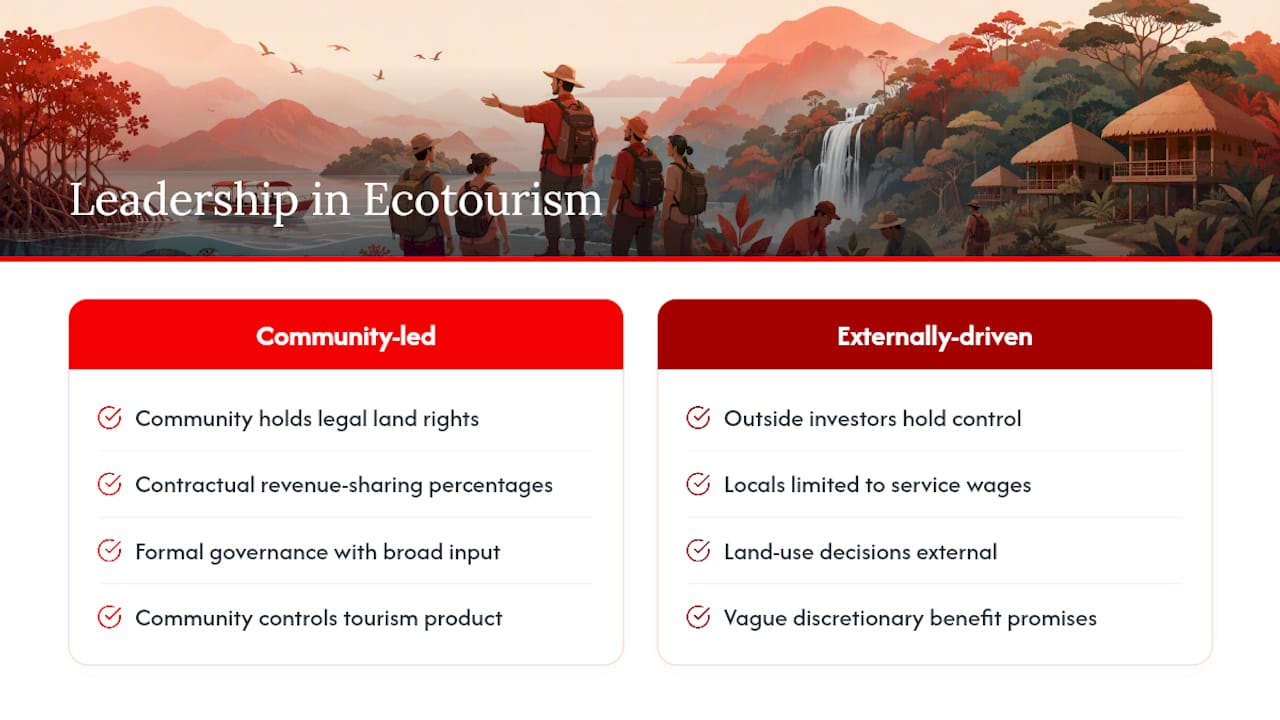
The strongest ecotourism outcomes happen when Indigenous and local communities control planning decisions, not just staff the resulting jobs. Projects designed without that input tend to replicate old colonial patterns: outside investors profit, locals get service-sector wages, and the underlying land-use decisions stay entirely out of community hands.
Community conservancies across parts of East and Southern Africa show what the alternative looks like. Land that communities once used for subsistence farming or grazing gets formally designated for wildlife tourism, with the community holding legal rights over both the land and a negotiated share of tourism revenue. That structure gives residents a direct financial reason to prevent poaching and habitat destruction, because the wildlife itself has become the economic asset.
Benefit-sharing works best when it’s contractual, not discretionary. Vague promises of “community benefit” tend to evaporate once a project turns a profit; specific, legally binding revenue-sharing percentages hold up far better over time. World Bank research points to elite capture as one of the most common failure modes here: without formal governance structures giving broad community input, a small number of local leaders or families can absorb most of the benefit while the wider population sees little change to their circumstances.
Indigenous-led cultural experiences represent the clearest version of this principle in practice. When a community designs and controls the tourism product itself, from pricing to what visitors see and learn, the economic and cultural benefits stay aligned rather than working against each other.
The Money Behind the Mission: Funding Models and Reinvestment
Ecotourism’s financial architecture runs on a few repeatable models, each with different reinvestment logic. Entrance and permit fees are the most direct, charged per visitor and often earmarked by law for specific conservation activities like ranger patrols or habitat restoration. Concession fees work differently: a private operator pays a government or community landowner for the right to run tours or lodges on protected land, creating a steady revenue stream independent of daily visitor counts.
Tourism-specific taxes, sometimes called biodiversity or conservation levies, get added to accommodation or park bookings and flow into national or regional conservation funds. Donor-matching arrangements add another layer, where conservation NGOs multiply tourism-generated revenue with grant funding, effectively doubling or tripling what tourist dollars alone could accomplish.
Reinvestment is where funding models succeed or collapse. Money collected without a transparent allocation plan too often disappears into general budgets instead of the ranger salaries, monitoring equipment, or community programs it was meant to support. The Bwindi gorilla permit model works specifically because a fixed percentage is legally designated for neighboring communities, removing the reinvestment decision from year-to-year political discretion. That structural guarantee, more than the raw revenue figure, is what makes the funding model durable over decades rather than dependent on whichever administration happens to be in power.
Government Policy’s Role in Shaping Ecotourism
Governments shape ecotourism through three main levers: land designation, fiscal incentives, and regulatory standards. Declaring an area a national park or protected reserve is the foundational policy step, since it creates the legal container within which ecotourism operates at all.
Fiscal policy follows close behind. Tax incentives for certified sustainable operators, reduced permit fees for community-owned ventures, and grant programs for ecolodge development all steer private investment toward genuinely low-impact models rather than conventional resort development dressed up in green branding.
Regulatory standards are where governments either enforce credibility or let it slide. Some countries have adopted GSTC-aligned national certification schemes, giving legal weight to sustainability claims that would otherwise be pure marketing. Others leave certification entirely voluntary, which is part of why greenwashing remains such a persistent problem across the industry.
Visitor caps and zoning regulations inside protected areas represent the most direct government tool for preventing overtourism, capping daily entries to sites like popular hiking trails or dive locations before ecological damage occurs rather than after. The strongest national ecotourism policies combine all three levers: protected land, financial incentives for community and low-impact ownership, and enforceable sustainability standards, rather than relying on any single mechanism to carry the whole system.
What Comes Next for Ecotourism
We think the next real opportunity in this space is regenerative, not just sustainable, travel: experiences designed to actively restore habitat and revive cultural practices, not merely avoid harm. Research on clustered community projects backs this up, showing that coordinated regional networks protect more landscape than isolated ventures ever could on their own.
None of that works without Indigenous rights and long-term, locally led governance sitting at the center of the model. Projects designed around outside investors first and communities second tend to underdeliver on both conservation and equity, no matter how polished the marketing looks.
Our team at Lizard’s Lunch encourages you to choose verified, transparently reported experiences over convenient greenwashed ones, and to support community-led programs whenever a genuine choice exists. That single habit, repeated across enough travelers, is what actually shifts an industry.
Where to Verify These Claims Yourself
A handful of primary sources cover almost everything discussed here in far more depth than any single article can:
- TIES’s ecotourism overview for the foundational definition and principles.
- GSTC’s criteria page for the certification standards behind credible sustainability claims.
- WWF’s responsible travel guidance for practical, traveler-facing tips.
- The 2023 Philippines ecotourism case study for a peer-reviewed look at measured local outcomes.
Use these to check any operator’s claims against an actual standard rather than taking a brochure’s word for it. If an eco-label can’t be traced back to one of these frameworks, treat it with skepticism.
Frequently Asked Questions
What is the main role of eco tourism in conservation?
The primary role of eco tourism is generating direct financial support for protected-area management, ranger operations, and habitat monitoring through entrance fees, permits, and concession revenue, while also building visitor awareness that translates into longer-term conservation support.
How does eco tourism help local communities specifically?
It creates jobs in guiding, hospitality, and craft production, and research shows tourist spending can generate $2 or more in local income for every dollar spent in well-managed destinations, spreading economic benefit beyond a single lodge or operator.
Is ecotourism the same as sustainable tourism?
No. Ecotourism is a specific, nature-focused segment of travel tied to conservation outcomes, while sustainable tourism is a broader goal that applies to any type of trip, from resorts to cruises, aimed at reducing overall negative impact.
How can I tell if an ecotourism operator is legitimate or greenwashing?
Look for GSTC accreditation, published annual sustainability reports with real data, documented local ownership, and small group sizes. More than 350 eco-labels exist and many carry little independent verification, so ask direct questions about where fees go.
What role do Indigenous communities play in ecotourism development?
Indigenous and local communities work most effectively when they lead planning and hold formal governance rights, not just staff positions, since projects designed without that input frequently fail to deliver equitable, lasting benefits.
















Leave a Comment
Your email address will not be published. Required fields are marked with *