
Discover why electric vehicles are worth it in 2026. Uncover the benefits of savings, technology, and environmental impact today!
Electric vehicles (EVs) are battery-powered automobiles that produce zero direct tailpipe emissions and deliver measurable savings on fuel, maintenance, and long-term ownership costs. A 2026 MIT study confirms that EVs reduce greenhouse gases by 40% to 60% compared to gas-powered cars across most U.S. locations. The reasons to choose electric cars go well beyond environmental impact. From instant torque to software updates that improve your car after purchase, the advantages of EVs touch nearly every part of the ownership experience. This guide breaks down the environmental, financial, and technological case for making the switch, with real data and honest nuance.
Why electric vehicles are better for the environment
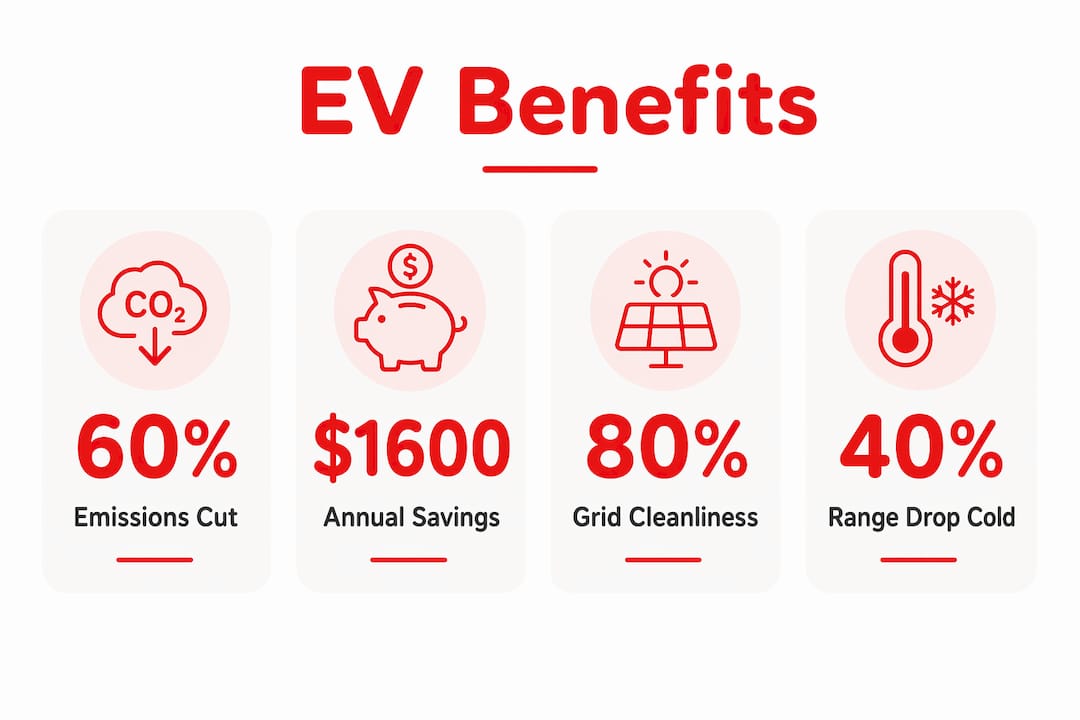
The environmental case for EVs is one of the most well-documented in modern transportation research. Battery-electric vehicles cut greenhouse gas emissions by 40% to 60% compared to their gasoline counterparts in most U.S. regions. That figure accounts for the full lifecycle, including the electricity used to charge the battery, not just what comes out of the tailpipe.
The size of that reduction depends on where you live. A driver in the Pacific Northwest, where hydroelectric and wind power dominate the grid, sees larger emissions cuts than a driver in a coal-heavy region. Traffic density and driving distance also shape the outcome. Stop-and-go urban driving, where regenerative braking recaptures energy, tends to favor EVs even more than highway cruising.
A common concern is winter weather. Cold temperatures do reduce battery range temporarily, but winter conditions do not negate the annual emissions benefits of an EV. Even in the most unfavorable climates studied, EVs still came out substantially cleaner than gas vehicles over a full year of driving. The seasonal dip in efficiency is real but not a dealbreaker.
The long-term picture is even more compelling. Electricity grids are decarbonizing globally, which means the emissions savings from an EV you buy today will grow over the life of the vehicle. An EV purchased in 2026 will be running on a cleaner grid in 2031 than it does today, without any changes to the car itself. That makes EVs a genuinely future-proof choice in a way that no gasoline vehicle can match.
You can explore the broader connection between clean transportation and climate change solutions to see how individual choices fit into the larger picture.
| Emissions factor | Impact on EV benefit |
|---|---|
| Clean regional grid (hydro, wind, solar) | Emissions reduction closer to 60% |
| Coal-heavy regional grid | Emissions reduction closer to 40% |
| Urban stop-and-go driving | Regenerative braking increases efficiency |
| Cold winter climate | Temporary range reduction, no annual emissions reversal |
| Future grid decarbonization | Emissions savings increase automatically over vehicle life |
Pro Tip: Check your state’s electricity mix using the EPA’s Power Profiler tool before purchasing. Knowing your grid’s carbon intensity gives you a realistic picture of your personal emissions savings from day one.
What are the financial advantages of owning an electric vehicle?
The financial case for EVs has crossed a critical threshold. EVs are now competitive with gas cars in total lifetime ownership costs across most U.S. regions, even without federal tax credits factored in. That finding from MIT and Earth.com represents a genuine shift from even three years ago, when higher sticker prices made the math harder to justify.
The savings come from two main sources: fuel and maintenance. At 12,000 miles driven annually, the average EV owner saves approximately $686 on fuel and around $900 on maintenance each year compared to a gas vehicle. That adds up to roughly $1,586 in annual savings, or more than $15,000 over a decade of ownership. Those numbers assume average U.S. electricity and gasoline prices, so your actual savings will vary.
Here is where the financial advantages of EVs become most tangible for everyday drivers:
- Fuel costs: Electricity is cheaper per mile than gasoline in virtually every U.S. state, and unlike gasoline prices, electricity rates are far more stable year to year.
- Maintenance simplicity: EVs have no oil changes, no spark plugs, no fuel filters, and no timing belts. Fewer moving parts means fewer repair bills.
- Regenerative braking: Brake pads on EVs last significantly longer because the motor handles most of the deceleration, reducing wear on physical brake components.
- Home charging: Charging overnight at home on a standard 240-volt outlet costs a fraction of a gas fill-up, and you start every morning with a full “tank.”
- Regional incentives: In the UK, EVs receive exemptions from low-emission zone charges and lower Vehicle Excise Duty rates. In the U.S., federal and state tax credits can reduce purchase prices by thousands of dollars.
- Resale value stability: As gasoline prices rise and EV infrastructure expands, used EV values are holding up well in most markets.
The volatility of gasoline prices is an underappreciated factor. Gas prices in the U.S. swung by more than $1.50 per gallon between 2022 and 2024. Electricity prices, by contrast, move slowly and predictably. For anyone budgeting household expenses, that stability has real value.
If you want to approach the purchase itself with confidence, a guide on buying a car without overpaying walks through negotiation strategies that apply directly to EV purchases.
What technological features distinguish electric vehicles from traditional cars?
The technology inside a modern EV is not just different from a gas car. In several key ways, it is genuinely better to live with day to day. The driving experience starts with instant torque from 0 rpm, which means an EV accelerates smoothly and immediately the moment you press the pedal. There is no waiting for an engine to rev up or a transmission to find the right gear. The result is a driving feel that many owners describe as effortless.
Here are the standout technological features that separate EVs from traditional vehicles:
- Instant torque and smooth acceleration. Electric motors deliver maximum torque from a standstill, making merging, overtaking, and city driving noticeably more responsive than in comparable gas vehicles.
- One-pedal driving. Regenerative braking allows you to slow the car simply by lifting off the accelerator. One-pedal driving reduces fatigue in stop-and-go traffic and becomes the preferred driving mode for most EV owners within a week of ownership.
- Quieter cabin. Without an internal combustion engine, road noise becomes the dominant sound inside the car. Many EV owners report that the quiet cabin transforms long drives and daily commutes into noticeably more relaxing experiences.
- Over-the-air software updates. Manufacturers like Tesla, Rivian, and Ford (with its Mustang Mach-E) push software updates that add features, improve performance, and fix issues without a dealership visit. Your car can genuinely get better after you buy it.
- Battery technology advances. Lithium iron phosphate (LFP) batteries, now used in many entry-level EVs, offer excellent longevity and tolerate frequent full charges better than older lithium-ion chemistries. Sodium-ion batteries are emerging as a lower-cost alternative that performs well in cold climates.
- Simplified maintenance. No oil changes, no exhaust system, no complex transmission. EVs have fewer moving parts, which translates directly into lower routine maintenance costs and fewer scheduled service visits.
One honest caveat: EVs currently report about 80% more reliability problems than gas cars, according to Consumer Reports. Most of these issues trace back to complex new software and first-generation technology rather than the drivetrain itself. The mechanical simplicity is real. The software growing pains are also real. Choosing a model from a manufacturer with a strong software track record reduces this risk considerably.
Pro Tip: Set your daily charging target to 80% to 90% rather than 100%. Charging to full capacity every night stresses the battery chemistry over time. This one habit can meaningfully extend your battery’s lifespan and protect your long-term investment.
How do regional and individual factors shape EV benefits?
The electric vehicle environmental impact and financial advantages are real for most drivers, but they are not identical for everyone. Understanding how your specific situation affects the equation helps you make a genuinely informed decision rather than relying on national averages.
The single biggest variable is your local electricity grid. A driver in Washington State, where over 70% of electricity comes from hydroelectric sources, sees dramatically lower lifecycle emissions than a driver in West Virginia, where coal still plays a significant role. The MIT research is clear that location shapes emissions outcomes significantly, though the benefits are positive in the vast majority of U.S. regions.
Driving patterns matter just as much. Urban drivers who cover 20 to 40 miles daily in stop-and-go traffic get the most from regenerative braking and rarely stress their battery range. Rural drivers covering 150 miles a day on highways face different considerations, particularly around charging infrastructure and range anxiety. The good news is that the average American drives fewer than 40 miles per day, which puts most drivers squarely in the EV sweet spot.
| Driver profile | EV benefit level | Key consideration |
|---|---|---|
| Urban commuter, clean grid | Very high | Maximum emissions and cost savings |
| Suburban driver, mixed grid | High | Strong savings, occasional public charging needed |
| Rural driver, long distances | Moderate | Range planning and charging access are priorities |
| Cold climate driver | Moderate to high | Temporary range reduction, annual savings still positive |
| Driver with home charging | Very high | Maximum convenience and lowest per-mile cost |
Home charging access is the factor that most dramatically affects the ownership experience. Drivers who can plug in overnight at home enjoy the lowest possible charging costs and the convenience of starting every day with a full charge. Apartment dwellers or those without dedicated parking face a more complex situation, though public charging networks are expanding rapidly. As of early 2026, the UK alone has over 87,000 public EV chargers, supported by government infrastructure grants. The U.S. is on a similar expansion trajectory under the National Electric Vehicle Infrastructure program.
Climate effects are worth understanding clearly. Cold weather reduces range by 20% to 40% in extreme conditions, which affects trip planning but not the fundamental value of the vehicle. As grids continue to decarbonize, the regional differences in emissions savings will narrow over time, making the benefits more uniform regardless of where you live.
Key takeaways
Electric vehicles deliver measurable environmental, financial, and technological advantages for most drivers, with the scale of those benefits shaped by local grid cleanliness, driving habits, and access to home charging.
| Point | Details |
|---|---|
| Emissions reduction is proven | EVs cut greenhouse gas emissions by 40% to 60% compared to gas cars in most U.S. regions. |
| Lifetime costs are competitive | Average annual savings of $686 on fuel and $900 on maintenance make EVs cost-effective without tax credits. |
| Technology improves ownership | Instant torque, one-pedal driving, and over-the-air updates create a driving experience gas cars cannot match. |
| Location shapes your benefit | Grid cleanliness and home charging access are the two biggest variables in your personal EV advantage. |
| Future savings grow automatically | As electricity grids decarbonize, the emissions benefits of your EV increase over its lifetime without any changes to the car. |
Why I think the EV conversation is missing its best argument
Most articles about why electric vehicles are worth buying lead with the environment or the savings. Both are legitimate. But after spending time with the research and talking to EV owners across different lifestyles, I think the most persuasive argument is the one that gets the least attention: the daily convenience of never visiting a gas station again.
The home charging experience transforms your routine in a way that is genuinely hard to appreciate until you live it. You plug in when you get home, the same way you charge your phone, and you wake up to a full charge every morning. No detours. No standing in the cold. No watching the pump tick past $80. That shift in routine is small on paper and surprisingly significant in practice.
I also think the reliability concern from Consumer Reports deserves honest acknowledgment rather than dismissal. The 80% higher reported problem rate is real, and it is mostly software-driven. The right response is not to ignore it but to choose your model carefully. Established manufacturers with strong over-the-air update records, like Tesla or Ford with its Mach-E platform, have demonstrated they can fix software issues remotely. That changes the calculus considerably.
The financial case has also matured faster than most people realize. The MIT finding that EVs are now cost-competitive without tax credits is a genuine milestone. It means the decision is no longer about whether you can afford an EV. It is about whether an EV fits your driving life. For most people researching this question, the honest answer is yes. Pair that with smart home energy upgrades and the savings compound further.
The one group I would encourage to pause before committing is rural drivers without home charging access. The benefits are real for them too, but the friction is higher. For everyone else, the combination of lower running costs, a genuinely better driving experience, and an improving environmental footprint makes the switch worth serious consideration right now.
— Alexander
Ready to make your home work harder for you?
Owning an EV is one piece of a larger picture. The biggest savings come when your home and your car work together. A dedicated Level 2 home charger, smart energy scheduling, and efficient home systems can cut your overnight charging costs significantly and add real comfort to daily life. Lizardslunch has you covered with guides on home upgrades that boost value and the benefits of home automation for smarter living. Whether you are planning a charging setup or exploring energy-efficient improvements, these resources help you get the most from your investment in electric driving.
FAQ
How much do electric vehicles actually save per year?
At 12,000 miles annually, EV owners save approximately $686 on fuel and around $900 on maintenance compared to gas car owners, totaling roughly $1,586 per year. These figures come from MIT research and apply across most U.S. regions even without federal tax credits.
Are electric vehicles really better for the environment?
Yes. Battery-electric vehicles reduce greenhouse gas emissions by 40% to 60% compared to gas cars in most U.S. locations, accounting for the full lifecycle including electricity generation. Even in coal-heavy grid regions, the reduction remains substantial.
Does cold weather make EVs impractical?
Cold weather temporarily reduces battery range by 20% to 40% in extreme conditions, but it does not eliminate the annual emissions or cost benefits of EV ownership. Planning for slightly shorter range in winter is a practical adjustment, not a fundamental flaw.
Are electric cars worth it without a home charger?
EVs are still worth considering without home charging, but the convenience advantage shrinks. Public charging networks are expanding rapidly, with the UK reaching over 87,000 public chargers in early 2026, and U.S. infrastructure is growing under federal programs. Urban drivers near public chargers manage well; rural drivers should assess local network coverage carefully.
Why do EVs have more reliability problems than gas cars?
Consumer Reports data shows EVs report about 80% more reliability problems than gas vehicles, primarily due to complex new software and first-generation technology rather than mechanical failures. EVs have far fewer moving parts and lower routine maintenance needs, so most issues are software-related and increasingly resolved through over-the-air updates.


















Leave a Comment
Your email address will not be published. Required fields are marked with *