

Discover why invest in tech stocks in 2026. Learn how this booming sector drives economic growth and boosts your investment portfolio.
Technology stocks are defined as equity shares in companies whose primary business is developing, producing, or distributing technology products and services. If you are asking why invest in tech stocks, the answer starts with one fact: the sector now drives more economic growth, more corporate spending, and more earnings revisions than any other in the global market. Global semiconductor sales reached $791.7 billion in 2025, a 25.6% increase over 2024, with projections to surpass $1 trillion in 2026. That single figure tells you where the world’s capital is flowing. The Magnificent Seven, which includes Apple, Microsoft, Nvidia, Alphabet, Amazon, Meta, and Tesla, now represent roughly 35% of the S&P 500, making technology the most consequential sector in any diversified portfolio.
What are the primary benefits of investing in technology stocks in 2026?
The benefits of tech investing go well beyond simple price appreciation. Technology companies today occupy multiple roles in a portfolio simultaneously: growth engine, defensive holding, and cyclical hedge. That versatility is rare in any single sector.
Here are the core advantages of tech stocks that make them compelling right now:
- Earnings momentum. Tech sector earnings are the most upwardly revised globally in 2026. Upward revisions signal that analysts are consistently underestimating how well these companies perform, which tends to push prices higher over time.
- Financial strength. The Magnificent Seven’s cash holdings grew 300% between 2011 and 2025. That kind of cash buffer gives large tech companies the ability to weather downturns, buy back shares, and fund acquisitions without taking on debt.
- AI-driven demand. Artificial intelligence is generating a wave of new spending across hardware, software, and cloud infrastructure. Companies supplying the picks and shovels of AI, such as Nvidia for chips and Microsoft for cloud platforms, are capturing enormous revenue growth.
- Digital transformation. Corporate adoption of cloud computing, cybersecurity tools, and software-as-a-service platforms continues to accelerate. These are recurring revenue streams, which makes tech earnings more predictable than many investors assume.
- Sector resilience. Technology has become the market’s default defensive and cyclical hedge simultaneously. When the economy slows, companies still pay for software licenses and cloud services. When it accelerates, they spend more on hardware and infrastructure.
Pro Tip: When evaluating the advantages of tech stocks, look beyond the headline names. Semiconductor equipment makers like ASML and Applied Materials often capture AI-driven growth with less valuation risk than the most hyped chip designers.
The Nasdaq-100 Technology Sector Index delivered a total return of 23.22% in april 2026 alone, leading the broad market rally. That kind of short-term performance reflects genuine earnings strength, not just speculation.
How do market dynamics and sector trends affect tech stock investments?
Understanding the forces shaping the sector is just as important as knowing the benefits. The tech market in 2026 is not a monolith. It is a collection of subsectors moving at very different speeds, driven by very different catalysts.
The Magnificent Seven’s outsized influence
The Magnificent Seven’s 35% weight in the S&P 500 means that passive index investors are already heavily concentrated in tech whether they realize it or not. Their cash reserves, which grew 300% over 14 years, give these companies a structural advantage over smaller competitors. That financial strength also means they can fund massive capital expenditure programs without needing external financing.
AI capex and cash flow pressure
The numbers behind AI infrastructure spending are striking. AI capex now consumes an estimated 93% of hyperscalers’ cash flow from operations in 2026, up from 33% in 2023. That is a dramatic shift in just three years. It means companies like Amazon, Microsoft, and Alphabet are plowing nearly all of their operating cash into data centers, chips, and power infrastructure.

| Metric | 2023 | 2026 |
|---|---|---|
| AI capex as % of hyperscaler cash flow | 33% | 93% |
| Global semiconductor sales | ~$630 billion | Projected >$1 trillion |
| AI subscription penetration (companies) | 40% | 50%+ |
| Magnificent Seven S&P 500 weight | ~25% | ~35% |
Sector dispersion and stock picking
Dispersion among tech subsectors and regions is rising sharply in 2026. Software, semiconductors, and hardware stocks are trending in very different directions. That divergence creates real opportunities for active investors who can identify which subsectors have the strongest earnings visibility. It also means that a passive, index-only approach may not capture the best returns available within the sector.
Pro Tip: Pay attention to the evolving tech trends reshaping business models. Companies riding multiple tech waves at once, such as AI plus cybersecurity, tend to show more durable earnings growth than pure-play bets.
Physical infrastructure has also become a critical factor. Investment in data centers and power grids became essential for tech growth starting in late 2025. This echoes old economy dynamics, where access to physical assets determines competitive position. Utilities, construction firms, and industrial companies supplying this infrastructure are now indirect beneficiaries of tech growth.
What are the risks and challenges when investing in tech stocks?
No honest discussion of reasons to buy tech stocks is complete without a clear look at the risks. The sector’s strengths are real, but so are its vulnerabilities.
- Price volatility. Tech stocks move fast in both directions. A single earnings miss or a shift in AI spending guidance can send a stock down 15–20% in a day. Investors with short time horizons or low risk tolerance can find this painful.
- Capex ROI uncertainty. The 93% cash flow commitment to AI infrastructure is only justified if those investments generate strong returns. Right now, the returns on AI capex are not fully proven. If revenue from AI products disappoints, companies may be forced to cut spending sharply, which would hurt the entire supply chain.
- Valuation risk. High-growth tech stocks often trade at elevated price-to-earnings multiples. When interest rates rise or growth expectations fall, those multiples compress quickly. Recent price corrections have created value opportunities, but valuations in some subsectors remain stretched.
- Disruption risk. The same speed of change that makes tech exciting also makes it dangerous. A company that dominates today can be displaced by a new platform or business model within a few years. Kodak, Nokia, and BlackBerry are the classic cautionary tales.
- Infrastructure bottlenecks. Power grid capacity and semiconductor manufacturing constraints can slow the deployment of AI infrastructure. These physical limits are real and can delay revenue timelines for companies depending on rapid AI rollout.
Warren Buffett has avoided tech stocks for most of his career, citing a preference for companies with predictable cash flows and slow-moving competitive moats. His rationale is a useful reminder that tech’s model volatility is a genuine risk, not just a theoretical one. That said, Buffett’s framework was built for a different era. The Magnificent Seven’s cash generation and market dominance now resemble the durable moats he has always sought.
How can investors effectively approach investing in technology companies?
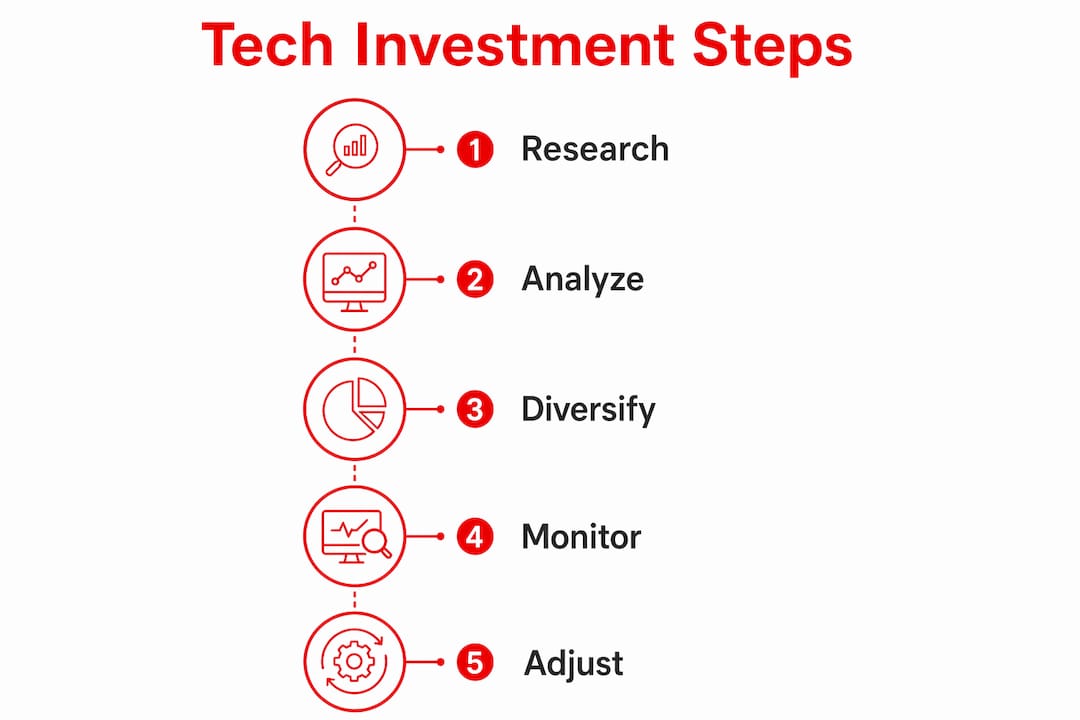
Practical tech stock investment tips matter as much as understanding the sector’s appeal. A thoughtful approach separates investors who capture tech’s upside from those who get burned by its volatility.
- Take a global, bottom-up approach. A global, active approach is critical as market leadership broadens beyond U.S. mega caps. Asian semiconductor manufacturers, European software firms, and emerging market cloud providers all offer exposure to tech growth with different risk profiles.
- Focus on earnings quality, not just growth. Companies with proven earnings growth, high return on equity, and recurring revenue streams are more resilient than speculative AI plays. Look for businesses where revenue is contractual, not discretionary.
- Balance across subsectors. Software, semiconductors, and hardware behave differently across economic cycles. Holding all three reduces the risk of being overexposed to one subsector’s specific headwinds.
- Use price corrections as entry points. Recent corrections in tech stocks have created genuine value opportunities for investors focused on firms with proven earnings growth. Waiting for a pullback before adding to positions is a disciplined habit that pays off over time.
- Monitor capex-to-revenue ratios. For AI-exposed companies, track how much of their cash flow is going into capital expenditure versus being returned to shareholders. A company spending 93% of cash flow on capex needs to show revenue results quickly.
- Consider ETFs for broad exposure. Funds tracking the Nasdaq-100 or specific tech subsectors give you diversified exposure without the single-stock risk of betting on one company’s AI strategy.
Pro Tip: The digital tools shaping business today, from AI platforms to cloud services, are the same products generating revenue for the tech companies you are evaluating. Using these tools yourself gives you genuine insight into which products are sticky and which are just hype.
Valuation discipline is the most underrated skill in tech investing. The sector’s earnings momentum is real, but paying 60 times earnings for a company with uncertain AI revenue is a different bet than paying 20 times earnings for a profitable software business with 90% gross margins.
How has AI adoption shaped the investment outlook for tech stocks?
Artificial intelligence is not a future trend for tech stocks. It is the present reality driving capital allocation, earnings growth, and competitive positioning right now.
More than 50% of companies now pay for AI subscriptions in 2026, up from 40% a year prior. That 10-percentage-point jump in one year shows how fast corporate AI adoption is accelerating. For investors, this translates directly into revenue growth for companies selling AI software, cloud compute, and the chips that power it all.
The investment implications spread across multiple subsectors:
- Semiconductors. Nvidia’s dominance in AI training chips is well documented, but the broader semiconductor supply chain, including memory makers like SK Hynix and equipment suppliers like ASML, is also capturing AI-driven demand.
- Cloud platforms. Microsoft Azure, Amazon Web Services, and Google Cloud are all reporting accelerating growth as companies move AI workloads to the cloud. These platforms benefit from both the infrastructure buildout and the software subscriptions running on top of it.
- Cybersecurity. Every new AI deployment creates new attack surfaces. Companies like CrowdStrike and Palo Alto Networks are seeing demand grow as enterprises secure their AI infrastructure.
- Enterprise software. Salesforce, ServiceNow, and SAP are embedding AI features into existing platforms, which increases the value of their subscriptions and reduces customer churn.
The proliferation of AI across business functions means that tech sector growth is no longer concentrated in a handful of hyperscalers. It is broadening across the entire ecosystem, which is exactly the kind of durable, wide-based growth that makes a sector worth holding for the long term.
Key Takeaways
Technology stocks offer the rare combination of growth potential, financial strength, and sector versatility that makes them a core holding in any serious investment portfolio.
| Point | Details |
|---|---|
| Earnings momentum is real | Tech sector earnings are the most upwardly revised globally in 2026, signaling consistent analyst underestimates. |
| AI capex is a double-edged sword | Hyperscalers now commit 93% of cash flow to AI infrastructure, creating both opportunity and ROI risk. |
| Dispersion demands active selection | Software, semiconductors, and hardware trend differently, so passive indexing alone may miss the best returns. |
| Price corrections create entry points | Recent valuation pullbacks offer disciplined investors a chance to buy quality tech at more reasonable prices. |
| Global diversification adds resilience | Broadening market leadership beyond U.S. mega caps means Asian and European tech firms now offer compelling exposure. |
Why I think most investors are still underestimating tech in 2026
I have watched investors treat technology as a single, monolithic bet for years. They either go all-in on the Magnificent Seven or avoid the sector entirely because it feels too volatile. Both approaches miss the real opportunity.
The most interesting thing happening in tech right now is not the AI hype. It is the sector’s transformation into something that looks more like essential infrastructure than a growth gamble. When 93% of a hyperscaler’s cash flow goes into data centers and power grids, you are no longer just buying a software company. You are buying a company that owns the physical backbone of the digital economy. That is a fundamentally different investment thesis than buying a dotcom stock in 1999.
The dispersion story is equally compelling. Semiconductor equipment makers are not priced the same as AI chip designers. Enterprise software companies with 90% gross margins are not priced the same as speculative AI startups. The spread between the best and worst performers in the sector is wider than it has been in a decade. That spread is where active investors make real money.
My honest view is that the investors who will do best in tech over the next five years are not the ones who pick the hottest AI name. They are the ones who build a diversified position across subsectors, stay disciplined on valuation, and treat price corrections as gifts rather than warnings. The sector’s long-term earnings trajectory is as strong as it has ever been. The question is not whether to own tech. The question is how to own it wisely.
— Alexander
Tech insights worth adding to your reading list
Understanding technology as an investment theme goes hand in hand with understanding how technology reshapes everyday life and business. At Lizardslunch, you will find a wide range of articles covering technology’s pros and cons across consumer and business contexts, giving you a grounded perspective on which tech trends have real staying power and which are short-lived. For investors who want to connect market themes to real-world applications, exploring how gadgets shape daily life can sharpen your instincts for identifying which products and platforms are genuinely sticky. Lizardslunch covers the full spectrum of technology’s impact, from consumer behavior to business transformation, so you always have context behind the numbers.
FAQ
Why invest in tech stocks over other sectors?
Tech stocks offer a combination of earnings growth, financial strength, and AI-driven demand that few other sectors can match. The sector also functions as both a growth holding and a defensive position, making it unusually versatile in a portfolio.
What are the biggest risks of buying tech stocks?
Price volatility, uncertain returns on AI capital expenditure, and elevated valuations are the primary risks. Warren Buffett’s long-standing avoidance of tech highlights the challenge of predicting which companies will hold their competitive position over time.
How does AI adoption affect tech stock performance?
AI adoption is accelerating fast. More than 50% of companies now pay for AI subscriptions in 2026, up from 40% a year prior. That growth drives revenue for chip makers, cloud platforms, cybersecurity firms, and enterprise software companies simultaneously.
Is passive indexing enough for tech stock exposure?
Passive indexing gives you broad exposure but may not capture the best returns as sector dispersion rises. Active, bottom-up stock selection across subsectors and geographies is increasingly important for generating returns above the index.
How large is the semiconductor market in 2026?
Global semiconductor sales reached $791.7 billion in 2025 and are projected to surpass $1 trillion in 2026, driven by AI chip demand and edge computing growth. That scale confirms semiconductors as one of the most consequential investment themes of the decade.


















Leave a Comment
Your email address will not be published. Required fields are marked with *