

Discover the role of gadgets in daily life—explore their benefits and tradeoffs in enhancing productivity, health, and connectivity.
Gadgets are defined as purpose-built electronic devices that extend human capability across communication, health, productivity, and entertainment. The role of gadgets in daily life has grown from simple convenience to something far more structural: your smartphone, smartwatch, and laptop now shape how you work, rest, move, and connect. Research confirms that mHealth tools using smartphones and wearables significantly reduce sedentary behavior among office workers, which means these devices are actively reshaping physical health, not just digital habits. Understanding what gadgets actually do for you, and where they quietly work against you, is the smartest place to start.
How gadgets improve convenience and productivity every day
Everyday technology for productivity works best when it removes friction from tasks you would otherwise spend mental energy managing. A smartphone consolidates your calendar, email, navigation, banking, and communication into one device you carry in your pocket. A smart thermostat like Google Nest learns your schedule and adjusts temperature automatically, cutting energy use without any manual input. These are not luxuries. They are time-recovery tools.

Wearables deserve special attention here. About 45.2% of physical activity interventions using wearables showed effectiveness for at least one health outcome, particularly when paired with behavior-change strategies like coaching or goal-setting. That figure matters because it tells you wearables alone are not magic. The Apple Watch or Fitbit on your wrist becomes genuinely useful when it connects to a structured habit, not just a step count you glance at and ignore.
Here is a quick look at the gadgets most people rely on daily and what they actually deliver:
- Smartphones (Apple iPhone, Samsung Galaxy): instant communication, navigation, banking, and access to thousands of productivity apps
- Laptops and tablets (MacBook, iPad): mobile workstations that support remote work, creative projects, and video conferencing
- Smart speakers (Amazon Echo, Google Nest Hub): hands-free timers, reminders, music, and smart home control
- Wearables (Apple Watch, Garmin Forerunner): real-time health monitoring, sleep tracking, and fitness coaching
- Smart home devices (Philips Hue, Ring doorbell): automated lighting, security alerts, and energy management
The AI-enhanced mobile apps that use sensor-based personalized prompts outperform simple text reminders for improving physical activity among sedentary workers. This tells you that the design of your gadget experience matters as much as the gadget itself.
Pro Tip: Set your phone’s Screen Time or Digital Wellbeing feature to block distracting apps during your two most productive hours of the day. Protecting that window consistently delivers more output than any productivity app you could add.
How gadgets shape entertainment and social connection
Streaming devices and smart TVs have fundamentally changed how you consume media. Where cable once dictated your schedule, devices like Apple TV 4K, Roku Ultra, and Samsung QLED TVs now give you on-demand access to Netflix, Disney+, HBO Max, and thousands of other platforms. You choose what you watch and when. That shift in control is genuinely significant for how people experience leisure time.
Social connection through gadgets is equally transformative. Platforms like Instagram, WhatsApp, and TikTok, accessed primarily through smartphones, allow you to maintain relationships across continents in real time. Gaming consoles like the PlayStation 5 and Xbox Series X add another layer, creating shared virtual spaces where friends and strangers collaborate or compete in immersive environments. Virtual reality headsets like the Meta Quest 3 push this further, placing you inside experiences rather than simply viewing them on a screen.
The tradeoff, however, is real and worth understanding. Short rapidly switching videos reduce immediate memory accuracy and weaken neural synchrony in brain regions tied to attention and memory. Put simply, the TikTok scroll that feels engaging is actively making it harder for your brain to retain what it just processed. This is not a moral judgment. It is neuroscience.
Here is a comparison of popular entertainment gadgets to help you understand what each delivers:
| Gadget | Primary use | Standout feature | Best for |
|---|---|---|---|
| Apple TV 4K | Video streaming | Dolby Vision and Atmos support | Premium home theater |
| Meta Quest 3 | Virtual reality | Mixed reality passthrough | Immersive gaming and fitness |
| PlayStation 5 | Console gaming | Haptic feedback DualSense controller | Story-driven and multiplayer games |
| Amazon Echo Show | Smart display | Video calls plus smart home hub | Family communication and routines |
| Roku Ultra | Budget streaming | Universal search across platforms | Cord-cutters on a budget |
Fragmented, rapidly changing content engages bottom-up attention (the reflexive, reactive kind) while impairing the top-down cognitive control you need for deep learning, creative thinking, and sustained focus. Knowing this lets you make smarter choices about which gadgets and content formats you give your attention to.
Privacy and cognitive challenges with everyday gadget use
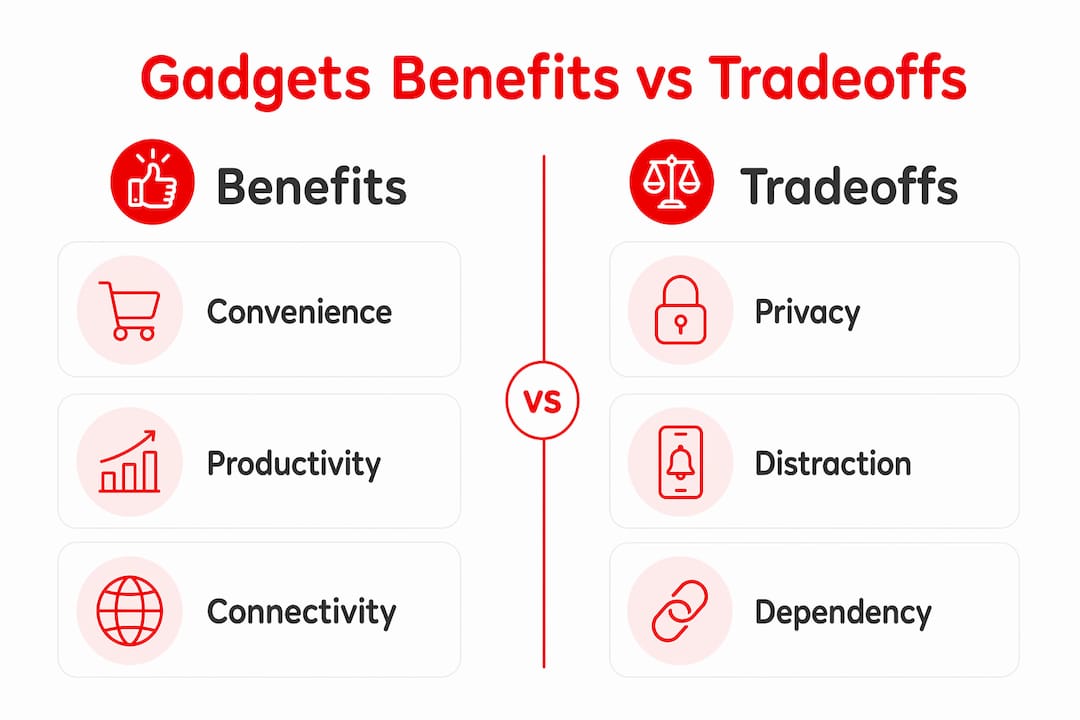
The benefits of gadgets in daily use come with two challenges that most people underestimate: privacy vulnerabilities and reduced attention capacity. Neither is inevitable, but both require awareness to manage.
On the privacy side, the risks go deeper than most users realize. Raw accelerometer data from wearables allows re-identification of individuals with 96% accuracy, even after anonymization. The WristPrint study demonstrated that a single day of motion sensor data carries a biometric signature unique enough to identify you. This means the fitness data your Garmin or Apple Watch collects is not as private as the terms of service might suggest. When that data is shared with third-party researchers or app developers, traditional anonymization protocols are insufficient to protect your identity.
The cognitive picture is equally sobering. Social psychologist Jonathan Haidt, in his 2026 MIT Compton Lecture, presented evidence that smartphone and social media use may reduce human attention capacity by 10 to 50%, with task engagement duration dropping below 30 seconds for many users. That is a staggering range, and even the lower end represents a meaningful loss of the focused attention that drives learning, creativity, and deep work.
These are not reasons to abandon your devices. They are reasons to use them with intention. Privacy protocols must evolve to address re-identification risks in high-frequency sensor data, and users who understand this can take practical steps: reviewing app permissions, limiting data sharing to trusted platforms, and choosing wearables from companies with transparent data policies.
Pro Tip: On your wearable’s companion app (Fitbit, Garmin Connect, Apple Health), go to privacy settings and disable third-party data sharing unless you have a specific reason to enable it. Most users leave this on by default without realizing what they have agreed to.
The attention challenge is equally manageable. Human agency exists to change habits and mitigate the harms of gadget overuse. Limiting exposure, creating phone-free zones in your home, and deliberately choosing longer-form content over short video feeds are all evidence-backed strategies for reclaiming cognitive capacity.
How to incorporate gadgets wisely into your daily routine
Getting the most from everyday technology means being deliberate about which gadgets you use, how you use them, and what behavior they are meant to support. Gadget acquisition alone does not produce results. Effective gadget use depends on how technology is embedded into daily routines and behavior-change strategies, not just ownership.
Here are five practices that translate gadget potential into real daily benefit:
- Pair your wearable with a specific goal. A Fitbit or Apple Watch becomes far more effective when linked to a concrete target, such as 8,000 steps per day or seven hours of sleep, rather than used as a passive tracker. Research shows that pedometers’ immediacy and user-friendliness drive higher engagement and behavior change, particularly when feedback is simple and visible.
- Choose content formats that support retention. Opt for podcasts, long-form YouTube videos, or audiobooks over short-video feeds when your goal is learning. Designing gadget interfaces to reduce fragmented attention through longer, cohesive content enhances memory retention compared to rapidly switching stimuli.
- Audit your app permissions quarterly. Open your phone’s privacy settings every three months and review which apps have access to your location, microphone, camera, and health data. Remove access that is not actively necessary.
- Use smart home devices to automate low-value tasks. Devices like the Amazon Echo, Philips Hue smart lighting, and iRobot Roomba handle reminders, ambiance, and cleaning automatically. This frees your attention for tasks that actually require your focus.
- Set physical boundaries for device use. Keep phones out of bedrooms to protect sleep quality. Designate one room in your home as screen-free. These boundaries are not about restriction. They are about protecting the mental space where your best thinking happens.
One additional consideration: most users abandon wearable activity trackers within six months, with roughly one-third of purchasers stopping use entirely. Sustainable gadget habits require devices that serve multiple functions and stay engaging over time. A smartwatch that handles notifications, payments, and fitness tracking holds your attention far longer than a single-purpose step counter.
Key takeaways
Gadgets genuinely improve daily life when they are chosen with purpose and used within a structure that supports real behavior change, not just passive ownership.
| Point | Details |
|---|---|
| Wearables need behavior pairing | Wearables show effectiveness in 45.2% of interventions when combined with coaching or goal-setting. |
| Short video content impairs memory | Rapidly switching video formats reduce memory accuracy and weaken brain synchrony in attention regions. |
| Wearable data is not truly anonymous | Accelerometer data re-identifies individuals with 96% accuracy, requiring active privacy management. |
| Attention capacity is at risk | Smartphone overuse may reduce attention capacity by up to 50%, making intentional limits necessary. |
| Gadget habits require design | Sustainable use depends on multifunctional devices embedded in structured daily routines, not standalone tracking. |
Why I think most people are using their gadgets backwards
I have spent years watching people buy the latest Apple Watch or Samsung Galaxy and expect the device to do the work for them. The gadget arrives, the excitement lasts two weeks, and then it becomes another object on the nightstand. What I have found, consistently, is that the people who get the most from their technology are not the ones with the most devices. They are the ones who treat each gadget as a tool with a specific job.
The privacy issue is where I think the conversation is most underdeveloped. Most people know, in a vague way, that their data is being collected. Very few understand that their movement patterns alone, captured by a wrist-worn device, can identify them with near-perfect accuracy. That changes how I think about which apps I grant health data access to, and it should change how you think about it too.
The attention piece is the one that concerns me most personally. I have noticed, and I suspect you have too, that sitting with a single task for 45 minutes without reaching for a phone feels harder than it used to. That is not weakness. It is a trained response to years of rapid-switching content. The good news, as Haidt’s MIT lecture makes clear, is that this is reversible. Intentional limits, longer content formats, and phone-free spaces genuinely work. The technology is not the enemy. Passive, unconsidered use of it is.
The most exciting thing about gadgets right now is not any single device. It is the growing awareness that how you design your relationship with technology matters more than which technology you own. That is a shift worth leaning into.
— Alexander
Discover more ways to make technology work for you
If this article sparked ideas about how technology can genuinely improve your daily experience, there is a lot more to explore. Smart gadgets are transforming not just how we work and play, but how we live at home. From automated lighting and security systems to energy-saving smart appliances, the right tech choices can make your space feel more comfortable, more efficient, and more you. Check out the guide to home improvement tech ideas for practical inspiration on upgrading your living space with technology that actually delivers. And if you want a deeper look at the devices reshaping everyday routines, the guide on smart gadgets for easier living is a great next read.
FAQ
What is the role of gadgets in daily life?
Gadgets serve as tools that extend human capability across communication, health monitoring, productivity, and entertainment. Their core function is to reduce friction in everyday tasks, from managing schedules on a smartphone to automating home routines with smart speakers.
Do wearables actually improve physical health?
Research shows that wearables show effectiveness in roughly 45% of physical activity interventions, but results are significantly stronger when devices are paired with coaching, feedback, and clear behavioral goals rather than used as passive trackers.
Can gadgets reduce your attention span?
Yes. Evidence presented at the 2026 MIT Compton Lecture by Jonathan Haidt indicates that heavy smartphone and social media use may reduce attention capacity by 10 to 50%, with many users struggling to sustain focus on a single task for more than 30 seconds.
Is fitness data from wearables private?
Standard anonymization is not sufficient to protect wearable data. The WristPrint study found that raw accelerometer data re-identifies individuals with 96% accuracy using just one day of motion sensor readings, making active privacy management a necessity for wearable users.
How do you get the most from everyday gadgets?
Pair each device with a specific behavioral goal, audit app permissions regularly, and choose content formats that support retention rather than rapid switching. Sustainable gadget habits come from intentional use embedded in structured routines, not from owning more devices.
















Leave a Comment
Your email address will not be published. Required fields are marked with *