
Learn why window ACs usually cool more efficiently, how CEER and EnerGuide labels compare units in Canada, and when a portable model makes sense.
For steady, efficient room cooling, a window AC is usually the better choice, and that holds true across most homes with a workable window. We’d point you toward a portable AC only when window installation is impossible or you need cooling that moves with you. Our take leans on EnerGuide and CEER standards alongside independent lab testing, not marketing claims on a box.
TL;DR:
- Use SACC, CEER, and the mandatory EnerGuide label to compare models; raw BTU claims are not standardized across portable and window units.
- If a portable is unavoidable, choose a dual hose model when possible: tests found 10% to 30% higher efficiency and cooling up to 40% faster.
- Check lease rules and window compatibility before buying; window installation can require lifting 50 to 80 pounds, while portable units still need a sealed vent kit.
- Match SACC to room size, then account for sun and insulation; oversized units cool quickly but may leave humidity behind.
- ENERGY STAR certified room units typically use about 10% less energy, while daily portable use favors continuous drainage over a tank that needs emptying.
Table of Contents
- Performance, Efficiency, and Cost: How the Two Really Compare
- Single-Hose vs. Dual-Hose Portable ACs: Worth the Upgrade?
- How to Choose and Size the Right Unit for Your Space
- Installation Realities and What to Check Before You Buy
- Maintenance Habits That Keep Your Energy Bill Down
- How We Weighed Lab Testing Against Canadian Regulation
- Our Honest Take on the Portable vs. Window Debate
- Growing Your Own Content and Advertising Reach
- FAQ
- Sources
Performance, Efficiency, and Cost: How the Two Really Compare
The BTU number printed on a box tells you less than you’d think. Portable units and window units are tested differently, which is why Natural Resources Canada now anchors its efficiency rules to SACC (Seasonally Adjusted Cooling Capacity) rather than raw BTU. Minimum CEER for portable air conditioners is calculated using a formula based on SACC, and every portable model sold must carry a mandatory EnerGuide label on its packaging. That label is the real comparison tool, not the headline BTU figure.
CEER itself matters because it accounts for more than peak performance. As Hydro-Québec explains, CEER captures energy use during active cooling, standby, and off modes, which gives a fuller picture of what a unit will cost you to run over a season. The utility’s guidance is blunt about sizing too: bigger is not always better, because an oversized unit cools the air quickly without pulling enough humidity out of the room, leaving it cold but clammy.
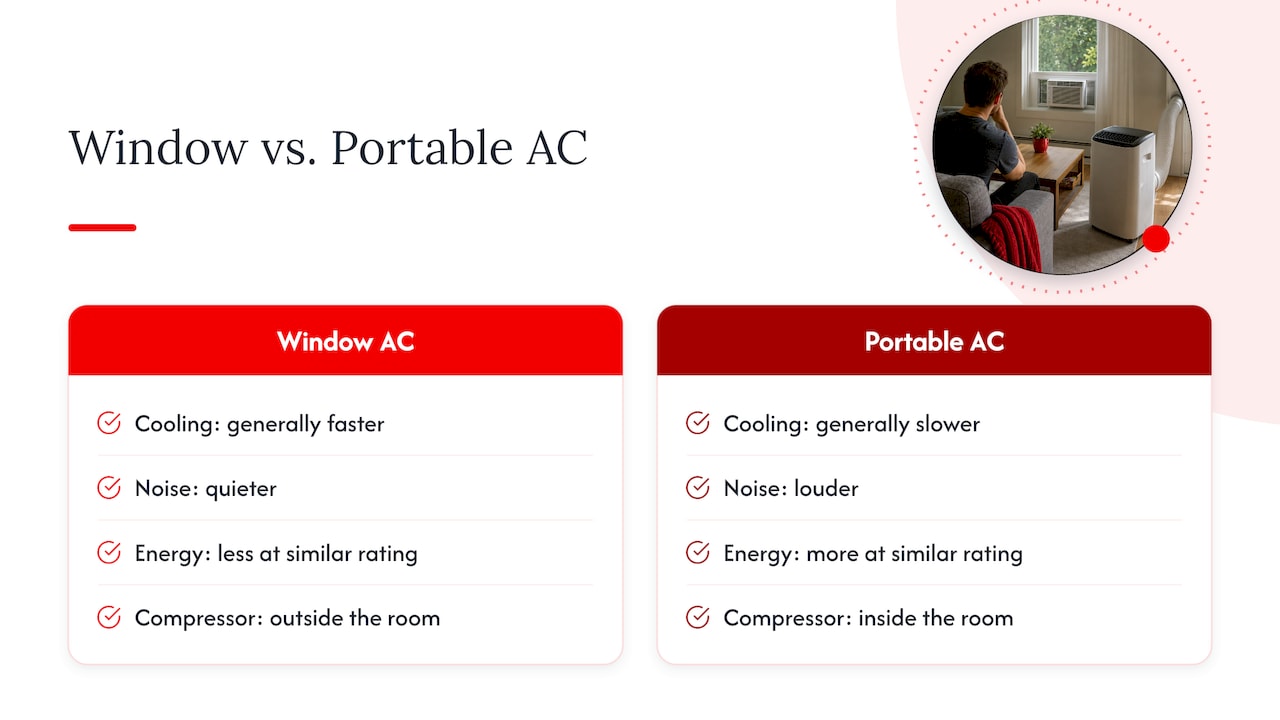
Independent lab work backs up what regulators are measuring. Testing from Consumer Reports found that window units generally cool a space faster, run quieter, and consume less energy than portable units with a similar nominal rating. Part of the reason is mechanical: a window unit’s compressor and fan sit outside the room, venting heat directly outdoors, while a portable’s entire mechanical assembly, compressor included, stays inside the space you’re trying to cool. That’s a built-in disadvantage for noise and, in many cases, for efficiency too.
Picture a typical 10-foot by 12 foot bedroom run for eight hours overnight. A correctly sized window unit with a strong CEER rating will reach your target temperature and then cycle efficiently, sipping power during the off periods that CEER accounts for. A single-hose portable unit working the same room has to fight two extra battles: it’s drawing some of its intake air from inside the already-cooled room, and its own compressor noise and heat output are happening in your space rather than outside it. Over a full cooling season, that difference shows up on your utility bill, even when both units claim the same cooling capacity on paper.
Humidity control follows a similar pattern. Window units, with their compressor and condenser outside, tend to dehumidify more consistently because the system isn’t recirculating warm, moist interior air back through its intake. Portable units, especially single-hose models, struggle more with this, which is one reason a room cooled by a portable can feel cold but still sticky.
Single-Hose vs. Dual-Hose Portable ACs: Worth the Upgrade?
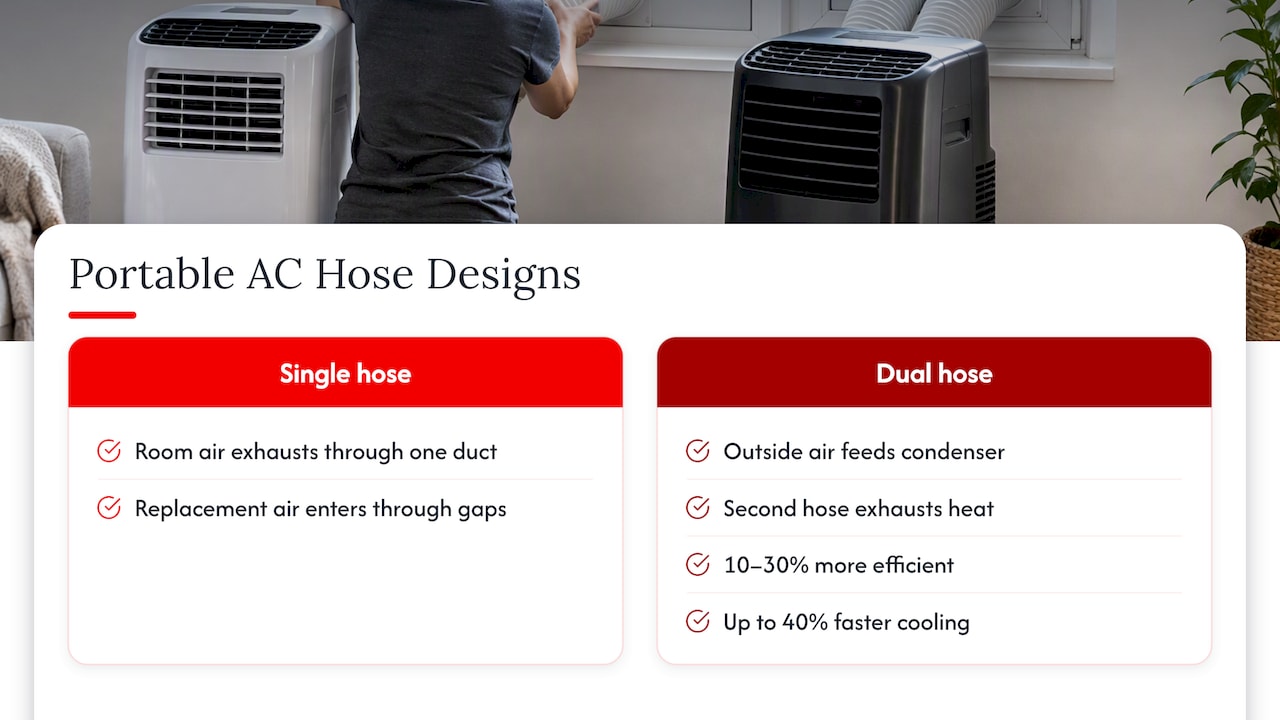
If you’ve settled on a portable unit, the hose configuration matters more than almost any other spec. A single-hose portable pulls air from inside your room, cools part of it, and exhausts the rest outside through one duct. That process creates negative pressure in the room: as air gets pushed out, replacement air gets pulled in through every gap, under doors, around window seals, from attics or outside, often warm and humid. Forbes’ comparison of dual-hose and single-hose designs found this negative-pressure effect is the main reason single-hose models underperform their rated capacity.
A dual-hose portable AC separates the job: one hose draws outside air in for the condenser, a second hose exhausts the heat, and neither depends on pulling conditioned room air through the system. That design change produces a measurable gap in results. Research cited by Forbes shows dual-hose units running 10% to 30% more efficiently than single-hose counterparts, with cooling speeds up to 40% faster in some tests.
Before buying any portable unit, check three things on the label: the SACC rating (not just BTU), the CEER number, and confirmation of an EnerGuide label, which Natural Resources Canada requires on every unit sold. Also weigh the drain setup and unit weight; a heavier dual-hose model with a continuous drain line will perform better but won’t be as easy to shuffle between rooms.
How to Choose and Size the Right Unit for Your Space
Start with square footage, then adjust for sun exposure and insulation rather than chasing the biggest BTU number you can find. An oversized unit cools the air fast, but Hydro-Québec’s efficiency guidance notes that speed without matching humidity removal leaves a room feeling damp rather than comfortable. A south-facing room with lots of glass needs more capacity than a shaded north-facing one of the same size, even though the square footage is identical.
Run through this checklist before you decide:
- Window compatibility: confirm your window type, casement, slider, or awning, can actually accept a window unit’s bracket.
- Lease or HOA rules: some buildings restrict exterior brackets or window-mounted appliances entirely.
- Mobility need: if you’re cooling different rooms on different days, or renting short-term, portability outweighs raw efficiency.
- Noise tolerance: bedrooms and home offices benefit from a window unit’s quieter profile since the compressor sits outside.
- Typical hours of use: units running nightly for a full season justify paying more upfront for a better CEER rating.
For a rough cost estimate, add the unit’s purchase price plus any installation cost, then weigh that against expected seasonal energy use. The EnerGuide label and CEER rating are your best guides here since they’re standardized across brands, unlike marketing claims about “cooling area.” A unit with a stronger CEER will often cost less to run over a full summer even if its sticker price is slightly higher.
Compare these exact specs side by side before purchasing: SACC, CEER, confirmation of an EnerGuide label, ENERGY STAR certification where available, and drain type (manual bucket versus continuous hose). ENERGY STAR certified room air conditioners typically use about 10% less energy than standard models and often add features like smart controls or better window-seal insulation.
Installation Realities and What to Check Before You Buy
Window units take real installation work: lifting a unit that can weigh 50 to 80 pounds into a frame, securing support brackets, and sealing foam strips around the gaps. Plan for a second person to help and roughly 30 to 60 minutes for a straightforward double-hung window. Portable units skip the lift but still need a vent hose routed through a window kit, which takes its own 15 to 20 minutes to fit and seal properly.
Before buying either type, check your lease or condo bylaws for rules on exterior brackets, window-blocking restrictions, or appliance visibility from the street. Some buildings prohibit anything protruding from a window entirely, which settles the decision for you.
Safety matters on both sides. A window unit’s bracket needs to bear real weight without stressing the sash, so follow the manufacturer’s mounting hardware rather than improvising with wood blocks. For portables, keep the vent hose run as short and straight as possible since kinks and long runs reduce airflow and strain the compressor, a detail Popular Mechanics’ testing flags as a common reason portables underperform their rated cooling once installed.
Maintenance Habits That Keep Your Energy Bill Down
Window units need filter cleaning every two to four weeks during heavy use, plus a coil check at the start of the season. Portable units need the same filter attention, but add one more task: managing condensate. Many portables collect water in an internal tank that needs periodic emptying, though some models support a continuous drain hose that bypasses the tank entirely, worth prioritizing if you’re running the unit daily.
Small habits add up over a season. Use a built-in timer or sleep mode rather than running full blast overnight, set your thermostat target a few degrees higher than you think you need, and seal gaps around the window unit’s frame or the portable’s vent kit with weatherstripping. Our energy-saving tips for 2026 cover more of these small adjustments if you want to trim your summer bill further.
Pro Tip: At the end of the season, clean the filter and coil thoroughly, drain any remaining condensate completely, and store the unit upright in a dry spot to avoid mold buildup before next summer.
How We Weighed Lab Testing Against Canadian Regulation
Our team worked through Natural Resources Canada’s efficiency rules, EnerGuide labeling requirements, Hydro-Québec’s seasonal advice, and independent test summaries to build the guidance above. We leaned on CEER and SACC over raw BTU claims because regulatory testing ties those figures to standardized conditions, while BTU alone can vary by how a manufacturer tests it.
Our scenario-based takeaway: for a small bedroom, a correctly sized window unit generally performs better on noise and efficiency. For a rental with restricted or incompatible windows, a dual-hose portable is the stronger pick among portables. For a large living room with heavy sun exposure, prioritize CEER rating over sticker price, regardless of which type you choose.
Our Honest Take on the Portable vs. Window Debate
We’d generally steer most readers toward a window unit whenever the window and the building allow it. The efficiency gap tends to be noticeable, and humidity control often is more consistent. That said, renters with fixed-pane windows, HOA restrictions, or a genuine need to move cooling between rooms have practical reasons to choose a portable, and a dual-hose model often narrows the performance gap. Whichever way you lean, check the EnerGuide label, confirm the CEER rating, and size the unit to your actual room before you buy.
— Alexander
Growing Your Own Content and Advertising Reach
If comparing specs and reading regulatory fine print for an air conditioner feels like a lot of legwork, you already know how much research goes into writing something people actually trust. We put that same approach into advertising and content partnerships at Lizard’s Lunch, helping brands reach readers who are actively researching purchase decisions like this one. Our advertising and guest post opportunities connect you with an audience already in research mode, looking for practical, well-sourced guidance before they spend money. If you’re weighing how to get a product or service in front of readers who read deep, researched comparisons like this one, reach out through our advertising page to see what fits.
FAQ
Is a window AC cheaper to run than a portable AC?
Generally yes, because window units place the compressor outside and avoid the negative-pressure losses common in single-hose portables. A unit’s CEER rating is the clearest way to compare expected running cost between specific models.
Does a dual-hose portable AC really cool faster than single-hose?
Yes. Research on dual-hose designs shows cooling speeds up to 40% faster and efficiency gains of 10% to 30% compared with single-hose units, since dual-hose models avoid pulling conditioned room air back through the intake.
What does SACC mean and why does it matter more than BTU?
SACC, or Seasonally Adjusted Cooling Capacity, is the standardized measurement Canadian regulations use to set minimum efficiency requirements, and it reflects real-world cooling performance better than a manufacturer’s raw BTU claim.
Can a portable AC work as well as a window unit in a dry climate?
In very dry conditions, some households also consider an evaporative cooler as an alternative worth comparing against either AC type; our partner guide on evaporative coolers versus AC walks through that specific tradeoff. For typical humidity levels, a window unit still outperforms most portables on cooling consistency.
How do I know if my room needs a bigger or smaller unit?
Match SACC to your square footage first, then size up slightly for strong sun exposure or poor insulation, since an undersized unit won’t keep pace and an oversized one cools fast without removing enough humidity according to Hydro-Québec’s sizing guidance.


















Leave a Comment
Your email address will not be published. Required fields are marked with *