
Run eight pantry-item experiments parents can do in 5–15 minutes. Step-by-step demos, safety rules, and challenge frames turn each activity into a short…
You can run a genuine, reliable science experiment at home today using nothing more than what’s already sitting in your pantry and craft drawer. Magic milk, a baking-soda volcano, and homemade Oobleck all deliver real “wow” moments with almost zero setup. Every activity here works for kids roughly age 4 and up, though anything involving vinegar, dish soap, or small parts needs an adult nearby. The full shortlist, with age and mess ratings, is right below.
TL;DR:
- Many experiments like magic milk and Skittles rainbow require minimal supplies and can be safely done with children as young as three with adult supervision.
- Acid-base reactions, such as baking-soda volcanoes, are reliable and teach fundamental chemistry concepts with simple household ingredients.
- Substitutions like watered-down juice for food coloring or crushed antacid tablets for fizzing agents can be used when supplies run low, but certain chemicals should be avoided unless necessary and supervised.
- Proper safety precautions include wearing goggles, avoiding ingestion, and working near ventilation, especially when handling vinegar, food coloring, or baking soda.
- Turning experiments into lessons involves setting specific goals, constraints, and testing variables to deepen understanding and foster curiosity.
Table of Contents
- Which Kids Science Experiments at Home Work Best by Age?
- How Do You Run the Most Popular Experiments Step by Step?
- What Household Materials and Substitutions Work Best?
- What Safety Rules Should You Follow for Home Science?
- How Do You Turn a Demo Into a Real STEM Lesson?
- Why Do Experiments Sometimes Fail (and How Do You Fix Them)?
- Why We Think Every Family Should Run Experiments Weekly
- Where Else Can You Learn More About Home Science?
- Sources
Which Kids Science Experiments at Home Work Best by Age?
Picking the right activity comes down to three things: how much mess you can tolerate, how much hands-on help the child needs, and how many minutes you actually have. The list below organizes the most reliable home science projects for kids by those three factors, plus the single scientific idea each one teaches.
- Magic milk (ages 3+): 5 minutes prep, low mess, needs active help for toddlers. Teaches surface tension.
- Baking-soda volcano (ages 4+): 10 minutes prep, medium mess, needs monitoring. Teaches acid-base reactions.
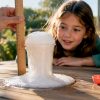
- Oobleck (ages 3+): 5 minutes prep, high mess, needs active help. Teaches non-Newtonian fluids.
- Skittles rainbow (ages 3+): 5 minutes prep, low mess, needs monitoring. Teaches diffusion.
- Chromatography flowers (ages 6+): 15 minutes prep, low mess, needs monitoring. Teaches pigment separation.
- Density column or lava lamp (ages 5+): 10 minutes prep, medium mess, needs active help. Teaches density and liquid layering.
- Balloon rocket (ages 5+): 10 minutes prep, low mess, needs monitoring. Teaches force and motion.
- Tin-foil boat and penny test (ages 6+): 15 minutes prep, low mess, needs monitoring. Teaches buoyancy and basic engineering.
If you’re short on supplies, both the Skittles rainbow and the balloon rocket work with items most households already have on hand, making them the easiest fallback picks. Collections like the one from WeAreTeachers round up dozens more variations if your family burns through this shortlist fast.
How Do You Run the Most Popular Experiments Step by Step?
Magic milk. Materials: whole milk, a shallow dish, food coloring, dish soap, a cotton swab.
- Pour milk into the dish, about a quarter inch deep.
- Add 4 to 5 drops of different food colors near the center.
- Dip the cotton swab in dish soap.
- Touch the swab to the middle of the milk without stirring.
- Watch the colors burst and swirl outward.
- Repeat with a fresh swab to extend the reaction.
Expected result: colors swirl instantly as soap breaks the milk’s fat molecules. Time: 10 minutes. Cleanup: rinse the dish, wipe the counter. Ages 3+, with active adult help for pouring and swab handling. The science: dish soap disrupts the fat and protein structure in whole milk, and the fat molecules scatter, dragging the color with them. Ask your child: “What happens if we use skim milk instead of whole?”
Baking-soda volcano. Materials: a plastic bottle, baking soda, vinegar, food coloring, a tray.
- Set the bottle on the tray.
- Add baking soda through the neck.
- Add food coloring to vinegar in a cup.
- Pour the vinegar mixture into the bottle.
- Step back and watch the eruption.
- Reset with fresh soda for another round.
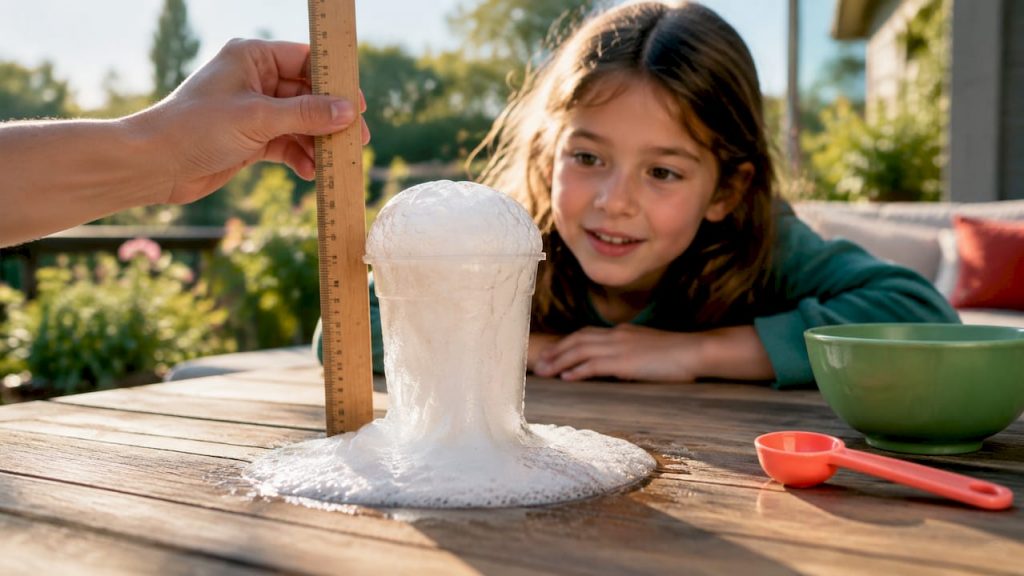
Expected result: fizzing foam erupts from the bottle opening. Time: 15 minutes including reset. Cleanup: rinse the tray, mop up any overflow. Ages 4+, adult monitoring required near the vinegar pour. The reaction between the acid in vinegar and the base in baking soda releases carbon dioxide gas, and that gas is what forces the foam upward. National Geographic Kids runs a similar reaction in its science activities for children, if you want a second version to compare results against.
Journaling prompt: have your child record how high the eruption went and guess why doubling the vinegar changed the result.
What Household Materials and Substitutions Work Best?
Most of these experiments draw from the same short list of pantry and craft staples:
- Vinegar, baking soda, and dish soap for reactions and fizzing effects.
- Food coloring, cornstarch, and cooking oil for color and texture demonstrations.
- Balloons, zip-top bags, and coffee filters for air pressure and filtration activities.
- Alka-Seltzer or a crushed antacid tablet as a safer stand-in for stronger fizzing agents.
If you’re out of food coloring, watered-down juice or Kool-Aid powder works in a pinch for the Skittles and density experiments. Skip Borax, concentrated hydrogen peroxide, and rubbing alcohol unless a recipe specifically calls for them and an adult handles the measuring. Cornstarch and water are a far safer route to a slime-like texture than anything requiring a hazard label.
What Safety Rules Should You Follow for Home Science?
Supervision should scale with age, not with how simple the experiment looks. Toddlers age 0 to 3 shouldn’t attempt anything on this list beyond supervised sensory play with cornstarch or Oobleck. Kids age 4 to 7 need an adult actively helping with pouring, mixing, and cleanup. Kids age 8 and up can usually work with supervision from a distance, depending on the chemicals involved.
- Have kids wear goggles and an apron for anything involving vinegar or food coloring.
- Never allow tasting or ingestion of experiment materials, even “safe” ones like baking soda paste.
- Work near a sink or open window for ventilation during fizzing reactions.
- Keep small parts like beads or coins away from children under 3.
- Wash hands after every experiment and store leftover chemicals out of reach.
Adult supervision isn’t optional for this category. Good Housekeeping’s roundup of kid-friendly experiments notes that experts recommend supervision any time household chemicals like vinegar, baking soda, or dish soap are involved, with younger children needing hands-on help and older kids needing monitoring rather than direct assistance.
How Do You Turn a Demo Into a Real STEM Lesson?
A demonstration becomes a lesson the moment you add a goal, a constraint, and a variable to test. Instead of just watching the volcano erupt, ask: “Can you make it erupt higher using less vinegar?” That single question turns a one-time show into a repeatable experiment.
- Give each activity a challenge frame: a goal (tallest eruption), a constraint (only two tablespoons of vinegar), and one variable to change between trials.
- Use a simple observation checklist: what did you predict, what happened, what would you change?
- For the tin-foil boat, frame it as “how many pennies before it sinks” instead of just building a boat.
- Compare two trials side by side rather than judging a single result as success or failure.
Pro Tip: Set a two-minute timer before each trial and challenge your child to beat their own previous result. The countdown keeps younger kids focused and turns repetition into a game instead of a chore.
Why Do Experiments Sometimes Fail (and How Do You Fix Them)?
Most failed experiments trace back to wrong proportions or the wrong material, not bad luck. Chromatography often disappoints because permanent markers won’t bleed the way water-based markers do, and magic milk falls flat with skim milk instead of whole. Volcanoes that fizzle out usually have stale baking soda or too little vinegar.
- Swap permanent markers for water-based ones in chromatography and diffusion experiments.
- Use whole milk, not low-fat, for reliable magic milk results.
- Refresh baking soda if reactions seem weak, since it loses potency over time.
- Try the volcano outdoors on a hot day versus a cold one to test how temperature changes the reaction speed.
Why We Think Every Family Should Run Experiments Weekly
Short, repeated experiments build curiosity in a way that one big science fair project never does. We’d rather see a family run a five-minute magic milk demo every Saturday than one elaborate volcano once a year. Keep an adult nearby for anything involving chemicals, jot down what happened each time, and browse a roundup of at-home science activities when you’re ready for more.
— Alexander
Where Else Can You Learn More About Home Science?
For deeper dives, Good Housekeeping’s experiment roundup, National Geographic Kids’ Science Lab, and National Geographic Education all offer tested activities and age guidance worth bookmarking.














Leave a Comment
Your email address will not be published. Required fields are marked with *