
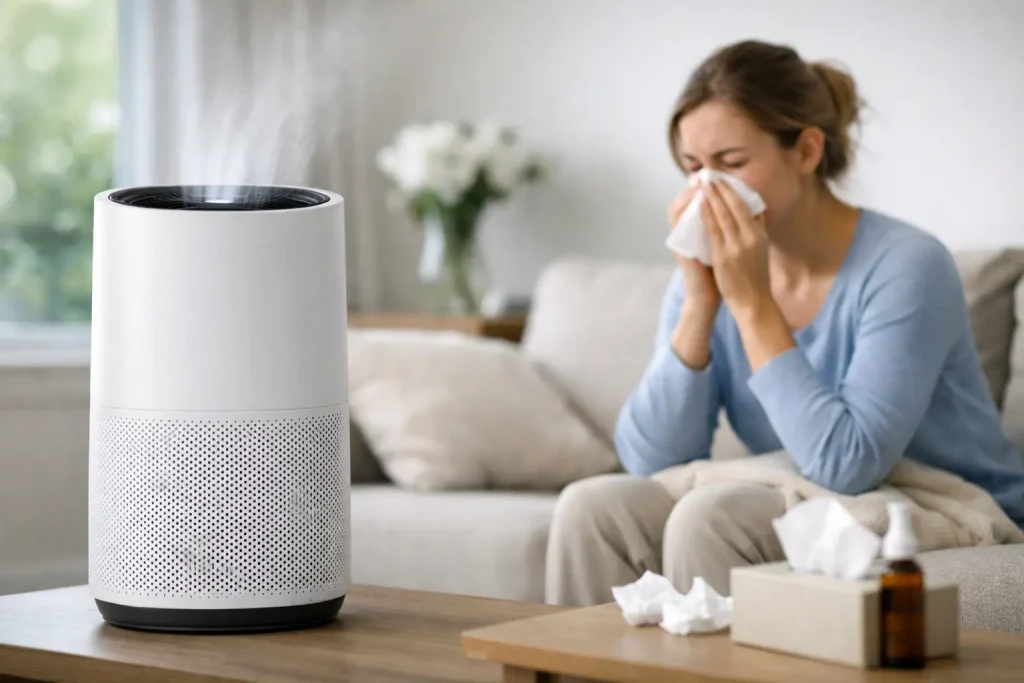
Our air purifier review for allergies explains HEPA filters, room sizing, noise, and features that help reduce indoor allergens at home every day well.
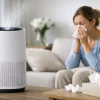
A sneezing fit that starts the moment you settle onto the couch is often a clue that your indoor air needs attention. This air purifier review for allergies focuses on what actually makes a difference: particle filtration, proper room coverage, realistic noise levels, and habits that keep allergens from circulating in the first place.
For most allergy households, an air purifier is not a cure-all. It will not remove every allergen already trapped in rugs, upholstery, or bedding. But the right unit can reduce the airborne particles you breathe, especially pollen, pet dander, dust-mite debris, mold spores, and smoke particles that can make symptoms feel worse.
What an Air Purifier Can Help With
Air purifiers work by pulling room air through filters and returning cleaner air to the space. Their strongest role is reducing particles that are floating around, not allergens that have settled on surfaces.
That distinction matters. A purifier can capture pet dander kicked up when a dog jumps off the sofa, but it cannot replace vacuuming the sofa. It can reduce pollen that entered through an open window, but it cannot prevent pollen from coming in on shoes, jackets, and hair.
For people with seasonal allergies, a purifier is often most useful in bedrooms and home offices, where many hours are spent with doors and windows closed. For pet allergies, it can help in the room where the pet and family spend the most time. The payoff depends on using the machine consistently and choosing one sized for the room.
Air Purifier Review for Allergies: The Features That Matter
Marketing language can make one purifier sound dramatically better than another, even when both use similar filtration. Start with the specifications that affect performance instead of extras that look impressive on a product page.
A true HEPA filter is the priority
For allergy relief, a HEPA filter should be the non-negotiable feature. HEPA filters are designed to capture at least 99.97% of particles measuring 0.3 microns under standard test conditions. That particle size is commonly described as a challenging size to filter, so the rating is meaningful.
Look for wording such as “True HEPA” or a clearly stated HEPA standard. Be cautious with vague labels like “HEPA-type,” “HEPA-style,” or “HEPA-like.” Those terms are not necessarily useless, but they do not promise the same verified level of filtration.
A washable pre-filter is also valuable. It catches larger debris, hair, and lint before they reach the main filter. Cleaning it regularly can help preserve airflow and extend the life of the more expensive HEPA filter.
Room size should be treated conservatively
A purifier rated for 1,000 square feet may sound ideal for a large living room, but coverage claims are not always directly comparable. Some are based on a single air change per hour, which is not enough for someone trying to manage noticeable allergies.
A better shopping metric is CADR, or Clean Air Delivery Rate. CADR measures how quickly a purifier reduces smoke, dust, and pollen in a controlled space. Higher numbers generally mean faster particle removal. Pollen CADR is particularly relevant here, though dust CADR is helpful for everyday indoor allergens as well.
Choose a unit that can handle your room at multiple air changes per hour, not merely one pass of the air. If a bedroom is 200 square feet, buying a purifier rated just above 200 square feet can leave you running it at its loudest setting. A larger-capacity model can clean the air effectively at a lower, quieter speed.
Noise matters more than most shoppers expect
The highest fan setting usually delivers the best cleaning performance, but it can be too loud for sleeping, reading, or working. A purifier that gets switched off every night cannot help much.
Check the decibel rating for both low and high speeds, then think about how the unit will be used. A bedroom model should have a quiet sleep mode and controls that can dim or turn off bright lights. A living-room purifier can tolerate more fan noise during the day, particularly if it needs to handle pets, cooking particles, and foot traffic.
Activated carbon is useful, but not the allergy star
An activated carbon filter can help reduce odors and certain gases. It is worthwhile if your home also deals with pet smells, cooking odors, or outdoor smoke. Still, carbon is not a substitute for HEPA filtration when allergies are the concern.
The amount of carbon matters, too. A thin carbon sheet may provide modest odor control, while a heavier carbon filter generally has more capacity. Do not pay a large premium for odor claims if the purifier lacks strong particle-filtration performance.
Smart Features: Convenient, Not Essential
Air-quality sensors, app controls, automatic modes, and filter-life reminders can make a purifier easier to live with. An auto mode can raise fan speed when it detects a spike in particles, such as after vacuuming or cooking.
However, sensors have limits. Many consumer sensors are better at detecting fine particles than larger allergen particles, and they may not respond immediately to pollen or pet dander. Use auto mode as a convenience feature, not proof that the room is allergen-free.
A basic purifier with a strong HEPA filter, reasonable CADR, and affordable replacement filters is often a smarter buy than a feature-packed model with costly maintenance. Before purchasing, check the price and availability of replacement filters. If a filter costs nearly as much as the unit after a year or two, the initial bargain can become expensive quickly.
Where to Put an Air Purifier for Best Results
Placement can change the results more than many people realize. Put the purifier in the room where symptoms are most disruptive, usually the bedroom. Keep it on the floor or a sturdy low table with several inches of open space around the air intake and exhaust.
Avoid hiding it behind a chair, under a desk, or in a tight corner. Do not aim the airflow directly at your face if the moving air feels irritating. Instead, let the unit circulate air across the room without obstruction.
Keep bedroom doors and windows closed when pollen counts are high. Running a purifier in an open room connected to a hallway, kitchen, and living area can dilute its impact because it is effectively trying to clean a much bigger space. If your home has an open layout, a larger model or separate units in key rooms may be more practical.
The Trade-Offs Worth Considering
The best air purifier for allergies is rarely the smallest, cheapest, or quietest option. Compact models are easier to move and take up less space, but they may need to run on high to keep up. Larger units usually move more air at lower speeds, though they cost more and can be visually bulky.
Energy use is another consideration. Most modern purifiers use a manageable amount of electricity on lower settings, but running multiple units around the clock adds to household costs. If you need to prioritize, start with the bedroom and run the purifier continuously there. A steady low or medium setting is usually more useful than turning it on only when symptoms start.
If anyone in the household has asthma, severe allergies, or frequent respiratory symptoms, use an air purifier as one part of an overall plan. Cleaning, moisture control, allergen-proof bedding covers, pet management, and medical guidance can all matter. Skip ozone-generating devices and be wary of products that claim to “destroy” allergens without relying on tested filtration.
A Practical Buying Checklist
Before committing to a model, make sure it has these four basics:
- A clearly identified HEPA filter rather than a loosely defined HEPA-style filter.
- Capacity that exceeds the square footage of the intended room.
- A noise level you can tolerate during sleep or daily routines.
- Replacement filters that are available and reasonably priced.
If a purifier meets those standards, the remaining choice comes down to your space and habits. A pet-heavy living room may benefit from higher airflow and a washable pre-filter. A pollen-sensitive sleeper may value a quiet bedroom unit with dimmable controls. For many homes, two properly sized midrange units in the rooms that matter most will outperform one undersized machine placed in a central hallway.
The most helpful purifier is the one you will keep running, maintain on schedule, and pair with a cleaner home routine. Start where you sleep, give the unit room to work, and let the results build over days rather than expecting instant relief after one hour.











Leave a Comment
Your email address will not be published. Required fields are marked with *