
Discover the role of wearable tech in travel for 2026! Explore how smart devices enhance your journey with real-time navigation and health features.
Wearable technology in travel is defined as a category of body-worn smart devices, including smartwatches, AI-powered glasses, and fitness trackers, that deliver hands-free navigation, health monitoring, real-time translation, and contactless payments without requiring you to pull out your phone. The role of wearable tech in travel has expanded dramatically in 2026, with devices like Ray-Ban Meta AI smart glasses and Huawei smartwatches moving from novelty accessories to genuine trip companions. These devices let you stay present in a Parisian market or a Bangkok shopping district while still managing directions, language barriers, and even your boarding pass from your wrist or your face. The result is a more immersive, less screen-dependent way to explore the world, and the smart travel accessories market is only getting more exciting.
How does wearable tech improve navigation and translation for travelers?
Wearable devices solve two of the most persistent friction points in travel: getting lost and getting lost in translation. AI-powered smart glasses like the Ray-Ban Meta line overlay live directional cues, landmark recognition, and augmented reality information directly into your field of vision. You can walk through Rome’s Trastevere neighborhood and identify a 16th-century church without ever breaking stride to consult a map app.
Haptic navigation takes this a step further by removing the visual element entirely. Haptic turn signals delivered through smartwatch vibrations guide you left or right without a single glance at a screen. This keeps your eyes on the street, your ears open to the environment, and your awareness sharp in unfamiliar cities. For solo travelers especially, that situational awareness is not a luxury. It is a safety feature.

Real-time translation: what it does well and where it falls short
Live translation through AI glasses or smartwatch apps works impressively well in quiet, controlled settings. You can point your glasses at a restaurant menu in Tokyo and receive an instant English overlay. Conversational translation in a hotel lobby or a calm café is genuinely useful and fast.
The honest limitation is that translation accuracy drops significantly in noisy environments and with regional dialects or accents. A busy street market in Marrakech or a crowded train station in Mumbai will challenge any wearable’s microphone and AI processing. Latency, the brief delay between speech and translation output, can also make natural conversation feel stilted. Wearable translation is a powerful first layer of communication, but you still want a backup plan for critical interactions like medical situations or complex negotiations.
- AI smart glasses deliver visual landmark recognition, menu translation, and AR navigation overlays
- Smartwatch haptics provide discreet turn-by-turn vibration cues for eyes-free navigation
- Voice translation apps on wearables handle conversational phrases in quiet settings effectively
- Limitations to know: noisy environments reduce translation accuracy; haptic signals require practice to interpret correctly
Pro Tip: Practice your smartwatch’s haptic navigation pattern at home for at least a week before your trip. The learning curve for haptic signals is real, and decoding vibration patterns in a foreign city for the first time adds unnecessary stress.
What role do wearables play in travel health and wellness?
Wearable devices are the most practical health monitoring tools a traveler can carry, tracking heart rate, blood oxygen levels, sleep quality, and daily step counts continuously and passively. For travelers managing chronic conditions like hypertension or diabetes, a smartwatch that flags an irregular heart rate or a sudden drop in blood oxygen provides a layer of medical awareness that no app on a phone can replicate with the same immediacy. You do not need to remember to check. The device checks for you.
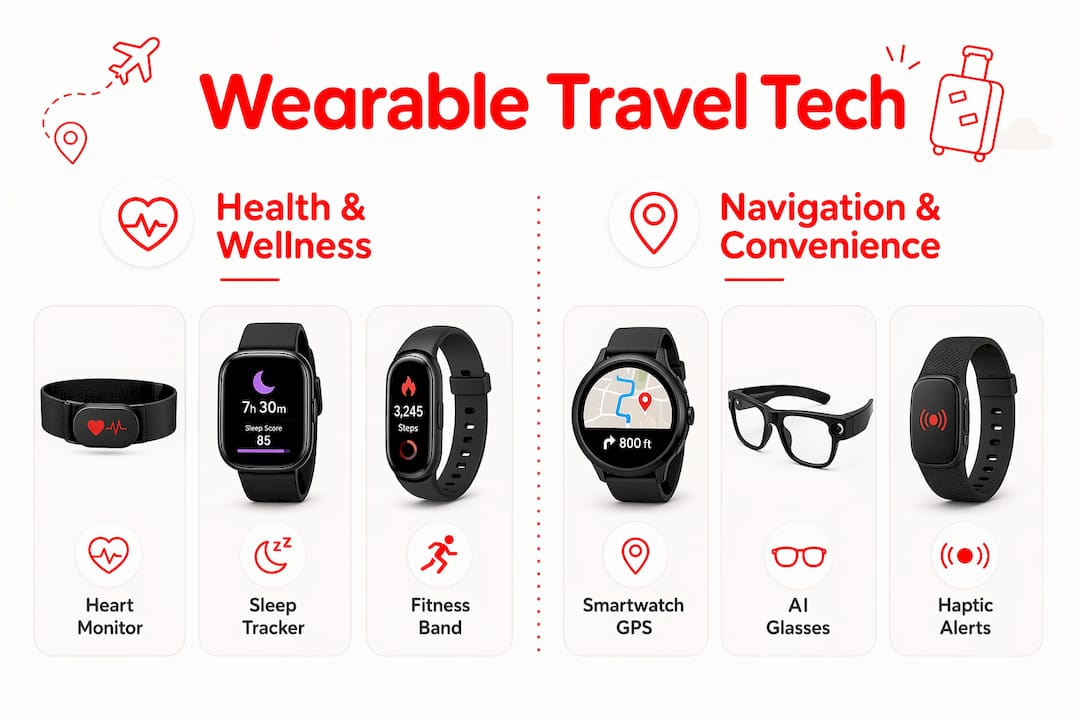
Fitness tracking during travel also serves a motivational function that goes beyond simple step counting. Huawei’s collaboration with Siam Piwat in Bangkok runs a compelling example of this: between May and August 2026, travelers using Huawei wearables can earn 500-baht gift cards after hitting 2,000 steps in Thai retail locations. This program targets over 200 million Huawei wearable users globally. That is a retail incentive structure that turns your morning walk through a shopping district into a rewarded wellness activity, blending tourism, fitness, and commerce in a way that feels genuinely fresh.
Vision correction meets AI: the prescription glasses breakthrough
One of the most underreported stories in wearable technology for tourism is the prescription AI glasses category. 75% of U.S. adults require vision correction, and 64% of those use prescription glasses. For years, AI smart glasses were inaccessible to the majority of travelers who actually needed corrective lenses. Meta’s 2025 launch of prescription-ready Ray-Ban Meta glasses changed that equation. The device sold 7 million units in 2025 alone, and prescription versions are available starting at around $500. That number represents a massive, previously excluded audience now able to access hands-free AI travel assistance without sacrificing their vision correction.
For travelers managing wellness routines on the road, wearables also help maintain consistency. Sleep tracking on devices like the Garmin Fenix series or Apple Watch Ultra 2 gives you data on how time zone shifts and long-haul flights affect your sleep architecture. That information lets you adjust your schedule, hydration, and light exposure to recover faster and enjoy your destination more fully from day one.
How do wearables enhance travel connectivity and convenience?
The impact of wearables on travel logistics is most visible at the moments that used to require the most fumbling: boarding a flight, entering a hotel room, paying for a coffee, or accessing a museum. Smartwatches with NFC (near-field communication) chips store digital wallets, boarding passes, and loyalty cards. You raise your wrist, tap the reader, and move on. No unlocking a phone, no digging through a bag, no missed tap because your screen timed out.
Huawei’s integration with Siam Piwat in Bangkok illustrates how far this convenience extends in travel retail. Wrist-raise access to membership perks, navigation within shopping complexes, and retail promotions is now live across the Siam Piwat ecosystem, compatible with iOS, Android, and HarmonyOS devices. This kind of integration connects your online travel profile with your physical movement through a destination, making the experience feel genuinely connected rather than fragmented.
Here is how wearable connectivity typically works across a modern trip:
- Pre-departure: Load your boarding pass, hotel key, and travel insurance card onto your smartwatch via apps like Apple Wallet or Google Wallet.
- At the airport: Tap through security and boarding gates without touching your phone. Smartwatches with LTE connectivity also let you receive gate change alerts independently.
- At your destination: Use NFC payments at restaurants, transit systems, and shops. In cities like Bangkok, London, and Tokyo, contactless wearable payments are widely accepted.
- In retail and tourism hubs: Access visitor cards, museum memberships, and loyalty rewards through wearable-based programs like the Huawei and Siam Piwat partnership.
- Managing communications: Receive flight alerts, translation prompts, and navigation cues without pulling out your phone, keeping your device secure in your bag.
The persistent challenge is ecosystem fragmentation. Most wearables still require a connected smartphone within Bluetooth range to operate their full feature set. True phone-free operation remains limited. Cross-platform compatibility is improving, but an Apple Watch user and a Huawei Watch user will have very different experiences with the same travel app. Checking compatibility before you travel is not optional. It is part of your packing list.
Comparing popular travel wearables and 2026 tech trends
Choosing the right device depends on what you want your wearable to do most. Here is a direct comparison of the leading options for travelers in 2026:
| Device | Best for | Key travel features | Starting price |
|---|---|---|---|
| Ray-Ban Meta AI Glasses | Navigation, translation, photography | AR overlays, live translation, hands-free camera | $224 (standard), $500+ (prescription) |
| Apple Watch Ultra 2 | Health monitoring, payments, LTE | ECG, blood oxygen, NFC payments, independent LTE | ~$799 |
| Huawei Watch GT 5 Pro | Fitness tracking, retail integration | Step challenges, NFC, HarmonyOS ecosystem | ~$350 |
| Garmin Fenix 8 | Outdoor navigation, wellness | Topographic maps, sleep tracking, multi-GNSS | ~$900 |
| Fitbit Charge 6 | Budget health tracking | Heart rate, sleep, Google Wallet | ~$160 |
Entry-level AI smart glasses starting at $224 represent the most accessible point of entry for travelers who want hands-free assistance without committing to a premium smartwatch. The Ray-Ban Meta first-generation glasses handle navigation, photography, and live translation at a price point that competes with a good travel camera lens.
The Apple Watch Ultra 2 and Garmin Fenix 8 target travelers who prioritize health data and outdoor navigation over social integration. Both offer independent LTE, which means they can receive alerts and make calls without your phone nearby, a genuine advantage in destinations where you want to leave your phone locked in a hotel safe.
Pro Tip: Before buying a travel wearable, check whether its core apps, especially navigation and payment apps, are compatible with your phone’s operating system. A Huawei watch paired with an iPhone loses significant functionality, and ecosystem fragmentation is the number one source of traveler disappointment with these devices.
Battery life remains the most practical constraint across all categories. AI glasses typically last 4 to 6 hours of active use. Smartwatches range from 18 hours (Apple Watch Ultra 2 with heavy use) to 14 days (Garmin Fenix 8 in battery-saver mode). For long-haul travel days, a portable charging case for your glasses and a watch with at least 3-day battery life are worth prioritizing. The best travel wearables solve real problems without creating new ones, and a device that dies mid-afternoon in an unfamiliar city is a problem. Experts consistently advise against high-maintenance gadgets that demand constant charging or complex setup routines.
The broader trend shaping wearable tech in 2026 is the move toward what designers call the “disappearing screen.” Haptic cues, bone conduction audio, and ambient AI replace the need to look at a display, letting technology fade into the background while you stay fully present in your destination.
Key takeaways
Wearable travel technology delivers the most value when you choose devices matched to your specific travel style, prepare for their learning curves before departure, and treat them as complements to your experience rather than replacements for genuine exploration.
| Point | Details |
|---|---|
| Navigation goes hands-free | Haptic smartwatch cues and AR glasses keep your eyes on your surroundings, not a screen. |
| Health monitoring travels with you | Continuous heart rate, oxygen, and sleep tracking supports wellness and chronic condition management on the road. |
| Payments and passes on your wrist | NFC-enabled smartwatches store boarding passes, hotel keys, and digital wallets for frictionless travel moments. |
| Prescription AI glasses open access | 75% of adults needing vision correction can now use Ray-Ban Meta prescription glasses starting at $500. |
| Ecosystem compatibility matters | Most wearables require smartphone proximity; check app compatibility with your phone’s OS before purchasing. |
Why I think the “phone-free travel” promise is still a few years away
I have tested a lot of travel wearables, and the honest truth is that the marketing is running about two years ahead of the hardware. Every device I have tried promises a phone-free experience, and every device I have tried still needs my phone within arm’s reach to deliver its best features. That is not a failure. It is just where the technology actually is right now.
What genuinely excites me is the haptic navigation direction. The first time you navigate a city block using only wrist vibrations, with your phone in your bag and your eyes on the street, something clicks. You realize the screen was never the point. The information was the point, and there are better ways to deliver it than a glowing rectangle you have to stop and stare at. That experience is real today, even if it requires practice.
The fragmentation problem is the one I find most frustrating. A universal interoperability standard for wearables across global travel destinations would transform the category overnight. Right now, whether your device works seamlessly in Bangkok, Berlin, or Buenos Aires depends on a patchwork of regional app support and hardware compatibility. That is a solvable problem, and the Huawei and Siam Piwat partnership in Bangkok shows what is possible when a retailer and a device maker commit to building a connected experience together.
My advice: buy one wearable that solves your single biggest travel pain point, whether that is health monitoring, navigation, or payments. Master it before you travel. Then add a second device once you know what you actually need. The travelers who get the most from these devices are the ones who treat them as tools to be learned, not gadgets to be unboxed at the airport.
— Alexander
Explore smarter ways to travel with the right gadgets
The devices covered in this article are just one part of a much larger picture of how technology is reshaping the travel experience. If you want to go deeper on how smart devices improve everyday life and travel comfort, the Lizardslunch guide on gadgets in daily life breaks down the real benefits and tradeoffs of carrying smart tech on the road. For a broader look at what to pack, the essential travel gadgets guide covers the devices that consistently earn their place in a travel bag. You can also explore smart gadgets for everyday life to see how wearables fit into a connected lifestyle beyond the trip itself.
FAQ
What is the role of wearable tech in travel?
Wearable tech in travel provides hands-free navigation, real-time language translation, health monitoring, and contactless payments through devices like smartwatches and AI smart glasses. These tools reduce phone dependency and keep travelers more aware of their surroundings.
Are AI smart glasses worth it for travelers?
Ray-Ban Meta AI glasses start at $224 for standard lenses and $500 or more for prescription versions, making them accessible for travelers who want hands-free navigation and translation. They work best in quiet environments and for visual tasks like menu reading and landmark identification.
Can smartwatches replace your phone while traveling?
Most smartwatches still require a connected smartphone within Bluetooth range to access their full feature set, including navigation and translation apps. Devices with independent LTE, like the Apple Watch Ultra 2 or Garmin Fenix 8, offer more autonomy but do not fully replace a phone.
How do wearables help with travel health monitoring?
Smartwatches and fitness trackers continuously measure heart rate, blood oxygen levels, sleep quality, and activity, giving travelers real-time health data without any manual effort. This is particularly useful for managing chronic conditions or recovering from jet lag across time zones.
What should I check before buying a travel wearable?
Check that the device’s core travel apps are compatible with your smartphone’s operating system, since ecosystem fragmentation is the leading cause of traveler disappointment with wearables. Also prioritize battery life, NFC payment support, and whether the device works in the specific countries you plan to visit.

















Leave a Comment
Your email address will not be published. Required fields are marked with *