

Learn what remote work is and discover its growth, benefits, and challenges. This 2026 guide prepares you for the new work reality.
Remote work is defined as a professional arrangement where employees perform their job duties from a location outside a traditional office, typically from home, a coworking space, or any internet-connected environment. This model has shifted from a rare perk to a mainstream reality, with US remote workdays jumping from 5% pre-2020 to roughly 28% of all workdays by 2024. Whether you are curious about making the switch or simply want to understand what the arrangement actually involves, this guide covers the full picture: the numbers, the real benefits, the genuine challenges, and the practices that make it work.
What is remote work, and how widespread has it become?
Remote work, also called distributed work or telework, is the practice of completing professional responsibilities outside a centralized employer location. The arrangement relies on digital tools, including video conferencing platforms, cloud-based project management software, and instant messaging apps, to keep workers connected and productive. It is not a single format. Some workers go fully remote with no required office days. Others follow a hybrid model, splitting time between home and office. A smaller group works as digital nomads, moving between locations while maintaining employment.
Who is doing remote work in 2026?
The growth in remote work adoption is not evenly distributed across industries or roles. Knowledge workers in technology, finance, marketing, consulting, and professional services account for the largest share of remote employees. These roles depend on computers and communication rather than physical presence, making location flexibility natural. By contrast, healthcare, manufacturing, retail, and construction remain largely on-site by necessity.

Demographic factors also shape who works remotely. Parents and caregivers represent a significant portion of remote workers. Research shows that balancing caregiving responsibilities is the leading motivating factor for remote work preferences, ranking above productivity gains or personal comfort. That finding reframes how we should think about remote work. It is not primarily a lifestyle upgrade. For many people, it is a structural solution to the challenge of managing work alongside family obligations.
Remote work adoption at a glance
| Category | Key Fact |
|---|---|
| US remote workday share (2024) | 28% of total workdays, up from 5% pre-2020 |
| Top motivating factor | Caregiving responsibilities |
| Industries most represented | Technology, finance, marketing, consulting |
| Work models available | Fully remote, hybrid, digital nomad |
| Primary enablers | Cloud software, video conferencing, broadband internet |
The shift from 5% to 28% of workdays happening outside the office represents a structural change in how American employers and employees think about productivity. That kind of growth does not reverse easily, and most workforce analysts expect distributed work to remain a permanent feature of professional life.
What are the advantages and challenges of remote work?
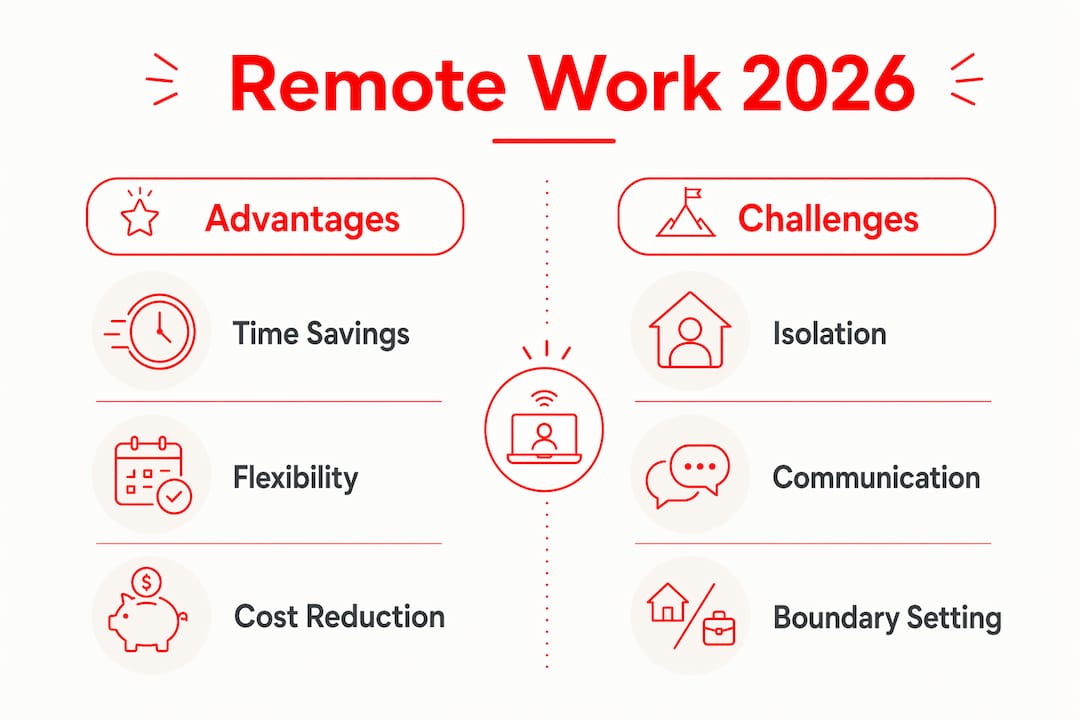
Remote work delivers real, measurable benefits for both workers and employers. It also introduces friction that office environments naturally resolve. Understanding both sides helps you decide whether the arrangement fits your situation.
The advantages worth knowing
The most immediate benefit is time. Remote employees save an average of 72 minutes every day by eliminating their commute. That is nearly nine full working days reclaimed per year. Workers typically redirect that time toward sleep, exercise, family, or focused work, all of which improve overall well-being.
Employers benefit just as directly. Companies that offer remote options see a 25% lower employee turnover rate compared to office-only workplaces. Lower turnover means lower recruiting and training costs, which adds up quickly for any organization with more than a handful of employees. Remote work also expands talent pools dramatically, letting companies hire the best candidate regardless of geography.
The environmental case for remote work is also compelling. Reducing commuting through distributed work arrangements can cut carbon emissions by 30–38%, with some estimates showing total workforce footprint reductions of up to 58%. That figure reflects fewer cars on the road, less office energy consumption, and reduced demand for commercial real estate.
- Work-life balance: Flexible scheduling lets workers attend school pickups, medical appointments, or personal errands without burning vacation time.
- Autonomy: Remote work gives individuals control over their environment, which research links directly to higher feelings of competence and well-being.
- Cost savings: Workers spend less on commuting, work clothing, and daily lunches.
- Productivity: Many remote workers report fewer interruptions than in open-plan offices, leading to longer stretches of focused work.
The challenges that catch people off guard
Social isolation is the most commonly reported downside of remote work. Without the casual hallway conversations and shared lunches that office life provides, some workers feel disconnected from their colleagues and company culture. This is not a minor inconvenience. Sustained isolation affects motivation, creativity, and mental health over time.
Communication also becomes more deliberate and more demanding. In an office, you can tap a colleague on the shoulder for a quick answer. Remotely, every question requires a message, a call, or an email, which adds friction to fast-moving projects. Teams that do not build strong communication protocols often experience misalignment and duplicated effort.
Boundary setting is the third major challenge. Without clear disconnect rituals, work bleeds into personal time. Workers who respond to messages late at night or on weekends report lower psychological well-being and higher intentions to quit their jobs. The flexibility that makes remote work attractive can become a trap if you never fully switch off.
Pro Tip: Set a hard stop time each day and mark it in your calendar as a recurring “offline” block. Treat it the same way you would treat a client meeting. This single habit protects your deep work capacity and your personal time simultaneously.
How does remote work culture differ, and what makes it successful?
Remote work culture is the set of shared values, communication norms, and behavioral expectations that shape how a distributed team operates. It differs from office culture in one fundamental way: nothing happens by accident. In a physical office, culture forms organically through proximity. Remotely, every element of culture must be built deliberately.
The building blocks of a strong remote culture
- Clear communication protocols. Successful remote teams define which tools handle which types of communication. Urgent issues go to instant messaging. Project updates go to task management software. Strategic discussions happen on video calls. Without these norms, workers waste time deciding how to communicate rather than actually communicating.
- Documented processes. Remote teams rely on written documentation far more than office teams. When institutional knowledge lives in people’s heads rather than shared documents, remote workers hit walls constantly.
- Regular video check-ins. Scheduled one-on-ones and team meetings replace the informal visibility of office life. These calls serve a social function as much as a practical one.
- Remote mentorship programs. Clear mentorship structures are vital for sustaining career growth in distributed teams. Without them, junior employees miss the informal coaching that office proximity naturally provides.
- Psychological safety. Remote workers need to feel comfortable raising problems, asking questions, and admitting mistakes without fear of being overlooked or penalized for not being physically present.
Remote work requires intentional culture-building at every level. The teams that thrive are those where managers treat communication, recognition, and connection as core responsibilities rather than nice-to-haves. Distributed work does not reduce the need for leadership. It raises the bar for it.
Individual suitability also matters. Remote work suits people who are wired for autonomy and who perform best in low-stimulation environments. If you find open offices distracting and prefer to manage your own schedule, remote work likely aligns with your natural working style. If you draw energy from constant social interaction and struggle with self-direction, the arrangement may feel isolating rather than freeing.
Pro Tip: Before committing to a fully remote role, spend two weeks working from home during your current job, even if just for a few hours each day. Pay attention to how you feel by Friday. Your honest reaction tells you more than any personality quiz.
For workers who want a change of scenery without full isolation, local coffee shops and coworking spaces offer a middle ground that combines flexibility with ambient social energy.
What best practices help you thrive when working remotely?
Thriving in a remote arrangement requires more than a laptop and a Wi-Fi connection. The workers who succeed long-term build deliberate systems around their environment, schedule, and social connections.
Setting up your workspace
Your physical environment directly affects your output. A dedicated workspace, even a corner of a room with a proper desk and chair, signals to your brain that work mode is active. Mixing your work and living spaces in the same chair or on the same couch blurs the psychological boundary between rest and productivity. Investing in ergonomic desk options pays off quickly in comfort and focus over a full workday.
Lighting and noise control matter just as much as furniture. Natural light reduces eye strain and supports alertness. Noise-canceling headphones block distractions during focused work and signal to others in your home that you are unavailable. A tidy, purpose-built space is not a luxury. It is a productivity tool.
Building a schedule that protects your time
- Set fixed start and end times. Consistency trains your brain and sets expectations for colleagues and household members alike.
- Block deep work hours. Schedule your most demanding tasks during your peak energy window, whether that is early morning or mid-afternoon.
- Build transition rituals. A short walk, a cup of coffee, or a five-minute review of your task list signals the start of the workday. A similar ritual at the end signals the close.
- Avoid working outside standard hours. Night and weekend remote work correlates with decreased well-being and higher turnover intentions. Protecting your off-hours is not laziness. It is a performance strategy.
Staying connected and mentally healthy
Social connection requires active effort when you work remotely. Schedule virtual coffee chats with colleagues. Join professional communities in your field. If you work from home full-time, plan at least one in-person social activity each week outside of work. Isolation compounds quietly, and the workers who manage it best are those who treat social connection as a non-negotiable part of their week.
Mental health deserves the same attention. Remote work gives you more control over your environment, but it also removes the natural structure that office life provides. Exercise, regular meals, and time outdoors all support the cognitive function and emotional stability that remote work demands. For deeper guidance on productivity when working remotely, practical frameworks make a measurable difference.
Pro Tip: Use a physical notebook to write your three most important tasks each morning before opening your laptop. This analog habit anchors your focus before digital notifications pull your attention in every direction.
Remote workers who choose their arrangement voluntarily, rather than being mandated into it, report higher job satisfaction and stronger feelings of autonomy. If you have the option to negotiate your arrangement rather than accept a blanket policy, advocate for the terms that genuinely fit your life.
For workers who want to push their remote productivity further, structured approaches to time management and task batching consistently outperform reactive, inbox-driven workdays.
Key Takeaways
Remote work succeeds when individuals build deliberate systems around their environment, schedule, and social connections rather than relying on the structure that office life provides automatically.
| Point | Details |
|---|---|
| Remote work definition | A professional arrangement where job duties are performed outside a traditional office, enabled by digital tools. |
| Rapid adoption | US remote workdays grew from 5% pre-2020 to 28% by 2024, making distributed work a permanent workforce feature. |
| Top personal benefit | Workers save an average of 72 minutes daily by eliminating commuting, improving work-life balance significantly. |
| Key employer advantage | Companies offering remote options see 25% lower employee turnover, reducing recruiting and training costs. |
| Success factor | Voluntary choice, clear boundaries, and intentional culture-building determine whether remote work improves or harms well-being. |
Our team’s perspective on remote work in 2026
Our team at Lizard’s Lunch has watched the remote work conversation evolve from a pandemic-era emergency measure into a genuine lifestyle choice, and the shift has been fascinating. The data tells one story. The lived experience tells another, richer one.
The number that stays with us is the caregiving statistic. When research shows that balancing family responsibilities outranks productivity and comfort as the top reason people value remote work, it reframes the entire debate. Remote work is not primarily about wearing sweatpants or skipping a commute. For a huge portion of the workforce, it is about being present for the people who need them most. That is a deeply human motivation, and it deserves more weight in how employers design their policies.
We also think the boundary problem is underestimated. The workers who struggle most with remote work are not the ones who lack discipline. They are the ones who never built a clear line between work and personal time because no one told them they needed to. The office used to draw that line automatically. Remotely, you draw it yourself, and that requires intention.
The workers who thrive are those who treat remote work as a craft. They design their environment, protect their schedule, and invest in their social connections with the same care they bring to their actual job. That mindset shift, from passive recipient of flexibility to active architect of your workday, makes all the difference.
— Our team at Lizard’s Lunch
Your home setup matters more than you think
A productive remote work life starts with the right physical environment. If your home workspace feels cramped, uncomfortable, or uninspiring, your output will reflect it. The good news is that targeted home improvements can transform an ordinary room into a space where you genuinely want to spend your workday. From better lighting and soundproofing to dedicated office nooks, the upgrades that support remote work also add lasting value to your home. Our team at Lizard’s Lunch has put together home renovation ideas that bring both character and function to your space. You can also explore home workspace optimization tips that turn any corner of your home into a focused, comfortable place to do your best work.
FAQ
What is the remote work definition in simple terms?
Remote work is a professional arrangement where employees complete their job duties from a location outside a traditional office, typically using internet-connected devices and digital communication tools.
Why do people choose remote work over office work?
The top reasons include saving commute time, balancing caregiving responsibilities, and gaining more control over their daily schedule. Research identifies caregiving as the single leading motivating factor.
Is remote work effective for productivity?
Remote work improves productivity for individuals who prefer low-stimulation environments and self-directed schedules. Workers who choose the arrangement voluntarily report higher job satisfaction and autonomy than those assigned to it by policy.
What are the biggest challenges of remote work?
Social isolation, blurred work-life boundaries, and weaker informal communication are the most common challenges. Working outside standard hours is directly linked to lower well-being and higher intentions to leave a job.
How do you start remote work if you have never done it before?
Begin by setting up a dedicated workspace, establishing fixed work hours, and identifying the digital tools your role requires. Testing the arrangement part-time before committing fully gives you an honest read on whether it suits your working style.


















Leave a Comment
Your email address will not be published. Required fields are marked with *