
Unlock your strength potential with our simple beginner’s guide. Learn effective full-body workouts, form tips, and essentials for quick gains.
Start with full-body strength training several times a week, including multiple exercises per session, with a few sets of repetitions each. Pick a weight you can lift for the full rep range with clean form, per MS Canada’s guidelines, warm up for five to ten minutes first, and stop each set a couple of reps before your form breaks down. That’s the entire starting formula. Everything else in this guide just fills in the details.
TL;DR:
- Beginners can experience rapid neural strength gains within the first four to six weeks, primarily from improved muscle fiber recruitment rather than muscle growth.
- Proper warm-up, including dynamic movement for five to ten minutes and bodyweight checks, significantly reduces injury risk before lifting externally loaded weights.
- Mastering five core movement patterns—squat, hinge, push, pull, and core— ensures a solid foundation for developing nearly any strength training routine.
- Using small, consistent weight increases and tracking progress in a log optimizes gains and prevents early plateaus in beginner programs.
- A minimal equipment setup, like resistance bands and dumbbells, suffices for initial months, and emphasizing technique over load reduces injury and supports steady improvement.
Table of Contents
- Why strength training matters for beginners
- What warm-up and safety steps come before you lift?
- What are the core movement patterns you need to learn first?
- Beginner workout templates you can start this week
- How do you progress and track results without stalling out?
- What equipment do you actually need to get started?
- Nutrition, sleep, and recovery basics that support your progress
- Common beginner mistakes and quick fixes
- How our team at Lizard’s Lunch recommends using these plans
- How do you stay motivated through the first few months?
- What injuries are most common for beginners, and how do you prevent them?
- Our editorial take on getting started the right way
- Sources
Why strength training matters for beginners
The payoff from strength training shows up faster than most beginners expect, and it shows up in ways that have nothing to do with how you look in a mirror. Within the first four to six weeks, most of your strength gains come from your nervous system learning to recruit muscle fibers more efficiently, not from the muscle itself growing. That’s why a total beginner can go from struggling with a bodyweight squat to loading a bar in a matter of weeks. Harvard Health’s guide to starting a strength training program points to this early neural adaptation as the reason logging your workouts matters so much at the start. The visible changes lag behind the internal ones.
The broader case for lifting weights builds from there:
- Stronger bones. Resistance training places mechanical stress on bone tissue, which is one of the few proven stimulants for maintaining bone density as you age.
- Better joint stability and mobility. Strength through a full range of motion protects your knees, hips, and shoulders during everyday movements like carrying groceries or climbing stairs.
- Improved metabolic health. Muscle tissue is metabolically active even at rest, which helps with blood sugar regulation and long-term weight management.
- Functional independence. Grip strength and lower-body power are two of the strongest predictors of staying mobile and self-sufficient later in life.
- Mental payoff. Consistent training sessions build a sense of competence that carries into other parts of your week.
None of this requires elite genetics or hours in a gym. It requires showing up, following a sensible plan, and giving your body time to adapt.
What warm-up and safety steps come before you lift?
Skipping the warm-up is the single fastest way to turn a good session into a bad one. Give yourself five to ten minutes of dynamic movement before you touch a weight: a brisk walk or light jog, leg swings, walking lunges, arm circles, and a few bodyweight squats to raise your core temperature and wake up the joints you’re about to load. Mayo Clinic’s strength training guidance backs this five-to-ten-minute window as sufficient preparation before working sets. If you want more structured warm-up ideas, dynamic movement sequences borrowed from Latin dance warm-up routines translate surprisingly well into a pre-lifting flow, since they emphasize controlled hip and shoulder rotation.
Before adding any external load, walk through this quick checklist:
- Can you squat to a comfortable depth with your knees tracking over your toes, not caving inward?
- Can you hold a plank for 20 to 30 seconds without your lower back sagging?
- Can you hinge at the hips (think bending to pick something off the floor) while keeping your spine neutral rather than rounding?
- Does your shoulder move through a full overhead range without pinching or pain?
If any of those feel unstable or painful, spend a session or two drilling the bodyweight version before loading it, a practice the Government of Canada’s physical activity guidance also recommends for reducing early injury risk.
Sharp, localized pain during a movement is different from the dull, generalized soreness you’ll feel a day later. Soreness is normal. Sharp pain, joint clicking with discomfort, or numbness down a limb are signals to stop and, if they persist, see a physical therapist or physician.
Pro Tip: Do your warm-up sets with an empty barbell or the lightest dumbbell you own before jumping to your working weight. Two or three “practice” sets at near-zero load groove the movement pattern and cost you almost nothing.
What are the core movement patterns you need to learn first?
Every effective beginner program is built on five movement patterns, and learning them well matters more than memorizing a long list of exercises. Master these five and you can build almost any workout around them.
- Squat trains the quads, glutes, and core, and mirrors sitting down and standing up. Regressions: bodyweight squat, box squat to a chair. Progressions: goblet squat with a dumbbell, barbell back squat.
- Hinge trains the hamstrings, glutes, and lower back, and mirrors bending to lift something off the ground. Regressions: hip hinge with a dowel against your back, glute bridge. Progressions: dumbbell Romanian deadlift, barbell deadlift.
- Push trains the chest, shoulders, and triceps, and mirrors pushing a door or a shopping cart. Regressions: wall push-up, incline push-up on a bench. Progressions: standard push-up, dumbbell bench press.
- Pull trains the back and biceps, and mirrors pulling a suitcase off a shelf. Regressions: resistance band row, assisted pull-up machine. Progressions: dumbbell row, lat pulldown.
- Core trains the muscles that stabilize your spine during every other lift. Regressions: dead bug, bird dog. Progressions: plank variations, weighted carries.
The most common fault across all five patterns is the same: rushing the range of motion instead of controlling it. A squat that bounces at the bottom or a row that swings the weight up with momentum teaches your body the wrong pattern, even if it moves the weight. Slow down, especially on the way down or back, and the pattern locks in faster.
Mayo Clinic notes that even a single well-executed set of 12 to 15 reps taken close to fatigue can build real strength for a true beginner, which underscores how much technique outweighs volume in these early weeks.
Beginner workout templates you can start this week
You don’t need a complicated split to make progress in your first months. A full-body approach, hit two or three times a week, beats any split routine for beginners because it lets you practice each movement pattern more often, which is exactly what a nervous system still learning these patterns needs.
Two-day full-body plan (30 to 40 minutes per session)
- Goblet squat: 3 sets of 10 reps
- Dumbbell Romanian deadlift: 3 sets of 10 reps
- Incline push-up or dumbbell bench press: 3 sets of 10 reps
- Resistance band row or dumbbell row: 3 sets of 10 reps
- Plank: 3 sets, hold 20 to 30 seconds
Rest 60 to 90 seconds between sets, per the loading guidance in MS Canada’s beginner recommendations. Train on non-consecutive days, such as Monday and Thursday, so each muscle group gets at least 48 hours to recover.
Three-day full-body plan (45 to 60 minutes per session)
- Barbell back squat or goblet squat: 3 sets of 8 to 10 reps
- Barbell deadlift or dumbbell Romanian deadlift: 3 sets of 8 to 10 reps
- Dumbbell bench press: 3 sets of 8 to 10 reps
- Lat pulldown or dumbbell row: 3 sets of 8 to 10 reps
- Walking lunge: 2 sets of 10 reps per leg
- Dead bug or bird dog: 2 sets of 10 reps per side
Rest 90 to 120 seconds between the bigger lifts (squat, deadlift, bench) and 60 to 90 seconds on the smaller accessory work. Schedule sessions on Monday, Wednesday, and Friday.
Four-week sample progression
- Week 1: Learn the movements. Use lighter loads and focus entirely on form. If a set of 12 feels too easy, add a small amount of weight next session rather than mid-set.
- Week 2: Add weight to any lift where you hit the top of your rep range (12 reps) with room to spare, following the small session-to-session increments a phased 12-week beginner program recommends for this early stage.
- Week 3: Continue adding small increments where you’re still progressing. If a lift stalls at the same weight for two sessions in a row, hold there one more week instead of pushing through.
- Week 4: Take a lighter “deload” week, dropping your working weights by roughly 10 to 20% or trimming a set off each exercise, to let your joints and connective tissue catch up before the next block.
If you’re training at home without a full rack, swap barbell moves for their dumbbell or resistance band equivalents listed under each pattern above. A resistance band row and a dumbbell row train the same muscles through nearly the same range of motion, so the substitution costs you very little.
How do you progress and track results without stalling out?
True beginners get a grace period that more experienced lifters don’t: the ability to add a small amount of weight almost every single session for several weeks in a row. Exercise scientists call this the novice effect, and it’s why your first month of strength training for beginners often produces faster numbers on the bar than any other phase of your lifting life.
Finding your starting weight doesn’t need guesswork. Use this three-step method:
- Start empty or light. Use just the bar, a light dumbbell, or a resistance band with minimal tension for your first working sets.
- Add small increments. Add 2.5 to 5 pounds (or move up one band level) each set until the reps get genuinely challenging.
- Stop at the right signal. Stop adding weight once your bar speed slows noticeably or you sense you have only about three reps left before failure, a method Barbell Medicine’s beginner prescription uses to land beginners on a safe, appropriate starting load.
That “three reps in reserve” feeling matters beyond just picking a weight. Research on training effort from Florida Atlantic University found that stopping short of full failure, roughly a 6 to 8 out of 10 effort, preserves technique and lowers injury risk while still building strength effectively.
When session-to-session progress stalls, which usually happens somewhere in weeks four to eight, switch to adding weight weekly instead of every workout, or borrow the structure from a phased program that shifts focus every few weeks. A stall for two sessions running is your cue to hold the weight steady rather than force it. Log every session, even briefly. Weight, sets, and reps in a notes app is enough. Reviewing that log is often the only way to see the progress that isn’t yet visible in the mirror.
What equipment do you actually need to get started?
You don’t need a home gym or a $150-a-month membership to start strength training for beginners. A minimal setup handles the first several months just fine:
- A set of resistance bands (light, medium, heavy)
- One adjustable dumbbell pair, or a couple of fixed-weight pairs spanning a light and moderate load
- A yoga mat for floor work and core exercises
- Comfortable shoes with a flat, stable sole
If you’d rather train at a commercial gym, machines are genuinely useful for a beginner, not a shortcut for people who can’t “really” lift. A trainer tip from Nike’s guide to starting weightlifting points out that machines reduce the stability demands of free weights, which lets a new lifter focus purely on the movement pattern and gradually increasing load without also having to manage balance. Leg press, chest press, and seated row machines are reasonable entry points before you move to their free-weight equivalents.
Adapting exercises for limited equipment is mostly a matter of substitution: a heavy backpack replaces a dumbbell, a sturdy chair replaces a bench for step-ups, and a doorframe with a towel can approximate a row. The pattern matters more than the tool.

Nutrition, sleep, and recovery basics that support your progress
Strength training for beginners works best when the other 23 hours of your day support it. Aim for roughly 0.7 to 1 gram of protein per pound of body weight daily, spread across meals, to give your muscles the raw material to adapt. You don’t need protein powder to hit that number. Chicken, eggs, Greek yogurt, beans, and fish all count.
Sleep matters just as much as the workout itself. Aim for seven to nine hours a night, since most of the tissue repair and hormonal recovery from a training session happens while you’re asleep, not while you’re lifting.
If you also do cardio, schedule it on separate days from your strength sessions where possible, or do it after lifting rather than before, so fatigue from cardio doesn’t compromise your squat or deadlift form.
Watch for these recovery signals:
- Needs more recovery: persistent soreness lasting more than 72 hours, declining performance on lifts you’d normally handle easily, poor sleep, or irritability.
- Ready to progress: you complete all reps with a couple left in reserve, recover fully between sessions, and feel eager rather than dreading the next workout.
Common beginner mistakes and quick fixes
Most early setbacks in strength training for beginners trace back to a short list of repeatable errors.
- Loading up too fast. Fix: follow the three-step starting-weight method and resist the urge to match what someone else in the gym is lifting.
- Skipping the warm-up. Fix: block out five to ten minutes before every session, no exceptions, even when you’re short on time.
- Letting form slip to move more weight. Fix: film a set on your phone occasionally and compare it to a clean rep from earlier in the program.
- Training too often without rest. Fix: give the same muscle groups at least 48 hours between sessions, as Mayo Clinic’s strength training tips recommend.
After each session, run a quick self-audit: did your form hold up through the last rep of every set, did you leave a couple of reps in reserve, and are you recovered enough to hit the next scheduled session? If the answer to any of those is no, adjust before your next workout rather than after three more.
How our team at Lizard’s Lunch recommends using these plans
Our team at Lizard’s Lunch built these templates to work without a coach standing over your shoulder, but that doesn’t mean expert guidance is optional if you want it. If you’re supplementing this plan with online coaching or video instruction, check for certifications from NASM, ACSM, or the NPTA’s list of recognized Canadian fitness certifications before trusting a program. When our team reviewed sample versions of these session structures, the clearest pattern was that beginners who logged their sets stuck with the plan longer than those who didn’t, and that digital tools like progressive overload tracking apps made that logging nearly automatic. One editorial caveat worth repeating: if you manage a heart condition, joint replacement, or any chronic condition, loop in a physician or physical therapist before starting.
How do you stay motivated through the first few months?
The gap between starting strength training and sticking with it for six months rarely comes down to willpower. It comes down to how the habit is structured. Beginners who tie training to a fixed slot on the calendar, Monday and Thursday at 6 p.m., say, rather than “whenever I feel like it,” show up more reliably than those relying on daily motivation to decide.
Small, visible wins matter more than they seem to. Logging your sets, even in a plain notes app, gives you concrete proof of progress during the weeks when strength gains are neurological and invisible in the mirror. Watching your squat weight tick upward week over week, even by five pounds, does more for consistency than any amount of pep talk.
Give yourself permission to have an off session. Missing one workout because of a bad night’s sleep or a packed schedule isn’t a failed program, it’s a data point. The lifters who last are the ones who treat a missed session as a blip and show up for the next one, not the ones chasing a perfect streak.
Finally, connect the habit to something bigger than the workout itself, whether that’s carrying groceries without strain, keeping up with your kids, or just feeling steadier on your feet. Strength training for beginners sticks best when the gym session is in service of a life outside it, not a goal that exists in isolation.
What injuries are most common for beginners, and how do you prevent them?
The injuries that sideline new lifters are almost always preventable, and they follow a predictable pattern. Lower back strain from rounding the spine during a hinge or squat is probably the most common, usually caused by lifting too much weight before the movement pattern is grooved. Fix it by mastering the bodyweight hinge and keeping a neutral spine before adding load.
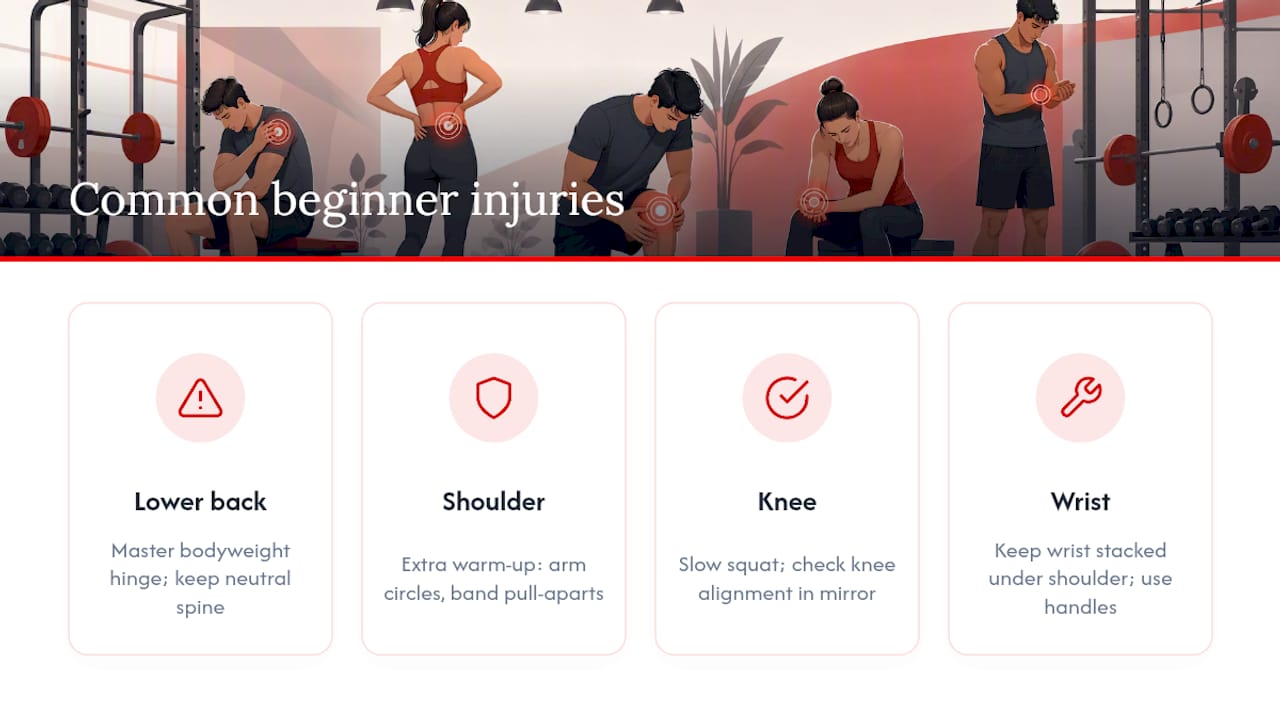
Shoulder impingement shows up frequently in beginners who jump straight into overhead pressing or bench pressing without building shoulder mobility first. Spend extra warm-up time on arm circles and band pull-aparts before pressing movements.
Knee discomfort, often from a squat where the knees cave inward or track too far past the toes without control, is another frequent complaint. Slowing the squat down and checking knee alignment in a mirror or on video fixes most cases before they become painful.
Wrist strain during push-ups or presses usually traces back to a bent wrist under load. Keep the wrist stacked directly under the shoulder, or use push-up handles if flexibility is limiting.
The through-line across all four: control the movement, respect the 48-hour recovery window between sessions on the same muscle group, and treat sharp or localized pain as a stop signal rather than something to push through.
Our editorial take on getting started the right way
Most beginner advice overcomplicates the first month. Complex periodization schemes, exercise-selection debates, and conflicting rep-range philosophies dominate fitness content, but almost none of it matters for someone doing their first squat this week. What matters is showing up two or three times, hitting the same handful of movement patterns, and writing down what happened.
The conventional advice that frustrates us most is the instinct to hand beginners a program built for intermediate lifters, heavy on variety and light on repetition of the basics. Beginners don’t need variety. They need reps on the same five patterns until those patterns feel automatic, because that repetition is exactly what drives the neural adaptations responsible for early strength gains.
If we had to prioritize one thing above all else, it wouldn’t be the program at all. It would be the log. A beginner with a mediocre program who tracks every session will outperform one with a perfect program who doesn’t, because progress you can’t see is progress you’ll eventually abandon. Pick a plan from this guide, write down your numbers, and let the small session-to-session gains do the convincing your motivation can’t.
Strength training pairs naturally with the rest of your daily habits, and if you’re looking to build out sleep, nutrition, and stress management alongside your new lifting routine, our complete guide to a healthy lifestyle walks through how those pieces fit together.
— Alexander


















Leave a Comment
Your email address will not be published. Required fields are marked with *