

Practical FHSA explainer for Canadians: CRA rules, $8,000 annual/$40,000 lifetime limits, the 15 year window, and when to use FHSA vs TFSA.
The First Home Savings Account gives eligible Canadians a tax deduction on contributions and a completely tax-free withdrawal for a qualifying first home, up to $8,000 a year and $40,000 over a lifetime. It works best for buyers who are reasonably confident they’ll purchase within about 15 years and who want a deduction now rather than later. The Canada Revenue Agency sets and enforces every rule governing the account.
TL;DR:
- The FHSA allows a maximum of $8,000 in contributions annually, with unused room carrying over only up to $8,000 from previous years.
- To qualify for a tax-free withdrawal, buyers must sign a purchase agreement, intend to occupy the home within one year, and meet the first-time buyer criteria.
- Over-contributing beyond the $8,000 annual limit triggers a 1% monthly penalty, emphasizing the importance of careful contribution planning.
- If the purchase falls through or the buyer delays, funds can be transferred to an RRSP tax-deferred, avoiding penalties and preserving retirement savings.
- Using both partners’ FHSAs can double household contribution capacity, while supplementing with a TFSA or RRSP depends on the buyer’s confidence and timeline.
Table of Contents
- How the First Home Savings Account Canada Program Actually Works
- Who Qualifies as a First-Time Buyer, and What the Paperwork Looks Like
- Contribution Limits, Carryforward, and What the Deduction Is Worth
- FHSA vs TFSA vs RRSP: Where Should Your Money Actually Go?
- What Happens if You Never Buy a Home
- Choosing a Provider and What to Hold Inside the Account
- A Practical Plan for Stacking Your FHSA and TFSA
- Stacking the FHSA With Other First-Time Buyer Programs
- Mistakes That Cost FHSA Holders Real Money
- Real Scenarios: How the FHSA Plays Out in Practice
- Our Take on Whether the FHSA Is Worth Opening
- Sources
- FAQ
How the First Home Savings Account Canada Program Actually Works
The FHSA borrows its best features from each of Canada’s two most popular savings vehicles. Contributions reduce your taxable income the same way an RRSP contribution does, and when you eventually withdraw the money for a qualifying home purchase, you pay zero tax on it, just like a TFSA withdrawal. That combination doesn’t exist anywhere else in the Canadian tax system.
The account has a defined lifespan. It can stay open for a maximum of 15 years from the date you first open it, and it closes automatically at the end of the year you turn 71. If you make a qualifying withdrawal before either deadline, the CRA requires you to close the account by December 31 of the following year, according to guidance from RBC.
A qualifying withdrawal isn’t automatic just because you buy any property. You need:
- A written agreement to buy or build a qualifying home located in Canada
- Genuine intent to occupy that home as your principal residence within one year of purchase
- Confirmation that you meet the first-time buyer test at the time of withdrawal
Miss any one of those conditions and the withdrawal gets taxed as ordinary income instead of flowing out tax-free. That’s the trade-off for the deduction you claimed going in.
Who Qualifies as a First-Time Buyer, and What the Paperwork Looks Like
The CRA’s definition is stricter than most people assume. To qualify, you (and your spouse or common-law partner) must not have lived in a home either of you owned at any point during the current calendar year or the four preceding calendar years, a window several banks, including Scotiabank, summarize the same way. That means someone who sold a home in 2020 and has been renting since could still qualify to open an FHSA and make a withdrawal in 2026.
When it’s time to actually withdraw the funds, here’s the process:
- Sign a written agreement to purchase or build the qualifying home before you submit your withdrawal request.
- Complete the FHSA withdrawal form your financial institution provides, confirming intent to occupy the property within one year.
- Submit the request to your provider, who reports the withdrawal to the CRA as tax-free.
- Close the account by December 31 of the year following the qualifying withdrawal, or transfer any remaining balance first.
The most common timing confusion involves closing dates rather than a 30-day rule. There’s no rule forcing you to withdraw funds exactly 30 days before closing. The real constraint is the one-year occupancy intent and the account closure deadline after your first qualifying withdrawal.
Contribution Limits, Carryforward, and What the Deduction Is Worth
Every FHSA holder gets an $8,000 annual contribution limit and a $40,000 lifetime cap, figures confirmed on BMO’s FHSA page. Unused room carries forward, but only up to $8,000 from the prior year, so you can’t stockpile a decade of unused space the way you can with a TFSA.
By the Numbers: Contribute the full annual limit in a year you earn a significant income and sit in a moderate tax bracket, and you would see a meaningful tax deduction back at tax time, on top of the fact that withdrawal is entirely tax-free later.
A few mechanics worth knowing:
- Contribution room only starts accumulating once the account is actually open, so opening one early, even with a small first deposit, locks in room you’d otherwise lose, a point BMO flags directly.
- Contributions made in the first 60 days of a calendar year do not count toward the prior tax year’s return, unlike RRSP contributions.
- Over-contributing beyond your limit triggers a 1% monthly penalty tax on the excess amount.
Two people buying together can each open their own FHSA, effectively doubling the household’s annual and lifetime room.
FHSA vs TFSA vs RRSP: Where Should Your Money Actually Go?
Each account solves a different problem, and the FHSA isn’t automatically the right first stop for every saver. The FHSA gives you a deduction plus a tax-free withdrawal but only for a qualifying home purchase within the account’s lifespan. The TFSA offers total flexibility with no deduction, and money can come out anytime for any reason with zero tax hit. The RRSP’s Home Buyers’ Plan lets you borrow up to $60,000 from retirement savings tax-free, but you have to repay it over 15 years or face it added back as taxable income.
Financial advisors quoted by Fidelity Canada generally recommend funding the FHSA first if you’re fairly confident you’ll buy within its 15-year window, then routing any leftover savings capacity into a TFSA for flexibility. Here’s how that plays out by situation:
- Committed buyers with a 3 to 7 year timeline: Max the FHSA first. The deduction and eventual tax-free withdrawal both work in your favor with little downside risk.
- Uncertain timelines or possible moves abroad: Lean TFSA. You keep access to your money without worrying about qualifying-withdrawal conditions.
- Couples with high combined income: Both partners open FHSAs, doubling contribution room, while surplus cash flows into TFSAs.
- Buyers also saving for retirement: Consider the RRSP Home Buyers’ Plan alongside the FHSA rather than instead of it. They aren’t mutually exclusive.
What Happens if You Never Buy a Home
Plans change, and the FHSA was built with that in mind. A non-qualifying withdrawal (pulling money out without a qualifying home purchase) gets added to your taxable income for that year, which erases much of the benefit you claimed at contribution time.
The better fallback: transfer the balance to an RRSP or RRIF. That transfer happens tax-deferred, and critically, it does not use up any of your existing RRSP contribution room, a detail confirmed by LifeMoney’s comparison of TFSA and FHSA strategies. Your money effectively becomes retirement savings instead of home savings, with no tax penalty for the change of plans.
Before the 15-year or age-71 deadline hits:
- Confirm whether a purchase is realistically still on the table
- Initiate an RRSP/RRIF transfer well before the account’s forced closure date
- Talk to your provider about processing timelines, since transfers can take several business days
Pro Tip: Don’t wait until the final year to decide. Start the RRSP transfer conversation at least a few months before any deadline so paperwork delays don’t force a taxable non-qualifying withdrawal by default.
Choosing a Provider and What to Hold Inside the Account
Every major Canadian bank and most online brokerages now offer FHSAs, and the differences between them matter more than the marketing suggests. Here’s what to check before opening one:
- Investment selection. A basic savings-style FHSA at a branch might only offer a GIC or high-interest cash option, while a self-directed brokerage account (through providers like RBC, CIBC, or a discount trading platform) lets you hold ETFs, mutual funds, or individual stocks.
- Fees and minimums. Some providers waive account fees entirely; others charge annual administration costs on smaller balances.
- Transfer and withdrawal support. Ask specifically how the institution handles qualifying withdrawal paperwork and RRSP transfers, since processing speed varies widely between banks.
- Promotional rates. A limited-time bonus rate on a savings FHSA looks appealing, but compare it against long-term expected returns from an invested portfolio if your timeline runs five years or longer.
If you’re buying in under three years, capital preservation through a GIC or high-interest account usually makes more sense than market exposure.
A Practical Plan for Stacking Your FHSA and TFSA
Many personal finance experts have watched enough shifts play out to know that most successful savers don’t overthink the split. If you’re committed to buying, put your first $8,000 of annual savings capacity into the FHSA to capture the deduction, then route any additional savings into a TFSA.
A simple allocation example: a saver earning $70,000 who can put away $10,000 a year would send $8,000 into the FHSA and the remaining $2,000 into a TFSA. Couples can mirror this by each opening an FHSA, doubling total room to $16,000 annually between them.
- Revisit your allocation every year contribution limits reset or your income changes brackets
- Rebalance investments inside the FHSA as your purchase timeline shortens, shifting from growth assets toward cash or GICs
- Consider transferring to an RRSP only once a purchase genuinely looks unlikely, not as a knee-jerk reaction to a slow year
Pro Tip: If your income fluctuates, claim the FHSA deduction in whichever tax year you’re in the highest bracket. You can contribute one year and defer claiming the deduction to a later return, similar to how RRSP deductions work.
Broader saving habits matter here too. Our personal finance trends coverage looks at how Canadian households are adjusting monthly budgets to prioritize these kinds of long-horizon savings goals.
Stacking the FHSA With Other First-Time Buyer Programs
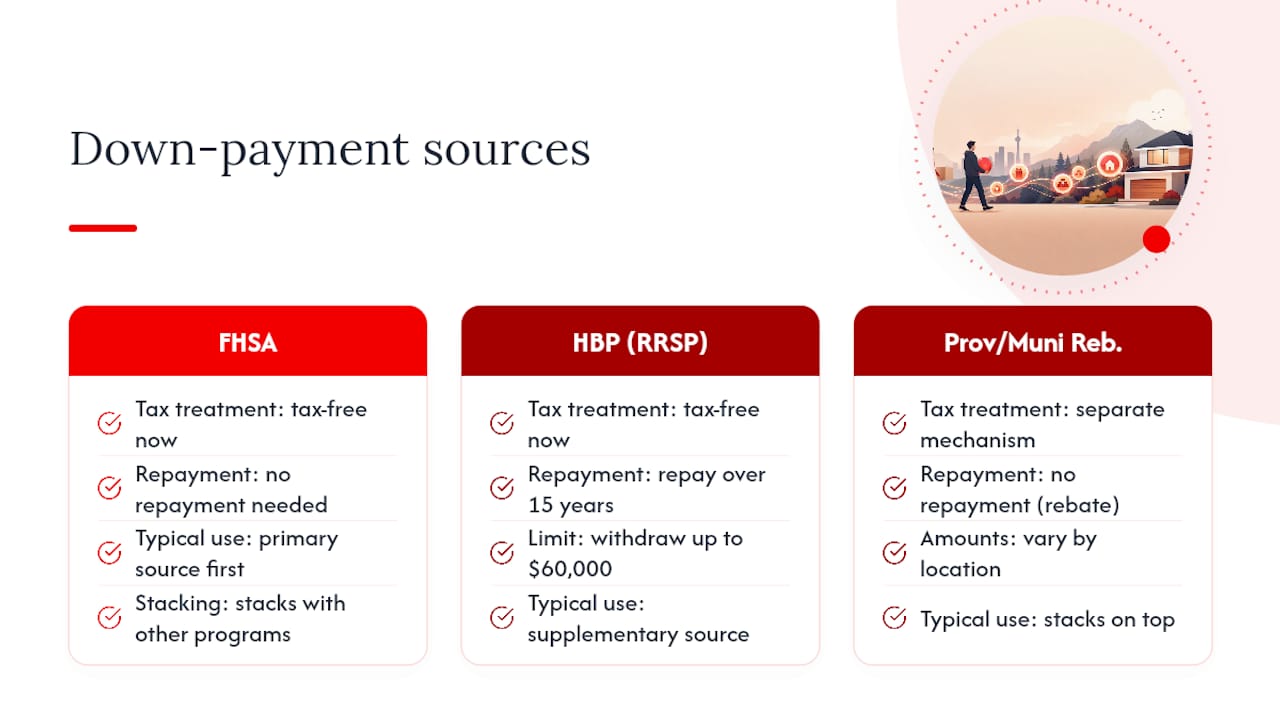
The FHSA doesn’t have to work alone. The RRSP’s Home Buyers’ Plan lets a first-time buyer withdraw up to $60,000 from an RRSP without immediate tax, provided it’s repaid over 15 years. Used together, a couple could theoretically pull from an FHSA (tax-free, no repayment needed) and an HBP withdrawal from their RRSPs (tax-free now, repayment required later) for a much larger combined down payment.
Provincial and municipal land transfer tax rebates for first-time buyers exist in several provinces and stack on top of federal programs because they operate through a completely separate mechanism. Some municipalities also run their own first-time buyer incentive or rebate programs, though eligibility and amounts vary by location, so check your specific city or province’s housing authority for current details.
The key sequencing question is which pool of money to draw from first. Because FHSA withdrawals never require repayment while HBP withdrawals do, many buyers use the FHSA to cover as much of the down payment as possible and treat the RRSP’s Home Buyers’ Plan as a supplementary source only if the FHSA balance falls short. If you’re also planning a mortgage renewal down the line, understanding your full repayment picture matters. Our mortgage renewal action plan walks through the kind of timeline planning that pairs well with FHSA and HBP withdrawal decisions made years earlier.
Mistakes That Cost FHSA Holders Real Money
The most expensive mistake is withdrawing funds without a signed agreement in place first. Without that documentation, the CRA treats the withdrawal as non-qualifying, and it gets taxed as regular income, wiping out the benefit you worked to build.
Opening the account too late is a quieter but equally costly error. Contribution room doesn’t exist before the account is open, so someone who waits five years to open an FHSA has permanently lost access to that room, unlike an RRSP where room accumulates automatically based on earned income.
Over-contributing is another common trap, particularly among couples who don’t coordinate their combined contributions across two accounts.
Some buyers also assume the FHSA works like a TFSA for flexibility, forgetting that a withdrawal without a qualifying purchase in place triggers immediate tax consequences. And a surprising number of account holders let the 15-year or age-71 closure deadline sneak up without initiating an RRSP transfer, forcing a rushed decision under time pressure.
Finally, treating the FHSA purely as a high-interest savings account when your timeline is actually seven or more years out means leaving growth on the table that a modest ETF allocation could have captured.
Real Scenarios: How the FHSA Plays Out in Practice
By year four, she has $32,000 in contributions plus growth, signs a purchase agreement on a condo, and withdraws the full balance tax-free to cover her down payment. Total tax saved across four years: over $7,000, on top of investment growth that was never taxed.
A couple in their early thirties, each earning a moderate income, both open FHSAs the same year. Each contributes up to their annual limit, effectively doubling the household’s contribution room. After several years, they have accumulated significant funds plus growth, which they use entirely toward their first home. Because both accounts existed independently, they doubled their tax-sheltered saving capacity compared to a single-income household.
A different case: a 35-year-old opens an FHSA, contributes for several years, then accepts a job overseas and abandons plans to buy in Canada. Rather than withdrawing the balance and paying tax on it as income, the saver transfers the entire amount to an RRSP. No tax is triggered, and none of the existing RRSP room gets consumed, preserving the deduction already claimed while converting the purpose of the savings entirely.
Our Take on Whether the FHSA Is Worth Opening
The FHSA earns its place for anyone who can realistically see themselves buying within 15 years, and the deduction alone often justifies opening one even with modest early contributions. Confirm your eligibility against the CRA’s first-time buyer test, pick a provider that matches your investment timeline, and consider topping up a TFSA once your FHSA room is used. For edge cases, like blended household incomes or an uncertain move abroad, a conversation with a financial advisor beats guesswork. This guide is built around official CRA rules and the FAQ pages published directly by Canada’s major banks.
— Alexander
This article is general information, not a substitute for advice from a qualified financial advisor. Consult a qualified financial professional about your own circumstances before acting on anything here.
Sources
- First Home Savings Account (FHSA)
- FHSA: First Home Savings Account – BMO Canada
- When to use an FHSA, TFSA or both
FAQ
Is It Worth Putting Money Into an FHSA?
Yes, for most people planning to buy their first home within roughly 15 years, since the FHSA delivers both a tax deduction now and a completely tax-free withdrawal later. The main exception is buyers with a highly uncertain timeline, where a TFSA’s flexibility might matter more.
What Is the Best Type of First Home Savings Account in Canada?
There’s only one FHSA structure defined by the CRA, but the best provider depends on your timeline. A savings or GIC-based FHSA suits buyers purchasing within a few years, while a self-directed brokerage FHSA holding ETFs fits longer horizons where growth matters more than capital preservation.
What Is the Difference Between a TFSA and a First Home Savings Account?
A TFSA offers no deduction on contributions but lets you withdraw funds anytime, tax-free, for any purpose. An FHSA gives you a deduction on contributions, but tax-free withdrawals are limited to a qualifying first-home purchase, with other withdrawals taxed as income.
What Is the 30-Day Rule for FHSA?
There isn’t an official CRA rule requiring withdrawals exactly 30 days before closing. The real requirements are a signed purchase agreement before withdrawal and genuine intent to occupy the home within one year, according to official CRA guidance.

















Leave a Comment
Your email address will not be published. Required fields are marked with *