

Memory foam, inflatable, wrap or microbead? Compare the main travel pillow types, see who each suits, and learn how to wear one for real neck support.
The best travel pillow is the one that keeps your neck in a neutral position in the seat you will actually sit in. Each type does that in a different way. Memory foam U-shapes cushion the neck, inflatables pack down small, filled pillows squash into a bag, and wraps and chin-support designs stop your head from dropping forward. Below, we walk through each type, who it suits, and how to test one before a long haul.
Picture the red-eye from Vancouver to Toronto, or the overnight leg to Europe. You have dimmed the window shade, settled your blanket, and then your head slumps forward and jolts you awake. A well-matched pillow is the difference between that cycle and a few real hours of rest. Let’s find yours.
TL;DR
- There are five main types: memory foam U-shaped, inflatable, compressible filled (microbead or fibre), wrap or brace style, and chin-support or loop designs.
- Your sleeping habit decides the winner. Head dropping forward calls for front support. Leaning sideways calls for a firm side wall or a wrap.
- Try wearing the pillow in the front like a scarf before you give up on it. The position matters as much as the design.
- A pillow cannot fix a bad seat. Pair it with good posture, a sensible carry-on plan and a quick test at home.
- Don’t pack your bed pillow from home. Health Canada advises against it because of bedbugs.
Table of Contents
- What a travel pillow actually has to do
- The main travel pillow types
- Travel pillow types at a glance
- Which type fits your sleeping style?
- How to wear a travel pillow (it is not always behind your neck)
- Test before you fly
- If you have neck pain
- Hygiene and bedbugs: pillows on the road
- Packing a travel pillow without wasting space
- What to use if you do not have a travel pillow
- A buying checklist
- Our perspective: fit first, features second
- Want to reach travellers like you?
- FAQ
- Sources
What a travel pillow actually has to do
Sleeping upright is hard because your neck muscles relax once you doze off. Orthopedic specialist Dr. Ricarda Seemann explains that head muscles stop supporting the cervical spine as they do when you are awake, so the pillow has to step in as that support. Her point for shoppers is useful: a pillow should not force you into a posture. If it feels like it is fighting your body, it is probably wrong for your neck length and shoulder width.
Orthopedic surgeon Dr. Jason Snibbe makes a similar case: the right pillow keeps your neck neutral, and what is right depends on whether you tend to lean forward or backward when you sleep. Both experts also remind us that a pillow is a tool to reduce the lack of support. It does not turn an economy seat into a bed.
So before you compare shapes, answer three questions:
- Where does your head go when you doze? Forward, to one side, or back?
- How much room do you have? A window seat with a wall to lean on is a different job from a middle seat.
- How much space can you spare in your bag? A bulky pillow clipped to the outside of a carry-on is fine for some trips and a nuisance for others.
The main travel pillow types
The differences below come from how each design is built and how it behaves in a seat. Where we mention numbers or expert opinions, they are linked. The rest is practical guidance from comparing how these designs are normally made.
Memory foam U-shaped pillows
This is the classic. A curved block of memory foam sits behind and around your neck, with the open end at the front. Foam holds its shape, which means it cushions the back and sides of the neck and does not collapse when your head leans on it.
Best for: back sleepers, window-seat leaners, and travellers who want something familiar and supportive.
Watch out for: bulk. A good foam U is the largest of the common types, so it rides on your neck, on your carry-on strap or in a dedicated pouch. Foam also gets warm. On a hot flight you may notice it. Cheaper versions can be too soft, so your head slides off sideways.
Tip: many people find a plain U is more comfortable worn with the opening at the side or the back. More on that in the section on how to wear it.
Inflatable pillows
Inflatables are the space-savers. You blow them up (or press a valve), and when you land you let the air out and roll the pillow into something about the size of a deck of cards. Shapes include U-shapes, rectangles and block-style pillows that you rest your head on at the tray table.
Best for: minimalist packers, backpackers, and anyone who flies with just a personal item. They suit the traveller who values weight and space above plush comfort.
Watch out for: firmness that you cannot fine-tune unless you let air in and out a little at a time. Over-inflating is the usual mistake: a rock-hard pillow pushes your head forward. Surface material matters too, since some plastics feel clammy against skin and make noise when you shift. A fabric cover makes a big difference. Check the valve before you fly, because a slow leak is no fun at 35,000 feet.
Compressible filled pillows (microbead, fibre or foam crumb)
These are soft, squishy pillows filled with small beads or fibre. They compress in a bag, they are light, and they mould to you. Many people find them the cosiest to snuggle into.
Best for: short flights, train rides, car trips and people who want a gentle cushion more than strict support.
Watch out for: a soft fill compresses under your head weight, so on a long overnight flight your head can slide and your neck can tilt. They are a comfort pillow, less of a structural one. If you tend to get stiff necks, this type is rarely the best first choice.
Wrap and brace-style pillows
These hide a firm, flexible support inside a scarf-like cover. You wrap the scarf around your neck and the internal brace holds your chin and jaw so your head does not drop. Many fold flat and are quite compact.

Best for: side sleepers, restless sleepers, and travellers who lean toward the window or aisle. The firm side wall makes it easier to rest your head on the seat wing or the wall.
Watch out for: it can feel odd for the first few minutes, as the firmer structure is different from a soft cushion. It also takes a moment to wrap right. Try it at home first, with the scarf snug, not tight.
Chin-support and loop designs
These pillows overlap or join at the front, under the chin, so your head is held from dropping forward. Some use a hook-and-loop closure. Others are a twisted fabric loop that you can wear around your neck, over your head or as an eye mask.
Best for: forward nodders, which is a very common problem, and travellers who want versatile shapes.
Watch out for: anyone who dislikes anything under the chin, and for warm cabins. A tight closure also feels too confining for some people. If you feel claustrophobic wearing a scarf, skip this one.
Rectangular and lean-forward pillows
A smaller group worth knowing: a flat or cushioned pillow you rest on the tray table and lean onto, or a strap-based pillow that attaches to the seat in front. They solve the “head falls forward” problem by giving you somewhere to put your head.
Best for: people who naturally sleep leaning forward, and long-haul travellers in seats with a tray table that is stable.
Watch out for: you need a tray table, and you need the person in front not to recline into your space. On a full flight those two conditions are not always met.
Travel pillow types at a glance
| Type | Support level | Packs down | Best for | Main drawback |
|---|---|---|---|---|
| Memory foam U-shape | High | Poor to moderate | Back sleepers, window leaners | Bulky, can run warm |
| Inflatable | Adjustable, usually moderate | Excellent | Light packers, backpackers | Over-inflating, valve leaks, material feel |
| Compressible filled | Low to moderate | Good | Short trips, soft cushion lovers | Head can slide on long flights |
| Wrap or brace style | High and firm | Good (often folds flat) | Side sleepers, forward nodders | Takes getting used to |
| Chin-support or loop | Moderate to high | Good | Forward nodders, versatile use | Can feel confining or warm |
| Rectangular or lean-forward | Depends on tray table | Good | People who lean forward | Needs stable table and space |
Which type fits your sleeping style?
This is where most buying advice goes wrong: people pick by reviews, then find a top-rated pillow doesn’t fit their body. Dr. Snibbe’s advice is to choose by posture. Here is a simple way to do that.
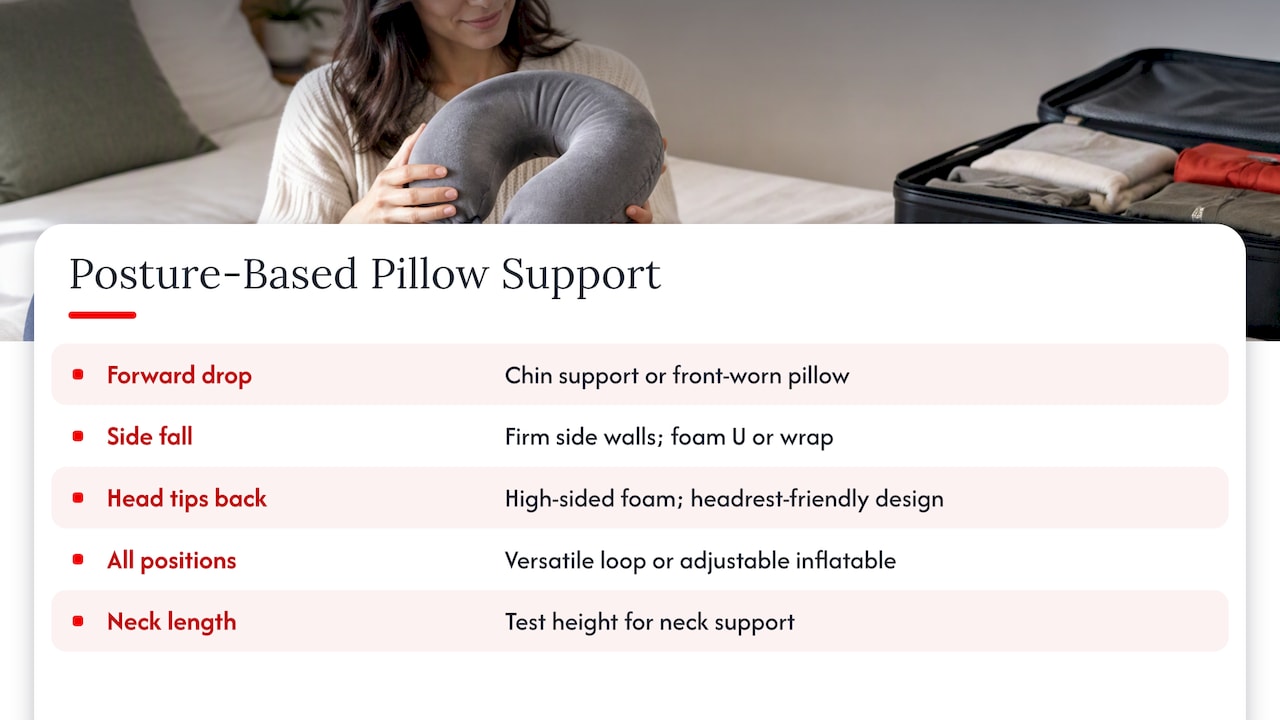
If your head drops forward: look for chin support (wrap, brace or overlapping foam), or a pillow you can wear in the front. A U-shaped pillow worn the conventional way often leaves a gap at the front, which is exactly where forward drop happens.
If your head falls to one side: pick a firm wall on each side. A foam U or a wrap works. Soft fills tend to let your head roll off.
If you tip your head back: a high-sided foam pillow behind the neck stops the head from falling back, and a headrest-friendly design helps. Avoid overly thick backs that push your chin onto your chest.
If you sleep in every position: a versatile loop or an adjustable inflatable gives you options. This one is a fair compromise.
If you have a short or long neck: a pillow that is too tall for a short neck pushes the chin down. One that is too low leaves a long neck unsupported. This is why testing matters.
How to wear a travel pillow (it is not always behind your neck)
A common mistake is to use every pillow in the conventional position, with the bulk behind the neck. Dr. Shoaib Muhammad argues that for many travellers, wearing the pillow in the front, like a scarf, gives noticeably better support against forward head drop. The same piece describes the “wobble-nod-snap” cycle that many people recognize: you drift off, your head tips, you jerk awake, and repeat.
Before you decide a pillow does not work, try these changes:
- Rotate it. Put the opening at the back and the thick part under your chin.
- Try it backwards. Some people lean back or rest their head against a wing of the seat; a reversed pillow can help here.
- Adjust the snugness. A pillow that is too tight restricts breathing and one that is too loose lets the head fall.
- Recline a notch if the seat allows it, and be considerate of the person behind.
- Lower your seat belt, tray and headrest adjustments so your head and shoulders are aligned.
These are free to try and take a minute each. We’d suggest running through them before you spend more.
Test before you fly
The single best habit is to test your pillow in conditions that mimic an economy seat. Dr. Muhammad’s advice is to try it in a limited space and watch whether it pushes your head forward. Here is a home test that takes about 15 minutes:
- Sit in a dining chair with a straight back and put your feet flat.
- Wear the pillow in the position you plan to use on the plane.
- Close your eyes, relax your shoulders, and let your head settle.
- Check for forward push, pinching under the chin, or pressure at the base of the skull.
- Swap positions and repeat.
If it feels like a fight, it is the wrong shape. If you are buying in store, ask about the return policy before you go. Many stores let you try before you commit. If you are buying online, check the return window before the trip, so you have time to send it back.
If you have neck pain
Be careful here. Not every “orthopedic” or “neck support” label rests on clinical data. Many such products are simply ergonomic designs, and real relief often comes down to individual anatomy: neck length, shoulder width and how you lean naturally. A pillow does not replace a neutral-spine posture in the seat.
If you have chronic neck pain, a recent injury, numbness or tingling in your arms, speak with your family doctor, physiotherapist or chiropractor before a long trip. They can tell you what position is safe for you and whether a particular type of support suits your condition. Look for pillows that give steady, stable support without forcing your neck into a tight or unnatural angle.
Hygiene and bedbugs: pillows on the road
Your travel pillow is convenient, but bring it in with the same care as other luggage. Health Canada’s advice on bedbugs is direct: don’t bring your own pillow when you travel, because pillows give bedbugs another place to hide and can carry them home. The same page notes that bedbugs can hide in luggage, clothing and other personal items.
So a compact travel pillow with a washable cover is a smarter choice than a pillow from your bed. Practical steps:
- Keep the pillow in a sealed bag between uses, and don’t put it on hotel beds or floors.
- When you get home, inspect it and the rest of your luggage before bringing it into the bedroom.
- Wash the cover after the trip, following the care label.
For more on staying organized and safe on the road, our travel safety checklist covers what to do before you leave.
Packing a travel pillow without wasting space
Space is where types differ most. A foam U can eat up a third of a small carry-on. An inflatable disappears into a pocket. Here is how to think about it:
- Wear it through security and onto the plane. A pillow on your neck takes no bag space.
- Clip it to the outside of your bag. Many foam and filled pillows have a strap or a loop for this. It works for most trips, but check airline rules on carry-on size, since a dangling pillow can count toward your allowance.
- Compress it. Filled pillows squash into packing cubes or a jacket pocket.
- Choose inflatable if you travel light. If you fly with one personal item, this is likely your best fit.
If you are trying to fit everything into a single cabin bag, our guide to packing a carry-on efficiently has a system you can adapt, and our picks for the best carry-on backpack show how much room a bulky pillow really needs. Add the pillow to your list with our step-by-step travel checklist so it does not stay on the bedroom chair.
What to use if you do not have a travel pillow
No pillow, or forgot yours? You have options that cost nothing.
- A rolled hoodie or sweater wedged between your head and the window gives you a firm wall.
- A scarf or large shawl folded into a thick band and worn in the front mimics a wrap pillow.
- A jacket stuffed into your bag’s side pocket, pressed against the window, works like a small cushion.
- A lumbar roll (a small rolled towel or cushion) behind your lower back can reduce the slouch that drags the head forward.
As the experts say, a pillow only mitigates a lack of support. Posture, seat position and a bit of lumbar support matter just as much. A little extra comfort for longer trips can start at home, too: our piece on getting better rest with a therapeutic sleeping pillow shows how pillow shape affects sleep generally.
A buying checklist
When you are ready to buy, here is what to check, in order of importance:
- Fit and posture. Does it suit your sleeping style and keep your head neutral?
- Support firmness. Firm enough that your head does not slide, soft enough that it does not push.
- Size when packed. Be honest about your bag.
- Cover. Removable and washable is ideal. A soft, breathable fabric beats slick material.
- Adjustability. Straps, toggles and valves let you fine-tune.
- Return policy. This matters most for online orders.
- Price against use. If you fly twice a year, a mid-range pillow is fine. If you fly monthly, a better-built one pays off. Prices at big Canadian retailers vary widely by material and design, so compare a few before you commit.
Ignore marketing claims that promise to cure neck pain. Look for honest descriptions of shape, materials and dimensions, and read recent reviews for notes on how the pillow behaves on long flights.
Our perspective: fit first, features second
We read a lot of travel pillow roundups, and they tend to crown one winner. We think that misses the point. In our view, there is no single best pillow, because necks, shoulders and sleeping habits differ. The advice that holds up best, from the specialists we cite above, is to match the design to your posture, test it in a cramped setting, and try different wearing positions before you spend more.
Our team’s rule of thumb: start with your biggest problem. If your head falls forward, shop for front support. If you are short on luggage space, begin with an inflatable and add a fabric cover. If you want comfort on short trips, a soft filled pillow is a fine, low-cost choice. And whatever you pick, remember the pillow is one part of a bigger comfort plan that includes your seat, your layers and your route.
We also like pairing a pillow with smart planning. Booking choices and timing affect how rested you arrive, and our look at travel booking trends can help you choose flights that fit your sleep.
— Our team at Lizard’s Lunch
Want to reach travellers like you?
If you run a brand or a service for people on the move, we offer banner placements and guest posts for readers who plan trips and look for gear. You can see the options on our advertise with us page.
FAQ
What type of pillow is best for neck pain while travelling?
There is no single best type. Experts suggest choosing the pillow that keeps your neck in a neutral position and does not force you into a posture. A firm foam U or a wrap with front support suits many people. If you have chronic pain, check with your doctor or physiotherapist first.
How should you use a travel pillow?
Try more than one position. The conventional spot behind the neck suits some people, but wearing the pillow in front like a scarf often gives better support against forward head drop. Rotate it or reverse it before deciding it does not work.
What can I use instead of a travel pillow?
A rolled sweater or hoodie against the window, a thick folded scarf worn at the front, or a small rolled towel behind your lower back all help. None replace good seat posture, but they work in a pinch.
Can I bring my own pillow from home when I travel?
We would not. Health Canada advises against bringing your own pillow because it gives bedbugs another place to hide. A compact travel pillow with a washable cover is a better choice, and you should still inspect it and your luggage when you get home.
Are inflatable pillows as good as memory foam?
They are good for different reasons. Inflatables win on packing size and let you tune firmness. Memory foam wins on steady support and comfort over many hours. Your luggage space and sleeping style should decide.















Leave a Comment
Your email address will not be published. Required fields are marked with *