
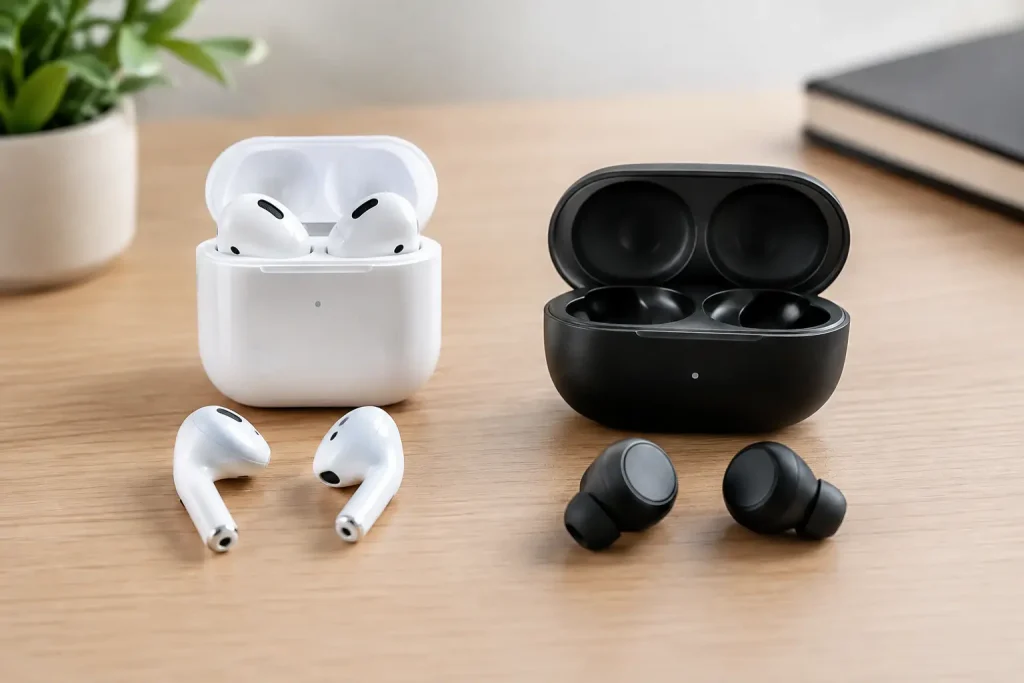
AirPods versus earbuds can be a confusing choice. Compare sound, fit, battery life, features, price, and compatibility to buy with confidence every day.
A commuter pulls out white AirPods at the airport. A gym regular reaches for sweat-resistant earbuds with ear hooks. Both are listening wirelessly, but they may be shopping for very different things. The airpods versus earbuds question is slightly misleading because AirPods are earbuds – Apple’s earbuds, specifically. What most buyers mean is whether they should pay for Apple’s popular lineup or choose another brand’s wireless earbuds.
The better pick comes down to the phone in your pocket, how you listen, and whether convenience or value ranks higher on your list. AirPods can feel nearly effortless for Apple users, while competing earbuds often offer more options at lower prices.
AirPods Versus Earbuds: The Key Difference
AirPods are a family of wireless earbuds made by Apple. That family includes standard AirPods, AirPods Pro, and AirPods Max, although the over-ear Max model is technically headphones rather than earbuds. Standard AirPods have an open-fit design, while AirPods Pro use silicone ear tips and include more advanced noise control.
“Earbuds” is the broader category. It includes wireless models from brands such as Sony, Bose, Samsung, Jabra, Beats, Anker’s Soundcore line, and many budget-focused companies. Some use an open fit like standard AirPods. Others seal the ear canal with tips, include ear hooks for workouts, or prioritize audiophile-friendly sound settings.
That distinction matters because comparing a pair of entry-level earbuds with AirPods Pro is not a fair matchup. Compare products by price tier and purpose instead. A $30 pair may be perfect as a backup for the gym, while a $200 pair should be judged on sound, call quality, comfort, and features that justify the investment.
Apple Integration Is AirPods’ Biggest Advantage
If you use an iPhone, iPad, Mac, and Apple Watch, AirPods offer an unusually easy ownership experience. Pair them once with your Apple account, and they can move between compatible devices with minimal effort. Open the case near an iPhone, follow a quick on-screen prompt, and you are ready to listen.
Features such as Find My location tracking, Siri access, battery pop-ups, and audio sharing with another set of AirPods are also built into Apple’s ecosystem. Higher-end models add Personalized Spatial Audio, which can make supported movies and music feel wider and more immersive.
For someone who regularly switches from a work MacBook to an iPhone at lunch and an iPad at night, that convenience is worth real money. It removes small daily annoyances that cheaper earbuds may create.
There is a trade-off. AirPods work with Android phones and Windows computers over Bluetooth, but the experience becomes more basic. You lose many settings, easy device switching, and some ecosystem-only features. If you have an Android phone, AirPods are rarely the strongest value unless you simply prefer their fit and sound.
Other Earbuds Offer More Choice for Every Listener
The broader earbud market is far less one-size-fits-all. Android users can find models with close integration to their own devices, including quick pairing and location tools. Many earbuds also provide companion apps with equalizer controls, touch-control customization, and multiple noise-canceling modes.
Sound is an especially personal area. AirPods are tuned for a balanced, accessible sound that works well for podcasts, pop music, calls, and casual video watching. But many competing earbuds let you adjust bass, treble, and vocal clarity. That can be a major benefit if you listen to hip-hop, classical music, metal, or live recordings and want more control.
Fit options are wider, too. Standard AirPods are comfortable for many people, but their open design does not create a seal. If they tend to slip from your ears, no software feature can fix that. Competing earbuds may offer several ear-tip sizes, foam tips, stabilizing fins, or wraparound hooks that stay put during runs and high-impact workouts.
This variety also helps shoppers with smaller ears or anyone who finds conventional earbuds uncomfortable after an hour. The best earbuds are not simply the ones with the longest feature list. They are the pair you can wear through a flight, meeting, or workout without constantly adjusting them.
Sound Quality and Noise Cancellation Depend on the Model
Do not assume that AirPods automatically sound better than other earbuds, or that a lesser-known brand sounds worse. Audio quality varies by model, fit, music source, and personal preference.
A sealed in-ear design generally delivers stronger bass and better passive noise reduction than an open-fit earbud. That is why AirPods Pro can sound fuller and isolate more background noise than standard AirPods. The seal keeps outside sound from competing with your music, and it prevents lower frequencies from leaking away.
Active noise cancellation, or ANC, is another area where product tiers matter. Premium AirPods Pro offer effective ANC for steady sounds like airplane engines, air conditioners, and office chatter. Premium alternatives from Bose, Sony, and other established audio brands can match or beat them in certain situations, particularly for people who want the strongest possible quiet on flights.
Budget earbuds now often advertise noise cancellation, but the label alone does not guarantee a premium result. Lower-priced ANC may soften a hum yet do little for voices or sudden sounds. Read the feature description carefully, and remember that a secure ear-tip seal is the foundation of good noise reduction.
Transparency modes deserve attention as well. They use microphones to bring in outside sound, making it easier to hear a gate announcement, speak with a cashier, or stay aware near traffic. AirPods handle this naturally, but several competing premium models do it well. For outdoor walkers and commuters, it is a practical safety feature rather than a flashy extra.
Battery Life, Charging, and Durability
Most true wireless earbuds provide several hours of playback per charge, with a charging case supplying extra power on the go. The exact number changes when you turn on ANC, take calls, or use spatial audio, so advertised battery estimates are best treated as a comparison point rather than a promise.
Many non-Apple earbuds stand out with longer total battery life, especially in the budget and midrange categories. AirPods prioritize compact cases and ecosystem features, while competitors sometimes build larger cases that can last for days between wall charges. If you travel frequently or dislike carrying a cable, compare total case battery as closely as single-charge playback.
Charging is another small but meaningful detail. AirPods are especially convenient for households already using MagSafe or Apple Watch charging accessories. Other earbuds may rely on USB-C, wireless charging, or both. USB-C is increasingly useful because one cable can charge a newer phone, tablet, laptop accessory, and earbuds.
For workouts, look beyond battery numbers. Check the water- and sweat-resistance rating, typically shown as an IP rating. A model rated for sweat and splashes is sensible for the gym, but it is not necessarily safe to submerge. Wipe earbuds dry after a hard session, and do not leave the charging case in a damp gym bag.
Price Is Where Alternatives Often Win
AirPods are polished products, but they are not usually the cheapest route to dependable wireless listening. Standard AirPods carry a recognizable name and strong Apple integration, while AirPods Pro command a premium for noise cancellation, better fit options, and extra features.
Outside Apple’s lineup, shoppers can find capable earbuds at almost every price. A midrange pair may offer adjustable EQ, multipoint Bluetooth, ear hooks, or a long battery life for less than premium AirPods. Multipoint is particularly useful for people who want earbuds connected to a laptop and phone at the same time, though performance differs by brand.
The cheapest options can be tempting, but extremely low prices often bring weaker microphones, unreliable touch controls, and shorter product support. That does not mean you must buy the most expensive pair. It means choosing the lowest-priced model that meets your actual needs is usually smarter than chasing the lowest number on the page.
Which Choice Makes Sense for You?
Choose AirPods if you use Apple devices daily and want the simplest pairing, switching, and tracking experience. AirPods Pro make the strongest case for frequent travelers, office workers, and listeners who want silicone tips with strong noise cancellation.
Choose other wireless earbuds if you use Android, need a more secure fit, want deep sound customization, or are working within a firm budget. They may also be the better choice if you need ear hooks, multipoint connectivity, or a specific sound profile.
Before buying, think about where the earbuds will spend most of their time: a quiet home office, a crowded train, a treadmill, or a carry-on bag. The pair that fits that routine well will feel like a smart purchase long after the first charge.
















Leave a Comment
Your email address will not be published. Required fields are marked with *