
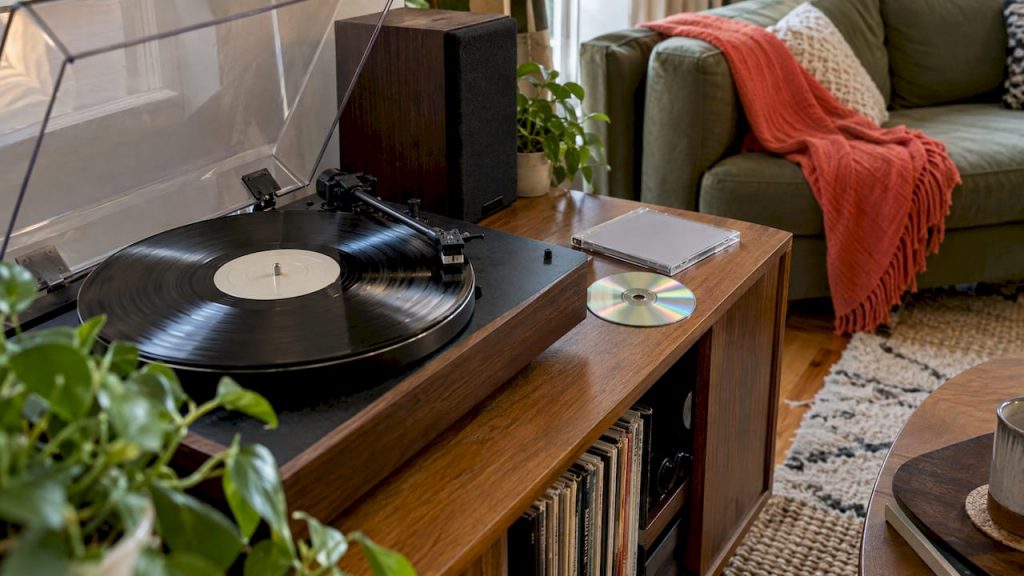
CD vs vinyl compared on measured sound quality, mastering, gear, cost and collecting, so you can pick the format that suits how you listen.
On measurements, CD wins: it has a wider dynamic range, cleaner stereo separation and no wear from playing. Vinyl wins on ritual, artwork and a sound many people simply love. The better format for you depends on whether you want accuracy and value or an experience, and on how well the record or disc was mastered in the first place.
That is the honest answer, and it is a happy one. Both formats are alive, both reward you for caring about your music, and neither is a mistake. Below we walk through what the numbers say, why vinyl feels “warm”, what mastering changes, what gear you need and how to choose.
TL;DR
- Measured quality: a CD offers roughly 96 dB of dynamic range and over 90 dB of channel separation. Vinyl manages about 55 to 70 dB and around 30 dB of separation.
- The “warm” sound: it comes mostly from the format’s distortions and, very often, from a different master. It is a real pleasure, just not a sign of higher fidelity.
- Gear matters more than format: CD gives great results with modest equipment. Vinyl needs a well-set-up turntable to shine.
- Pick CD for accuracy, value and low fuss. Pick vinyl for the ritual, the big artwork and listening to albums start to finish.
Table of Contents
- What the measurements say
- Why vinyl sounds warm
- Mastering matters more than the format
- The gear you need
- Cost and convenience in Canada
- Durability, care and storage
- How to choose
- Pressing and releasing your own music
- Perspective
- Reach readers who love music and audio
- FAQ
- Sources
What the measurements say
Start with the specifications, because they settle the “technical quality” part of the debate quickly.
A standard Red Book CD stores audio at 16-bit and 44.1 kHz. According to PMA Magazine, that gives a theoretical dynamic range of roughly 96 dB, a flat frequency response from 20 Hz to 20 kHz, channel separation above 90 dB and no mechanical wear from playback. The same article reports that good vinyl pressings deliver about 65 to 70 dB of usable dynamic range at the start of a side, falling to around 55 dB near the label, with a noise floor near minus 60 dB and about 30 dB of channel separation at 1 kHz.
| Measure | CD | Vinyl |
|---|---|---|
| Dynamic range | About 96 dB in theory | About 55 to 70 dB, lower toward the inner grooves |
| Channel separation | Over 90 dB | About 30 dB at best |
| Frequency response | 20 Hz to 20 kHz, flat | Varies with pressing and playback chain |
| Wear from playing | None mechanical | Every play touches the groove |
| Surface noise | None | Always some |
An academic source agrees. Tufts Now explains that an LP can play about 70 dB between its loudest and softest sounds while a CD can handle over 90 dB. It adds that a loud bass signal in one channel of a record can push the needle out of the groove, which is why engineers keep bass frequencies centered.
What the numbers mean in practice
Dynamic range is the gap between the quietest and loudest moments. A bigger gap means more contrast, in theory. In practice, you rarely hear all of it. PS Audio’s Paul McGowan points out that using a CD’s full 96 dB would push peaks to around 111 dB in a typical room, beyond what most speakers can deliver. So CD has headroom to spare, and vinyl’s smaller range means the mastering engineer has to fit the music into a tighter space.
The Harvard Gazette makes the same point from the listener’s side: modern digital audio reproduces signals so well that the difference from analog is imperceptible to all but the sharpest ears, and CD-quality audio nearly covers the dynamic range and bandwidth of human hearing.
That is good news for CD buyers. It means the disc in your hand is not a compromise.
Why vinyl sounds warm
If CD measures better, why do so many people swear by records? There are a few honest reasons, and none of them make your preference wrong.
Distortion can be pleasant
New Scientist notes that the characteristic vinyl sound comes from the limitations and distortions built into the format, including rumble from the turntable drive and noise from the stylus meeting tiny imperfections in the groove. Pitchfork’s Mark Richardson describes the “warmth” many people hear as less accurate bass, and says vibrations and distortions from a poorly made turntable can make a record sound warmer than a CD.
That is not an insult. Plenty of us love a little crackle and a soft, rounded edge. BBC Science Focus says vinyl has its own distinctive sound, filled with surface crackle, pops and distortion that people love, though calling it “better” probably isn’t accurate. Think of it like a warm bulb versus a bright one: neither is wrong, they set a different mood.
You may be hearing a different master
This is the part many guides skip. PMA Magazine argues that listeners often call vinyl “warmer” or more “natural” because they are hearing a different master, not some magic in the groove. Digital masters from the loudness-war era often use aggressive compression and limiting, which shrinks dynamic range. Vinyl avoids many of those problems by necessity.
Louder adds a useful description of the two flavors. Critical listeners may find CDs a little clinical, with detail that can be startling, but CDs are also immediate and exciting. Vinyl is less aggressive and good at creating a sense of space and air around the musicians.
The album experience
The Harvard Gazette notes that once you put a record on, you are locked in, so you hear the album as an album instead of a pile of shuffleable songs. For fans of album-oriented music, that is a big part of the appeal. Flipping a side is a small act that slows you down and makes you pay attention.

Mastering matters more than the format
Here is the secret behind most “vinyl sounds better” stories: the mastering decisions made before the music reached the disc.
How vinyl mastering differs
According to Sound on Sound, separate masters are needed for CD and vinyl, though in most cases the processing can be the same. The crucial differences are practical: how much limiting is applied, the word length (16-bit for CD, 24-bit ideal for vinyl) and how the files are sequenced. For vinyl, the best source is dynamic and limited very lightly or not at all, because there is a physical limit to what the lathe’s cutting head can take. A CD master can be as loud as the client likes.
PMA Magazine lists what vinyl mastering does to cope: it removes subsonic content below 20 Hz to cut rumble, rolls off ultrasonic frequencies, tames harsh sibilants that could damage the lacquer, lowers levels and centers the bass. The result can be a quieter, more dynamic, more spacious-sounding record.
A mastering studio explains the same priorities from the bench: Studios 301’s Steve Smart says vinyl demands strict attention to low frequencies and to fast, abrasive high-frequency transients, while CD mastering focuses on getting the top end right.
Loudness limits the cut
B-Side Journal explains that vinyl physically limits how loud a record can be cut, since heavy compression or too much low end can make the needle jump or distort. The CD format removed many of those constraints and allowed higher average loudness. That is why a gently mastered record can sound more open than a squashed CD of the same album.
It works the other way too. Audioholics’ Gene DellaSala observes that more care is often taken mastering for vinyl to avoid excess compression, and that heavily squashed digital releases can make technically inferior analog versions sound better. A well-mastered CD, though, can beat a poor record every time.
Not every record is analog
The BBC Science Focus piece points out that many modern records are cut from digital masters, so they are no longer a pure analog signal. PMA Magazine adds that some pressings come from the same brick-walled digital files used for streaming or CD, so with no separate vinyl master, you should not expect miracles. Pitchfork notes a long-running suspicion among audiophiles that some LP reissues are mastered from a CD source.
A quick way to shop smarter
- Look for releases credited to a named mastering engineer, and for pressings that say they were cut from the original analog tapes or a dedicated vinyl master.
- Read reviews that comment on the specific pressing, not just the album.
- For CDs, look for older or remastered editions that critics describe as dynamic rather than loud.
- If you already own both formats of one album, play them at matched volume and see which you prefer. Your ears are the final judge.
The gear you need
A format is only as good as the chain that plays it. Louder’s Steve May says that to hear vinyl at its best you need a good record player set up correctly, with attention to the cartridge and tonearm, and the rewards can be profound. CD, by contrast, needs little expertise to deliver great results and offers higher quality for less. What Hi-Fi? agrees that much of a record’s or CD’s “personality” comes down to the quality and feel of the player.
What a CD setup needs
- A CD player or a transport with a decent digital output
- An amplifier and speakers, or a good pair of headphones
- Nothing else to align or calibrate
What a vinyl setup needs
- A turntable with a decent tonearm and cartridge
- A phono stage, built into the turntable, the amplifier or sold separately
- Speakers or powered speakers
- A carbon brush and a stylus cleaning routine
- A level, vibration-free shelf, since the stylus picks up bumps
If you like to listen privately, a good pair of headphones lifts both formats. Our noise cancelling headphones review guide helps you sort through what to look for when you want to hear every detail without the room getting in the way.
Cost and convenience in Canada
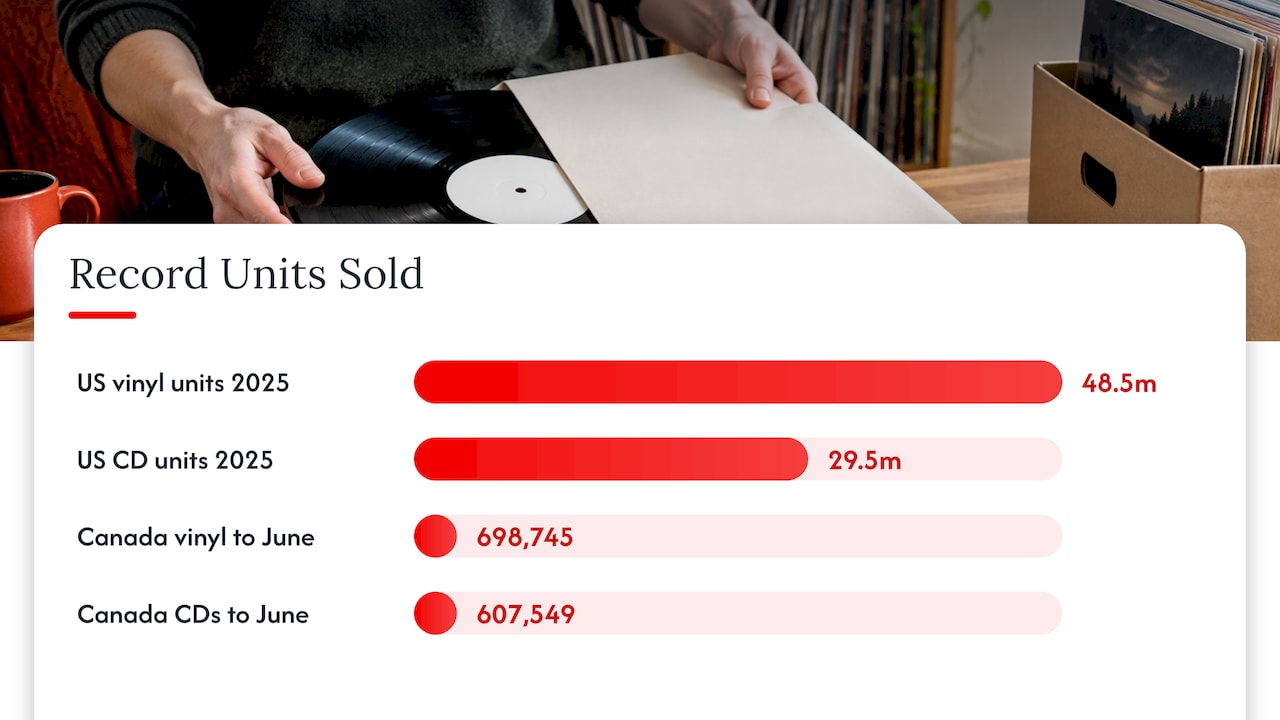
There is real momentum behind records. In the United States, Forbes reporting on an RIAA report says vinyl sales passed $1 billion in 2025, with an estimated 48.5 million new vinyl units sold against 29.5 million CDs. Canadian numbers tell a similar story. Broadcaster Alan Cross’s weekly sales tracking showed about 698,745 vinyl records sold in Canada by early June 2025, up 13.4% on the same point in 2024, against 607,549 CDs, down from the year before.
What does that mean for your wallet? New records tend to cost noticeably more than new CDs, and used CDs are often some of the cheapest ways to own an album in physical form. Check the current price at your local independent shop or online retailer, since prices change with the release and the pressing. Because CD needs less of an equipment investment, a CD collection is usually the cheaper route to good sound.
Where to look
- Independent record stores in your city often sort used CDs and used records separately, and staff will usually tell you about notable pressings.
- Record fairs and thrift shops can be treasure hunts for both formats.
- Artists’ own online stores often sell signed CDs or limited colored vinyl.
Durability, care and storage
The CD has the clear advantage on wear. PMA Magazine notes there is no mechanical wear from playback. Craig Peacock, writing in a personal essay on the digital side, argues that vinyl brings unavoidable wear, inner-groove distortion and surface noise. You do not have to agree with his conclusion to take the care point seriously.
Looking after records
- Store them upright, never stacked flat.
- Keep them out of heat and direct sun, which can warp them.
- Handle by the edges and label.
- Brush off dust before each play.
- Keep the stylus clean, and replace it on the schedule the manufacturer gives.
Looking after CDs
- Hold discs by the edge.
- Return them to the case after listening.
- Wipe gently from the center outward if they get fingerprints.
- Avoid leaving them in a hot car.
How to choose
| If you care most about… | Lean toward |
|---|---|
| Accuracy and low noise | CD |
| Value and a small budget | CD, especially used |
| Large artwork and liner notes | Vinyl |
| Listening to a full album without skipping | Vinyl |
| A hands-on ritual | Vinyl |
| Portability, a car or a small setup | CD |
| A particular well-cut pressing of a favorite album | Whichever has the better master |
Many people do not choose at all. They buy CDs for discovery, travel and the car, and they buy records of the albums they love most for the shelf and the Sunday afternoon. That approach makes sense, and the collection grows in a thoughtful way.
A simple rule of thumb
If you want the most accurate version of the sound at the lowest cost and effort, buy the CD. If you want to slow down, enjoy the sleeve and love a bit of analog character, buy the record. If you already have both, trust your ears, not the spec sheet.
Pressing and releasing your own music
Some readers ask this question because they are making music, not just buying it. The format choice then becomes a production decision: a vinyl master needs light limiting, careful low end and a sequence that fits each side, while a CD master can be prepared in 16-bit at the loudness you choose. For a look at how artists present tracks and let listeners sample them before they buy, see this guide to previewing songs before buying, and for the wider renewal of interest in records and the technology around it, read about the vinyl revival and modern tech.
Perspective
We read a lot of audio debates and we notice a pattern: the people who enjoy their music most are rarely the ones who won the argument. They are the ones who found a format and a setup that makes them want to press play.
Our view is simple. Treat the numbers as a map, not a verdict. CD gives you a clean, wide, low-effort path to great sound. Vinyl gives you a ceremony, big artwork and a distinctive character. Both are worth exploring, and both reward curiosity about who mastered the music and how.
We also like the idea that a good guide shows you the next door to open. If you enjoy a format, there is always another opportunity nearby: a better pressing, a new listening room, a pair of headphones, a local shop you have not visited. That is the spirit we bring to every topic we cover, from music and tech to travel and home.
Alexander
Reach readers who love music and audio
If you run a brand, shop or project in music, audio or lifestyle, we welcome you to talk to us about banner ads and guest posts. Our readers come to us for guides, reviews and ideas across technology, entertainment, travel and more, so it is a friendly place to share your story.
FAQ
Is vinyl better than CD?
Not on measured quality. CD has more dynamic range, much better channel separation and no mechanical wear. Vinyl has a distinctive, often loved sound and a more tactile experience, and a well-mastered record can sound better than a loudness-war CD. “Better” depends on whether you value accuracy or character.
Does vinyl sound better than CD?
It can sound different, and sometimes more pleasing, but that is not the same as more accurate. Much of the difference comes from the master and the playback chain. If the record and the CD were cut from the same file, the CD is the more faithful copy.
Are CDs coming back?
Vinyl is the growth story: U.S. sales passed $1 billion in 2025 according to the RIAA report covered by Forbes. CDs still sell in the tens of millions of units in the U.S. and remain a cost-effective way to own music. For many listeners, they are a practical, high-quality choice.
Why are so many young people buying vinyl?
Part of it is the experience: large artwork, a ritual of putting the record on and hearing the album in order. The Harvard Gazette notes that vinyl pushes you to listen to an album as a whole. A record is also something you can hold and display, which streaming cannot offer.
Do I need expensive gear to enjoy vinyl?
You need a properly set-up turntable, a phono stage and decent speakers, but you do not need to spend a fortune to enjoy it. Louder notes that vinyl rewards good setup, while CD gives great results with little expertise. Start with a solid, well-aligned entry-level setup and upgrade the cartridge later if you wish.
Sources
- Does vinyl sound better? | Harvard Gazette
- Does music sound better on vinyl records? | Tufts Now
- The Format Fallacy | PMA Magazine
- Unlocking dynamics | PS Audio
- The sound of vinyl | New Scientist
- Does Vinyl Really Sound Better? | Pitchfork
- Does vinyl really sound better? | BBC Science Focus
- CD vs vinyl | Louder
- How does mastering differ for vinyl and digital releases? | Sound on Sound
- Mastering for Vinyl | Studios 301
- The Loudness War | B-Side Journal
- Analog (Vinyl) vs Digital Audio | Audioholics
- Vinyl, CD and streaming | What Hi-Fi?
- Proudly Digital | Craig Peacock
- Vinyl Sales Surpassed $1 Billion In 2025 | Forbes
- CDs vs. vinyl sales report | A Journal of Musical Things
















Leave a Comment
Your email address will not be published. Required fields are marked with *