

Discover the best wireless earbuds for tech enthusiasts in 2026. Explore top picks like Sony and Bose, plus budget-friendly options!
What are the best wireless earbuds for tech enthusiasts right now?
The best wireless earbuds for tech enthusiasts include the Sony WF-1000XM6 for overall excellence, the Bose QuietComfort Ultra Earbuds (Gen 2) for world-class noise cancellation, the Apple AirPods Pro 3 for Apple ecosystem users, the Technics EAH-AZ100 for audiophiles desiring studio-monitor accuracy, and the Bowers & Wilkins Pi8 for those seeking reference-grade sound. Budget buyers can find genuine ANC performance from options like the CMF Buds 2 Plus and EarFun Air Pro 4 Plus at affordable price points.
Our team at Lizard’s Lunch evaluated 25 pairs across sound quality, codec support, noise cancellation depth, battery life, and platform compatibility. The comparison table below captures the full picture.
| Product | Best For | Price Range | Sound Quality | Noise Cancellation | Battery Life | Platform | Special Features |
|---|---|---|---|---|---|---|---|
| Bose QuietComfort Ultra Earbuds (Gen 2) | Comfort + ANC | $$$$ | Warm, consumer-tuned | World-class | Up to 6 hrs (ANC on) | Multi-platform | CustomTune spatial audio, all-day comfort |
| Apple AirPods Pro 3 | Apple users | $$$$ | Natural, warm | Excellent | Up to 6 hrs | Apple ecosystem | Seamless device switching, flexible spatial audio |
| Samsung Galaxy Buds4 Pro | Samsung users | $$$ | Balanced | Good | Up to 6 hrs | Android/Samsung | Galaxy AI features |
| Sony WF-1000XM6 | Best overall | $$$$ | Accurate, detailed | Excellent | — | Multi-platform (LDAC on Android) | 8-mic AI beamforming, LDAC, IPX4 |
| Technics EAH-AZ100 | Android audiophiles | $$$$ | Studio-monitor clarity | Adaptive, class-leading | 10+ hrs (ANC on) | Multi-platform | LDAC, Bluetooth LE Audio, 3-way multipoint |
| Bowers & Wilkins Pi8 | Reference audiophiles | $$$$ | Reference-grade | Strong | — | Multi-platform | Carbon Cone drivers, aptX Lossless, retransmission case |
| Sennheiser Momentum True Wireless 4 | Audiophile heritage | $$$ | Wide soundstage, clear | Good | roughly 7 hrs | Multi-platform | aptX Lossless, LE Audio, Bluetooth 5.4 |
| EarFun Air Pro 4 Plus | Budget ANC | $$ | Balanced | Effective | 6+ hrs (tested) | Multi-platform | ANC comparable to pricier models |
| CMF Buds 2 Plus | Budget ANC | $ | Solid | Strong for price | Good | Multi-platform | ANC at budget price point |
| Anker Soundcore Liberty 4 Pro | Value all-rounder | $$ | Good | Solid | Long | Multi-platform | LDAC, ANC, long battery |
| Anker Soundcore Liberty Pro 5 | Value mid-tier | $$ | Good | Decent | Good | Multi-platform | Competitive feature set |
| Google Pixel Buds 2a | Google ecosystem | $$ | Clear | Moderate | Good | Android/Google | Google Assistant, fast pair |
| Nothing Ear Wireless | Style + performance | $$$ | Balanced | Good | Good | Multi-platform | Transparent design, LHDC codec |
| Nothing Ear (a) | Design + value | $$ | Solid | Decent | Good | Multi-platform | Stylish design, dependable audio |
| Beats Powerbeats Pro 2 | Athletes | $$$$ | Energetic | Moderate | 10+ hrs | Apple/Android | Heart rate monitor, secure ear hook |
| Sony LinkBuds Fit | Fitness | $$$ | Balanced | Good | Good | Multi-platform | Secure fit, workout-focused |
| Shokz OpenFit Pro | Outdoor awareness | $$$ | Open, airy | Open-ear (no seal) | Good | Multi-platform | Bone conduction, situational awareness |
| Bose Ultra Open | Open-ear comfort | $$$$ | Open, natural | Open-ear (no seal) | Good | Multi-platform | Clip-on open-ear design |
| SteelSeries Arctis GameBuds | Gamers | $$$ | Gaming-tuned | Moderate | Good | Multi-platform | Low latency, custom audio tuning |
| Anker Soundcore AeroClip Earbuds | Active lifestyle | $$ | Decent | Open-ear | Good | Multi-platform | Clip-on, sweat-resistant |
| Cambridge Audio Melomania A100 | Portable hi-fi | $$$ | High-fidelity | Decent | Long | Multi-platform | High-fidelity, compact design |
| Status Pro X Wireless Earbuds | Balanced audiophile | $$$ | Clear, detailed | Moderate | Long | Multi-platform | Long battery, clear sound |
| EarFun Free 2S | Entry-level budget | $ | Decent | Basic | Good | Multi-platform | Affordable true wireless |
| Baseus Inspire XP1 | Budget all-around | $ | Solid | Basic | Good | Multi-platform | Good price-performance ratio |
A few standouts deserve more than a table row. The Sony WF-1000XM6 earns its “best overall” slot with eight microphones per pair using AI-powered beamforming, LDAC codec support for high-resolution audio on Android, and genuinely excellent call quality. The Technics EAH-AZ100 demonstrated excellent battery life with ANC on in standardized testing, outperforming many competitors including the Sony WF-1000XM5. That kind of real-world endurance matters on long travel days.

The Bowers & Wilkins Pi8 sits at $499 and earns every dollar of it. Its 12mm Carbon Cone drivers deliver what FutureAudiophile describes as “crisp, detailed highs, firm, realistic midrange, strong bass performance, and incredible dynamic range.” The Pi8’s charging case doubles as a wireless transmitter, rebroadcasting audio from a 3.5mm or USB-C source directly to the earbuds over aptX Adaptive at 24-bit/96kHz. No other earbud case on this list does that.
Budget buyers should look seriously at the CMF Buds 2 Plus. Testing shows it hits 83% average noise reduction, the same figure as the Powerbeats Pro 2 at $249.99, at a fraction of the price. The EarFun Air Pro 4 Plus lands around $100 and delivers noise cancellation comparable to pricier models without any ecosystem lock-in.

Table of Contents
- How do these earbuds compare by platform, price tier, and specialty?
- How to choose the best wireless earbuds for your needs
- What do experts say about audiophile-grade wireless earbuds?
- Key Takeaways
- Our team’s perspective on where wireless earbuds are headed
- Lizardslunch covers the tech content you actually want to read
How do these earbuds compare by platform, price tier, and specialty?
Apple, Android, and multi-platform options
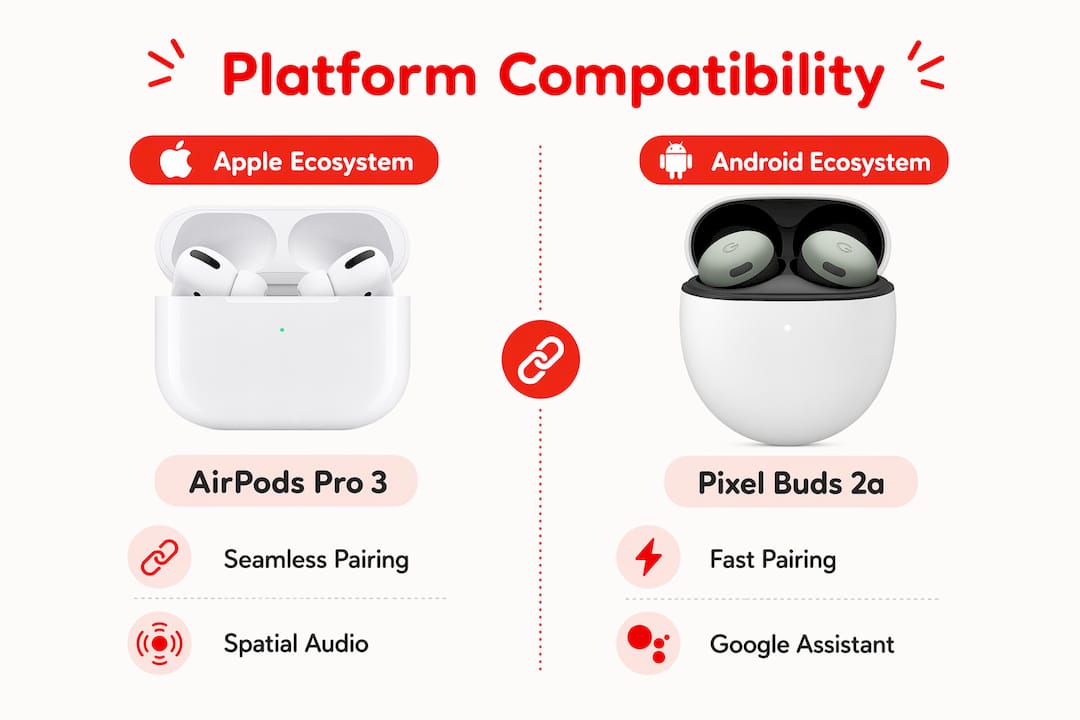
Platform compatibility shapes the experience more than most buyers expect. Apple AirPods Pro 3 deliver seamless device switching, natural voice call processing, and flexible spatial audio across the Apple ecosystem, including Dolby Atmos content. Samsung Galaxy Buds4 Pro unlock Galaxy AI features exclusively on Samsung phones, making them a strong choice only if you’re already in that ecosystem. Sony and Technics both work well across platforms, though LDAC’s high-resolution audio is an Android-only benefit.
Google Pixel Buds 2a suit Google ecosystem users who want fast pairing and Google Assistant baked in. The Nothing Ear Wireless and Nothing Ear (a) work across platforms and bring a distinctive transparent design that stands out in a sea of identical black ovals.
Budget, midrange, and premium tiers
At the budget end, the EarFun Free 2S and Baseus Inspire XP1 offer true wireless audio under $50 with basic feature sets. Step up to the CMF Buds 2 Plus or EarFun Air Pro 4 Plus and you get genuine ANC. The Anker Soundcore Liberty 4 Pro and Liberty Pro 5 sit in the midrange, offering LDAC, solid ANC, and long battery life at prices that don’t require a second thought.
Premium earbuds from Bose, Sony, Apple, Technics, Sennheiser, and Bowers & Wilkins justify their prices through driver technology, codec support, and ecosystem depth. The Sennheiser Momentum True Wireless 4 at around $270 brings aptX Lossless, Bluetooth 5.4, and LE Audio readiness alongside roughly seven hours of playback per charge, making it one of the most complete packages at its price point.
Specialty categories worth knowing
- Gaming: SteelSeries Arctis GameBuds deliver low-latency audio with custom tuning built for competitive play.
- Fitness: Beats Powerbeats Pro 2 adds heart rate monitoring and a secure ear-hook design with over 10 hours of battery life. Sony LinkBuds Fit offers a workout-focused secure fit with balanced sound.
- Open-ear: Shokz OpenFit Pro uses bone conduction for full situational awareness. Bose Ultra Open and Anker Soundcore AeroClip Earbuds use clip-on designs for a similar open feel.
- Portable hi-fi: Cambridge Audio Melomania A100 and Status Pro X Wireless Earbuds prioritize long playback and clear, detailed sound for audiophiles who travel.
Microphone and call quality
Call quality splits the field in a way specs sheets rarely reveal. Apple AirPods Pro 3 produce the most natural-sounding voice calls because their noise processing is tuned for voice clarity rather than maximum ambient blocking. The Technics EAH-AZ100’s aggressive AI noise suppression, by contrast, can make call voices sound robotic in some environments. Sony WF-1000XM6 strikes a strong balance, with eight microphones and AI beamforming delivering excellent call performance without sacrificing ANC depth.
Charging methods at a glance
- Wireless charging: Available on Bose QuietComfort Ultra Earbuds (Gen 2), Technics EAH-AZ100, Sony WF-1000XM6, Apple AirPods Pro 3, and Sennheiser Momentum True Wireless 4.
- Fast charging: Most flagship models offer an hour of playback from five to ten minutes in the case.
- Retransmission case: Bowers & Wilkins Pi8 case streams audio from a wired source directly to the earbuds, bypassing Bluetooth entirely for 24-bit/96kHz playback.
How to choose the best wireless earbuds for your needs
Start with your ecosystem
Your phone determines which features you’ll actually use. AirPods Pro 3 are the obvious choice for iPhone users, but the gap closes fast if you’re on Android. Sony WF-1000XM6 and Technics EAH-AZ100 both support LDAC on Android for genuinely higher-resolution audio. Samsung Galaxy Buds4 Pro unlock their best features only on Galaxy devices, so check the fine print before buying.
Prioritize codec support for audio quality
Codec support often defines true wireless audio quality more than driver size alone. LDAC transmits up to 990kbps, far above the standard SBC ceiling. AptX Lossless, supported by the Bowers & Wilkins Pi8 and Sennheiser Momentum True Wireless 4, transmits CD-quality audio over Bluetooth without compression. Bluetooth LE Audio with the LC3 codec, found in the Technics EAH-AZ100 and Sennheiser Momentum True Wireless 4, future-proofs your purchase as more devices adopt the standard.
Pro Tip: If you own an Android phone that supports LDAC, prioritize earbuds with LDAC or aptX Lossless over those without. The difference in perceived detail on well-recorded music is audible, not just measurable.
Evaluate ANC honestly
Spending more does not automatically mean better noise cancellation. The Apple AirPods Pro 3 leads the market at 90% average noise reduction in standardized testing, while the CMF Buds 2 Plus hits 83% at a fraction of the price. What drives ANC performance is microphone array quality and processing chip, not the price tag. Look for average attenuation across all frequencies rather than peak decibel claims, which manufacturers often measure at a single favorable frequency.
Match comfort and fit to your use case
Fit affects both comfort and passive isolation, which amplifies ANC effectiveness. The Technics EAH-AZ100 weighs 5.9g per bud and suits long listening sessions. Bowers & Wilkins Pi8 includes four ear tip sizes for a custom seal. For workouts, the Beats Powerbeats Pro 2 ear hook and Sony LinkBuds Fit’s secure design stay put during high-intensity movement. Open-ear options like Shokz OpenFit Pro and Bose Ultra Open sacrifice isolation for awareness, which is the right trade-off for outdoor runners.
Key selection criteria at a glance
- Audio quality: Match the sound signature to your taste. Flat and accurate for audiophiles, warm and energetic for casual listening.
- Battery life: Aim for at least 6–8 hours per charge with ANC on. Manufacturers test at low volumes without ANC; real-world figures run lower.
- App integration: Look for EQ customization, personalized hearing profiles, and codec selection. The Technics EAH-AZ100 and Sennheiser Momentum True Wireless 4 both offer deep app control.
- Bluetooth version: Bluetooth 5.3 and 5.4 improve connection stability and multipoint support. The Technics EAH-AZ100 supports three-way multipoint, letting you connect to three devices simultaneously.
- Water resistance: IPX4 covers sweat and light rain. If you train hard, look for IPX5 or higher.
What do experts say about audiophile-grade wireless earbuds?
Driver technology and codec support define the ceiling
True audiophile wireless earbuds rely on specialized driver materials and high-resolution codecs to push past Bluetooth’s inherent transmission limits. The Bowers & Wilkins Pi8 uses 12mm Carbon Cone drivers, a material borrowed from the company’s flagship over-ear headphones. Carbon construction raises the stiffness-to-mass ratio, which tightens transient response and reduces harmonic distortion at higher volumes. The result is cleaner high-frequency extension and tighter bass control compared to standard dynamic drivers.
The Technics EAH-AZ100 takes a different approach with its 10mm Magnetic Fluid Driver, covering a frequency response of 20Hz–40kHz, notably wider than the typical 20Hz–20kHz ceiling on most competitors. Bluetooth 5.3 with LDAC, SBC, AAC, and LC3 codec support gives it a future-proof edge. For audiophiles, that wider frequency range translates to audible air and detail in the upper registers that most earbuds simply cannot reproduce.
The ecosystem vs. performance trade-off
Tech-savvy buyers face a genuine choice between earbuds built for ecosystem convenience and those engineered for pure sonic performance. Apple AirPods Pro 3 win on usability: seamless device switching, natural voice calls, and spatial audio that works broadly across Apple’s hardware. The Technics EAH-AZ100 wins on sound quality and ANC depth, but its aggressive noise suppression can make call voices sound robotic compared to AirPods Pro’s more natural presentation. Neither is wrong. They solve different problems.
Bose QuietComfort Ultra Earbuds (Gen 2) occupy a third lane: world-class ANC and all-day comfort, tuned for consumer-friendly listening rather than studio accuracy. If your priority is blocking out a noisy office or a long flight, Bose delivers that experience better than most. If you want to hear every detail in a well-recorded album, Technics or Bowers & Wilkins is the answer.
Smart charging cases and retransmission
The Bowers & Wilkins Pi8 charging case functions as a wireless transmitter. Connect it to a laptop, in-flight entertainment system, or any device with a 3.5mm or USB-C output, and it rebroadcasts audio to the earbuds over aptX Adaptive at 24-bit/96kHz. That effectively bypasses Bluetooth’s usual compression, giving you near-lossless audio from sources that don’t support Bluetooth at all. For frequent travelers, that feature alone justifies serious consideration.
Key performance factors for audiophile earbuds
- Driver material: Carbon cone and balanced armature designs outperform standard polymer drivers in transient speed and distortion control.
- Codec ceiling: aptX Lossless transmits CD-quality audio. LDAC reaches 990kbps. Both far exceed SBC’s 328kbps ceiling.
- ANC vs. call quality: Aggressive noise suppression improves ambient blocking but can degrade voice naturalness. Apple AirPods Pro 3 prioritize natural voice; Technics EAH-AZ100 prioritizes maximum noise elimination.
- App depth: EQ customization with labeled frequency centers, personalized hearing profiles, and codec selection separate audiophile-grade apps from basic companion software.
- Spatial audio: AirPods Pro 3 handle spatial audio flexibly across Apple’s ecosystem. Technics EAH-AZ100 requires Dolby Atmos content for its spatial audio mode, which limits compatibility.
Key Takeaways
The Sony WF-1000XM6 is the strongest all-around choice for most tech enthusiasts, while codec support, ANC quality, and platform fit determine which earbuds are right for your specific needs.
| Point | Details |
|---|---|
| Codec support matters most | LDAC and aptX Lossless define audiophile wireless quality more than driver size alone. |
| ANC quality isn’t price-dependent | The CMF Buds 2 Plus hits 83% average noise reduction, matching the Powerbeats Pro 2 at a fraction of the cost. |
| Platform fit shapes the experience | Apple AirPods Pro 3 excels in the Apple ecosystem; Sony and Technics work best across platforms. |
| Retransmission cases add real versatility | The Bowers & Wilkins Pi8 case streams 24-bit/96kHz audio from wired sources, bypassing Bluetooth compression entirely. |
| Lizardslunch covers the full picture | Our team at Lizard’s Lunch covers tech gadgets and audio guides to help you make confident buying decisions. |
Our team’s perspective on where wireless earbuds are headed
The conventional wisdom in wireless audio says you have to choose between great sound and great convenience. Our team at Lizard’s Lunch thinks that framing is becoming outdated, but not for the reason most reviews suggest.
The real shift happening in 2026 is codec standardization. Bluetooth LE Audio with LC3 is moving from a spec-sheet bullet point to actual hardware support, and earbuds like the Technics EAH-AZ100 and Sennheiser Momentum True Wireless 4 are already there. When LE Audio becomes the baseline rather than the exception, the gap between ecosystem-optimized earbuds and audiophile-grade ones will narrow considerably. Apple will eventually have to respond, and when it does, the AirPods line will get meaningfully better for non-Apple content.
What we find underappreciated is the retransmission case feature on the Bowers & Wilkins Pi8. The ability to pipe audio from a non-Bluetooth source directly to your earbuds at 24-bit/96kHz is genuinely useful for travelers, and it’s the kind of practical innovation that rarely gets the attention it deserves in spec comparisons. Most reviews mention it once and move on. We’d argue it’s one of the most compelling reasons to consider the Pi8 over similarly priced competitors.
The budget segment is also more interesting than it looks. The CMF Buds 2 Plus and EarFun Air Pro 4 Plus have forced a real value reassessment. When a $50 earbud delivers 83% noise reduction and a $100 option matches the ANC depth of $250 models, the case for spending $300+ rests entirely on sound quality, codec support, and ecosystem features. That’s a harder sell than it was two years ago, and it’s pushing premium brands to justify their prices with genuine hardware differentiation rather than brand recognition alone.
Lizardslunch covers the tech content you actually want to read
If you’ve made it this far, you already know that choosing the right pair of premium wireless earbuds involves more than picking the most expensive option on the shelf. It’s about matching codec support, platform fit, ANC depth, and comfort to how you actually live and listen.
Lizardslunch publishes in-depth guides, expert roundups, and honest comparisons across tech, lifestyle, and gadgets, all written for curious, informed readers who want substance over hype. Whether you’re weighing a $50 budget pick against a $500 audiophile flagship, or trying to figure out which features actually matter for your commute, our technology guides give you the context to decide with confidence. Head over to explore more, and check out our budget earbuds guide if you want the best sound without the premium price tag.
















Leave a Comment
Your email address will not be published. Required fields are marked with *