
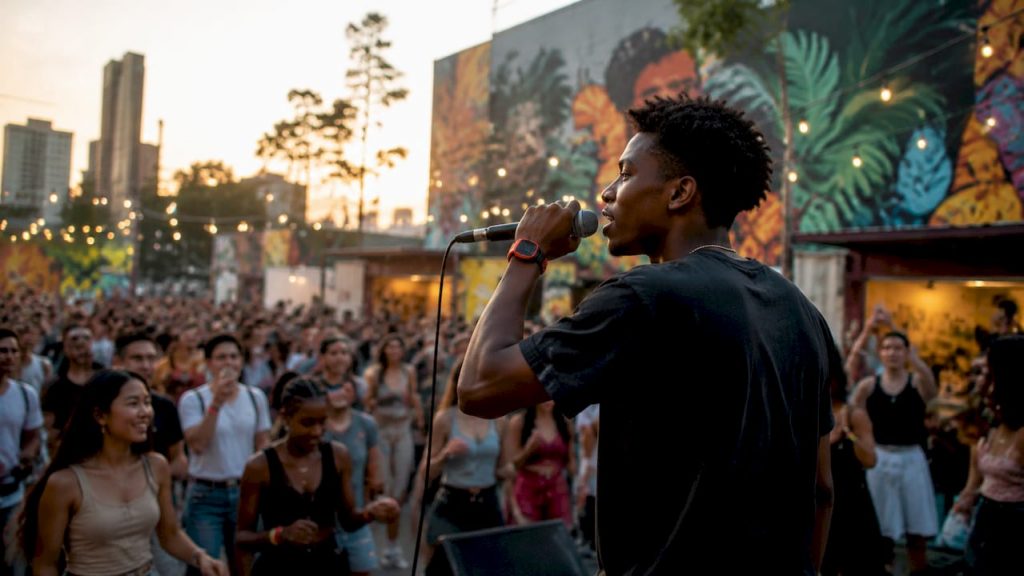
Explore hip hop: what it is, its origins, and its lasting impact. Discover the cultural movement that changed music and society.
Hip hop is defined as a cultural movement, not just a music genre, built on four foundational elements: MCing, DJing, breaking, and graffiti art. It was born on august 11, 1973 at 1520 Sedgwick Avenue in the Bronx, when DJ Kool Herc threw a back-to-school party that changed everything. What started as a neighborhood celebration became one of the most captivating and far-reaching cultural forces the world has ever seen. If you have ever wondered about hip hop, what it is at its core, and why it still resonates globally, you are in exactly the right place.
What are the core elements of hip hop culture?
Experts distinguish rap as the performance technique known as MCing, while hip hop is the broader culture that contains it. That distinction matters because it changes how you understand everything from the music to the fashion to the slang. Hip hop is a complete cultural ecosystem, and each element plays a specific role within it.
The four original pillars
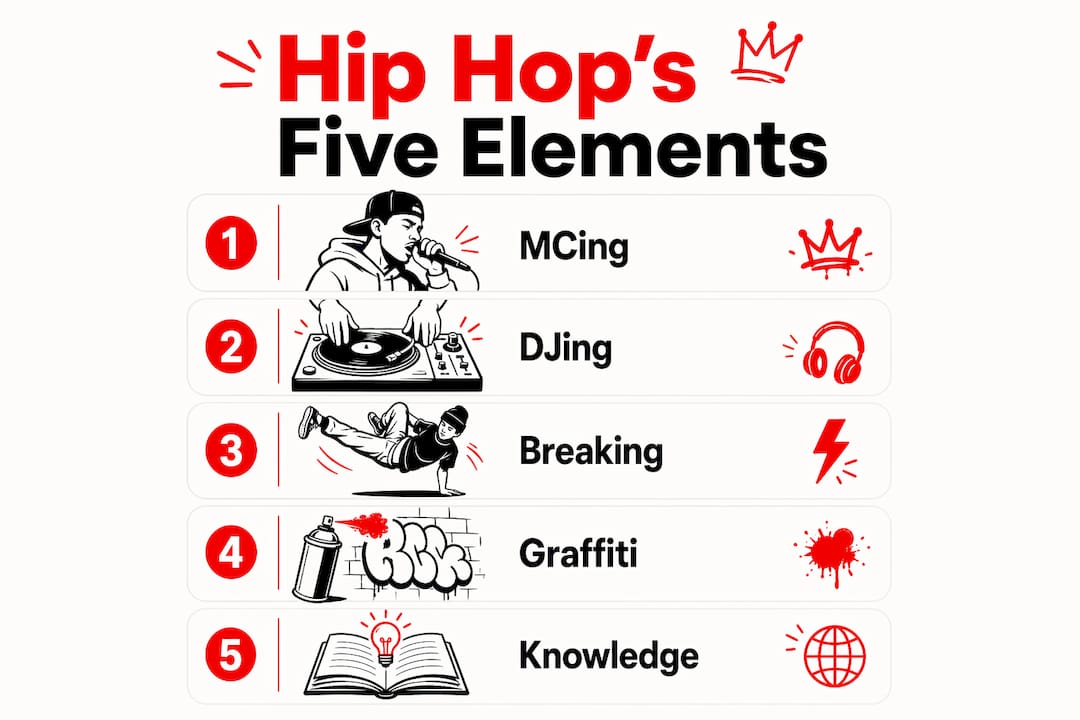
The four original elements of hip hop are MCing, DJing, breaking, and graffiti art. Each one developed independently in the Bronx before being recognized as part of a unified culture.
- MCing (rapping): The MC, short for Master of Ceremonies, speaks rhythmically over a beat to entertain, inform, or provoke thought. Artists like Grandmaster Flash and the Furious Five used MCing to narrate the realities of street life with raw honesty.
- DJing: The DJ creates the musical foundation by manipulating vinyl records on turntables. DJ Kool Herc’s “Merry-Go-Round” technique, which extended drum breaks by switching between two copies of the same record, is the technical innovation that gave hip hop its sonic identity.
- Breaking (b-boying/b-girling): Breaking is a physically demanding art form rooted in individual style and improvisation, not gymnastics routines. B-boys and b-girls compete through footwork, freezes, and power moves that reflect personal creativity.
- Graffiti art: Graffiti in hip hop is not random vandalism. It is a visual language, a way for artists to claim space and express identity in cities that largely ignored them.
The fifth element: Knowledge
Afrika Bambaataa promoted the hip hop elements to channel youth creativity away from gang violence, and later a fifth element was added to the framework: Knowledge. This addition was not accidental. Knowledge represents social consciousness, self-awareness, and the responsibility that comes with cultural power. It reflects hip hop’s role as a voice for communities that had been pushed to the margins.
Pro Tip: When you listen to hip hop music, pay attention to the lyrics as social commentary. Artists like Public Enemy and Kendrick Lamar use MCing to deliver messages that go far beyond entertainment.
| Element | Role in the culture | Real-world example |
|---|---|---|
| MCing | Verbal expression and storytelling | Kendrick Lamar’s narrative albums |
| DJing | Musical foundation and sonic innovation | DJ Kool Herc’s turntable techniques |
| Breaking | Physical expression and competitive art | B-boy battles at block parties |
| Graffiti art | Visual identity and spatial expression | Murals across New York City boroughs |
| Knowledge | Social consciousness and cultural responsibility | Public Enemy’s political messaging |
These five elements do not exist in isolation. They feed each other. A DJ’s beat inspires an MC’s verse. A b-boy’s footwork matches the rhythm a DJ creates. Graffiti covers the walls of the same neighborhoods where block parties happen. Together, they create a living, breathing culture that shapes fashion, language, and values far beyond the Bronx.
How did hip hop originate and what drove its creation?
Hip hop was born out of neglect. The South Bronx in the early 1970s was one of the most economically abandoned urban areas in America. Landlords burned their own buildings for insurance money. City services disappeared. The Cross Bronx Expressway, built by urban planner Robert Moses, had physically cut through thriving neighborhoods, displacing tens of thousands of residents and destroying community infrastructure. Young people in the Bronx had almost nothing. So they built something.
The night it all started
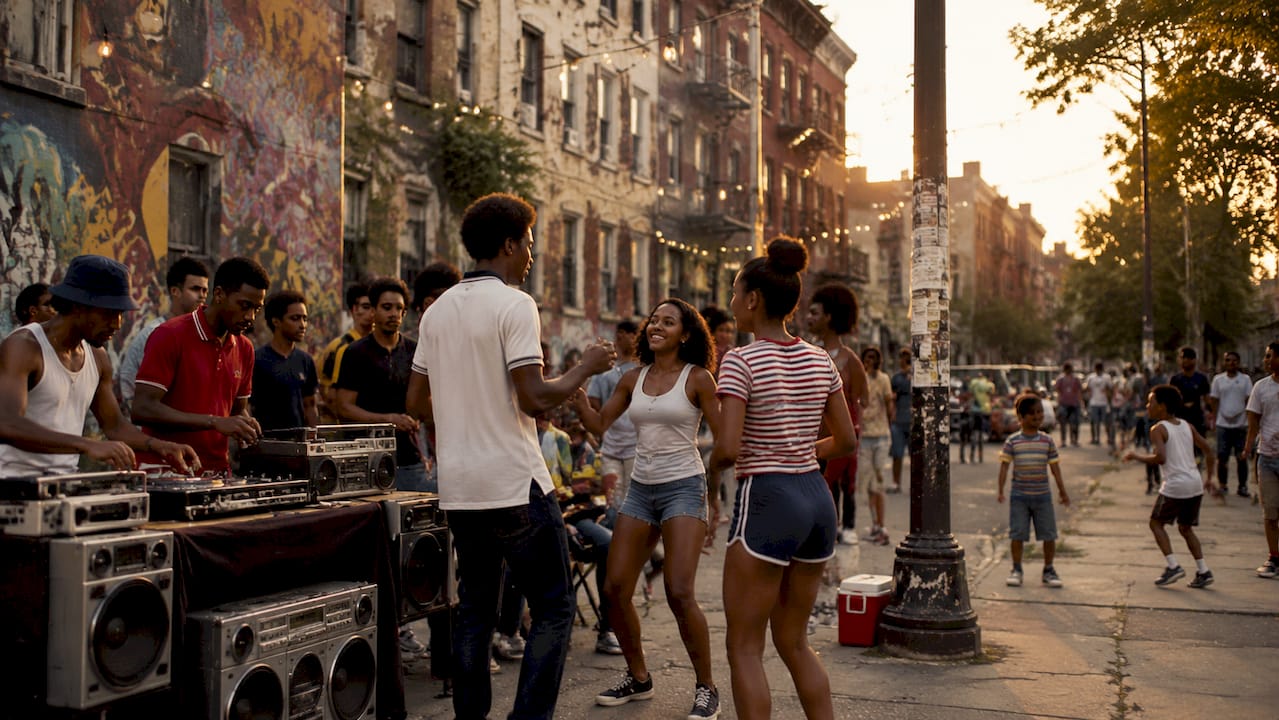
On august 11, 1973, DJ Kool Herc set up his home sound system in the recreation room of 1520 Sedgwick Avenue. The party was organized by his sister Cindy Campbell as a back-to-school fundraiser. Herc used two turntables to loop the drum break sections of funk and soul records, creating an extended groove that dancers could ride. That technique became the foundation of hip hop music as we know it.
The early scene spread through handcrafted flyers and word of mouth. There were no record labels, no managers, no marketing budgets. Young people promoted their own events, built their own speakers, and created their own audiences. This DIY spirit is not just a fun historical footnote. It is the reason hip hop carries such a strong sense of authenticity and ownership to this day.
Why the Bronx, and why then?
The conditions that produced hip hop were specific. Racial marginalization, urban disinvestment, and the destruction of community spaces forced young people to create their own culture from scratch. Block parties became the community centers that the city refused to provide. The Bronx was not a backdrop for hip hop. It was the reason hip hop had to exist.
- The Cross Bronx Expressway displaced over 60,000 residents, gutting stable neighborhoods.
- City budget cuts in the 1970s eliminated arts programs from public schools across New York City.
- Youth gangs dominated the streets, and Afrika Bambaataa used the hip hop elements to offer a creative alternative.
Pro Tip: If you visit New York City, the Bronx is worth exploring as the birthplace of this global culture. Check out what to do in NYC to make the most of your time in the city where hip hop was born.
How has hip hop grown into a global cultural force?
Hip hop has evolved from Bronx block parties into a global cultural and commercial force that shapes language, fashion, and business worldwide. That transformation happened in stages, and each stage added new dimensions to what hip hop means and who it belongs to.
From the Bronx to the world
Through the late 1970s and 1980s, hip hop spread from New York City to other American cities. Los Angeles developed its own distinct sound and style, producing artists like N.W.A and Dr. Dre who brought West Coast hip hop to national attention. By the 1990s, cities like Atlanta, Houston, and Detroit had developed their own regional flavors. Each city added something new without erasing what came before.
The global spread followed. Hip hop reached Japan, France, Brazil, Nigeria, and South Korea, where local artists absorbed the elements and made them their own. French hip hop artists like MC Solaar rapped in French over American-influenced beats. In Nigeria, Afrobeats artists borrowed hip hop’s rhythmic structure and blended it with West African musical traditions. Hip hop’s adaptability is its superpower.
“Hip hop is not just music. It is a mirror held up to society, reflecting what the powerful would rather not see.” This idea, shared widely among hip hop scholars and artists, captures why the culture has lasted more than 50 years.
Language, fashion, and business
Hip hop’s influence on language is impossible to overstate. Words like “drip,” “flex,” “lowkey,” and “lit” entered mainstream American English directly from hip hop culture. These terms carry specific meanings rooted in the culture’s values around authenticity, style, and self-expression. When you use them, you are borrowing from a tradition.
Fashion tells a similar story. Streetwear brands like Supreme and Off-White built entire business models on aesthetics that hip hop artists popularized. Luxury brands including Gucci and Louis Vuitton now actively court hip hop artists as collaborators, recognizing the culture’s power to define what is desirable.
Hip hop’s resilience lies in its ability to borrow from its environment and comment on it simultaneously. That quality keeps the culture fresh and relevant across generations and continents.
What are the biggest misconceptions about hip hop?
The most common misconception about hip hop is that it is the same thing as rap. Rap is one element of hip hop, specifically the MCing practice. Hip hop is the entire cultural framework. Calling hip hop “just rap” is like calling jazz “just trumpet playing.” The music is part of the culture, not the whole of it.
Clearing up what hip hop actually is
Another widespread misunderstanding treats hip hop as pure entertainment with no deeper meaning. Hip hop was built by marginalized youth without industry support, which means every element carries the weight of real lived experience. When Grandmaster Flash and the Furious Five released “The Message” in 1982, they were not performing. They were documenting.
Graffiti is another element that gets misread. Critics often dismiss it as vandalism. Within hip hop culture, graffiti is a discipline with its own techniques, vocabulary, and hierarchy. Writers develop tags, throw-ups, and full pieces over years of practice. The skill required is significant, and the tradition of graffiti as visual storytelling connects directly to the culture’s broader commitment to self-expression.
Breaking faces a similar misunderstanding. Many people assume it is a novelty act or a form of gymnastics. Breaking is a competitive art form built on improvisation and individual style. No two b-boys or b-girls move the same way, because the goal is to express your own identity through movement.
Pro Tip: To deepen your understanding of hip hop lyrics, listen to albums like Nas’s “Illmatic” or Kendrick Lamar’s “To Pimp a Butterfly” with the lyrics in front of you. The layered references and storytelling reveal a level of craft that casual listening misses.
| Common misconception | The reality |
|---|---|
| Hip hop equals rap | Rap is one element; hip hop includes DJing, breaking, graffiti, and Knowledge |
| Hip hop is just entertainment | It originated as social commentary from marginalized communities |
| Graffiti is vandalism | It is a disciplined visual art form with its own techniques and traditions |
| Breaking is gymnastics | It is an improvisational competitive art rooted in personal style |
| Hip hop elements are fixed | The framework evolved organically; Knowledge was added later to reflect social consciousness |
Understanding these distinctions gives you a much richer experience of the culture. You stop hearing noise and start hearing a conversation that has been going on for more than 50 years.
Key Takeaways
Hip hop is a complete cultural movement built on five elements, born from socio-economic neglect in the Bronx, and now one of the most influential forces in global language, fashion, and music.
| Point | Details |
|---|---|
| Hip hop is a culture, not just music | It includes MCing, DJing, breaking, graffiti, and the fifth element Knowledge. |
| It was born from necessity | Urban disinvestment and racial marginalization in the Bronx created the conditions for hip hop’s emergence in 1973. |
| Rap and hip hop are not the same | Rap is the MCing element within hip hop; the culture is far broader than any single element. |
| Youth built it without industry support | Hip hop is uniquely grassroots, created entirely by young people using DIY tools and community networks. |
| Its global reach is cultural, not just commercial | Hip hop has shaped language, fashion, and social movements across every continent. |
Why hip hop’s origins still matter today
We, at Lizard’s Lunch have spent years reading about and listening to hip hop, and the thing that strikes me most is how little credit the culture gets for its intellectual depth. People hear a trap beat and assume there is nothing underneath it. They miss the 50-year conversation happening in the lyrics, the samples, the visual art, and the dance.
What genuinely moves me about hip hop is that it was built entirely by young people who had no institutional support, no funding, and no permission. DJ Kool Herc did not get a grant. Afrika Bambaataa did not have a nonprofit behind him. They created something extraordinary from two turntables, a rec room, and a community that needed a reason to gather. That is genuinely rare in cultural history.
The commercialization debate is real, and we understand why purists feel protective. When luxury brands slap hip hop aesthetics onto $800 sneakers, something gets lost in translation. But we also think hip hop’s global spread proves the culture’s power rather than diluting it. When a teenager in Seoul or Lagos picks up a microphone and starts rapping in their own language about their own life, that is hip hop doing exactly what it was designed to do. It gives voice to people who were told they had none.
The fifth element, Knowledge, is the one we think deserves the most attention in 2026. Social consciousness is not a bonus feature of hip hop. It is the reason the culture has lasted. Every generation of artists that has kept hip hop vital has done so by staying honest about what they see around them. That honesty is the culture’s most durable quality, and it is worth protecting.
For a deeper look at the artists and moments that shaped this culture, the hip hop history guide at Lizard’s Lunch covers the full arc from the Bronx to the global stage.
Explore more culture and lifestyle content
Hip hop is one piece of a much larger picture of how culture shapes the way we live, dress, speak, and connect. We covers the full spectrum of lifestyle topics, from travel and technology to entertainment and home life. If you found this deep dive into hip hop culture rewarding, you will enjoy exploring how NYC culture influences content trends in the digital age. You can also check out our guide on healthy living insights for more content that connects culture, lifestyle, and everyday choices. There is always something new to discover.
FAQ
What is hip hop in simple terms?
Hip hop is a cultural movement that originated in the Bronx in 1973, built on five elements: MCing, DJing, breaking, graffiti art, and Knowledge. It is not just a music genre but a complete way of expressing identity and community.
What are the four elements of hip hop?
The four original elements are MCing (rapping), DJing, breaking (b-boying), and graffiti art. A fifth element, Knowledge, was added later to represent social consciousness within the culture.
Is rap the same as hip hop?
Rap is not the same as hip hop. Rap refers specifically to the MCing practice of rhythmic spoken word over a beat. Hip hop is the broader culture that contains rap along with DJing, breaking, graffiti, and Knowledge.
Who created hip hop?
DJ Kool Herc is widely credited as the founding figure of hip hop. His back-to-school party on august 11, 1973, at 1520 Sedgwick Avenue in the Bronx introduced the turntable techniques that became hip hop’s musical foundation.
Why did hip hop start in the Bronx?
Hip hop started in the Bronx because of extreme urban disinvestment, racial marginalization, and the destruction of community infrastructure caused by projects like the Cross Bronx Expressway. Young people created hip hop as a creative and communal response to being ignored by the city and its institutions.


















Leave a Comment
Your email address will not be published. Required fields are marked with *