
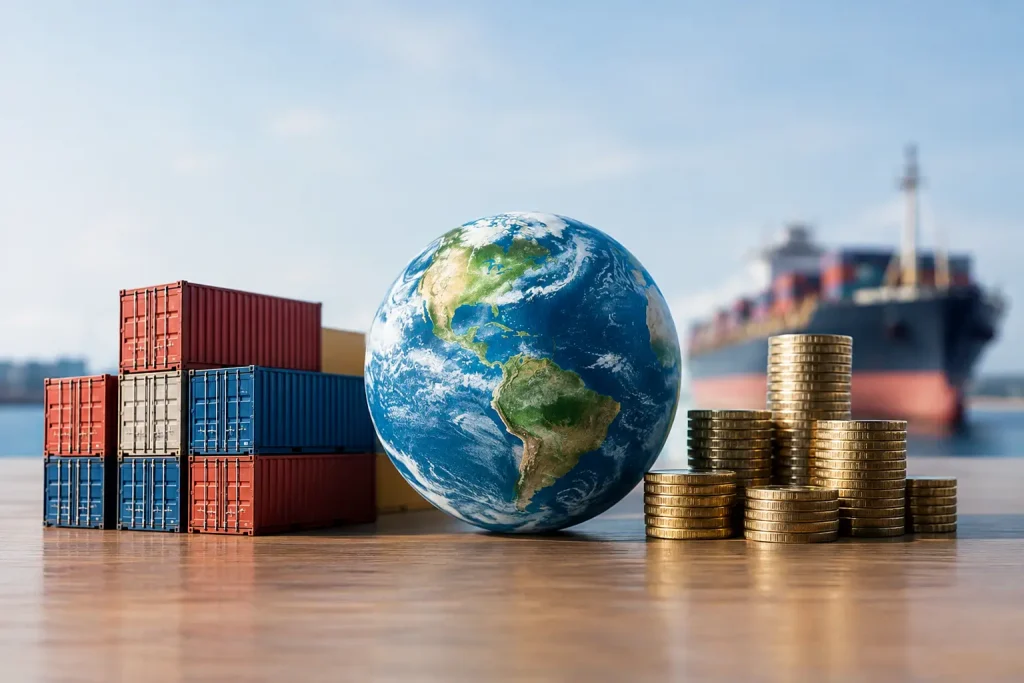
See how do global tariffs work, who pays, why nations use them, and how import taxes affect prices, jobs, supply chains, and your shopping cart at checkout.
A $30 pair of imported sneakers does not arrive in the United States with one simple price attached. Before it reaches a store shelf, it may pass through a port, a customs declaration, a tariff calculation, a distributor, and a retailer’s markup. That chain is the practical answer to how do global tariffs work: governments charge taxes on goods crossing their borders, and the cost can move through businesses until shoppers see it in the final price.
Tariffs are often discussed as a political headline or a tool in a trade dispute. But they also affect everyday decisions, from the price of a phone or appliance to the cost of materials for a local contractor. Understanding the basic mechanics makes those headlines much easier to read.
How Do Global Tariffs Work in Practice?
A tariff is a tax placed on imported goods. When a company brings products into a country, the importer usually pays the tariff to that country’s customs authority. The tariff amount is based on the product’s classification, its declared customs value, its country of origin, and the current trade rules.
For example, imagine a U.S. importer buys kitchen mixers from another country at a customs value of $100 each. If the applicable tariff is 15%, the importer owes $15 per mixer at the border. Its direct landed cost is now at least $115, before freight, insurance, warehousing, and other expenses.
The foreign manufacturer does not automatically pay that $15. The U.S. importer does. However, the financial burden rarely stays with one party. An importer may ask the supplier for a lower wholesale price, accept a smaller profit margin, raise the retailer’s price, or use some combination of all three. Retailers can then pass part or all of the increase to consumers.
That is why “who pays the tariff?” has two valid answers. Legally, the importer pays customs. Economically, the cost may be shared among importers, suppliers, retailers, and shoppers depending on market conditions.
The Three Parts of a Tariff Calculation
Tariff rules can get technical quickly, but the central calculation is straightforward. Customs authorities first identify what the item is, where it was made, and what it is worth for customs purposes.
Product classification
Nearly every traded product receives a code under the Harmonized System, a widely used international classification framework. A bamboo chair, a steel fastener, and a lithium battery do not fall under the same code, so they may face very different duty rates.
Classification matters because small product differences can change the tariff outcome. A business that classifies an item incorrectly may owe additional duties later, along with penalties in serious cases. For importers, this is a compliance issue, not just paperwork.
Country of origin
Origin is generally the country where a product was made or substantially transformed, not necessarily the country it shipped from. A laptop sent from a warehouse in one country may have originated elsewhere based on where its essential manufacturing occurred.
This distinction matters when one nation applies special tariffs to goods from a specific country. Routing a product through a third country does not usually erase its origin for customs purposes.
Customs value and duty rate
Many tariffs are ad valorem, meaning they are a percentage of the item’s value. A 10% tariff on a $500 product is $50. Others are specific duties, such as a set dollar amount per unit, pound, or liter. Some combine both methods.
The total duty can also include more than one tariff. An ordinary base duty might apply, followed by an additional tariff tied to a particular trade action. The final amount depends on the product, origin, and current law when it enters the country.
Why Governments Use Tariffs
Tariffs are not used for just one reason. Governments may impose them to raise revenue, encourage domestic production, respond to trade practices they consider unfair, or gain leverage in broader negotiations.
Historically, tariffs were a major source of government revenue. Today, many large economies rely far more heavily on income, payroll, and sales taxes, but customs duties still bring in public revenue.
Protection is another common goal. A tariff can make imported goods more expensive relative to domestically made alternatives, giving local producers more room to compete. This may help an industry facing low-priced imports, particularly in sectors considered strategically important, such as steel, semiconductors, energy equipment, or agriculture.
The trade-off is that protection can also raise costs for domestic companies that rely on imported parts or raw materials. A U.S. manufacturer may benefit from tariffs on competing finished products while paying more for imported components needed to make its own goods. The result depends on where a company sits in the supply chain.
Tariffs, Trade Deals, and Retaliation
Global trade is not governed by one universal tariff rate. Countries set many rates through their own tariff schedules, then adjust them through trade agreements, exemptions, and targeted measures.
A trade agreement can reduce or eliminate tariffs for qualifying goods traded between member countries. Qualification often requires meeting rules of origin, which are designed to ensure that the economic activity genuinely occurred within the agreement’s participating countries.
Tariffs can also escalate. If one country raises duties on another country’s exports, the affected country may respond with its own tariffs. This is known as retaliation. Agricultural goods, vehicles, machinery, and consumer products often become targets because they are economically meaningful and politically visible.
Retaliation does not mean every exporter stops selling. It means their goods may become less competitive in the other market. Some buyers switch suppliers, some absorb the higher cost, and some continue purchasing because substitutes are limited.
What Tariffs Mean for Consumers
Consumers tend to notice tariffs most clearly when a product has few alternatives or relies heavily on imported inputs. Electronics, furniture, apparel, vehicles, tools, and home goods can all be affected, although the effect is rarely identical across brands or stores.
A tariff does not automatically raise an item’s price by the exact tariff percentage. If an importer pays a 20% tariff, the retail price may rise by less than 20%, more than 20%, or not at all for a period of time. Inventory bought before the tariff took effect may still be on shelves. A retailer may also choose to absorb some cost to protect sales.
Competition matters too. If several brands can source a similar item from countries not subject to the tariff, price increases may be limited. If one country dominates production of a specialized component, businesses have less flexibility and may pass costs along more quickly.
For household budgeting, the biggest impact can be indirect. A tariff on metal, lumber, or electronic components may show up later in the price of an appliance repair, a renovation quote, or a new car rather than as a line item on a receipt.
How Businesses Respond When Tariffs Change
Tariffs reward preparation, but they do not offer a universal solution. A company may seek alternate suppliers, renegotiate contracts, redesign a product to use different materials, shift production, or change shipping and inventory plans.
Moving a supply chain is often slower and more expensive than it sounds. A new supplier needs to meet quality standards, build capacity, secure materials, and comply with labor and safety requirements. For a small business, even a modest tariff can be hard to absorb, while changing suppliers may require cash and expertise it does not have.
Some importers use tariff exclusions or special customs programs when available. Others purchase more inventory before an expected tariff increase. Those strategies can reduce short-term pressure, but they also carry risks, including storage costs and the possibility that demand slows before the goods are sold.
A Better Way to Read Tariff Headlines
When a new tariff is announced, look beyond the percentage. Ask which products are covered, which country of origin is affected, when the rule takes effect, and whether exemptions or trade-agreement rates apply. Those details determine whether a headline will affect a particular company, industry, or purchase.
Tariffs are neither automatically a consumer disaster nor a guaranteed win for domestic industry. They are a policy tool with real costs, potential benefits, and consequences that travel through a complicated supply chain. The next time a tariff makes news, follow the product from factory to port to shelf – that is where its real impact becomes clear.


















Leave a Comment
Your email address will not be published. Required fields are marked with *