
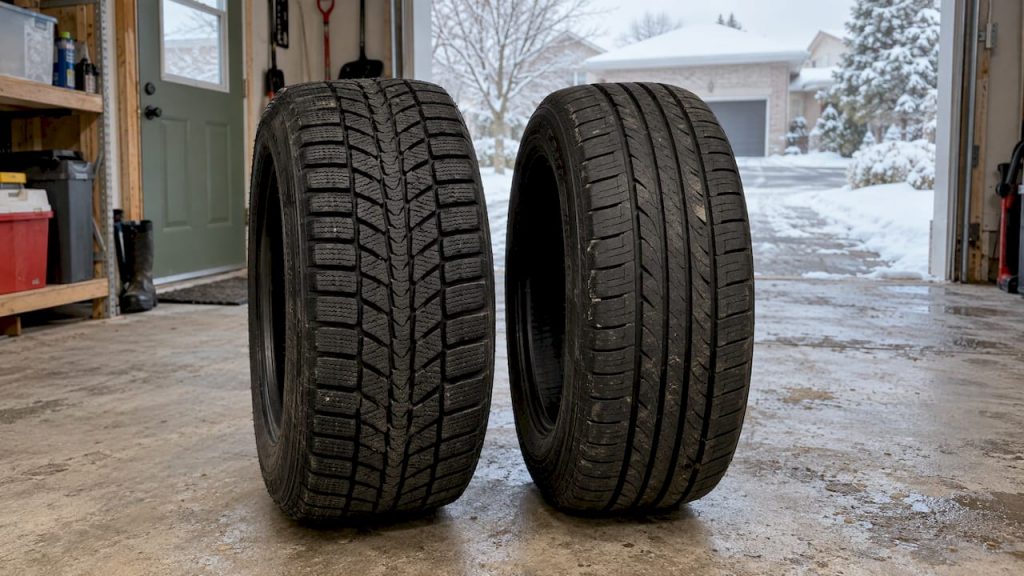
Winter tires, all-season or all-weather? See how they differ on snow and ice, what Canadian provinces require, when to switch and what it costs.
If your winter means regular snow, slush or temperatures that sit below freezing for weeks, a matched set of four dedicated winter tires is the strongest choice, and the research below shows why. All-season tires work for mild, mostly clear winters, and all-weather tires sit in between: better than all-seasons in snow, still behind true winter tires on ice. Here is how to tell which one fits your commute, your province and your budget.
Think of it like choosing footwear for a trip: the same pair rarely suits a city sidewalk and a frozen trail (our hiking boots vs. trail runners guide makes the same point for the outdoors). Tires are the only part of your vehicle that touches the road, so the compound and tread you pick decide how well you accelerate, turn and stop.
TL;DR
- Below about 7°C, all-season and summer tires start to lose elasticity and grip, while winter tires stay flexible at much lower temperatures (Transport Canada).
- All-weather tires (all-season tires with the mountain-and-snowflake symbol) beat ordinary all-seasons in snow but still stop longer than winter tires on ice.
- Quebec requires winter tires from December 1 to March 15, and British Columbia requires them on designated highways. Most other provinces recommend rather than require them.
- Install four matching tires, watch your tread depth, and switch when daily temperatures hover around 7°C, not when the first storm hits.
Table of Contents
- The quick answer, by driving situation
- What actually separates winter tires from all-season tires
- What the tests show
- All-weather tires: the middle option
- Reading the sidewall: 3PMSF vs. M+S
- Winter tire laws in Canada
- When to switch to winter tires
- Are winter tires worth the cost?
- How to choose, step by step
- Keeping tires working all winter
- Common questions that come up before buying
- Reaching Canadian drivers on our site
- FAQ
- Sources
The quick answer, by driving situation
Before the detail, here is a simple way to sort yourself. This table reflects the research cited later in this guide, not a rule.
| Your situation | Best fit | Why |
|---|---|---|
| Regular snow, ice, rural or hilly roads, cold prairie or Atlantic winters | Four winter tires | Best braking and cornering on snow and ice |
| Quebec, or driving on BC mountain highways | Winter tires, or 3PMSF-marked tires that meet the rules | Legal requirement in those places |
| Mixed winters, you want one set year-round | All-weather tires | Snow-rated, no seasonal swap |
| Mild urban winter, short trips, little snow | All-season tires, with caution | Adequate when conditions are moderate |
| You keep the car three years or more | Winter tires on their own rims | They replace wear you would otherwise put on all-seasons |
What actually separates winter tires from all-season tires
Three things: rubber, tread and the temperature each is built for.
Rubber that stays soft in the cold
Transport Canada explains that below 7°C all-season and summer tires begin to lose elasticity and traction, while winter tires keep their elasticity and grip at much lower temperatures. Rubber that goes stiff cannot mould itself to tiny bumps in the pavement, and that molding is where grip comes from.
The Automobile Protection Association (APA) puts numbers on it: summer rubber hardens around 10°C, all-season rubber stays flexible to about −10°C, and winter rubber is meant to stay flexible to about −30°C. Alberta Transportation says much the same, noting that modern winter compounds keep their elasticity at temperatures approaching −30°C and below. Across much of Canada, a January morning is well inside that range.
It works the other way too. Winter rubber wears quickly in warm weather, which is why winter tires are not a year-round answer.
Tread built to bite and clear slush
Winter tires carry deeper, more numerous grooves and fine slits called sipes. Those edges bite into snow and channel slush away. All-season tread is a compromise, tuned for wet and dry pavement as well as light snow.
Why you cannot have everything in one tire
Car and Driver describes wet traction and cold traction as an industry “target conflict”: gaining one costs you some of the other. That is the engineering reason a single tire cannot match a winter tire in January and a summer tire in July.
What the tests show
Claims are easy; stopping distances are harder to argue with. Here is what independent and government testing reported.
- Braking from 50 km/h. A review of winter-tire research by the Traffic Injury Research Foundation described a demonstration in which a car with winter tires stopped in 18 metres, versus 27.1 metres on all-seasons, and an SUV stopped in 18.6 metres versus 31.1 metres. Only the winter-tire vehicles completed a 90-degree turn at 40 km/h in that demonstration (TIRF review, 2012). That is an older review, but its direction matches newer work.
- Ice. The APA reports that in comparison tests the best winter tires stopped 30 to 60 feet shorter than all-season tires from 50 km/h on ice.
- A larger vehicle. Transport Canada tested a 21-passenger minibus braking from 80 km/h on snow. With six winter tires it stopped an average of 5.6 metres shorter than with all-seasons on the front axle and winter tires on the rear, and it cornered faster too. That is a useful reminder that how many winter tires you fit matters as much as having them.
None of these numbers means you will be in a crash without winter tires. They mean the margin between stopping and not stopping is wider when the rubber is built for the cold.
All-weather tires: the middle option
The term causes confusion, so let us be exact. “All-weather” tires are a step up from standard all-seasons. They carry the three-peak mountain snowflake symbol, which a plain all-season tire usually does not, and are designed to stay on the car year-round. Alberta Transportation describes them as having more aggressive siping and softer compounds than all-season tires.
How much better are they? Tests by a tire maker, reported by The Globe and Mail in 2022, compared three types of the same brand. In snow at 60 km/h and −11°C, the all-weather tire stopped in 43 metres, versus 50 metres for the all-season and 38 metres for the winter tire. On ice at 40 km/h and −10°C, the distances were 45, 53 and 36 metres (The Globe and Mail). Those are one manufacturer’s results for one set of products, so treat them as an illustration of the ranking: winter tires first, all-weather second, all-season third.
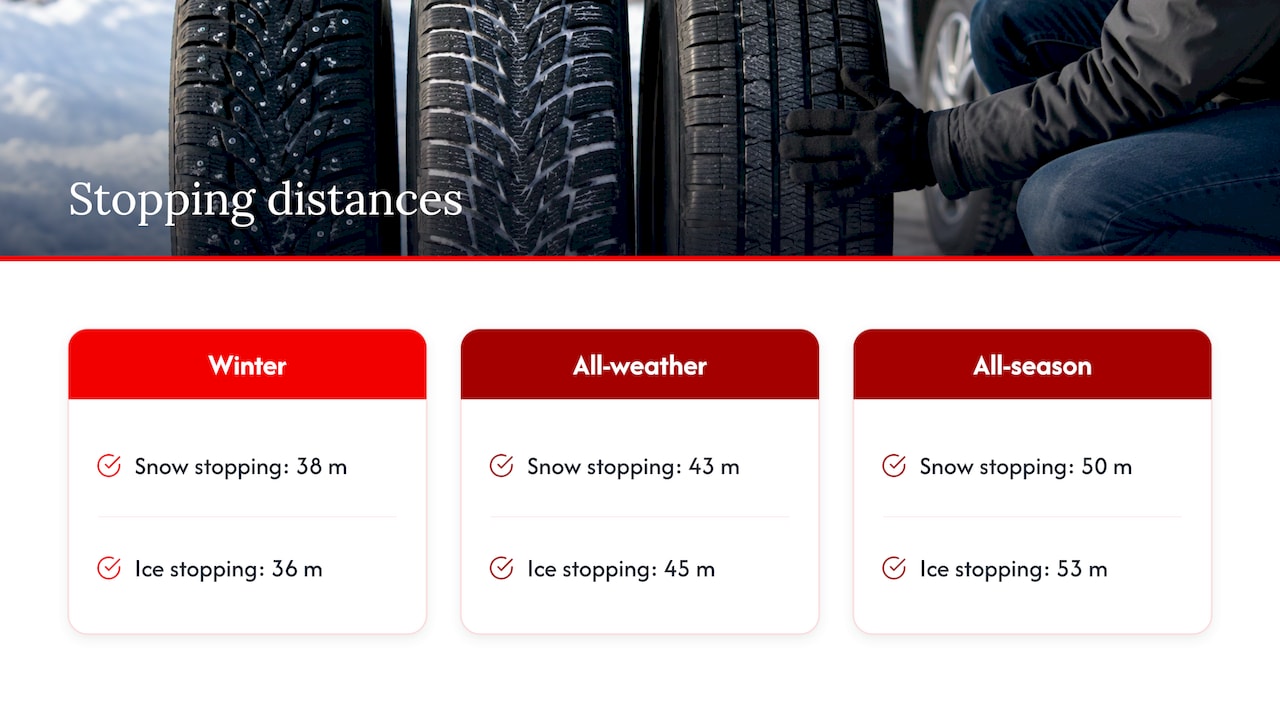
The ice gap is the part to remember. The APA notes that the snow-tire standard used for the symbol does not include ice traction as a test criterion, and that the harder year-round compound will not equal a dedicated winter tire on ice. CAA-Quebec likewise states that winter-approved all-season tires are legal in Quebec but are not a replacement for traditional winter tires, with longer braking distances especially on ice.
So who is an all-weather tire for? A driver in a region with variable winters who wants better snow performance than all-seasons without storing a second set. If your roads are regularly icy, a winter set is the safer pick.
Snow tires vs. all-weather: the same question
People search “snow tires” and “winter tires” interchangeably. They are the same thing. The comparison readers care about is dedicated winter tire versus all-weather tire, and the answer above applies: the winter tire wins on ice and in deep cold, the all-weather wins on convenience.
Reading the sidewall: 3PMSF vs. M+S
Two markings decide a lot of buying and legal questions.
- M+S (mud and snow) is based on tread geometry only. It says the tread pattern looks like one that handles mud and snow, not that the tire was tested.
- Three-Peak Mountain Snowflake (3PMSF) is a mountain with a snowflake inside. According to Car and Driver, it means the tire was tested to deliver at least 110 percent of the traction of a reference all-season tire under the ASTM E1136-14 standard. Every dedicated winter tire carries it, and so do all-weather tires.
If you are shopping, the snowflake symbol is the quickest filter. An M+S-only tire is not the same product, and in Quebec it will not satisfy the law.
Winter tire laws in Canada
There is no national rule. Each province decides, and the answer for you depends on where the vehicle is registered and where you drive.
Quebec
Motor vehicles registered in Quebec, rentals included, must have winter tires from December 1 to March 15, with listed exceptions. Compliant tires carry the three-peak mountain snowflake pictogram or are studded. The fine for non-compliance is $200 to $300. Studded tires are allowed from October 15 to May 1 on passenger vehicles, and grooves must be at least 1.6 mm deep, with 4.8 mm recommended in winter. The province suggests a quick check: place a quarter in the groove with the caribou’s nose pointing down.
British Columbia
BC’s official guidance says a legal winter tire on a passenger vehicle must have at least 3.5 mm of tread and carry either the M+S or the three-peak symbol. The province recommends the three-peak symbol for cold-weather driving, prohibits summer tires on designated winter-month highways, and allows studs only from October 1 to April 30, protruding no more than 2 mm. Check the provincial page for which highways and dates apply to your route.
Alberta, Ontario and the rest
Alberta Transportation states that the province does not mandate winter tires but recommends four winter or all-weather tires in severe winter conditions. Several other provinces also leave the choice to you. Rules and enforcement can change, so before a long winter road trip, check the transportation ministry page for each province you will cross, particularly Newfoundland and Labrador, where chain rules can apply on snow- or ice-covered roads.
If you drive between provinces, the strictest rule you meet is the one that counts. A vehicle registered outside Quebec is not covered by the same registration-based rule, but a safe tire is still the sensible choice on Quebec’s winter roads.
When to switch to winter tires
The calendar is a poor guide. Temperature is the better one. Since all-season rubber starts losing elasticity below 7°C, a sensible habit is to book the swap when daily highs begin to settle around that mark, which in many parts of Canada falls in October or early November, long before the first heavy snowfall.
Some practical anchors:
- Quebec: the legal window starts December 1, but nothing stops you from switching earlier.
- BC: the rules for designated highways begin October 1.
- Elsewhere: follow the 7°C rule, and book early. Shops fill up quickly after the first snowfall.
In spring, the reverse applies. Take the winter tires off once temperatures are reliably above 7°C, so you are not wearing soft winter rubber down on warm pavement. In Quebec, the legal window ends March 15.
Are winter tires worth the cost?
The honest way to look at it is cost per year, not sticker price. AAA’s figures are American and in US dollars, but they show the typical shape of the expense: a set of four snow tires typically runs US$400 to US$800 for compact cars, US$600 to US$1,200 for small SUVs and US$800 to US$1,500 or more for large SUVs and trucks, before mounting and balancing. Extra steel rims and seasonal storage add to that. Canadian shop prices differ, so get a local quote.
Three things offset the cost:
- You are splitting the wear. While winter tires are on, your all-season or summer set is in the garage. The APA’s point is that if you plan to keep a vehicle more than three years, winter tires make sense because they replace a future set of all-seasons you would otherwise buy anyway.
- Their own rims make swaps cheaper. Mounting winter tires on dedicated wheels turns each changeover into a quick swap rather than a full remount.
- Insurance. AAA notes that some insurers offer discounts for winter tires. Ask your own insurer what applies in your province.
And there is the safety value. AAA says avoiding a single winter collision can cover the cost several times over. For anyone who drives through real winter weather, that makes the answer to “are winter tires worth it?” a clear yes.
How to choose, step by step
- Map your winter. How many days a year are below 7°C? Do you see packed snow, ice, or mostly cold, dry pavement? Do you drive rural roads, hills or highways with little plowing?
- Check your legal floor. In Quebec or on BC designated highways, you need compliant tires. Elsewhere it is a recommendation, but a strong one.
- Pick the category. Heavy snow and ice: winter tires. Variable winters and a wish for one set: all-weather. Mild urban winters: all-season, with caution.
- Look for the snowflake. The three-peak symbol should be on the sidewall.
- Buy four. Transport Canada advises installing winter tires in matched sets of four. Two on the front only can leave the rear of the car with less grip than the front, which is a poor trade.
- Check the tread. Transport Canada advises against using tires worn close to 4 mm (5/32 in) of tread on snow-covered roads. The quarter test from Quebec is a handy gauge.
- Plan storage and the swap. Decide where the off-season set will live and book the changeover before the rush.
Keeping tires working all winter
A few habits protect both your tires and your vehicle.
- Check pressure monthly. Cold air lowers tire pressure, so a tire that was fine in October can be low by January.
- Watch tread and sidewalls. Look for cracking and uneven wear. Rubber hardens as tires age, so older tires deserve an honest inspection by a tire professional before another winter.
- Drive to the surface. Winter tires shorten stopping distances but do not remove the need for more following distance and gentler inputs.
- Rinse off the salt. Road salt clings to the underbody, so a regular wash matters in winter. This guide to winter car wash frequency on salted roads covers how often to rinse.
Common questions that come up before buying
“Can I just put two winter tires on the drive wheels?” The research points the other way. Transport Canada’s minibus test found that a full winter set stopped shorter and cornered faster than a mixed setup, and the TIRF review concludes that only a matched set of four copes with deep or frequent slush, snow or ice.
“Do all-wheel-drive vehicles need winter tires?” All-wheel drive helps you accelerate, but braking and turning depend on tire grip, which is the part the rubber decides. The advice to fit four winter tires applies to every drivetrain.
“What if I rarely drive in snow?” Then cold matters more than snow. Below 7°C, even dry or wet pavement is tougher on all-season rubber, so an all-weather or winter tire still adds margin.
Our perspective
We write about the things readers do every day, from travel and gear to home and tech, and tires are a good example of a decision where plain information saves money and stress. Our team at Lizard’s Lunch looks at questions like this the way a practical friend would: what does the evidence say, who is it for, and what does it cost over several years?
On this topic, we think the most useful habit is to match the tire to your actual winter rather than the average one. A dedicated winter set rewards drivers who face ice and deep cold, an all-weather tire rewards drivers who value convenience and see moderate winters, and both reward you for checking the snowflake symbol and buying four. We encourage readers to explore these other options, ask a local tire shop for a quote and read their province’s official page before the first cold snap.
The best tire decision is the one made in October, not in the middle of a storm.
Alexander
Reaching Canadian drivers on our site
If you run an automotive or seasonal-driving business and want your guidance in front of readers who are researching topics like this one, we offer banner ads and guest posts. You can find the details on our advertise with us page.
FAQ
Are winter tires mandatory in Canada?
Not nationally. Quebec requires winter tires on registered vehicles from December 1 to March 15, and British Columbia requires winter-rated tires on designated highways, generally from October 1 to March 31 or April 30 depending on the route. Alberta recommends four winter or all-weather tires in severe conditions but does not mandate them, and Ontario leaves the decision to drivers.
Are winter tires worth it compared with all-weather tires?
If you see regular ice, packed snow or temperatures well below freezing, yes. In the Nokian tests reported by The Globe and Mail, the winter tire stopped about 9 metres shorter than the all-season on ice at 40 km/h and 9 metres shorter than the all-weather. If your winters are milder and you prefer one set, an all-weather tire is a reasonable step up from an all-season.
When should I switch to winter tires?
Book the swap when daily temperatures start hovering around 7°C, since that is where all-season rubber begins to lose grip. In many regions that means October or early November. In Quebec you must be on winter tires by December 1.
Do I need all four tires to be winter tires?
Yes. Transport Canada advises installing winter tires in matched sets of four. A mixed setup changes how the front and rear of the car grip, and the minibus test showed a measurable loss in braking and cornering when winter tires were not on every wheel.
What does the three-peak mountain snowflake symbol mean?
It shows that the tire passed a standardized snow traction test, reaching at least 110 percent of a reference all-season tire. Dedicated winter tires and all-weather tires carry it, while an M+S marking only describes tread design.
Sources
- Using winter tires, Transport Canada
- Results of winter tire testing on a multi-function activity vehicle, Transport Canada
- Winter tires: a review of research on effectiveness and use, TIRF
- What you need to know about winter tires, Automobile Protection Association
- How all-weather tires stack up against all-season and winter tires, The Globe and Mail
- Winter-rated all-season tires: know their limits, CAA-Quebec
- All-weather tires explained, Car and Driver
- Requirements for winter tires, Gouvernement du Québec
- Winter tire, all-season tire information, Alberta Transportation
- How much are snow tires? AAA
- Winter car washing frequency on salted roads, Diamondbrite

















Leave a Comment
Your email address will not be published. Required fields are marked with *